 by
by 
Did you know that a mere 1% shift in currency exchange rates can swing your property’s final cost by thousands of dollars for an overseas buyer? This volatility is exactly why learning how to price a property for the international market requires more than just looking at local comparables. You’re likely feeling the pressure of navigating a landscape where the 12-month Euribor sits at 2.804% and traditional residency incentives like Spain’s Golden Visa are a thing of the past. It’s natural to worry about overpricing your asset or letting it stagnate on global portals without the right sold data to back your claims.
We agree that the stakes are high, but you don’t have to guess your way through a cross-border transaction. This guide will help you master the art of global valuation to attract high-intent buyers and maximize your final sale price. You’ll discover how to balance local market realities with the lifestyle premium that investors crave in 2026. From understanding LTV ratios for non-residents to leveraging international property listings, we provide the framework you need for faster lead generation. We will explore how to position your home on a property advertising platform to reach a diverse global audience effectively.
Key Takeaways
- Learn how to price a property for the international market by balancing the local market floor with an international lifestyle ceiling to capture global capital.
- Discover how to identify functional comparables across different countries to ensure your listing remains competitive on high-traffic global portals.
- Use currency psychology and round-number pricing to make your asset feel like a deal to overseas buyers holding different currencies.
- Quantify the value of residency eligibility and digital nomad amenities to justify a premium price that local data might overlook.
- Apply the two-week rule to monitor lead volume and click-through rates, allowing you to adjust your strategic pricing range for maximum impact.
Why International Pricing Differs from Local Market Valuation
When you look at local comparable sales, you only see half the picture. International pricing is a strategic move to capture mobile capital. This refers to wealthy investors and lifestyle seekers who move money across borders based on global opportunities rather than local necessity. Understanding how to price a property for the international market means recognizing that your buyer isn’t just comparing your home to the one next door. They’re comparing your asset to a penthouse in Lisbon or a villa in Tuscany.
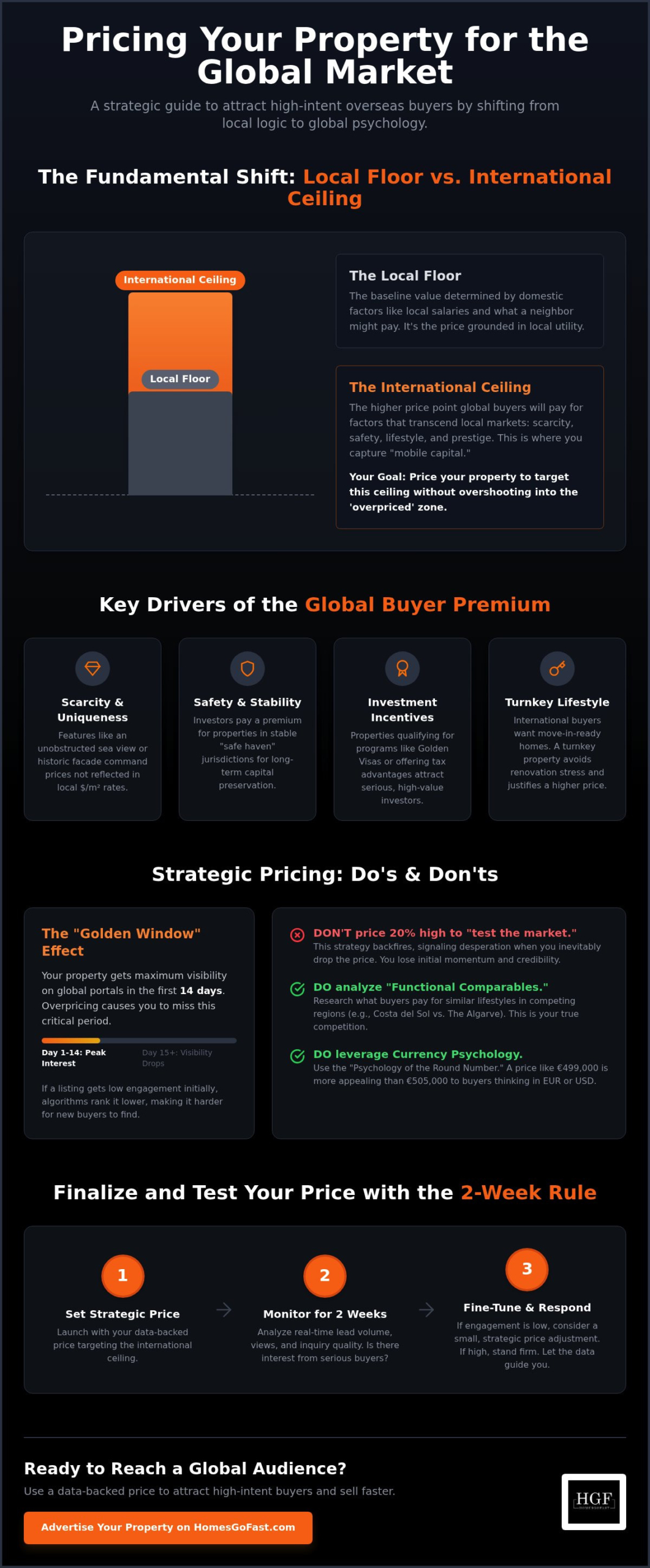
This creates a dynamic we call the Local Floor versus the International Ceiling. The local floor is the price a domestic resident pays for utility and proximity to work. The international ceiling is the premium an overseas buyer pays for lifestyle, safety, and currency diversification. Local agents often underprice properties with global appeal because they focus on domestic wages and local demand. They miss the “lifestyle premium” that a high-net-worth individual is willing to pay for a piece of paradise.
To better understand this concept, watch this helpful video:
The Concept of the ‘Global Buyer Premium’
Buyers are increasingly looking for stability and culture over pure square footage. Specific features like a historic facade, a panoramic sea view, or high-level security create scarcity on a global scale. This scarcity drives higher asking prices that local buyers might find irrational. Investors are attracted by safe haven status in jurisdictions like Greece or France, where legal protections for owners are robust. For those understanding international real estate trends, it’s clear that asset protection is often as important as rental yield. You can explore how these factors influence owner pricing to ensure you aren’t leaving money on the table.
Avoiding the Overpricing Trap on Global Portals
Don’t make the mistake of testing the market with a price that’s 20% too high. An unrealistic figure kills your Golden Window. This is the two-week period when your listing is fresh and gets the most visibility. If you overprice, you miss the initial wave of high-intent buyers. Global portals use price-drop alerts to re-engage users, but a significant drop can make you look desperate. You want to advertise properties at a level that triggers immediate inquiries. A well-researched price justifies your value and builds trust with buyers who are already wary of the complexities of purchasing abroad. Mastering how to price a property for the international market is about finding that sweet spot where value meets aspiration.
Conducting a Comparative Market Analysis for Global Buyers
Traditional market analysis usually stops at the neighborhood border, but global buyers don’t think that way. If you are selling a villa in the Algarve, your competition isn’t just the house down the street; it’s also a similar property on the Costa del Sol. These are “functional comparables.” Buyers are increasingly looking for specific lifestyle outcomes, such as 300 days of sunshine or proximity to an international airport. To understand how to price a property for the international market, you must analyze these regional rivals to ensure your asking price stays competitive within a broader geographic bucket.
Active listings on global portals are your most valuable resource. While local agents often rely on “sold” data, that information can be opaque or delayed by several months in many overseas jurisdictions. Active listings represent the current reality your buyer sees. If three similar homes in your area have been sitting on a portal for six months, they’re likely overpriced. You want to price your home just below these stagnant listings to trigger the “deal” reflex in savvy investors who are constantly scanning overseas property for sale for the best value.
Where to Find Reliable Global Property Data
Start by identifying regional shifts through the HomesGoFast global market trends report. This helps you spot where capital is flowing. For instance, secondary cities like Porto and Valencia are currently seeing an average annual appreciation of 7%, with prices roughly 25% lower than capital cities. You should also cross-reference portal asking prices with local tax office records and analyze price-per-square-metre trends in expat-heavy zones. This data allows you to justify a higher price point if your property is in a high-demand “micro-market” that local data might overlook.
Calculating Net Yields for the International Investor
Investors are attracted by transparency and hard logic. They care far more about net yields than gross figures. To build a winning pricing case, you must factor in local realities like non-resident income tax. In Spain, for example, this rate is 19% for EU/EEA residents and 24% for those outside the bloc. When you present a price that already accounts for management fees and these specific tax burdens, you reduce the buyer’s perceived risk. A property that is “turnkey ready” often commands a premium because it allows the investor to start generating ROI immediately without the stress of local renovations. If you’re ready to test your price, you can advertise properties to our global audience and gauge real-time interest from high-intent buyers.
Accounting for Currency Fluctuations and Transaction Costs
When you are learning how to price a property for the international market, you cannot ignore the psychological impact of currency conversion. Buyers think in round numbers within their home currency. A price of €495,000 might look attractive in Spain, but to a British buyer, the converted figure of £417,230 feels random and uncalculated. Investors are attracted by “clean” numbers that fit into their search filters on global portals. If you want to capture the American market, consider how your local price translates into USD benchmarks like $500,000 or $750,000.
A strong dollar often makes your property feel like it’s “on sale” to US buyers, even if you haven’t lowered your asking price. For example, if the Euro weakens against the Dollar, a €500,000 villa becomes significantly more affordable for a New Yorker overnight. You should always set your legal asking price in the local currency to protect your bottom line, but your marketing materials must highlight the value in the buyer’s currency. This approach helps you maintain a higher owner pricing strategy by emphasizing the relative discount created by exchange rates.
Managing FX Risk During the Negotiation
Currency volatility is a silent deal-killer. A 3% swing in exchange rates during a sixty-day legal process can add thousands to the buyer’s final bill, often leading them to pull out or demand a price reduction. You should proactively recommend currency specialists who offer forward contracts. These tools allow buyers to lock in an exchange rate for up to a year, providing the financial certainty needed to close the deal. If you’re selling in a region with a high-volatility currency pair, building a small “buffer” into your initial price can give you room to negotiate without losing your target ROI.
Transparency in Transaction Costs
Hidden costs are the #1 deal-killer in international real estate. Buyers are often shocked to learn they need an additional 10% to 15% of the purchase price to cover taxes and fees. In Spain, for instance, a resale home in Valencia carries a 9% Property Transfer Tax (ITP) as of June 2026, while a new-build attracts 10% VAT plus 1.5% Stamp Duty. By providing a clear “Cost of Purchase” breakdown upfront, you build immediate trust and authority. This transparency allows you to hold a higher asking price because the buyer feels confident that there are no nasty surprises waiting at the notary’s office. When you advertise properties with a full financial disclosure, you attract high-quality leads who are ready to move forward.
Pricing for the ‘Lifestyle Premium’ and Investment Potential
Pricing a home for a global audience requires you to look beyond simple yield calculations. While local buyers might prioritize proximity to schools or work, international buyers are often chasing a dream or a strategic lifestyle shift. To master how to price a property for the international market, you must quantify “intangible” assets like climate, safety, and community. Investors are attracted by long-term capital growth in emerging markets, but lifestyle buyers will pay a significant premium for properties that offer immediate freedom and ease of use.
The ‘Turnkey’ Premium
International buyers frequently pay 10% to 15% more for a move-in ready home. We call this the “Cost of Hassle” offset. Buying abroad is stressful enough without the prospect of managing a renovation from another continent. A property that is professionally staged and fully furnished allows the buyer to start enjoying their investment on day one. By removing the logistical burden of repairs and decorating, you move your asset into a higher pricing tier that local, “fixer-upper” comparables simply cannot reach. You can learn more about setting these strategic levels in our guide to owner pricing.
Marketing the Future Value
Buyers are increasingly looking for sustainable and energy-efficient features that protect their long-term investment. Properties holding green certifications like LEED or BREEAM see an average value increase of 12% in the current market. Additionally, you should use local infrastructure projects to justify your price point. A new high-speed rail link or an airport expansion within 45 minutes of the property adds tangible future value that savvy investors will recognize. Highlighting these growth prospects makes a higher sticker price feel like a logical financial decision rather than an emotional stretch. If you’re ready to reach these high-intent buyers, see how to advertise properties to our global network today.
Finalizing Your Asking Price and Testing Market Response
Setting a single, rigid number is often a mistake when you are deciding how to price a property for the international market. Instead, you should operate within a strategic range. This approach gives you the flexibility to accommodate the 3% to 5% price growth predicted for markets like Spain in 2026 while leaving room for negotiation. While domestic organizations like NAR might suggest waiting thirty days to adjust a price, the global market moves at a faster rhythm. You need to act quickly if the initial data doesn’t align with your expectations.
We recommend the two-week rule for analyzing portal response. Within fourteen days, you’ll have enough data to judge if your price is hitting the mark. If your click-through rate is high but your lead volume is low, your photography is doing its job, but your price is likely acting as a barrier. Conversely, if you aren’t getting clicks at all, you may have priced yourself out of the relevant search brackets entirely. Closing the gap with international buyers also requires understanding different “haggling” cultures; American buyers often expect a direct, data-driven negotiation, while Mediterranean buyers may view the process as a more fluid social interaction.
Reviewing Your Portal Analytics
Your dashboard tells a specific story about your valuation. A high “Save” count with a low “Enquiry” count usually means buyers love the property but find the price unrealistic for their current budget or currency strength. You must also consider search brackets. Pricing a home at €505,000 instead of €499,000 can hide your listing from thousands of buyers who set their filters to a €500,000 maximum. You can access professional listing packages and expert advice through our owner pricing consultations to ensure your headline figure is optimized for these digital filters.
The Power of the ‘Featured’ Boost
Before you commit to a price drop, consider an visibility boost. Sometimes the price isn’t the problem; it’s the reach. A “Featured” tag on a property advertising platform does more than just increase views. It creates a psychological “halo effect,” implying exclusivity and high demand that can justify a premium price. This is often more cost-effective than dropping your asking price by €10,000. If you have mastered how to price a property for the international market and you’re ready to test the response from high-intent buyers, you can sell your overseas property with HomesGoFast today.
- Pros of POA (Price on Application): Filters for high-net-worth individuals; keeps pricing confidential from neighbors.
- Cons of POA: Deters 40% of casual browsers; excludes the property from specific price-filtered searches.
Take Control of Your Global Property Sale
Success in the 2026 market depends on your ability to look beyond local boundaries. You now understand that mastering how to price a property for the international market is a blend of hard financial data and aspirational lifestyle appeal. By balancing local market floors with international ceilings and providing total transparency regarding transaction costs, you build the trust necessary to close complex cross-border deals. Remember to monitor your portal analytics closely during the initial listing phase to ensure your strategic range aligns with real-world buyer behavior.
The global marketplace is more accessible than ever for those with the right tools. Since 2002, we’ve helped thousands of owners bypass traditional hurdles through our global network of over 100 portals. Our expert guides for FSBO sellers provide the grounded reliability you need to navigate currency shifts and regional regulations with confidence. Don’t let your asset stagnate when high-intent buyers are searching for their next investment right now.
Set your price and reach millions of buyers—List on HomesGoFast now
The world is waiting for your property. With a clear pricing framework and global visibility, you’re ready to turn international interest into a successful sale.
Frequently Asked Questions
How do I determine the market value of my property for foreign buyers?
Market value for foreign buyers is determined by looking at functional comparables across lifestyle-equivalent regions. If you’re selling a villa in the Algarve, your buyer is likely also looking at similar homes on the Costa del Sol. You should analyze active listings on global portals to see what your current competition is asking, as this reflects the real-time choice available to your target audience.
Should I price my international property in my local currency or US Dollars?
You should always set your legal asking price in the local currency to protect your financial interests from exchange volatility. However, when considering how to price a property for the international market, your marketing materials should display prices in major currencies like USD, EUR, or GBP. Investors are attracted by round numbers that fit into their search filters, such as $500,000 or £750,000.
Why is my property not selling to international buyers despite a low price?
A price that is significantly below market value can sometimes deter international buyers by making them suspicious of legal defects or hidden structural issues. If your property isn’t selling, it might also suffer from a lack of turnkey appeal. Buyers are increasingly looking for move-in ready homes and may ignore a bargain if they perceive a high renovation hassle from abroad.
What is a lifestyle premium in international real estate?
The lifestyle premium is the additional value buyers place on emotional and quality-of-life factors that exceed local utility. This includes panoramic sea views, historic architectural charm, or high levels of community safety. While local buyers focus on proximity to work or schools, international buyers often pay more for the dream of owning a piece of a specific culture or climate.
How much negotiation room should I leave in my asking price?
You should typically leave a negotiation buffer of 5% to 10% within your strategic pricing range. This allows you to accommodate different haggling cultures without dipping below your required ROI. If you’re dealing with high-volatility currency pairs, this buffer also provides a vital safety net against exchange rate swings that can occur during the sixty-day legal process.
Do international buyers pay more than local buyers?
International buyers often pay more than local residents because they are accessing mobile capital rather than relying on local wages. They operate at the international ceiling, where value is driven by global scarcity rather than domestic affordability. This is why properties in expat-heavy zones often command prices that seem disconnected from the local economy.
How does a ‘Golden Visa’ affect the price of a property?
In 2026, the absence of a Golden Visa in countries like Spain means you can no longer command a premium based on residency eligibility. Properties that previously relied on this hook must now be priced based on rental yields or lifestyle factors. Sellers should pivot to highlighting features like high-speed internet to attract the digital nomad demographic, which has seen a 35% increase in demand since 2020.
What are the common mistakes when pricing an overseas home for sale?
The most common mistake is failing to account for transaction costs, which can add 10% to 15% to the buyer’s final bill. For example, if you don’t mention the 9% transfer tax in Valencia, the buyer may feel overcharged at the notary. Another error is overpricing by more than 20% to test the market, which kills your listing’s initial momentum and Golden Window of visibility.