

Did you know that global real estate investment is forecasted to exceed $1 trillion in 2026? Investors are attracted by the promise of high yields and lifestyle freedom, yet many hit a wall when it comes to financing. While you’re browsing the best property portals for international real estate, the reality of high deposit requirements for non-residents can feel daunting. It’s frustrating to face currency fluctuation risks or struggle to prove your creditworthiness across borders.
I understand that the mortgage process often feels like the largest hurdle to your overseas dream. This guide provides a clear roadmap of exactly where to apply for a loan and what LTV expectations look like in today’s market. We’ll break down the 2026 regulations, from France’s strict 35% debt-to-income ratios to the 70% LTV caps in Portugal. You’ll gain the confidence to navigate legal pitfalls and secure a deal that makes practical financial sense.
Key Takeaways
- Understand the fundamental differences between resident and non-resident borrowing to identify which of the three primary lending channels fits your financial profile.
- Discover how to utilize the best property portals for international real estate to find “mortgage-ready” listings and streamline your acquisition process.
- Learn the current 2026 LTV expectations and interest rate benchmarks across global regions to ensure your investment logic remains sound and realistic.
- Master the step-by-step application timeline, including why securing a ‘Decision in Principle’ is a critical first move before viewing any overseas homes.
- Gain expert insights into cross-border lending strategies that help you mitigate currency risks and navigate complex foreign ownership regulations with confidence.
What is an Overseas Mortgage and How Does Foreign Ownership Work?
An overseas mortgage is a cross-border financial instrument designed for non-residents who want to purchase property in a country where they don’t live or pay taxes. Unlike a domestic loan, this is a specialized product where the lender secures the debt against an asset in a foreign jurisdiction. Investors are attracted by the potential for high yields, but you must understand the distinction between buying as a resident expat and a non-resident investor. Expats living locally often access standard domestic rates, while non-residents are typically subject to different eligibility criteria and higher deposit requirements.
In 2026, international financing has become a strategic move for portfolio diversification. With global real estate investment volumes forecasted to exceed $1 trillion this year, savvy buyers are using leverage to spread their capital across multiple markets. When you browse the best property portals for international real estate, you’ll notice that ‘foreigner’ status is not a monolith. In countries like Spain or Portugal, your ability to secure a mortgage might even be tied to ‘Golden Visa’ programs, which can streamline the residency process while you manage your investment.
The Legal Right to Own vs. The Right to Borrow
Ownership and financing are two separate hurdles. Most countries welcome your capital, but fewer banks are willing to lend to you locally. For instance, in Mexico, foreigners cannot hold direct title within 50 kilometers of the coast; they must use a bank trust called a fideicomiso. Similarly, Thailand has strict quotas on foreign ownership of land. Even when ownership is permitted, a Foreign National Mortgage loan often includes a ‘Foreign Buyer Premium.’ This term describes the slightly higher interest rates and larger down payments lenders demand to mitigate the risk of lending across borders.
Why Buyers Are Increasingly Looking for International Finance
Buyers are increasingly looking for ways to balance ROI with personal freedom, a trend often called ‘lifestyle investing.’ The rise of remote work in 2026 continues to drive demand for homes in sun-drenched locales that also offer strong rental prospects. By using international finance, you can keep your domestic liquidity intact while your overseas asset grows. To understand how these shifts impact your buying power, you can explore our global market trends glossary for deeper context on current volatility and growth areas. Using the best property portals for international real estate allows you to compare these markets side-by-side before committing to a specific lender.
The Three Main Pathways to Financing an Overseas Property
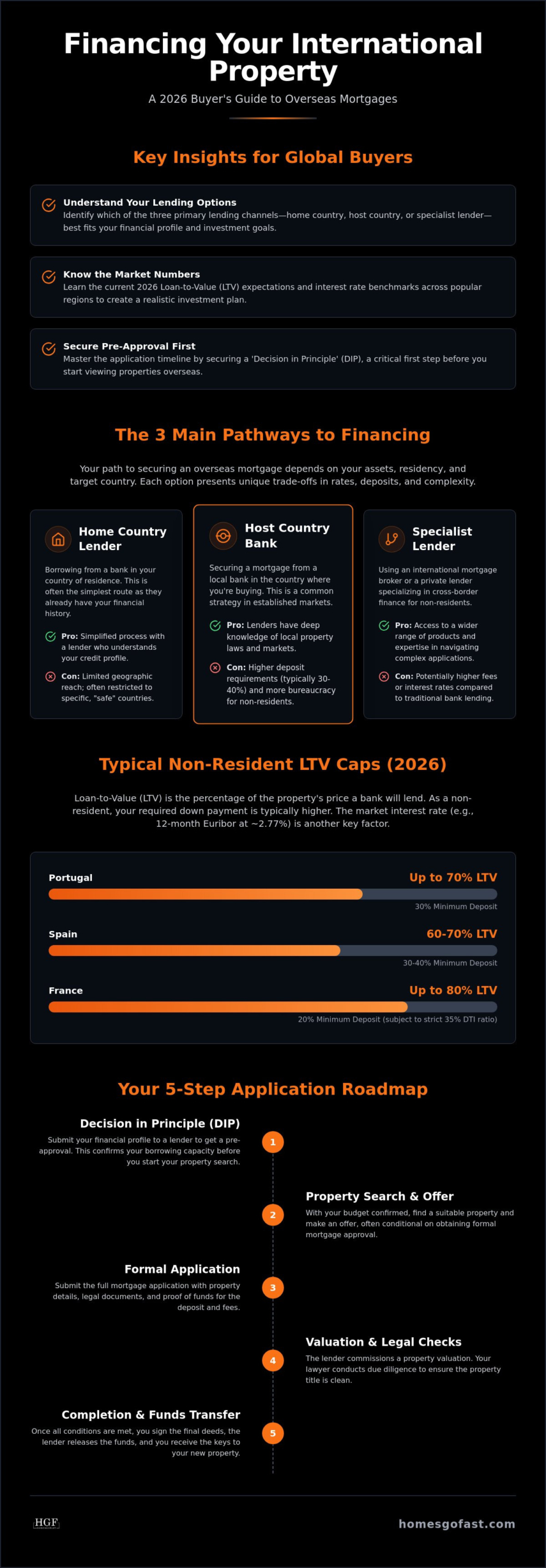
Securing capital for an international acquisition isn’t a one-size-fits-all process. The most effective path depends on your existing assets, your tax residency, and the specific country you’ve targeted. In 2026, with the 12-month Euribor sitting at approximately 2.767%, the interest rate environment is shifting. This makes it essential to weigh the complexity of different lending channels against their potential long-term savings. You’re essentially choosing between three distinct pathways: home-based, host-based, or alternative financing.
Before you dive deep into the best property portals for international real estate, you should decide which of these channels aligns with your financial goals. Some buyers prefer the comfort of a familiar bank, while others seek higher leverage through local lenders or developers. Each route has specific trade-offs regarding deposit size, interest rates, and the speed of the transaction.
Channel 1: Borrowing from a Lender in Your Home Country
Many global banks operate an “International Desk” model. This is often the most straightforward route because these lenders already have access to your credit history and understand your financial background. The main drawback is their limited geographic reach. Most domestic banks only lend in specific “safe” jurisdictions with high transparency. If you’re using the best property portals for international real estate to explore niche or emerging markets, your home-country bank may not be able to provide the necessary cross-border support.
Channel 2: Securing a Mortgage from a Local (Host) Bank
Securing a mortgage from a local bank in the country where you’re buying is a popular strategy in established markets like Spain. Host banks are experts in local property law, but they usually demand higher deposits from non-residents; typically between 30% and 40%. You’ll also need to navigate local bureaucracy, such as obtaining a tax ID like the NIE in Spain. There are several countries where foreigners can secure mortgages with relative ease, provided you can meet their strict LTV requirements and provide translated proof-of-income documents.
Channel 3: Developer and Seller Financing
Developer and seller financing are vital options in markets where traditional banking is restrictive. In high-growth regions like Panama or the UAE, developers frequently offer internal financing for new-build projects to attract foreign investors. You might also encounter “Vendor Take-Back” mortgages, where the seller acts as the bank. In this scenario, you pay the seller in installments over a set period. This can be an excellent alternative if you’re looking for speed or don’t meet the rigid criteria of traditional commercial banks.
Once you’ve identified your preferred financing route, you can browse international real estate listings to see how your budget aligns with current market prices across different territories.
Comparing the Pros and Cons of International Lending Options
Choosing the right financing structure requires a cold look at Loan-to-Value (LTV) ratios and the total cost of capital. In 2026, LTV expectations for non-residents have tightened across several popular jurisdictions. While you’re scouring the best property portals for international real estate, keep these regional benchmarks in mind:
- Spain and Portugal: Non-residents are typically capped at 60% to 70% LTV.
- France: Expect LTVs between 50% and 70%, requiring a substantial 30% to 50% deposit.
- Malaysia: Offers more leverage, with LTVs often reaching 70% for foreign borrowers.
- Uruguay: Lenders are more conservative, often requiring down payments of 40% to 60%.
Equity Release: Using Your Current Home to Buy Abroad
Remortgaging your primary residence to release equity allows you to enter a foreign market as a “cash buyer.” This status gives you immense negotiating power and speeds up the closing process significantly. However, this strategy carries the risk of securing a foreign asset against your main home; if the investment fails, your primary roof is at risk. This approach remains the fastest way to secure French homes for sale without navigating the strict 35% debt-to-income ratio imposed by French banks since 2022.
Currency Risk and Foreign Exchange (FX) Strategy
Currency volatility can turn a profitable investment into a monthly liability if you aren’t careful. Smart investors use a “Natural Hedge” by borrowing in the same currency as their expected rental income. If you’re buying a villa in the Algarve to rent to European tourists, a Euro-denominated loan ensures your repayments fluctuate in tandem with your earnings. Don’t rely on retail banks for your monthly transfers. Specialized FX brokers typically offer rates 2% to 4% better than high-street banks, which can save you thousands over the life of a 20-year mortgage.
A Step-by-Step Guide to the Application Process
The journey from browsing the best property portals for international real estate to holding the keys typically takes three to six months. You shouldn’t start viewing houses until you have a ‘Decision in Principle’ (DIP) from a lender. This document proves to sellers and agents that you’re a serious buyer with the financial backing to complete the deal, which is essential in competitive markets where homes move quickly.
Once you’ve found a property, the formal application begins. This involves a rigorous underwriting process where the lender scrutinizes your global financial footprint. In many jurisdictions, you’ll work closely with a Notary who acts as an impartial legal officer to ensure the transaction complies with local laws. It’s also vital to retain independent legal counsel to represent your interests specifically, especially when navigating foreign contracts.
The Documentation Checklist for Foreigners
Lenders require a comprehensive dossier to assess your creditworthiness across borders. 2026 regulations have significantly tightened Anti-Money Laundering (AML) checks, particularly for non-residents. You’ll need to provide:
- Proof of income, such as a P60 in the UK or a 1040 in the US.
- Last six months of personal and business bank statements.
- A detailed ‘Source of Wealth’ declaration explaining where your deposit originated.
- Certified translations of any documents not in the host country’s official language.
Valuations and Surveys: The Lender’s Perspective
Before a bank releases funds for an overseas property, they’ll appoint their own valuer. It’s vital to understand that banks often look at the ‘forced sale value’ rather than the optimistic listing price you see online. If the valuation comes in lower than your offer, you’ll need to bridge the gap with a larger deposit to maintain the required LTV ratio.
Avoid the ‘Surveyor’s Trap’ by hiring an independent surveyor to check for structural issues that might make the home unmortgageable. While the bank’s valuer protects the lender’s interest, your independent surveyor protects yours. Using the best property portals for international real estate can help you find listings that have already undergone preliminary checks, saving you time and potential frustration during the final stages of the loan approval.
Ready to put your financing plan into action? You can browse international real estate listings today to find properties that meet your specific investment criteria and budget.
Maximizing Your Success: Search and Finance Integration
In 2026, buyers are increasingly looking for ‘mortgage-ready’ listings in countries like Italy or Greece. These are properties where the legal paperwork and titles have been pre-vetted by agents familiar with foreign buyer requirements. This proactive step reduces the risk of a bank’s valuer finding structural or legal discrepancies that could stall your application. Investors are attracted by markets with clear financing paths, and choosing the right platform ensures you’re seeing properties that fit those parameters.
HomesGoFast acts as a vital bridge in this journey. We connect you with experienced agents who specialize in foreign buyer leads and understand the specific hurdles non-residents face. These agents often have established relationships with local lenders who are comfortable with cross-border income profiles. By using the best property portals for international real estate, you gain access to a network of professionals who can guide you through the local bureaucracy with efficiency and confidence.
Working with International Mortgage Brokers
A seasoned international mortgage broker acts as a savvy mentor. They maintain relationships with local ‘host’ banks that you might not find through a standard web search. Most brokers operate on a flat-fee basis or a percentage of the loan amount, typically around 1%. While their expertise is invaluable, you must verify that they’re regulated in their specific jurisdiction. An unregulated broker might lack the necessary professional indemnity insurance, leaving you vulnerable if the advice leads to a failed transaction.
Next Steps: From Finance to Key-in-Hand
Moving from a desire to a concrete solution requires a holistic view. You can’t look at the purchase price in a vacuum; you must consider it alongside local taxes and mortgage interest rates. To gauge realistic price ranges and market demand in your target area, explore our comprehensive international real estate listings checklist. This will help you align your budget with the 2026 market reality before you sign any contracts.
Whether you’re looking to buy your first overseas asset or you want to list your own property to reach our global audience, taking a structured approach to finance is the key to a stress-free transaction. Start your search today and secure your place in the global property market with confidence.
Securing Your Future in the Global Property Market
Mastering the 2026 mortgage landscape is about more than just finding a lender; it’s about aligning your investment logic with regional realities. You’ve learned that whether you’re navigating the LTV caps in Portugal or leveraging developer finance in the UAE, success depends on early preparation and a solid ‘Decision in Principle’. By using the best property portals for international real estate, you can bridge the gap between financial planning and finding a mortgage-ready asset that meets your lifestyle goals.
Since 2002, we’ve acted as a trusted connector for buyers across 50+ countries, providing the expert guidance needed to reduce the stress of cross-border transactions. Our platform is designed for efficiency, moving you quickly from a desire to a concrete solution. It’s time to take the next step toward your international acquisition with the grounded reliability of a seasoned global expert who understands the complexities of the modern marketplace.
Ready to see what’s possible? Explore thousands of overseas property listings and start your journey today. The global market is entering a new phase of growth, and your dream property is well within reach.
Frequently Asked Questions
Can I get a mortgage for an overseas property from my local bank?
Yes, but your options are usually limited to banks with dedicated international desks. Most domestic lenders only provide financing for properties in specific, high-transparency jurisdictions where they have a physical presence or legal partnership. If you are using the best property portals for international real estate to explore niche or emerging markets, you will likely need to secure a loan from a local host bank instead.
What is the typical deposit (LTV) required for a foreign property mortgage?
Non-residents generally need a deposit of 30% to 50% of the property value. While local buyers might access high LTV ratios, lenders view cross-border transactions as higher risk and cap non-resident loans accordingly. For example, in 2026, Spanish banks typically limit non-residents to a 60% or 70% LTV, requiring you to bring more equity to the table at the start of the transaction.
Is it better to borrow in my home currency or the local currency?
Borrowing in the currency of your income or the property’s rental yield is the safest strategy. This creates a natural hedge that protects you from exchange rate volatility. If you earn in GBP but have a mortgage in Euros, a sudden drop in the pound’s value could significantly increase your monthly repayment costs, potentially turning a profitable investment into a financial burden.
How does my credit score affect an international mortgage application?
Your domestic credit score acts as a baseline, but international lenders perform a much broader financial deep dive. They often use specialized agencies to verify your global creditworthiness and debt-to-income ratio. In 2026, banks are increasingly focused on your total liquidity and “Source of Wealth” rather than just a single three-digit number from a domestic credit bureau.
Are there specific countries where it is easier for foreigners to get a mortgage?
Established European markets like Spain, France, and Portugal have the most robust infrastructure for non-resident lending. These countries have long histories of foreign ownership and clear legal frameworks for repossessions, which gives banks the confidence to lend. When browsing the best property portals for international real estate, you’ll find that these regions often have the most “mortgage-ready” listings for international buyers.
What happens if I fail the ‘Source of Wealth’ check during the application?
Your application will be rejected immediately, and the lender may be legally required to report the transaction under Anti-Money Laundering regulations. Banks in 2026 are under intense pressure to verify that all deposits come from legitimate, taxed income. You must provide a clear paper trail, such as tax returns or legal sale documents, to prove exactly how you accumulated your capital.
Can I use rental income from the overseas property to qualify for the loan?
Some lenders allow you to use projected rental income to meet affordability requirements, but they usually apply a “haircut” to the figures. For instance, a bank might only recognize 70% of the projected rent to account for vacancies and maintenance costs. This is particularly common with DSCR loans in the United States, where the property’s cash flow is the primary qualifier for the mortgage.
What are the additional costs of an overseas mortgage compared to a local one?
You should budget for certified document translations, international bank transfer fees, and specialized mortgage arrangement fees. Some jurisdictions also require mandatory life insurance or local legal representation that can add thousands to your closing costs. These administrative expenses typically add an extra 2% to 5% to the total loan amount, so it’s vital to factor them into your initial investment logic.