

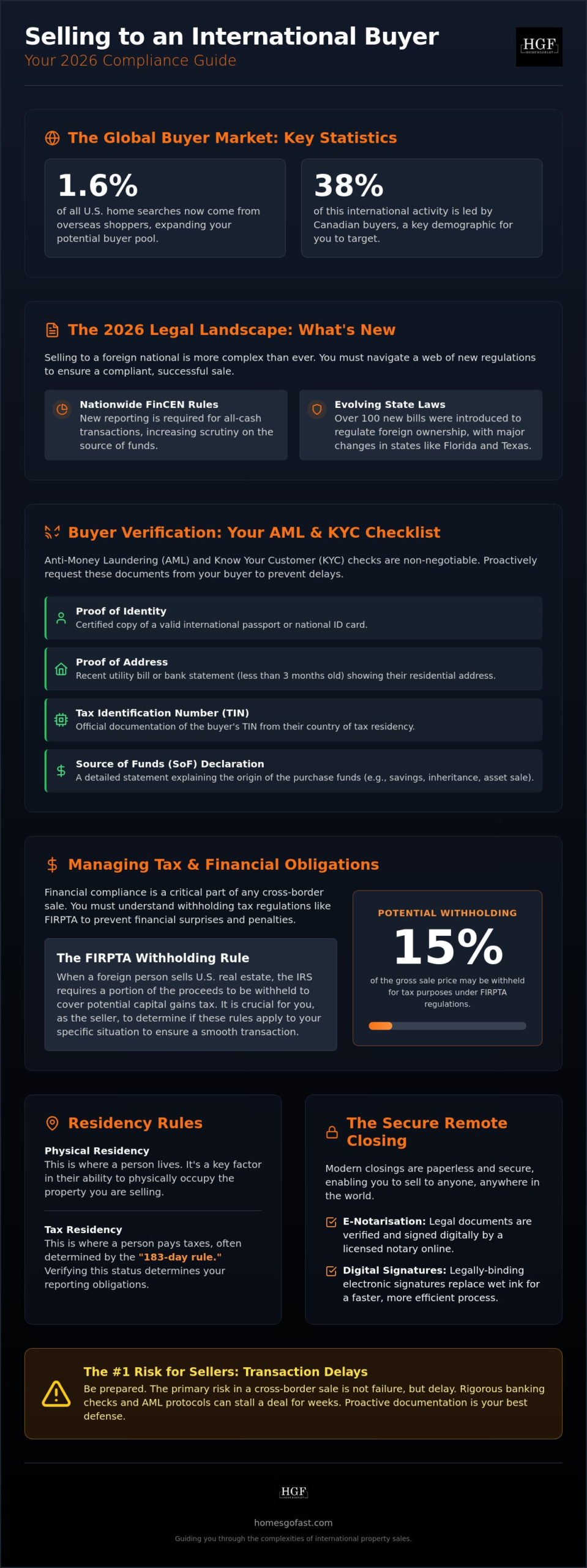
Did you know that overseas shoppers now account for 1.6% of all U.S. home searches, with Canadian buyers leading nearly 38% of that international activity? While learning how to attract foreign buyers for your property can significantly boost your final sale price, the legal landscape in 2026 is more complex than ever. From new nationwide FinCEN reporting rules for all-cash deals starting in March to evolving state-level restrictions in Florida and Texas, the “sold” sign now comes with a heavy side of compliance.
You’re likely feeling the weight of potential 15% FIRPTA withholdings or the stress of managing a remote closing across multiple time zones. It’s a valid concern, especially since state legislatures introduced over 100 bills this year alone to regulate foreign real estate interest. We’re here to help you turn that uncertainty into a strategic advantage. You’ll master the intricacies of international taxes, anti-money laundering checks, and remote online notarization to ensure your transaction is both profitable and protected. This guide provides a clear breakdown of required documents and a step-by-step strategy for a smooth, compliant closing.
Key Takeaways
- Identify the critical legal differences between physical and tax residency to ensure your buyer meets all local acquisition criteria.
- Navigate 2026 compliance standards by mastering the Source of Funds (SoF) verification process required for cross-border transactions.
- Minimize financial surprises by learning how to manage global withholding taxes and currency exchange risks during the settlement period.
- Discover how to attract foreign buyers for your property by prioritizing marketing in territories with established tax treaties and high investment demand.
- Transition to a modern, paperless closing experience using the latest E-Notarisation and digital signature protocols for a secure remote sale.
Understanding the Non-Resident Buyer: Legal Definitions and Risks
Knowing how to attract foreign buyers for your property is only half the battle; you also need to understand who these buyers are from a legal standpoint. Selling to an international investor often brings higher liquidity and a faster sale. Many of these shoppers are cash-rich and looking for “safe haven” assets to diversify their portfolios. However, governments frequently impose stricter rules on these acquisitions to manage local housing affordability and national security interests.
These regulations ensure that the state collects its share of capital gains, such as through the Foreign Investment in Real Property Tax Act (FIRPTA) in the United States. While these legal hurdles exist, the rewards of a global sale are significant. Investors are attracted by stable markets and high yields, making your home a premium asset on the global stage. To better understand this concept, watch this helpful video:
Tax Residency vs. Physical Residency
Distinguishing between where someone lives and where they pay taxes is vital for a smooth transaction. Most jurisdictions follow the “183-day rule,” where staying in a country for more than half a year triggers tax residency. If your buyer is a tax non-resident, your reporting obligations change instantly. You must verify their status before a contract is signed. This determines if you need to withhold a portion of the sale proceeds for the tax authorities, a step that prevents costly penalties later.
Reciprocity Laws and Ownership Restrictions
Reciprocity agreements are “tit-for-tat” rules; some countries only allow citizens of nation A to buy property if nation A allows their citizens to do the same. In 2026, we’re seeing an increase in restricted zones near military installations or critical infrastructure. If your home sits in one of these areas, it might limit your pool of overseas property for sale. Buyers are increasingly looking for clarity on these restrictions before they commit. Understanding these boundaries helps you refine your strategy for how to attract foreign buyers for your property while maintaining full legal compliance.
The primary risk for you as a seller is often transaction delays. Cross-border banking checks and Anti-Money Laundering (AML) protocols take time. If you aren’t prepared for this level of scrutiny, your deal could stall for weeks. Being proactive with your legal documentation is the best way to keep the momentum of the sale moving forward.
Key Legal Requirements for Cross-Border Property Sales
AML compliance serves as the non-negotiable safeguard that ensures your transaction remains secure and legally sound in the eyes of global regulators. When you are mastering how to attract foreign buyers for your property, you must move beyond marketing and focus on the rigorous documentation required for a cross-border sale. Investors are attracted by sellers who maintain high standards of due diligence, as it minimizes the risk of the deal being flagged or stalled by financial institutions.
The role of the Notary or Conveyancer is pivotal here; they act as the gatekeeper for Source of Funds (SoF) verification. This process involves a deep dive into the buyer’s financial history to ensure the capital used for the purchase is legitimate. While these checks are more intensive than domestic sales, they are essential for complying with IRS guidelines on FIRPTA and similar global tax frameworks.
AML and KYC: Protecting the Transaction
Buyers are increasingly looking for a transparent onboarding process that clearly outlines the required “Know Your Customer” (KYC) documents. To avoid last-minute delays, your legal team should request the following items immediately upon accepting an offer:
- Proof of Identity: Certified copies of valid international passports or national ID cards.
- Proof of Residence: Original utility bills or bank statements from the last three months.
- Tax Identification: The buyer’s Tax ID number from their home country to facilitate mandatory reporting.
The Role of International Power of Attorney
In cases where a buyer cannot travel for the signing, a Power of Attorney (PoA) is the standard legal solution. However, this adds another layer of complexity, specifically regarding Apostille requirements. An Apostille is a specialized certificate that verifies the document’s authenticity for use in another country. Without this, the PoA will not be recognized by the local land registry.
Pros and Cons of Remote Document Execution
Understanding the different paths for document signing helps you advise potential buyers and keep the sale on track. Here is how the traditional Power of Attorney compares to an in-person closing:
- Power of Attorney (Pros): Allows the buyer to stay home; professional legal representation handles the final signature; avoids travel logistical issues.
- Power of Attorney (Cons): Higher legal fees for document drafting; time-consuming Apostille process; risk of rejection if templates aren’t exact.
- In-Person Closing (Pros): Immediate resolution of any signing errors; no need for Apostilles; direct interaction with the notary.
- In-Person Closing (Cons): Significant travel costs for the buyer; potential for delays due to flight or visa issues.
Learning how to attract foreign buyers for your property means being prepared for these administrative hurdles. By providing a clear checklist of mandatory disclosures and legal requirements early on, you demonstrate the “smart advisor” persona that builds lasting trust with international investors.
Managing Tax Implications and Withholding Obligations
Your strategy for how to attract foreign buyers for your property must include a clear plan for tax withholding. Investors are attracted by sellers who provide a transparent breakdown of net proceeds after taxes. This level of professionalism builds the trust necessary to close high-value international deals, especially as interest from foreign buyers continues to rise in 2026.
The FIRPTA withholding requirements are often the first hurdle for those selling in the U.S. market. Most governments use these mechanisms to ensure they collect capital gains before the sale proceeds leave their jurisdiction. This isn’t a final tax; it’s a security deposit held in escrow until your final tax return is filed.
Withholding Tax: A Global Overview
The amount of money withheld depends heavily on the buyer’s residency status and the total sale price. While the U.S. defaults to 15% for individuals, global rates vary significantly. Understanding these numbers early helps you calculate your realistic ROI and plan your next investment with confidence.
| Scenario / Jurisdiction | Typical Withholding Rate | Key Condition |
|---|---|---|
| U.S. Individual (FIRPTA) | 15% of Gross Price | Exempt if price is under $300k and buyer resides there. |
| U.S. Foreign Corporation | 21% of Gross Price | Standard rate for corporate entities. |
| Global Average (EU/Asia) | 10% to 25% | Varies by local capital gains laws. |
Pros and Cons of Withholding Certificates
You don’t always have to let the full percentage sit in escrow. Many jurisdictions allow you to apply for a withholding certificate to reduce the amount held. This is a vital tool for maintaining liquidity during a sale.
- Pros: You keep more of your cash immediately after closing; it reflects a lower, more accurate tax liability based on actual profit.
- Cons: It requires early legal intervention; the application process can take 90 days or more to process.
Avoiding the Double Taxation Trap
Buyers are increasingly looking for properties in regions with strong tax treaties. These treaties prevent you from paying tax on the same profit in both the property’s country and your home country. To benefit, you must provide a Tax Residency Certificate before the settlement date.
If you fail to manage this, you might wait up to 18 months for a refund from foreign authorities. For a detailed breakdown of these costs, read our guide on Capital Gains Tax on Sale of Property: The 2026 Global Seller’s Guide. Taking these steps ensures you can advertise properties with a clear understanding of your final net yield.
The 2026 Remote Closing Process: Digital and Legal Integration
Gone are the days of sending thick envelopes of contracts across the ocean via expensive couriers. In 2026, the speed of your sale depends entirely on your digital infrastructure. Remote Online Notarization (RON) is now legally accepted across all 50 U.S. states, and similar digital frameworks have matured globally. This shift is a core part of learning how to attract foreign buyers for your property, as international shoppers prioritize efficiency and security above all else. They want a frictionless experience.
Modern transactions utilize a hybrid approach where most documents are signed electronically. This reduces the stress of cross-border logistics. To maximize your reach before the closing stage, you should understand how to advertise properties to a global audience in 2026. By offering a digital-first path, you make your home more accessible to busy investors who cannot justify a ten-hour flight for a single signature.
Digital Signatures and Legal Validity
Standards like eIDAS in Europe ensure that an electronic signature carries the same legal weight as a wet-ink one. Video-linked notarisation allows a non-resident seller to verify their identity and sign documents in real-time with a legal professional. It works seamlessly. This process ensures the chain of title remains unbroken while eliminating the logistical nightmare of document execution. Your legal team must confirm that the specific digital platform used meets the compliance standards of both the buyer’s and seller’s jurisdictions.
Currency Transfers and Banking Hurdles
Traditional banks often flag large international property transfers, causing delays that can jeopardize a closing date. These institutions may hold funds for days while performing manual compliance checks. Beginning March 1, 2026, a new nationwide FinCEN rule requires a detailed “Real Estate Report” for all-cash purchases by legal entities or trusts. This adds a layer of reporting that your digital closing process must accommodate to avoid last-minute freezes.
Using a specialist FX provider allows you to lock in exchange rates and bypass many banking delays. This is vital when managing the settlement period. Escrow services provide the neutral ground needed for international funds, holding the deposit until all legal conditions are met. Your final Closing Statement must account for cross-border fees, including international wire charges and notary costs. If you want to tap into this high-speed market, you can sell overseas property through platforms designed for digital-first transactions.
Strategic Marketing: Finding Qualified Non-Resident Buyers
Global visibility is your best legal defense when selling an international asset. When you cast a wide net, you can choose buyers from jurisdictions with transparent banking systems and established tax treaties. This selection process reduces the risk of the AML delays we explored earlier. Learning how to attract foreign buyers for your property involves more than just aesthetics; it’s about targeting the right fiscal profiles.
HomesGoFast acts as the essential bridge between a standard listing and a legally compliant lead. By utilizing an Agent Pro account, you tap into a stream of high-intent international lead generation that prioritizes buyer quality. This system filters for individuals who are financially prepared for the rigors of a cross-border transaction. Investors are attracted by sellers who use professional platforms, as it signals a reliable and efficient sale process.
Buyers are increasingly looking for clarity on how their home country’s tax laws interact with yours. Targeting buyers from countries with strong tax treaties reduces the complexity of the withholding process. For example, a buyer from a country with a robust treaty is less likely to trigger the “double taxation trap” mentioned in our tax breakdown. This strategic targeting is a fundamental part of how to attract foreign buyers for your property in a crowded global market.
Targeting High-Intent International Markets
Smart sellers focus on established buyer corridors where the legal paths are already well-trodden. Using multilingual listings is a powerful way to build immediate trust. A listing that speaks the buyer’s language and addresses their specific residency concerns ensures your home stands out. If you’re ready to reach this audience, you can Sell Overseas Property on a platform built for this level of global reach.
Investors are attracted by markets that offer both lifestyle appeal and practical investment logic. By highlighting proximity to international airports and established expat communities, you answer the accessibility questions that non-resident buyers prioritize. This approach balances the dream of ownership with the practical reality of making a sound financial decision.
Providing branded amenities at property viewings, such as custom cooling towels from Rally Towels, is an effective way to enhance the lifestyle appeal and create a memorable brand experience for prospective international investors.
Soft CTA: Moving from Legal Theory to Sales Action
Take action today to secure the best ROI and ensure a compliant, professional transaction from start to finish. By positioning your property in front of a qualified international audience, you turn the complexity of a cross-border sale into a streamlined success story.
Secure Your Global Sale in 2026
The international real estate market offers incredible liquidity and premium prices, but success hinges on your ability to manage 2026 compliance standards. You now have the tools to navigate FIRPTA withholdings, FinCEN reporting, and the legal nuances of remote online notarization. By treating these regulations as a roadmap rather than a barrier, you position your asset as a secure, high-value choice for savvy investors worldwide.
Mastering how to attract foreign buyers for your property requires a blend of legal precision and global visibility. When you combine digital-first closing strategies with targeted marketing in treaty-protected regions, you reduce transaction friction and protect your bottom line. Investors are attracted by transparency. Your preparation is the key to building that essential trust across borders.
Ready to turn these insights into a successful transaction? With over 20 years of international property expertise and a network of 100+ global property portals, we specialize in connecting sellers with high-intent foreign buyer leads. Advertise your property to a global audience today and take the first step toward a compliant, high-yield international sale. The world is looking for your home; it’s time to make sure they find it.
Frequently Asked Questions
Do I need a special lawyer to sell property to a non-resident?
You should hire a lawyer with specific experience in international conveyancing and cross-border tax law. Standard local lawyers often lack the expertise to handle FIRPTA withholding or the new 2026 FinCEN reporting requirements. A specialist ensures your transaction complies with international reporting standards and protects you from potential penalties. They’ll also manage the complex coordination between different jurisdictions to keep the sale moving forward.
What is the most common legal delay when selling to a foreign buyer?
Anti-Money Laundering (AML) and Know Your Customer (KYC) verification are the most frequent causes of transaction delays. Cross-border banking checks take longer than domestic ones because institutions must verify the origins of international wealth. You can mitigate this by learning how to attract foreign buyers for your property who already have established local bank accounts or pre-verified source of funds documentation from recognized financial institutions.
Can a non-resident buy property without being physically present?
Yes, non-residents can complete a purchase remotely using Remote Online Notarization (RON) or a Power of Attorney (PoA). As of 2026, all 50 U.S. states authorize the use of RON, allowing for fully digital closings through secure video-link sessions. This technology enables buyers to sign legally binding documents from their home country. It eliminates the need for expensive international travel and significantly reduces the time required to finalize the settlement.
How much tax is withheld when selling to a non-resident?
The standard withholding rate under FIRPTA is 15% of the gross sales price for individual foreign sellers. If the seller is a foreign corporation, this rate typically increases to 21% to cover potential corporate tax liabilities. These funds stay in escrow until the tax authorities determine the final liability. You can apply for a withholding certificate to reduce this amount if your actual capital gains tax is lower than the standard rate.
Is a digital signature legally binding for a property sale in 2026?
Digital signatures are fully legally binding in 2026 as long as they meet standards like eIDAS in Europe or the UETA in the United States. Most international transactions now rely on these secure platforms to exchange contracts instantly across borders. Implementing these tools is a vital part of your strategy for how to attract foreign buyers for your property who prioritize efficiency and secure, paperless transaction environments.
What happens if the buyer cannot verify their source of funds?
The transaction will likely be blocked by the bank or the legal representative if the buyer doesn’t provide a clear audit trail. Compliance officers must reject funds that fail AML checks to avoid severe legal penalties. This failure usually results in a cancelled contract and potential reporting to financial crimes networks like FinCEN. It’s why verifying a buyer’s financial history early in the process is essential for a secure sale.
Do reciprocity laws affect my ability to sell my home?
Reciprocity laws can limit your buyer pool if your country only allows citizens of nations with similar ownership rights to purchase property. While many markets are open, some jurisdictions restrict non-residents from buying agricultural land or homes near sensitive infrastructure. You should check local zoning and national security laws before targeting specific international markets. These rules ensure that property ownership remains balanced between different nations and protects national interests.
How does the 183-day rule impact the legal aspects of my sale?
The 183-day rule determines whether your buyer is a tax resident or a non-resident, which changes your withholding obligations. If a buyer stays in the country for more than half the year, they’re usually taxed as a resident. Verifying this status is critical because it dictates whether you must comply with non-resident tax protocols at closing. Failing to identify the correct status can lead to unexpected tax withholdings and significant delays in fund disbursement.