

What if the biggest threat to your international real estate dream isn’t a market crash, but a single missing signature on a foreign deed? Buyers are increasingly looking for stability in a shifting landscape, yet many wonder how to safely buy property overseas without falling into expensive legal traps. It’s natural to feel anxious about hidden encumbrances or watching your hard-earned ROI vanish because of sudden currency fluctuations.
We agree that the complexity of cross-border deals can be daunting. However, you don’t have to navigate these waters alone. This guide promises to equip you with a professional three-pillar framework to insulate your finances and verify legalities with absolute certainty. You’ll move from uncertainty to total confidence in your acquisition strategy by following a proven path used by seasoned experts.
We’ll preview the essential due diligence checklist every investor needs in 2026. You’ll also learn how to navigate new regulations, such as Portugal’s 7.5% flat property transfer tax, and discover how to move your money securely without losing a fortune to hidden bank fees. Let’s turn your global aspirations into a secure, high-yielding reality through practical, action-oriented steps.
Key Takeaways
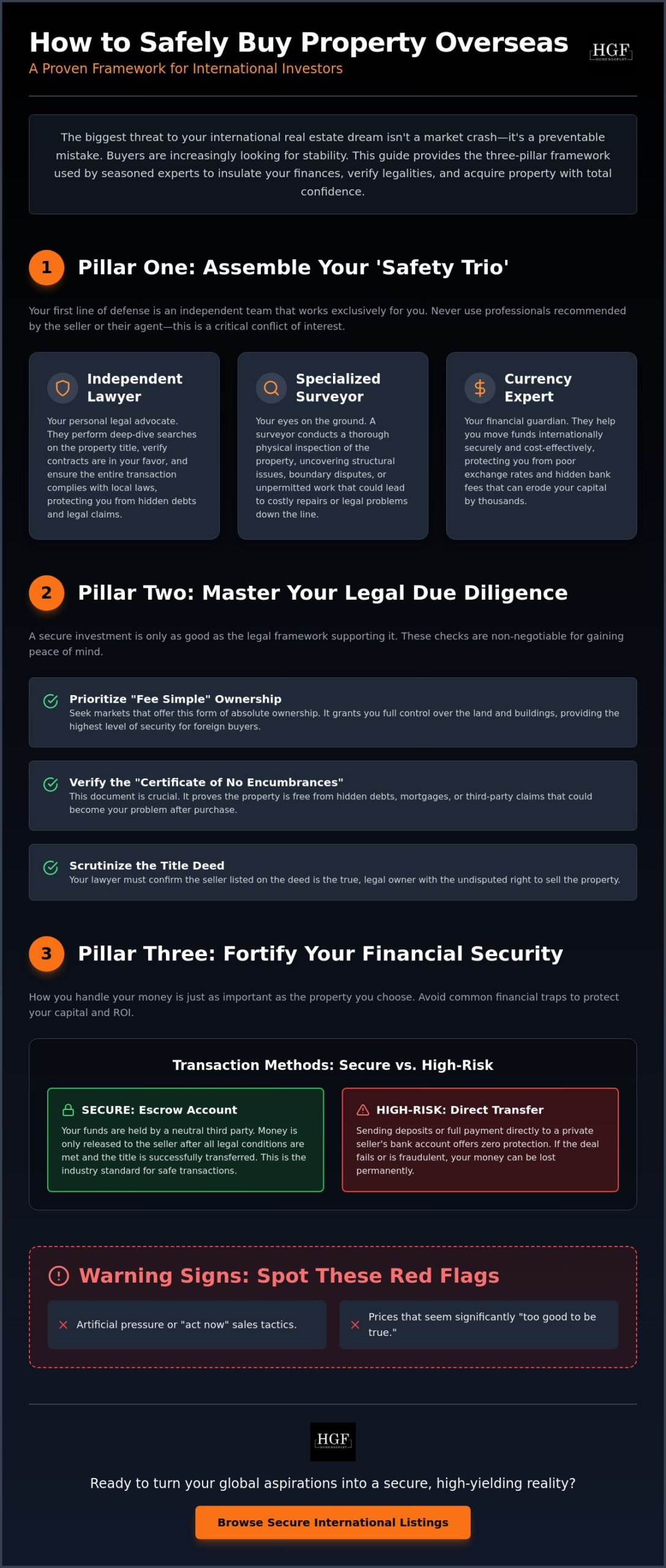
- Build your “Safety Trio” by hiring an independent lawyer, a specialized surveyor, and a currency expert to protect your investment.
- Avoid the most common pitfall by never using a legal representative recommended by the seller or their estate agent.
- Master how to safely buy property overseas by using secure escrow accounts instead of transferring deposits directly to private sellers.
- Learn to spot red flags like artificial pressure tactics and prices that seem too good to be true, as these often hide structural or legal issues.
- Gain peace of mind by prioritizing markets that offer “Fee Simple” or equivalent absolute ownership rights for foreign buyers.
The Foundation of a Safe Overseas Property Purchase
“Safe buying” is more than just a feeling of security; it’s a measurable combination of legal title clarity, financial transparency, and physical asset verification. You must ensure the seller actually owns the property and that no hidden debts are attached to the deed. Buyers are increasingly looking for jurisdictions with established protections, as understanding foreign ownership laws provides the necessary foundation for any cross-border transaction. Knowing how to safely buy property overseas starts with recognizing that an investment is only as good as the legal framework that supports it.
To better understand this concept, watch this helpful video:
Global property portals serve as your primary defense against market opacity. These platforms allow you to cross-reference prices and agent credentials before you ever step on a plane. For those targeting specific high-value markets like Manhattan, consulting specialized brokerages like Skyline Properties can provide access to off-market commercial listings that aren’t available on public portals. Due Diligence is the process of verifying every claim made by a seller or agent before any funds are committed.
Setting Your Safety Criteria in 2026
Investors are attracted by “Safe Haven” markets that offer long-term stability, even if the immediate yields are lower than in high-risk emerging territories. When you browse international real estate listings, look for these indicators of a transparent market:
- Detailed property history and verified tax records.
- Clear disclosures regarding local zoning and land use.
- Professional listings with high-quality data and agent credentials.
Don’t overlook physical accessibility when setting your criteria. Verify airport proximity and local infrastructure developments through digital records to confirm the area has the connectivity required to sustain its long-term value.
Why a Global Perspective Beats Local Bias
It’s easy to catch “vacation brain” after a few days of sunshine and local culture. However, a great holiday spot doesn’t always translate to a secure asset. You need to separate lifestyle aspirations from investment logic to protect your capital. Using global market trends helps you benchmark the price per square meter against broader regional averages. This data-driven approach prevents you from paying a premium on a property that locals wouldn’t touch.
Pay attention to how a home is marketed. If it’s presented to a global audience, it likely meets the standards of international investors, which bodes well for your future liquidity. Learning how to safely buy property overseas means looking at the data first and the sunset second.
Navigating Foreign Legal Systems Without the Risk
The Golden Rule of international acquisition is simple: never use a lawyer recommended by the seller or the estate agent. While this advice seems basic, many buyers fall into this trap to save time or money. A lawyer suggested by the counterparty has a natural conflict of interest. To understand how to safely buy property overseas, you must prioritize independent representation that answers only to you. This ensures that your legal counsel identifies risks rather than glossing over them to close a deal.
Investors are attracted by jurisdictions that offer “Fee Simple” or equivalent absolute ownership rights. This is the highest form of property ownership, granting you full control over the land and any buildings on it. In civil law countries like France, Italy, or Spain, the Notary acts as a public official who witnesses the transaction and ensures taxes are paid. However, the Notary does not act as your personal advocate. You still need an independent lawyer to perform deep-dive searches that a Notary might overlook.
Essential Document Verification
Before committing any capital, you must verify the “Certificate of No Encumbrances” or its local equivalent. This document proves that the property is free from hidden debts, mortgages, or legal claims that could pass to you upon purchase. Checking the Title Deed through an escrow or notary service is the only way to confirm current ownership and resolve potential boundary disputes before they become your problem.
Planning permissions are equally critical. You must ensure that a “dream villa” isn’t built on protected agricultural land or within restricted zones. For example, those looking at property for sale in Spain must be aware of the “Coastal Law” (Ley de Costas). This regulation can lead to the demolition of homes built too close to the shoreline without proper historical permits. Verifying these details is a non-negotiable step in securing your asset.
The Role of Independent Legal Counsel
Finding a bilingual lawyer who specializes in cross-border conveyancing is your best defense. They bridge the gap between your home country’s expectations and local realities. If you cannot be present for the signing, a Power of Attorney can be useful. However, you should restrict its scope to a specific property and a limited timeframe to prevent potential abuse of your legal standing.
Your purchase contract should always include protective clauses. Ensure it is “Subject to Survey” or “Subject to Finance” to allow you a safe exit if the building has structural issues or your mortgage application fails. Buyers are increasingly looking for these safeguards to maintain flexibility in a fast-moving market. If you are ready to explore secure options, you can browse international real estate listings that have been vetted by professional agencies.
A smart advisor knows that legal safety isn’t about avoiding foreign markets. It’s about applying the same rigorous standards you would use at home to a global context. By building a wall of independent legal protection, you turn a risky venture into a calculated, secure investment.
Financial Security: Protecting Your Capital and ROI
Securing a legal title is half the battle, but protecting your capital from market volatility is where many investors lose their edge. Currency risk is a silent profit killer. A 5% shift in exchange rates between your initial offer and the completion date can wipe out your entire renovation budget or force you to over-leverage. Currency Forward Contracts can lock in an exchange rate for up to 12 months to provide budget certainty.
One of the most vital rules for how to safely buy property overseas is the use of Escrow accounts. You should never transfer a deposit directly to a private seller. Instead, use a regulated third-party account that only releases funds when specific legal milestones are met. This protects your capital if the deal collapses or if the seller fails to clear existing debts as agreed.
Calculating the “True Cost” of an acquisition requires looking beyond the sticker price. You must factor in transfer taxes, which can be significant. For instance, Portugal recently introduced a flat 7.5% Property Transfer Tax (IMT) for non-residents. When you add notary fees and international bank charges, your closing costs can easily reach 10% to 15% of the purchase price. Buyers are increasingly looking for detailed cost breakdowns to avoid mid-transaction surprises.
Safe Money Transfer Strategies
Traditional high-street banks often charge excessive fees and offer poor exchange rates for large property sums. Specialist FX brokers are usually a better choice, providing more competitive rates and expert guidance on market timing. You’ll also need to prepare for rigorous “Anti-Money Laundering” (AML) and “Proof of Funds” compliance. In 2026, regulators require documented evidence of your capital’s origin to satisfy both your home bank and the destination country’s authorities.
Once the purchase is complete, managing ongoing costs is your next priority. Setting up a local bank account is essential for handling utilities and local taxes. In Spain, for example, the annual local property tax (IBI) generally ranges from 0.4% to 1.1% of the property’s cadastral value. Automating these payments ensures you remain in good standing with local municipalities.
Tax and Inheritance Planning
Investors are attracted by jurisdictions that offer “Double Taxation” treaties. These agreements prevent you from being taxed on the same income or gains in both your home country and the property’s location. Understanding how capital gains tax on sale of property impacts your long-term exit strategy is essential for a sound financial plan. High exit taxes can significantly diminish your total ROI if you don’t plan for them from day one.
Succession laws also vary wildly across borders. Some countries use “forced heirship” rules, which dictate that a portion of your estate must go to specific heirs regardless of what your will says. Learning how to safely buy property overseas involves consulting a cross-border tax specialist to ensure your asset is protected for future generations.
Identifying Red Flags: What Every Global Buyer Must Spot
Scams in the international market aren’t as random as they seem. They usually follow predictable patterns that you can identify with the right training. Learning how to safely buy property overseas means recognizing these signals before you commit your capital. A price that sits 30% below the local market average isn’t a “lucky find.” It’s typically a red flag for structural failure, a lack of planning permission, or a seller trying to offload a legal headache before it becomes public knowledge.
Pressure tactics are the oldest trick in the book. If an agent claims “another buyer is waiting” or “the price goes up tomorrow,” you should immediately step back. Professional markets don’t move that fast without documentation. If they can’t show you a written offer from another party, the pressure is artificial. Investors are attracted by transparency, and any attempt to rush your due diligence is a sign that something is being hidden.
Buying “off-plan” requires a specific safety net. You can safely buy property that hasn’t been built yet, provided you secure a Bank Guarantee. This ensures that if the developer goes bust or fails to finish the project, your deposit is returned by a financial institution. Never accept a developer’s personal promise without this institutional backing. Vetting your agent is just as vital. Check for professional registrations and international affiliations to ensure they answer to a global code of conduct.
Physical Due Diligence and Surveys
Don’t confuse a bank valuation with a structural survey. A valuation only tells the lender if the property is worth the loan. A structural survey tells you if the roof will last five years. When looking at older Italian homes for sale, pay close attention to damp and subsidence. These historic assets are beautiful, but they require a professional “Snagging List” to identify utility connection issues or foundation cracks that a local seller might overlook during a quick walkthrough.
Contractual Warning Signs
Avoid any contract that lacks a firm completion date and penalty clauses for delays. Without these, a developer has little incentive to finish your home on time. Perhaps the most dangerous red flag is the “under-the-table” payment. A seller might ask you to pay a portion of the price in cash to lower their reported tax. This is a massive legal risk for you. If authorities investigate, you could face heavy fines or even lose the property. Always ensure the full purchase price is recorded on the public deed.
If you want to start your search with confidence, you can browse international real estate listings from agents who maintain verified track records across multiple borders.
Building Your International Property Support Team
Success in a global market isn’t a solo endeavor. To master how to safely buy property overseas, you must assemble a “Safety Trio” of independent experts who work exclusively for you. This team should include an independent lawyer to handle the title, a specialized surveyor to verify the structure, and a currency expert to protect your budget from volatility. By coordinating these three professionals, you create a shield around your investment that no single salesperson can penetrate.
Finding the right partners is easier when you use professional platforms. Buyers are increasingly looking for Agent Pro accounts that feature a verified track record and established tenure in their respective markets. These agents are often more accountable because they operate within a global visibility framework that values long-term credibility over quick, one-off commissions. Investors are attracted by the transparency provided by these verified networks, which reduce the friction of cross-border deals.
Don’t ignore the “unofficial” due diligence found in local expat communities. While they aren’t legal experts, residents can provide invaluable intel on local noise levels, seasonal weather patterns, or the reliability of local utility providers. Combining professional advice with local lived experience is the smartest way to ensure your new home meets your lifestyle expectations and maintains its resale value.
Understanding the local culture is essential, but keeping an eye on what’s trending globally can also help you stay connected to the wider world; read more about the latest viral news and high-engagement stories.
Leveraging Technology for Remote Verification
Digital tools have transformed the initial search phase. You can now use high-definition drone footage to verify property surroundings, ensuring that a “quiet mountain retreat” isn’t actually next to a hidden industrial site. Virtual tours allow you to inspect the layout before you spend money on a flight. For your initial shortlist, consult The Ultimate Checklist for Navigating International Real Estate Listings in 2026 to ensure no detail is missed during your preliminary review.
Digital document vaults are another essential tool. They keep your legal trail organized and secure, allowing you to share sensitive information with your lawyer or bank instantly. This efficiency is vital when you’re competing for high-demand assets in a fast-moving international market where delays can lead to lost opportunities.
Final Steps Before You Sign
- The “Sleep on It” Rule: Never sign a contract on the same day as your first viewing. Distance provides the clarity needed to separate vacation excitement from investment logic.
- Confirm the “Long-Stop” Date: This clause protects your deposit. If the sale isn’t completed by this specific date, you have the legal right to walk away with your funds intact.
- The Final Walkthrough: Perform a check immediately before completion. Ensure the property condition hasn’t changed and that all inventory items, like appliances or furniture, are still present.
Learning how to safely buy property overseas becomes a streamlined process when you start with a wide view of the market. Take the first step today and explore international real estate listings that align with your security criteria and lifestyle goals.
Taking Control of Your International Investment
You’ve now mastered the professional framework needed to turn a complex cross-border transaction into a secure financial win. By prioritizing independent legal counsel, utilizing secure escrow accounts, and building your “Safety Trio” of experts, you remove the guesswork from the equation. Mastering how to safely buy property overseas is ultimately about replacing anxiety with a systematic, data-driven approach to due diligence and market analysis.
Success requires balancing your lifestyle aspirations with grounded investment logic. Whether you’re looking for a high-yield asset or a sun-drenched holiday home, the steps outlined here ensure your capital remains protected. Buyers are increasingly looking for platforms that offer transparency and established credibility to simplify these global moves. Since 2002, we’ve provided that reliability, offering expert guides for complex markets and a global reach that spans 50+ countries.
The global market is full of opportunity for those who move with confidence and clarity. Take the next step in your acquisition journey and start your safe search with verified international property listings at HomesGoFast.com today. Your dream of owning property abroad is within reach; let’s make it a secure reality together.
Frequently Asked Questions
Is it safe to buy property overseas without visiting first?
While technology like 4K drone footage and virtual tours makes remote viewing easier, it’s generally not recommended to buy without a physical visit. A visit allows you to experience the neighborhood, check for local noise pollution, and verify the property’s condition in person. If you must buy remotely, ensure your “Safety Trio” performs rigorous on-ground checks to mitigate the inherent risks of how to safely buy property overseas.
How do I know if an international real estate agent is legitimate?
Legitimate agents should hold professional registrations in their local jurisdiction and often belong to international trade bodies. You can verify their credibility by checking their tenure and looking for verified status on established global platforms. Always ask for their license number and cross-reference it with local regulatory databases. Reputable agents prioritize transparency and won’t pressure you into making a decision without proper legal documentation.
What is the biggest risk when buying property in a foreign country?
The most significant risk is a lack of clear legal title, which can lead to losing your asset if hidden debts or ownership disputes emerge. Financial volatility, such as currency fluctuations, also poses a major threat to your ROI. You can manage these risks by hiring independent legal counsel and using currency forward contracts. Understanding how to safely buy property overseas means preparing for these variables before you commit your capital.
Can a foreigner legally own land in most countries?
Yes, many countries allow foreigners to own land, but the rules vary significantly by jurisdiction. Some nations offer “Fee Simple” absolute ownership, while others may restrict foreigners to leasehold agreements or specific investment zones. For example, Greece has a tiered investment system for its residency program, while Spain and Portugal have recently restricted real estate-based residency routes. Always verify local ownership laws with an independent attorney before signing any contracts.
How much extra should I budget for legal and closing costs abroad?
You should typically budget between 10% and 15% of the purchase price for closing costs, though this varies by region. In Spain, resale properties attract a transfer tax (ITP) of 6% to 10%, while Portugal recently introduced a flat 7.5% tax for non-residents. These costs usually cover legal fees, notary charges, stamp duty, and registration. Factoring these expenses into your initial budget prevents mid-transaction financial stress and protects your renovation capital.
What happens to my deposit if the seller pulls out of the deal?
Your deposit should be protected by an escrow account or a specific clause that mandates a full refund if the seller defaults. In some jurisdictions, like Spain, an “Arras” contract may even require the seller to pay you double the deposit amount as a penalty for pulling out. Always ensure your purchase contract includes a “Long-Stop” date and clear penalty clauses to protect your funds during the transaction process.
Do I need a local bank account to buy property overseas?
While you might be able to make the initial purchase via a specialist FX broker, you’ll almost certainly need a local bank account for ongoing ownership. Local accounts are essential for paying utilities, annual property taxes like Spain’s IBI or Portugal’s IMI, and community fees. Most banks require your passport and proof of funds to open an account, which helps you remain compliant with international anti-money laundering regulations.