
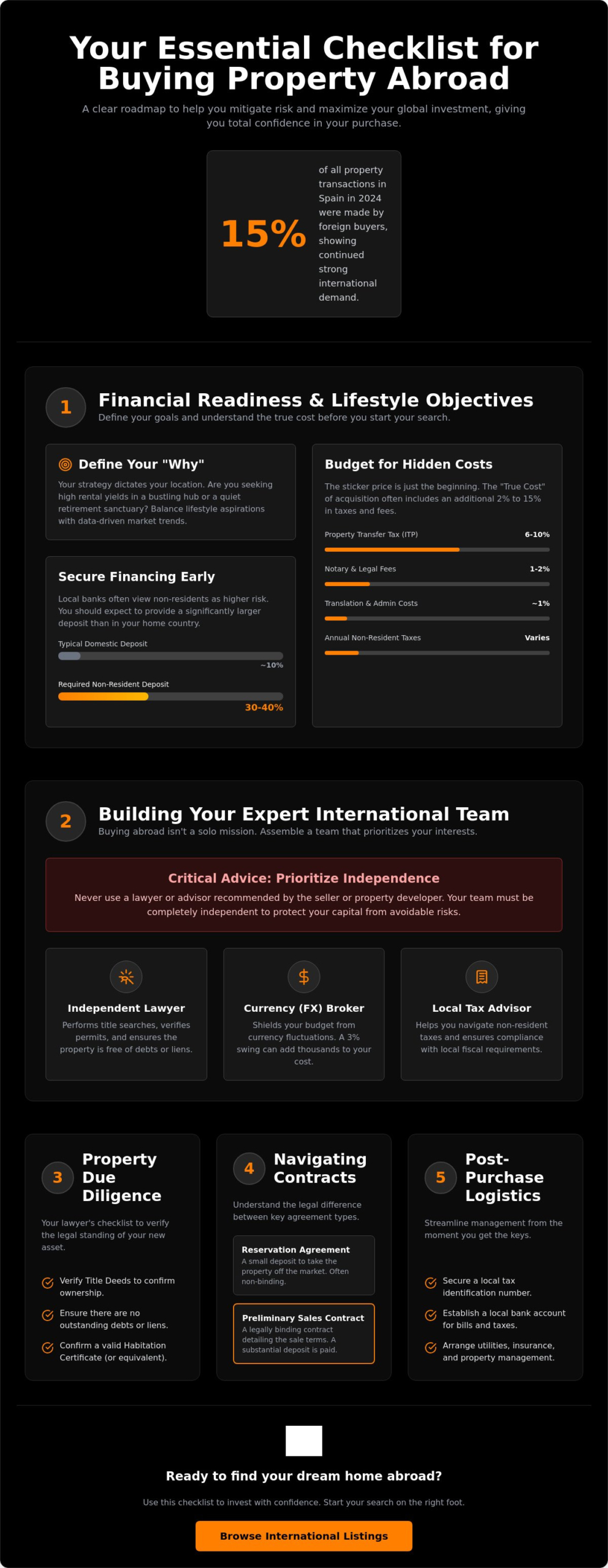
Did you know that foreign buyers represented 15% of all property transactions in Spain in 2024? Even with the 2025 abolition of the Golden Visa, investors are attracted by the long-term growth prospects and lifestyle appeal of international markets. You’re likely excited about the freedom of owning abroad, yet you’re probably worried about legal scams, language barriers, and shifting tax laws. This is why having a robust checklist for buying property in a foreign country is essential; buyers are increasingly looking for ways to secure their capital while browsing international property listings.
Our expert-led guide is designed to give you total confidence. It provides a clear roadmap to help you mitigate risk and maximize your global investment in 2026. We’ll walk you through everything from the Mexican bank trust system to the latest residency requirements in Portugal. By reviewing overseas real estate options, you’ll learn how to ensure financial transparency and legal security from the first search to the moment you hold the keys.
Key Takeaways
- Define your primary investment goals and calculate the total cost of acquisition to ensure your capital meets your long-term lifestyle or ROI objectives.
- Assemble an independent team of experts, including a local lawyer and an FX broker, to mitigate legal risks and maximize your purchasing power.
- Follow our comprehensive checklist for buying property in a foreign country to verify title deeds and secure the legal right to your new asset.
- Navigate the complexities of international contracts by understanding the legal differences between reservation agreements and binding preliminary sales.
- Streamline your post-purchase logistics by securing local tax identification and establishing bank accounts for seamless property management.
Phase 1: Financial Readiness and Lifestyle Objectives
Before you begin browsing overseas property for sale, you must define your “why.” Are you seeking high rental yields in a Mediterranean hub or a quiet retirement sanctuary in the tropics? Investors are attracted by emerging markets where capital growth outpaces domestic options, but your specific strategy dictates your location. A solid checklist for buying property in a foreign country starts with a cold, hard look at your liquidity and long-term objectives.
You also need a robust currency strategy. Markets move fast. A 3% swing in exchange rates can add thousands to your purchase price overnight. Establishing a relationship with a specialist currency broker early on can shield your budget from these fluctuations. Gaining a deep understanding international real estate dynamics helps you see beyond the aesthetic appeal to the financial reality of the transaction.
To better understand the nuances of land and property acquisition, watch this helpful video:
Defining Your Investment Horizon
Buyers are increasingly looking for locations that offer more than just sunshine. Accessibility is a major factor. Check for proximity to international airports and established expat infrastructure. If you’re looking for residency, research digital nomad visas or specific investment links that may have replaced older residency-by-investment schemes. Your investment horizon should balance lifestyle aspirations with data-driven global market trends to ensure a sound exit strategy when the time comes to sell.
The Hidden Costs of Buying Abroad
Don’t let the sticker price fool you. The “True Cost” of acquisition often includes local taxes ranging from 2% to 15% of the purchase price. For instance, in Spain, the Property Transfer Tax (ITP) for resale homes generally falls between 6% and 10% depending on the region. You should also budget for:
- Notary Fees: These are usually fixed percentages of the property value and are legally required in most civil law jurisdictions to formalize the sale.
- Translation Costs: You need every contract and legal document translated by a certified professional to ensure you aren’t signing away your rights.
- Non-Resident Taxes: Many countries levy an annual income tax on your property’s potential rental value, even if the home remains empty for part of the year.
Financing is another hurdle to clear early. Local banks often view non-residents as higher risk. Expect to provide a deposit of 30% to 40% rather than the 10% you might be used to in your home country. Verify these requirements with a local lender before you start your search to avoid disappointment during the negotiation phase.
Phase 2: Building Your Expert International Team
Buying a home abroad isn’t a solo mission. To succeed, you need a specialized support network that prioritizes your interests over the seller’s. Investors are attracted by the potential of foreign markets, but the most successful buyers are those who treat the acquisition like a business transaction. Your checklist for buying property in a foreign country must prioritize building a team of local experts before you even consider making an offer.
This team acts as your eyes and ears on the ground. They help you navigate unfamiliar legal systems and protect your capital from avoidable risks. If you haven’t started your search yet, you can browse overseas property for sale to identify markets where your budget aligns with your lifestyle goals.
The Importance of Independent Legal Counsel
Never use a lawyer recommended by the developer or the seller. You need an independent solicitor who is fluent in your language and understands the local property laws. Their job is to perform a comprehensive title search to ensure there are no outstanding debts, liens, or unpaid taxes attached to the property. They should also verify that the home has a valid Habitation Certificate, which proves the building meets local planning and safety standards. In many civil law jurisdictions, a Notary acts as a neutral government official who witnesses the signatures and ensures the transaction complies with national law.
Currency Specialists vs. Traditional Banks
High-street banks often charge exchange rate margins between 3% and 5%. By engaging a specialist Foreign Exchange (FX) broker, you can reduce these costs significantly, saving up to 4% compared to traditional bank rates. This is vital when transferring large sums for a property deposit or final payment. You should also ask your broker about forward contracts. These tools allow you to lock in an exchange rate for up to 12 months, protecting your budget from sudden currency fluctuations while you wait for the sale to close.
Beyond legal and financial experts, you should find a qualified local surveyor. They can identify structural issues, such as subsidence or damp, that aren’t apparent in glossy listing photos. Finally, consult a cross-border tax advisor. They will help you understand visa and residency requirements and how owning an asset abroad affects your tax liabilities in both your home and target country. Taking these steps ensures you have the legal security and financial transparency needed for a stress-free purchase.
Phase 3: The Property Due Diligence Checklist
After assembling your team, the focus shifts to the property itself. This is the most critical stage of your journey. You must verify every claim made by the seller or agent. A thorough checklist for buying property in a foreign country helps you avoid the common pitfalls of international acquisition, from illegal extensions to hidden communal debts.
- Verify the Title Deed: Known as the Escritura in Spain or Acte de Vente in France, this document confirms the seller has the absolute legal right to transfer the property to you.
- Confirm Planning Permissions: Ask for a “Certificate of No Infraction.” This ensures that any recent renovations or extensions were completed with the correct permits.
- Check Community Debts: In apartments or gated developments, ensure the current owner is up to date with community fees. Unpaid debts often transfer to the new owner.
- Investigate Zoning Laws: Don’t take a “permanent sea view” for granted. Check local plans to ensure your vista won’t be blocked by a new hotel or apartment block in two years.
- Review the Energy Performance Certificate (EPC): Buyers are increasingly looking for sustainable, energy-efficient assets to lower long-term running costs and improve future resale value.
Physical Inspections and Local Infrastructure
Don’t rely solely on professional photos. Visit the property at different times of the day. A quiet street at noon might become a noisy thoroughfare at night. You should also check the reliability of local infrastructure. For many, high-speed internet is no longer a luxury but a necessity for remote work potential. Look beyond the garden walls at the long-term “master plan” for the neighborhood; for instance, some investors use 3D printed architectural models from Protomolecule to visualize how new developments might impact their specific plot. New infrastructure projects like airports or train links can significantly boost your property’s value over time.
Legal and Administrative Verification
Before signing anything, confirm that all utility bills and local property taxes are paid in full. Your lawyer should ensure the property is registered correctly in the local Land Registry. Different countries have unique rules. For example, when looking at Italian homes for sale, you’ll encounter different historical preservation rules than when browsing property for sale in Spain. Investors are attracted by transparency, so ensure every administrative detail is documented and verified before proceeding to the contract stage.
Phase 4: Navigating the Transaction and Contracts
Once your due diligence is complete, you move into the legal commitment phase. This is where your checklist for buying property in a foreign country becomes a shield for your capital. You’ll encounter several layers of documentation, each designed to move you closer to ownership while defining the penalties for withdrawal. Understanding the weight of these signatures is vital to a stress-free acquisition.
- The Reservation Agreement: This initial document takes the property off the market for a set period, usually 15 to 30 days. You’ll pay a small reservation fee. Always verify if this deposit is refundable if your lawyer discovers legal issues later.
- The Preliminary Contract: Known as the Compromis de Vente in France or Arras in Spain, this is a binding commitment. It details the price, completion date, and any conditions that must be met.
- Cooling-Off Periods: Many jurisdictions offer a mandatory cooling-off period, typically between 7 and 14 days. This allows you to withdraw without penalty, but these rules vary significantly by country.
- The Completion Date: Ensure this date is realistic. International fund transfers and local bureaucracy can cause delays. Aim for a window that allows at least 10 working days for final banking clearances.
Comparison: Reservation vs. Preliminary Contracts
Investors are attracted by the structure of European property law, but the level of commitment changes drastically between the first and second signatures. In many European markets, the preliminary contract is the most critical legal step because it sets the terms of the sale in stone.
| Feature | Reservation Agreement | Preliminary Contract |
|---|---|---|
| Commitment Level | Low (Temporary hold) | High (Binding sale) |
| Typical Deposit | Fixed fee (€3,000 to €6,000) | 10% of purchase price |
| Refundability | Often conditional | Rarely refundable |
To protect your deposit, your lawyer should insert “Subject to Survey” or “Subject to Mortgage” clauses. These ensure that if a structural issue arises or your financing falls through, you can exit the deal with your funds intact. Buyers are increasingly looking for these protections to manage the risks of cross-border transactions.
The Final Signing and Fund Transfer
If you can’t be physically present for the final signing, you can use a Power of Attorney (POA). This legal document allows your lawyer to sign the deeds on your behalf. Confirm with your FX broker that funds will arrive in the local escrow account at least 48 hours before completion. Delays in currency delivery can result in heavy interest penalties or a breach of contract. Understanding global market trends helps you anticipate transaction speeds and banking requirements in your chosen territory.
Ready to take the next step in your journey? Browse international property listings to find your ideal investment today.
Phase 5: Post-Purchase Logistics and Management
Completion is a significant milestone, but your responsibilities as a global owner are just beginning. You’ve secured the keys, but now you must protect and manage the asset effectively. Finalizing your checklist for buying property in a foreign country requires a focus on fiscal compliance and long-term maintenance. Skipping these steps can lead to frozen bank accounts, service disconnections, or unexpected tax penalties.
First, register with the local tax authority to obtain your tax identification number. Whether it’s an NIE in Spain or a Fiscal Code in Italy, this number is essential for paying annual property taxes. You should also set up a local bank account immediately. Most utility providers only accept direct debits from domestic banks. This ensures your water, electricity, and internet services stay active while you aren’t physically present.
You should also draft a local will to cover your foreign asset. Your home-country will might not be sufficient or recognized by local probate courts, which could complicate matters for your heirs. If you plan to leave the property vacant for long periods, hire a reputable property management company. They can handle emergency repairs, monitor the property, and manage guest check-ins if you decide to enter the rental market. Furthermore, furnishing your new space with custom pieces from Revotica Matrac és Bútorgyár can help ensure your property is ready for immediate occupancy or high-end rental.
Maximising ROI and Market Demand
Investors are attracted by properties that offer “turnkey” management solutions. These services make your investment passive and highly scalable. Buyers are increasingly looking for properties with professional oversight to ensure the home remains in peak condition. Monitor local rental regulations closely, as many major tourist hubs are introducing stricter licensing requirements. If you eventually decide to sell your asset, you can learn how to advertise properties to reach a global audience of qualified buyers.
The 12-Month Review
Owning abroad is an ongoing commitment that requires an annual check-up. Perform a yearly tax audit to ensure all non-resident declarations are filed correctly with local authorities. It’s also wise to track your equity growth by comparing your home’s value against current international real estate listings. This data helps you decide the best time to renovate, refinance, or exit the market.
Finally, update your insurance policy every 12 months. Changes in occupancy, such as moving from personal use to short-term holiday rentals, can void your coverage if you don’t disclose them. Staying proactive ensures your international acquisition remains a source of wealth and freedom rather than a source of stress. By following this comprehensive roadmap, you’ve moved from a curious searcher to a savvy global property owner.
Secure Your Global Future Today
Owning property abroad is a transformative step that rewards those who prioritize preparation over impulse. By following our expert-led checklist for buying property in a foreign country, you’ve equipped yourself with the tools to navigate complex legal systems and volatile currency markets. You now recognize that a successful transaction depends on an independent team of experts and a commitment to verifying every administrative detail before signing your name.
Investors are attracted by the potential for high yields and personal freedom, but the most rewarding acquisitions are built on financial transparency. Whether you’re targeting a coastal villa in Spain or a modern apartment in Italy, your new roadmap ensures that your capital remains secure and your investment thrives in the global market. Success in 2026 relies on combining these lifestyle aspirations with grounded, practical investment logic.
Ready to start your journey? Browse the latest international real estate listings on HomesGoFast.com. Trusted by global buyers since 2002, we offer access to thousands of listings in over 50 countries. Our platform provides the global visibility and expert guides you need to master every major international market. The world is waiting; take the first step toward your international lifestyle with absolute confidence today.
Frequently Asked Questions
Do I need a local lawyer when buying property abroad?
Yes, you must appoint an independent local lawyer to protect your interests. They perform vital title searches and verify that the property is free of hidden debts or liens. Never use a lawyer recommended by the developer or seller, as they won’t provide the impartial oversight you need for a secure transaction.
How much extra should I budget for taxes and fees when buying a foreign home?
You should budget between 7% and 15% of the purchase price for closing costs. These fees vary by territory; for example, resale properties in Spain attract a transfer tax between 6% and 10%. In Portugal, the municipal tax can reach 8%, while additional notary and registration fees apply in almost every jurisdiction.
Can I get a mortgage in a foreign country as a non-resident?
Yes, many countries offer mortgages to non-residents, though you’ll typically need a larger deposit of 30% to 40%. In 2026, typical fixed interest rates for foreigners in Mexico range from 10.5% to 13.5%. Banks will require extensive documentation to prove your global income and creditworthiness before approving the loan.
What is the most common mistake when buying property in a foreign country?
The most frequent error is failing to use a comprehensive checklist for buying property in a foreign country to account for hidden costs. Many buyers focus only on the sticker price and ignore currency volatility or local tax liabilities. Investors are attracted by low prices but often lose their gains through poor financial planning or inadequate due diligence.
Is it safe to buy property “off-plan” from a developer?
It’s safe only if the developer provides a bank-backed guarantee for your stage payments. This insurance protects your funds if the developer goes bust or fails to complete the project on time. You must have your lawyer verify these guarantees and confirm that all planning permissions are in place before you pay a deposit.
How do I handle currency exchange for a large property purchase?
Use a specialist foreign exchange broker instead of a traditional high-street bank to save up to 4% on the transaction. Brokers offer forward contracts that let you lock in a specific exchange rate for future payments. This strategy protects your budget from sudden market swings while you’re waiting for the legal process to finish.
What happens if I buy a property and then the local laws change?
You’ll be subject to the new regulations, which is why monitoring market trends is essential. For instance, Spain officially abolished its Golden Visa program in April 2025, forcing buyers to pivot to digital nomad or non-lucrative visas. While you can’t always predict changes, having a local tax advisor helps you adapt to new fiscal or residency rules.
Do I need a local will for my overseas property?
Yes, drafting a local will is highly recommended to ensure your foreign asset is handled according to your wishes. Your home-country will may not be recognized by local probate courts, leading to lengthy legal delays for your heirs. A local will simplifies the inheritance process and ensures the property follows the specific succession laws of that jurisdiction.