

Did you know that global home sales are projected to climb by 14% in 2026? This surge isn’t just local; buyers are increasingly looking for opportunities beyond their own borders to secure better yields or a change of scenery. If you’ve been dreaming of a villa in Spain or a condo in Dubai, this guide to buying property abroad for beginners is designed to turn that aspiration into a concrete asset.
It’s natural to feel a bit overwhelmed by foreign legal systems, shifting currency rates, or the fear of hidden taxes that can eat into your budget. You want the freedom of an overseas home without the financial headache. We’re providing an expert framework that simplifies the entire process, from securing financing to navigating local regulations.
Investors are attracted by the stabilizing mortgage rates in Europe, which are settling between 3.5% and 4.5% this year. We’ll walk you through a clear, step-by-step roadmap that covers the total cost of ownership and the latest residency rules. By the end of this guide, you’ll have the confidence to contact international agents and make your first move in the global marketplace.
Key Takeaways
- Learn how the 2026 global mobility trend transforms international real estate into a strategic hedge against domestic market volatility.
- Understand the “Golden Rule” of hiring independent legal counsel and navigating the specific roles of notaries in different global jurisdictions.
- Discover how to balance lifestyle aspirations with rental yields by utilizing our framework for “test-living” in your target destination.
- Follow our comprehensive 5-step guide to buying property abroad for beginners to master everything from budgeting for hidden fees to final acquisition.
- Leverage established property advertising platforms to connect directly with verified local experts and explore a global inventory of listings.
Why Buying Property Abroad in 2026 is a Strategic Move
Buyers are increasingly looking for ways to protect their wealth from domestic inflation and market volatility. In 2026, international real estate serves as more than just a place to spend the summer; it’s a sophisticated hedge against localized economic downturns. By expanding your horizons, you’re not just buying bricks and mortar. You’re securing a foothold in a different economy. This guide to buying property abroad for beginners will show you how to align your personal dreams with a solid financial strategy.
To better understand this concept, watch this helpful video:
The Shift in Global Market Trends for 2026
Digital nomad visas have revolutionized buyer profiles across Europe and Latin America. Countries like Spain, Portugal, and Italy have established clear pathways for remote workers, which has stabilized coastal markets after the economic shifts of the mid-2020s. You’ll also notice a surge in sustainable developments. Buyers are prioritizing eco-conscious builds that reduce long-term utility costs and appeal to a more environmentally aware tenant base. You can explore these global market trends to see which regions are leading the way in 2026.
Diversifying Your Asset Portfolio Globally
Wealth protection often comes down to currency diversification. Owning a property valued in Euros or Dirhams protects you if your home currency fluctuates. A deep understanding international real estate involves looking at how different markets react to global pressures. For example, while domestic rental yields might be stagnant, emerging hotspots offer significantly higher returns. In Dubai, for instance, short-term rental yields can reach up to 12% in 2026, while Phuket offers similar potential for new developments.
Many buyers also view international acquisition as a “Plan B.” Whether through residency-by-investment programs or simply by establishing a legal footprint in another country, you gain a level of security that a single-market portfolio cannot provide. This guide to buying property abroad for beginners emphasizes that your investment should serve your future security as much as your current lifestyle. If you’re ready to start your search, browsing overseas property for sale is the first step toward building a truly global asset base.
Essential Legal and Financial Due Diligence for Beginners
The single most important rule in international real estate is simple: never use the seller’s lawyer. You need independent counsel whose only priority is protecting your interests. While a seller or developer might offer a “convenient” package deal that includes legal services, an independent solicitor ensures the title is clear and the contract is fair. This guide to buying property abroad for beginners emphasizes that your legal representative must be entirely separate from the selling party to avoid any conflict of interest.
Understand that the role of a notary varies significantly by jurisdiction. In Civil Law countries, such as those you’ll find when browsing French homes for sale, the notary is a public official. They witness the transaction and ensure the state gets its taxes, but they don’t necessarily advocate for you. Contrast this with Common Law systems where your personal lawyer handles the heavy lifting of due diligence. You should also commission a professional survey. It’s the only way to avoid buying a “money pit” with structural issues that aren’t visible during a casual walkthrough.
Never sign a document you don’t fully understand. Independent translation is a non-negotiable expense. Relying on a verbal summary from an agent isn’t enough when your life savings are at stake. Mastering the demands of buying a home abroad requires a commitment to checking every detail twice. Before you fly out for viewings, it’s a smart move to review international property listings to compare prices and ensure your budget is realistic for your chosen market.
Understanding Currency Fluctuations and Funding
Exchange rate volatility can make or break your budget. A mere 2% currency shift can add thousands to your final purchase price between the time your offer is accepted and the day of completion. Specialist currency brokers often provide significantly better rates than traditional banks for large international transfers. To mitigate risk, you might consider a “Forward Contract,” which is a financial tool that allows you to lock in a specific exchange rate for a future date to protect you from sudden market drops.
The Real Cost of Buying: Hidden Fees and Local Taxes
Calculate your total acquisition cost early. Transfer taxes vary wildly across borders; for instance, the Property Transfer Tax (ITP) in Spain ranges from 6% to 12% depending on the specific region. Don’t forget ongoing costs like non-resident property taxes and community maintenance fees. A vital tip for any guide to buying property abroad for beginners is to have your lawyer verify there are no outstanding utility debts on the property title, as these debts often stay with the building rather than the previous owner.
Selecting Your Destination: Lifestyle Appeal vs. Investment ROI
Choosing a location is where emotion meets economics. If you’re following this guide to buying property abroad for beginners, you must distinguish between a holiday spot and a viable asset. Are you looking for a retirement haven, a high-yield rental, or a renovation flip? Each goal requires a different lens. For example, a remote mountain village might offer peace for retirement, but it will likely fail the “Airport Rule.” Accessibility is the primary driver of rental demand and resale value. If it takes more than 90 minutes to reach your front door from a major hub, your pool of potential tenants and future buyers shrinks significantly.
Investors are increasingly attracted by secondary cities with high infrastructure growth, where entry prices are lower but capital appreciation potential is high. Before committing your capital, we recommend “test-living” in your target location during the off-season. A coastal town that feels vibrant in July can feel desolate and damp in January. Seeing the reality of local life helps you avoid making a choice based purely on vacation nostalgia. For additional security, consult the UK government guidance on buying property abroad to understand the broader legal and financial risks involved in different territories.
Spotlight on European Favourites: Italy, Spain, and Greece
Europe remains a powerhouse for international buyers. For those with a vision for restoration, Italian homes for sale offer enduring appeal, particularly in regions like Puglia or Sicily where renovation projects are still accessible. Meanwhile, Spain remains the top choice for expat infrastructure, offering a seamless blend of modern healthcare and established international communities. In the 2026 market, Greek homes for sale present a compelling value proposition, especially with the VAT suspension on new buildings continuing through December 31, 2026.
Assessing Expat Infrastructure and Community
Beyond the property itself, the surrounding ecosystem determines your quality of life and the home’s eventual resale value. Buyers are increasingly looking for locations that offer more than just a view; they want a functional lifestyle supported by reliable services. Consider these critical factors:
- Healthcare Quality: For retirees, proximity to high-standard medical facilities is a critical “hidden” factor that can impact long-term residency ease.
- Educational Facilities: If you’re targeting family-friendly zones, the presence of reputable international schools significantly boosts property demand and rental yields.
- The “Real” Story: Research expat forums and local social media groups. These platforms provide unvarnished insights into neighborhood safety, utility reliability, and community spirit.
Establishing these priorities early ensures your search is focused and productive. If you’re ready to compare different regions, browsing overseas property for sale will give you a realistic sense of what your budget can achieve in today’s market.
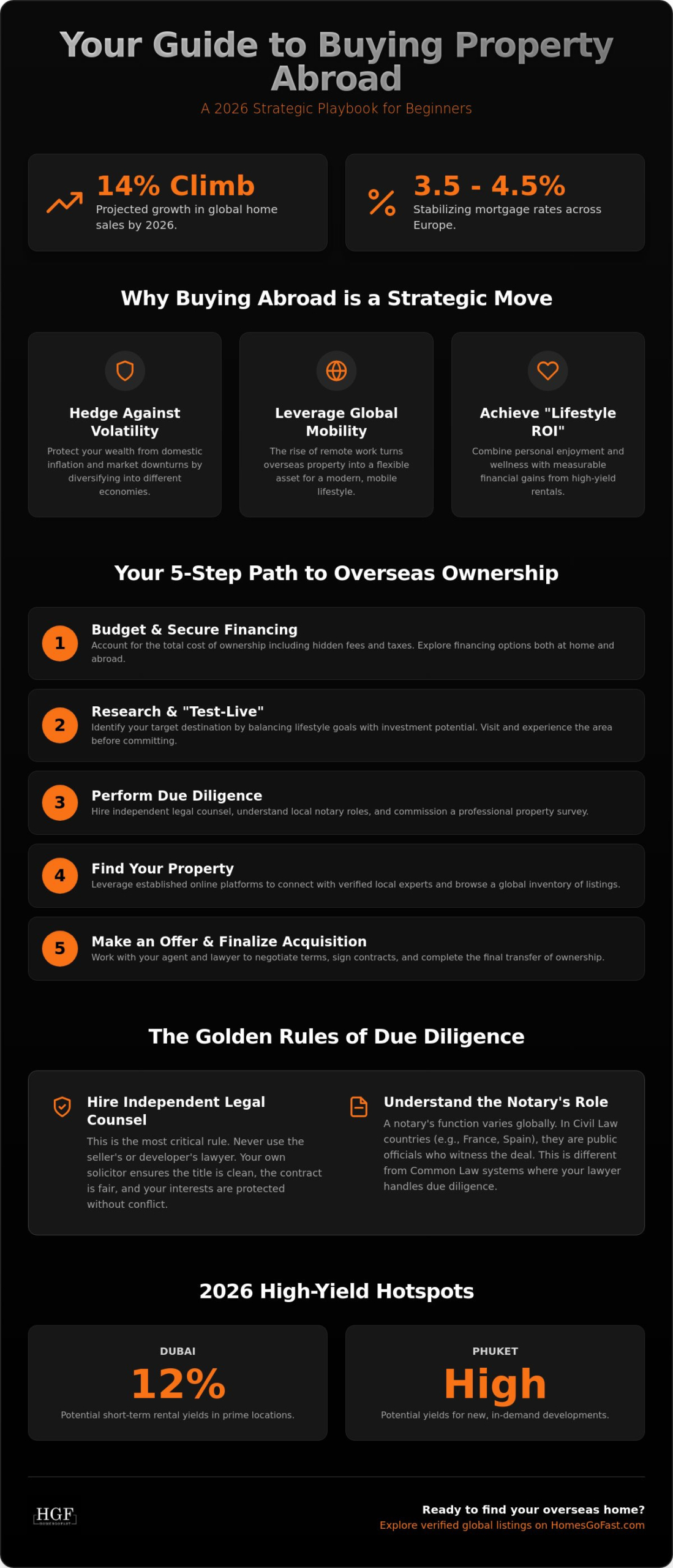
The 5-Step Process to Securing Your Overseas Home
Moving from the research phase to active acquisition requires a disciplined approach. This guide to buying property abroad for beginners breaks down the transition into five manageable stages. Following a structured framework helps you maintain control over your finances and prevents emotional decisions from clouding your investment logic. Investors are attracted by the efficiency of a well-planned purchase, ensuring that every dollar spent contributes to long-term value.
The sequence of your purchase typically follows this path:
- Step 1: Define Your Real Budget. Never look at the sticker price alone. You must include an 8% to 12% buffer for transfer taxes, notary fees, and legal costs. This ensures you aren’t caught short during the final stages of the transaction.
- Step 2: Narrow Your Search. Use established international real estate listings to filter properties by your specific criteria. This stage is about quality over quantity; aim for a shortlist of five to seven high-potential homes.
- Step 3: Conduct a Targeted Viewing Trip. Fly out with a pre-vetted list and a clear itinerary. Spend time in the neighborhood at different times of day to verify the “Lifestyle ROI” mentioned earlier.
- Step 4: Make an Offer and Sign the Preliminary Agreement. Once you’ve negotiated the price, you’ll sign a “Reservation Contract.” This document usually requires a small deposit to take the property off the market while your lawyer completes the final due diligence.
- Step 5: Completion and Title Deed Transfer. This is the final “Escrow” or Notary phase. You’ll sign the final deed, pay the remaining balance, and receive the keys to your new international asset.
Navigating Local Customs and Negotiations
The “asking price” is rarely a fixed number, but its flexibility depends on local culture. In France, for example, prices are often more firm than in the USA or parts of Latin America. Buyers are increasingly looking for local agents to bridge these cultural gaps. An experienced agent understands the nuances of price haggling in their specific territory. Remember that in many markets, a verbal offer is not legally binding until a written contract is signed and a deposit is paid.
Closing the Deal and Post-Purchase Logistics
Preparation for closing starts weeks before the final signature. You’ll need to obtain a local tax ID number early. For example, if you’re buying in Spain, you’ll need an NIE number before you can finalize any contract. Setting up a local bank account is also essential for managing future utility bill direct debits and local taxes. For a detailed deep-dive into the finer points of the search phase, refer to The Ultimate Checklist for Navigating International Real Estate Listings in 2026.
Ready to move from planning to action? You can browse thousands of homes for sale worldwide to find the perfect match for your 2026 investment goals.
Navigating Global Listings with HomesGoFast
Having a roadmap is essential, but you also need the right tools to execute your plan. This guide to buying property abroad for beginners concludes with how to effectively use international portals to find your ideal home. HomesGoFast acts as a vital bridge, connecting you directly with professional agents and private sellers across more than 50 countries. Instead of searching dozens of local sites in a foreign language, you can view thousands of overseas property listings in one centralized, easy-to-navigate location.
One of the most significant advantages for a first-time buyer is the “Agent Pro” network. This feature provides access to verified local experts who understand the specific regulations of their territory. These professionals act as your eyes and ears on the ground, helping you navigate the complexities we discussed earlier, such as local tax IDs or community fees. To stay ahead of the competition, we recommend setting up “Property Alerts.” In high-demand markets, the best opportunities often move quickly; being the first to know about a new listing in a secondary city or a coastal hotspot gives you a distinct advantage.
How to Filter for Quality in International Portals
In a global marketplace, the quality of a listing tells you a lot about the professionalism of the seller. Buyers are increasingly looking for transparency, so prioritize listings that feature high-quality photography and comprehensive descriptions. If a listing is vague, use the “Contact Agent” feature immediately to ask specific questions about zoning, title status, and whether the property has any outstanding debts. It’s also wise to cross-reference portal data with current global market trends to ensure the price point aligns with the broader regional economy.
Your Next Steps: From Research to Reality
Your journey from dreamer to international property owner starts with a single search. Now that you understand the legal safeguards, the financial risks, and the 5-step acquisition process, you have the framework needed to move forward with confidence. The transition from research to reality happens the moment you start engaging with the market and comparing live opportunities. Investors are attracted by the clarity of data, and there’s no substitute for seeing what your budget can actually buy in 2026.
Ready to explore? Browse our latest international listings here and start narrowing down your shortlist. A final piece of advice from a seasoned advisor: the best time to buy was ten years ago; the second best time is today. Don’t let the complexity of the global market stall your progress. With the right guidance and a reliable platform, your dream of owning a home abroad is well within reach.
Secure Your Global Future Today
Success in international real estate isn’t about luck; it’s about aligning your lifestyle goals with a rigorous financial strategy. You’ve now seen how to navigate legal due diligence, identify high-growth destinations, and execute a secure 5-step purchase process. This guide to buying property abroad for beginners has given you the framework to move from research to active acquisition with total confidence.
Since 2002, we’ve been connecting buyers and sellers across borders with a commitment to transparency and efficiency. Our global network of professional Agent Pro members provides the grounded, local expertise needed to navigate 2026’s market trends. With over 20 years of international real estate expertise, we’re here to help you bridge the gap between a dream and a deed.
Ready to take the next step? Explore thousands of overseas properties for sale on HomesGoFast and start your search today. The global market is moving fast, and there’s never been a better time to secure your perfect overseas home.
Frequently Asked Questions
Is it safe to buy property abroad as a beginner?
Yes, it’s safe if you follow a strict due diligence process and prioritize transparency. This guide to buying property abroad for beginners emphasizes that safety comes from hiring your own independent legal counsel and using established platforms to find verified listings. Never bypass local regulations or skip structural surveys, as these safeguards are your primary defense against fraud or “money pit” investments.
Can I get a mortgage for an overseas property purchase in 2026?
Yes, international mortgages are widely available in 2026, though terms differ from domestic loans. In Europe, you can expect rates between 3.5% and 4.5% for a 20-year term. If you’re looking at the United States, foreign national rates typically range from 6.73% to 7.23%. Be prepared for higher down payments of 25% to 30%, as lenders view non-resident loans as higher risk.
What are the most common mistakes beginners make when buying abroad?
The most frequent error is using the seller’s lawyer instead of independent counsel. Beginners also often fail to calculate the total cost of acquisition, ignoring the 8% to 12% buffer needed for taxes and fees. Other pitfalls include ignoring currency fluctuation risks and making a purchase based on a “holiday feeling” without researching local infrastructure or long-term rental demand.
Do I need to speak the local language to buy a house overseas?
You don’t need to be fluent, but you must have every legal document professionally translated. Never rely on a verbal summary from a real estate agent or a seller. Hiring an independent, bilingual lawyer is the best way to ensure you understand the fine print of your contract. This ensures that you’re fully aware of your obligations and rights before any money changes hands.
How much extra should I budget for taxes and legal fees?
You should budget between 8% and 12% of the purchase price for closing costs. These fees vary significantly by territory. For example, Germany’s transfer tax and notary fees total about 7.5%, while Spain’s transfer tax can range from 6% to 12% depending on the region. Always ask your lawyer for a complete breakdown of “Transfer Taxes” and annual non-resident property taxes before signing.
What is the “Golden Visa” and does it apply to my purchase?
A Golden Visa is a residency-by-investment program, but rules have tightened in 2026. In Greece, the minimum investment is now €250,000 for specific projects, rising to €800,000 in high-demand zones like Athens. Notably, Portugal no longer offers a real estate path for its Golden Visa. This guide to buying property abroad for beginners recommends checking the latest 2026 thresholds for your chosen country.
How do I verify that a foreign property seller actually owns the title deeds?
Your independent lawyer must conduct a formal title search through the local land registry or cadastre. This process confirms the seller’s legal right to sell and reveals if there are any outstanding debts, liens, or hidden “foreigner taxes” attached to the property. In many jurisdictions, debts stay with the property rather than the owner, making this verification step critical for your financial safety.