

How do you convince a buyer on the other side of the world to send a deposit for a property they have never physically visited? It’s the central challenge in a market where international property transactions in the U.S. recently surged to over 78,000 homes in a single year. You likely recognize the frustration of watching high-quality leads vanish because of “scam” perceptions or cultural barriers. In 2026, building trust with overseas property buyers requires more than just a good listing; it demands a strategy rooted in radical transparency and expert guidance.
Investors are attracted by the promise of global assets, but they’re also increasingly looking for sellers who understand the complexities of cross-border finance. Whether you’re navigating the 15% FIRPTA withholding rate in the U.S. or explaining the 60-day reporting deadlines for UK residential sales, your role is to act as a savvy mentor. We agree that the traditional sales pitch is no longer enough to satisfy today’s analytical, risk-averse buyer who prioritizes legal stability and financial clarity.
This article promises to equip you with the psychological frameworks and practical tools needed to convert skeptical leads into confident owners. You’ll learn how to shorten your sales cycle and build a referral-heavy client base by mastering the technical details that buyers are often afraid to ask about. We’ll break down everything from current Spanish mortgage rates to the latest ownership restrictions, ensuring you stay ahead of the curve in this competitive global marketplace.
Key Takeaways
- Identify the specific psychological triggers behind “Cross-Border Anxiety” and learn how to pivot from selling a lifestyle dream to providing tangible financial security.
- Discover why building trust with overseas property buyers requires a “Radical Transparency” model that addresses potential property flaws before the buyer even asks.
- Learn to navigate complex legal and financial objections by positioning yourself as a resourceful connector to independent, professional local experts.
- Shorten your sales cycle by applying the “Golden Hour” rule for lead response and using video tools to build a personal connection across borders.
- Leverage the global visibility and 20-year history of established listing platforms to provide the third-party verification that international investors demand.
The Psychology of the International Property Buyer in 2026
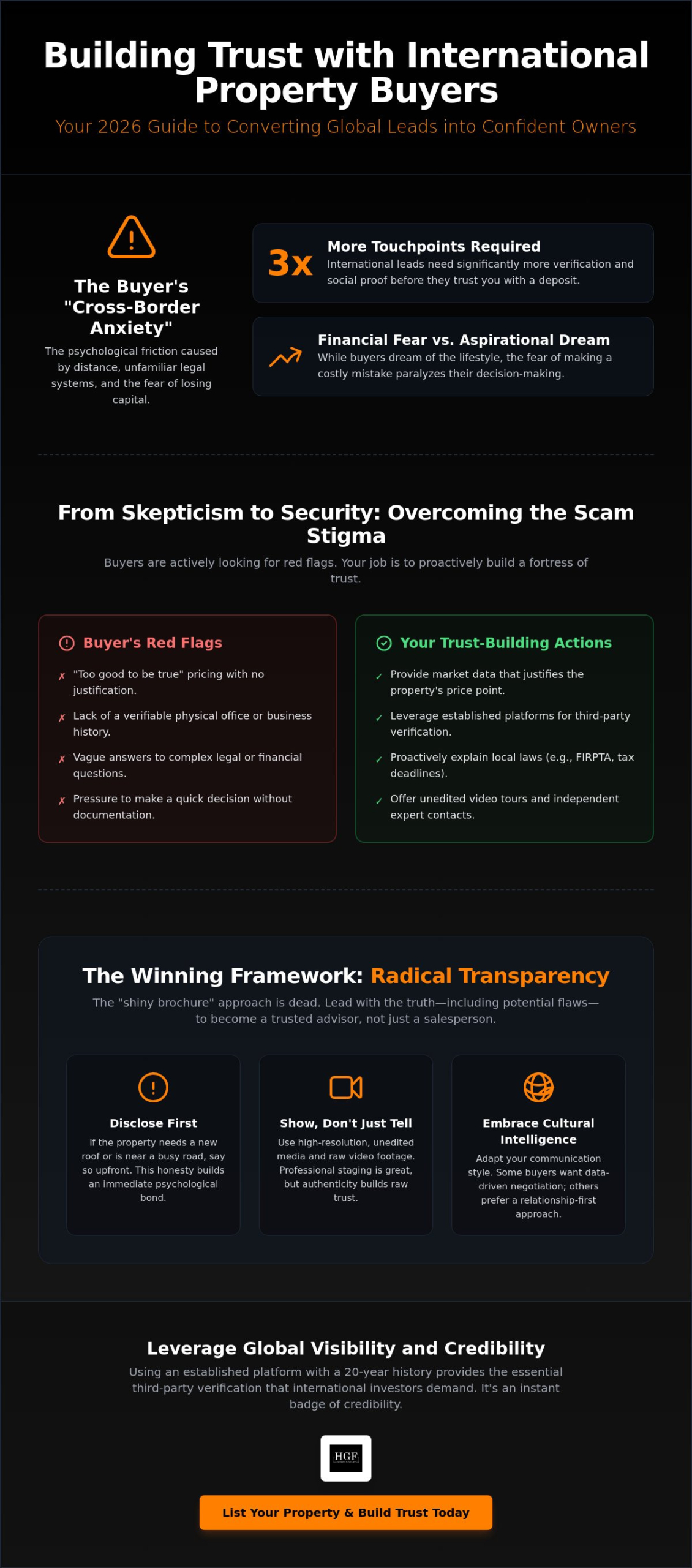
In 2026, the international real estate market is defined by “Cross-Border Anxiety.” This is the psychological friction caused by distance, unfamiliar legal systems, and the fear of losing capital. While the “Aspirational Dream” of owning a villa or a city penthouse remains strong, the “Financial Fear” of making a mistake often paralyzes decision-making. You must bridge this gap to succeed. Buyers aren’t just looking for a home; they’re looking for a safe harbor for their wealth.
Research suggests that international leads require three times more touchpoints than local buyers. This is because they aren’t just buying a property; they’re buying into a system they don’t fully trust yet. Understanding global property market dynamics helps you see why they demand so much social proof. They need to see that you are a verified professional before they’ll even consider a viewing. Your track record is now as important as the listing itself.
To better understand how to manage these relationships and expectations, watch this helpful video:
Overcoming the Scam Stigma
Buyers are increasingly looking for reasons to say no because they’ve been taught to avoid common international real estate red flags. These include “too good to be true” pricing, lack of a physical office presence, or vague business histories. You can de-escalate these fears by proactively providing market data that justifies your price point. When you sell overseas property through established platforms, you benefit from their third-party verification. This acts as a badge of credibility that reduces the perceived risk of a “phantom” listing. Transparency here is the fastest way of building trust with overseas property buyers.
The Role of Cultural Intelligence (CQ)
Investors are attracted by regions where sellers respect local customs and communication styles. Cultural Intelligence means moving beyond generic travel-blog fluff and offering high-value market insights instead. For example, some buyers might expect a direct, data-driven negotiation, while others prioritize a relationship-first approach. Adapting your communication style to match these regional expectations shows that you are a seasoned global expert. You can explore global market trends to stay informed on how different regions are currently behaving in the 2026 market. Avoid robotic jargon and focus on providing realistic ROI projections that reflect the current economic climate.
Radical Transparency as a Marketing Framework
In the 2026 market, the “shiny brochure” approach is dead. Buyers are smarter, more skeptical, and have access to more data than ever before. Radical Transparency is a marketing framework where you lead with the truth, including the potential downsides. If a property needs a new roof or is located near a busy road, say so. This honesty creates an immediate psychological bond. It proves you aren’t just a salesperson; you’re a smart advisor. When you use international real estate listings to provide full disclosure, you filter out mismatched leads and focus on serious investors.
High-resolution, unedited media is your best tool here. Professional staging is great, but raw video footage builds raw trust. Investors are often looking for “safe haven” assets, and they use international buyer trends to benchmark their decisions. By providing unedited media alongside “Investor ROI” tables, you validate your lifestyle claims with hard data. This approach is the cornerstone of building trust with overseas property buyers who cannot visit in person.
Virtual Tours and Live Video Verification
By 2026, 3D walkthroughs have become the baseline for international transactions. You can’t expect a buyer to move forward without a digital sense of space. However, to truly stand out, offer live video verification. Walk out the front door and show the street. Show the neighbor’s house. Show the local grocery store. This “neighborhood reality” de-escalates the fear of the unknown. Highlighting potential renovation needs upfront actually reduces “Buyer’s Remorse” later. It sets a realistic expectation that builds long-term credibility.
Data-Driven Listing Descriptions
Stop using generic adjectives like “stunning” or “beautiful.” Replace them with proximity data. Mention exactly how many minutes it takes to reach the nearest international airport, hospital, or expat hub. Investors are attracted by growth prospects, so include historical price trends for the area. You should also craft a “Property Fact File.” This document should list estimated utility costs, local property taxes, and any community fees. This level of detail makes it easier for buyers to run their numbers. If you are ready to reach a global audience with this level of transparency, you can advertise properties on a platform designed for international visibility.
Navigating the Legal and Financial Objections
The most common reason for a deal to collapse isn’t the property itself; it’s the legal fog surrounding it. When a lead says, “I don’t understand the local legal system,” they’re actually expressing a fear of being exploited. You don’t need to be a lawyer to solve this. Instead, position yourself as a connector. By introducing buyers to independent, reputable legal experts, you remove the “conflict of interest” barrier. This proactive step is vital for building trust with overseas property buyers who feel vulnerable in a foreign market.
Buyers are increasingly looking for more than just a house; they want a path to residency or tax efficiency. Investors are attracted by incentives like “Golden Visas” in Spain or Portugal, or the Non-Habitual Residency (NHR) schemes that offer significant lifestyle freedom. Explaining these rules simply helps the buyer see the property as a strategic move rather than just a purchase. To help them visualize the total investment, always provide a clear “Cost of Acquisition” breakdown.
| Expense Category | Typical Range / Context |
|---|---|
| Notary & Registration | 1% to 2.5% of the purchase price |
| Transfer Tax / VAT | 6% to 10% depending on the territory |
| Legal Fees | 1% to 1.5% for independent counsel |
| Currency Exchange Fees | 0.5% to 3% (Specialist vs. High-street bank) |
The ‘Smart Advisor’ Approach to Taxes
Taxation is often the elephant in the room. You can demonstrate your expertise by referencing the nuances of capital gains tax on sale of property early in the conversation. For example, UK residents selling overseas assets should know they face CGT rates of 18% or 24% depending on their income band. Explaining local property taxes without scaring the investor involves focusing on the net ROI. Mentioning the benefits of different ownership structures, such as using an LLC versus personal ownership, shows you understand the practical reality of making a sound financial decision.
Currency and Transaction Security
Currency volatility can change the final purchase price by thousands overnight. Recommend secure escrow services to protect the buyer’s deposit and suggest specialist currency firms to hedge against these fluctuations. Transparency in the “Proof of Funds” process isn’t just a legal requirement; it’s a two-way street that builds mutual respect. When you’re ready to showcase your property to a global audience, you can advertise properties on platforms that buyers already trust for their security and established history.
Communication Strategies for Cross-Border Nurturing
The “Golden Hour” rule is the bedrock of international sales. In 2026, responding to a lead within 60 minutes isn’t just polite; it’s vital for building trust with overseas property buyers. When a buyer in New York enquires about a property in London, they’re likely browsing multiple portals at once. The first professional to provide a high-value response instantly becomes the most reliable partner. If you wait 24 hours, the momentum dies. That “Cross-Border Anxiety” we discussed earlier starts to creep back in.
Use WhatsApp and video messaging to humanize the transaction. A quick, personalized video showing your face and the property entrance bridges thousands of miles in seconds. It moves the relationship from a cold email thread to a personal connection. To manage time-zone differences, set clear expectations in your initial reply. State your local time and when they can expect a follow-up. This transparency prevents the buyer from feeling ignored during your off-hours.
Transition your leads into a “Smart Advisor” email sequence. Instead of a relentless sales pitch, send high-value insights about market demand, local infrastructure, or residency rules. This approach positions you as a mentor rather than a salesperson. Investors are attracted by sellers who provide the data they need to make a sound financial decision without the pressure of a “hard sell.”
Multilingual Support and Translation
AI translation tools are excellent for initial property enquiries, but they have limits. They help you understand the buyer’s intent, but providing final legal documents in the buyer’s native tongue is a non-negotiable trust factor. If you’re marketing French homes for sale or properties in other Mediterranean hotspots, partnering with bilingual agents can bridge the cultural gap. It ensures that nuances in the contract aren’t lost in translation.
Post-Enquiry Nurturing
Nurturing doesn’t end with a “thank you” email. Provide “Local Living” guides that cover schools, healthcare, and expat hubs. Sharing testimonials from other international buyers who successfully closed deals adds essential social proof. This is a powerful method of building trust with overseas property buyers. You can also take a for sale by owner approach to add a personal, trustworthy touch to the negotiation. This direct connection often feels more authentic to a skeptical buyer than a corporate middleman.
If you want to start generating high-quality leads today, you can advertise properties on our global network.
Leveraging HomesGoFast for Global Credibility
Brand tenure is a silent but powerful closer in the 2026 real estate market. Buyers are increasingly looking for properties listed on established, 20+ year platforms because they offer a layer of security that newer, unverified sites lack. When you list your property on a portal with a history dating back to 2002, you aren’t just buying an ad; you’re borrowing two decades of brand equity. This established presence is a shortcut to building trust with overseas property buyers who may feel hesitant about local agencies they’ve never heard of.
A global portal acts as a “verified third party” for your listing. It provides a neutral environment where buyers can compare assets without feeling the direct pressure of a sales pitch. By utilizing an Agent Pro Account, you gain the tools needed to manage these international leads with professional efficiency. “Featured” placements also play a psychological role. They signal market demand and authority, showing buyers that your property is a high-priority asset in a competitive landscape.
The Power of Global Visibility
Listing on a London-based platform provides a unique “halo effect” of trust. Even for properties in emerging markets, being discoverable on a reputable UK portal suggests a level of vetting and international standard. This visibility allows you to reach a diverse audience across Spain, Italy, and other high-demand regions. Multilingual SEO ensures your property is discoverable in the buyer’s native language, which instantly makes the listing feel more credible and accessible. Investors are attracted by this ease of discovery and the professional presentation it implies.
Your Next Steps as a Global Seller
Before you launch your next campaign, conduct a final “Trust-Ready” audit for 2026. Does your listing provide the data-heavy descriptions and unedited media we’ve discussed? Are you prepared to respond within the “Golden Hour”? Success in the international market is about reducing friction and proving reliability at every touchpoint. If you’ve followed the frameworks in this guide, you’re already ahead of the competition. Building trust with overseas property buyers is a measurable process that rewards transparency and efficiency.
- Verify all proximity data (airports, hospitals, schools).
- Prepare your “Property Fact File” with utility and tax estimates.
- Ensure your contact details are updated for WhatsApp and video calls.
- Select your “Featured” placement to maximize initial momentum.
The rewards of the international market are vast, offering access to capital and buyers that local markets simply cannot match. If you are ready to reach a global audience, you can advertise properties on a platform that buyers have trusted for over twenty years. Start your journey as a smart advisor today and turn skeptical international leads into confident property owners.
Master the Global Marketplace in 2026
Success in the international arena depends on your ability to pivot from a salesperson to a trusted mentor. You now have the framework to replace buyer anxiety with financial confidence. By embracing radical transparency, mastering the “Golden Hour” response, and positioning yourself as a connector to legal experts, you remove the friction that often stalls cross-border transactions. Building trust with overseas property buyers is no longer a mystery; it’s a strategic process of providing the right data at the right time.
The next step is to put your property in front of the right eyes. Ready to reach a global audience? List your property on HomesGoFast today. We’ve been an industry leader since 2002, bringing over two decades of international real estate expertise to your listing. Our network of multilingual portals reaches active buyers in over 50 countries, and we’re trusted by professional agents and private sellers worldwide for reliable lead generation.
The global market is expanding, and buyers are looking for the grounded reliability you can now provide. Start your journey today and watch your international network grow.
Frequently Asked Questions
How can I verify a property seller is legitimate when buying overseas?
You can verify a seller’s legitimacy by checking their business registration, physical office location, and tenure on established property portals. Buyers are increasingly looking for sellers who provide third-party verification through platforms with a long history. Always cross-reference the seller’s details with local professional bodies or real estate associations to ensure they’re licensed to operate in that specific territory.
What are the most common scams in international real estate to watch out for?
The most common scams include “phantom listings” where the property doesn’t exist and duplicate listings with fake contact details. Another red flag is a seller who pressures you for a deposit via untraceable payment methods before a contract is signed. building trust with overseas property buyers requires avoiding these tactics and using secure escrow services to protect all parties during the transaction.
Should I use a local lawyer or one from my home country for an overseas purchase?
You should always hire a local lawyer who is independent of the seller or agent. While your home country lawyer understands your needs, they won’t have the specific expertise required to navigate foreign land registries or local tax codes. A local expert ensures the title is clear and that all local ownership rules are followed, providing the grounded reliability needed for a secure purchase.
How do I handle currency exchange when paying for a property abroad?
Handle currency exchange by using a specialist currency broker rather than a traditional high-street bank. Banks often charge higher fees and offer less competitive exchange rates, which can add thousands to your final purchase price. Specialist brokers allow you to fix a rate in advance, protecting you from volatility while you wait for the legal paperwork to complete.
Is it safe to buy a property ‘sight unseen’ using virtual tours?
It is safe to buy sight unseen only if you supplement virtual tours with live video verification and an independent surveyor’s report. Investors are attracted by the efficiency of digital walkthroughs, but they must see the “neighborhood reality” via a live call. This dual approach is a powerful tool for building trust with overseas property buyers who cannot travel but want to ensure the property’s condition.
What extra costs should I budget for when buying property in Europe or the Caribbean?
You should budget between 10% and 15% of the purchase price for extra costs like transfer taxes, notary fees, and legal registration. In Europe, taxes vary significantly by country; for example, Spain’s ITP tax can reach 10%. In the Caribbean, you might also face “Alien Landholding Licenses” which require additional fees and background checks before the sale can be finalized.
How does the ‘Golden Visa’ process work for property investors?
The Golden Visa process allows non-residents to gain residency by meeting a specific investment threshold, often starting around €500,000 in countries like Spain. Once you purchase a qualifying property, you apply through the local consulate with proof of investment and a clean criminal record. This pathway offers lifestyle freedom and a potential route to permanent residency or citizenship after a set number of years.
Can I get a mortgage for an overseas property as a non-resident?
Non-residents can obtain mortgages in many foreign markets, though Loan-to-Value (LTV) ratios are typically capped at 60% to 70%. Lenders will require extensive documentation, including proof of income, tax returns, and bank statements from your home country. Be prepared for slightly higher interest rates compared to local residents, as banks view international lending as a higher risk category.