What if your local acreage was the missing piece for a billion-dollar global portfolio? Learning how to sell land to international developers is no longer just about placing a listing; it’s about translating your property’s potential into the language of global ROI. Investors are increasingly looking for “execution certainty,” and positioning your land as a low-risk, high-reward asset is the secret to unlocking overseas capital.
You likely recognize the immense value of your land but feel frustrated by the lack of access to institutional buyers. It’s common to feel overwhelmed by foreign legal requirements or uncertain about how to price your acreage for a competitive global market. We understand that bridging the gap between local ownership and international property listings can feel like a significant hurdle without the right guidance.
This guide will help you master the complexities of cross-border transactions and learn how to position your land to attract reputable global firms. We’ll explore the “shovel-ready” standards they demand, how to craft a high-impact development pack, and how to manage the financial closing process with confidence. By the end, you’ll know exactly how to advertise properties to reach high-paying buyers across the globe.
Key Takeaways
- Master the art of how to sell land to international developers by positioning your asset as a high-yield opportunity that satisfies the surging global demand for infrastructure and data centers.
- Learn why achieving the “Shovel-Ready” standard is the key to commanding a premium price, ensuring your land has the utility access and clear titles that global firms require.
- Discover how to shift your marketing strategy from simple photos to ROI-driven data that speaks the language of international finance and attracts serious institutional buyers.
- Find out how to build a professional “Development Pack,” including feasibility studies and executive summaries that prove execution certainty to foreign investors.
- Navigate the complexities of cross-border closings by using secure escrow services and managing currency risks to protect your profits during long transaction periods.
The Strategic Advantage of Targeting International Developers in 2026
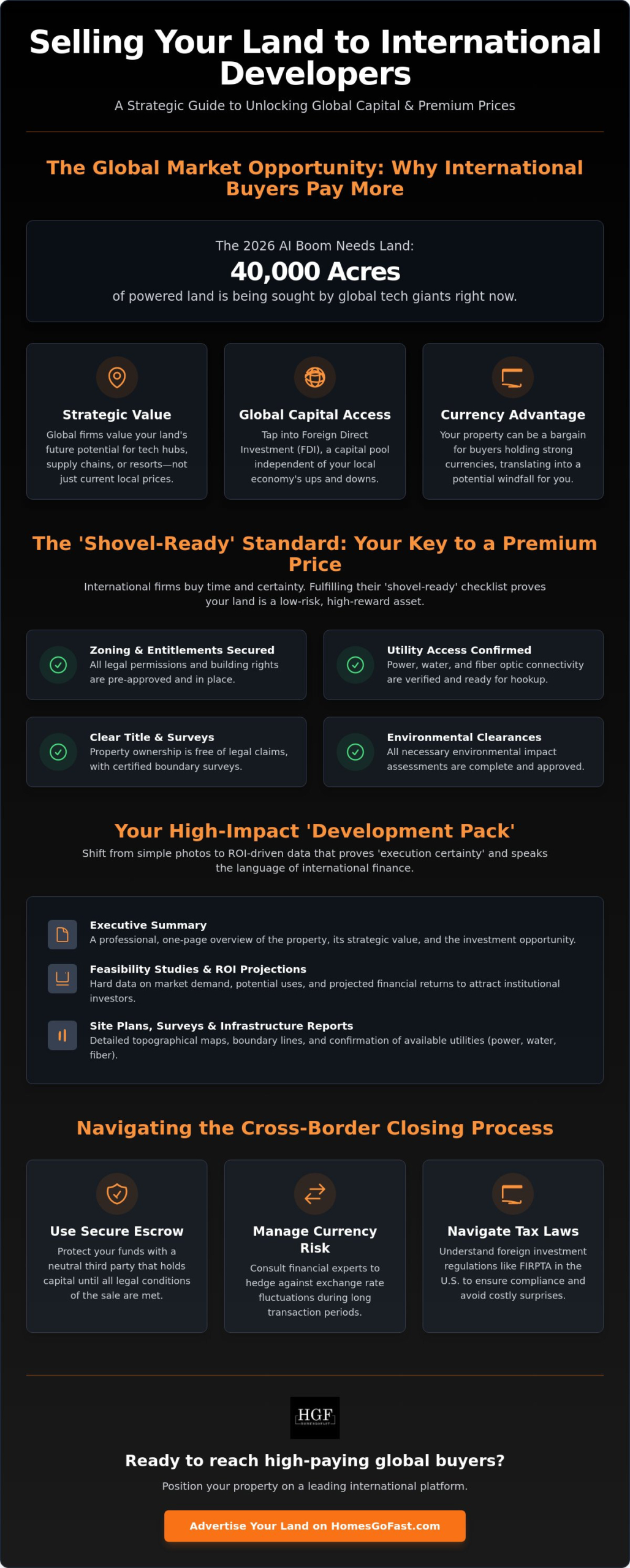
The global land market has undergone a massive shift. Institutional capital is flowing across borders at an unprecedented rate, driven by a need for scale that local markets often can’t provide. Understanding how to sell land to international developers requires you to look beyond your local fence line. These firms aren’t just buying dirt; they’re buying future capacity. For example, global tech giants are currently hunting for an estimated 40,000 acres of powered land to support the 2026 AI boom. If your acreage sits near a power grid or fiber optic line, you aren’t just a landowner; you’re a strategic partner in global infrastructure.
This influx is largely powered by Foreign Direct Investment (FDI). When you sell to an overseas firm, you’re tapping into a pool of capital that isn’t tied to your local economy’s fluctuations. It’s a win for you because you can often bypass local price ceilings. While a local builder might offer you a price based on the current neighborhood average, an international firm sees “strategic value.” They might be looking for a foothold for a global supply chain, a luxury resort brand, or a massive 2026 tech hub. This global perspective changes the valuation logic entirely, shifting the focus from “what is it worth now” to “what is it worth to a global portfolio.”
To better understand this concept, watch this helpful video:
Why International Buyers Often Pay a Premium
Currency plays a huge role in these transactions. If your buyer is holding a strong currency, your land might look like a bargain to them while the payout feels like a windfall to you. Investors are attracted by strategic positioning. They want land near transport hubs, coastlines, or established expat communities that offer long-term lifestyle appeal. Unlike local builders who need a quick flip, global firms often practice “land banking.” They have the capital to hold assets for decades. This means they’re less sensitive to temporary interest rate hikes and more focused on securing prime locations before they disappear.
The 2026 Global Land Market Outlook
Buyers are increasingly looking for “Green Development” opportunities. Sustainable land use is no longer a niche; it’s a core requirement for institutional funds. We’re seeing a massive influx of capital from Canada and the Netherlands into diverse territories, seeking land that can support eco-tourism or renewable energy projects. You must remain aware of the legal landscape, though. For instance, the U.S. Foreign Investment in Real Property Tax Act (FIRPTA) imposes specific withholding rules on foreign sellers that can catch the unprepared off guard. Staying updated on global market trends is essential if you want to sell overseas property at the highest possible valuation.
What International Developers Look for: The ‘Shovel-Ready’ Standard
Developers aren’t just buying soil; they’re buying time. In the global market, “shovel-ready” is the gold standard for execution certainty. When you understand how to sell land to international developers, you realize they prioritize projects where the administrative heavy lifting is already finished. Buyers are increasingly looking for sites where they can break ground within months, not years.
To help you understand the value gap, consider how readiness levels impact your asking price. Investors are attracted by low-risk entries, and the following table illustrates why documentation is worth the investment:
| Development Status | Investor Risk | Strategic Value |
|---|---|---|
| Raw Land (Unzoned) | High | Base Market Rate |
| Entitled (Zoning Approved) | Medium | 1.5x – 2x Premium |
| Shovel-Ready (Permits in Place) | Low | 3x+ Strategic Premium |
A clear, unencumbered title is your most powerful tool. Foreign firms must answer to institutional auditors and won’t risk capital on land with messy liens or historical disputes. To align with their expectations, you should use key development land valuation terms to justify your price. This professional transparency builds immediate trust across borders.
The Due Diligence Checklist for Global Firms
Global firms often follow stricter ESG (Environmental, Social, and Governance) mandates than local builders. Your development pack must include environmental impact assessments and soil testing. These technical reports prove the land can support high-density residential units or industrial infrastructure without hidden costs. Providing this data upfront reduces the developer’s due diligence timeline and reinforces your position as a savvy partner.
Zoning and Land Use Entitlements
Zoning is the primary hurdle for international capital. If your land is currently zoned as agricultural, it carries “hope value,” which institutional buyers often discount. You can maximize your ROI by securing “Pre-approval” for commercial or residential use before the pitch. Working with local municipalities to verify future infrastructure, such as road expansions or utility upgrades, ensures your site meets the high-capacity needs of a modern development.
If you’re ready to move from local interest to institutional offers, advertising land for sale on a global platform is the next logical step. By showcasing a ready-to-build asset, you attract reputable firms that value efficiency over a bargain hunt.
How to Market Your Land to a Global Audience
Marketing to a global firm requires a total shift in strategy. Local buyers look for a place to live; international developers look for a place to build profit. If you want to know how to sell land to international developers, you must stop thinking like a homeowner and start thinking like an asset manager. Your marketing materials should lead with Return on Investment (ROI) and feasibility data rather than just aesthetic photos. Investors are attracted by numbers that prove a project’s viability before they ever step foot on the soil.
High-resolution drone footage is now the industry standard for 2026. Developers in London or Dubai don’t want to fly halfway across the world just to see the terrain. They want virtual “topography overlays” that show exactly where infrastructure can sit. Providing this level of technical detail upfront builds the trust necessary for a cross-border deal. Multilingual listings are also vital. Translating your “development pack” into the languages of top landholders, such as Dutch or Mandarin, ensures your property isn’t overlooked by non-English speaking firms looking for a strategic foothold.
Leveraging International Property Portals
Local agents often lack the reach to find institutional capital. This is why overseas property listings are so effective. They put your land in front of a global audience specifically searching for expansion opportunities. To attract a developer, your listing must highlight site capacity, zoning status, and proximity to logistical hubs. You should use a property advertising platform that offers robust lead generation to filter out casual browsers and identify serious development firms with a history of international acquisition.
Direct Outreach: Pitching to the ‘Big Players’
Sometimes the best approach is to go straight to the source. You need to identify whether your land fits an industrial, residential, or commercial profile. Once you’ve found a firm whose portfolio matches your property, craft a professional Letter of Intent (LOI). This document should be concise and data-heavy, proving you’ve done the legwork on zoning and entitlements. If you’re serious about finding a high-paying buyer, consider attending international trade shows like MIPIM. These events allow you to network directly with decision-makers who are actively looking for their next major project. It’s a brisk, focused environment where the right connection can lead to a multi-million dollar closing.
Preparing Your ‘Development Pack’ for Maximum Impact
To win over a global firm, you must provide a turnkey information package. A “Development Pack” acts as your property’s professional resume. It proves you’ve done the heavy lifting and understand the technical requirements of high-value deals. Learning how to sell land to international developers effectively means providing every piece of data they need to make a “yes” decision without leaving their headquarters.
Your pack should follow a logical, data-driven structure that builds confidence at every step. Buyers are increasingly looking for documentation that is ready for institutional audit. To ensure your acreage stands out, compile these five essential components:
- Executive Summary: A high-level pitch highlighting the land’s strategic potential and proximity to global hubs.
- Feasibility Study: A data-heavy report showing the projected ROI and development capacity.
- Legal Dossier: Clear titles, tax records, and official zoning certificates.
- Visual Asset Folder: High-resolution drone footage and precise boundary maps.
- Local Market Report: Evidence of demand and current absorption rates in your specific region.
The Feasibility Study: Speaking the Developer’s Language
This is where you prove the financial viability of your land. You need to calculate the “Residual Land Value,” which is the amount a developer can afford to pay for the land after all costs and profit margins are deducted. Investors are attracted by transparency. By showing local “Absorption Rates,” you demonstrate how fast finished units sell in your area. Identifying clear “Exit Strategies,” such as a secondary sale to a REIT or a long-term leasing model, further reduces their perceived risk.
Visual and Technical Mapping
In international deals, an ALTA/NSPS Land Title Survey is often the gold standard. It provides a uniform level of detail that global firms trust, regardless of where they are based. You should also use GIS (Geographic Information Systems) data to highlight site advantages like elevation, utility access, and transport links. 3D site modeling significantly reduces a developer’s perceived risk by allowing them to visualize the finished project’s footprint on the terrain.
If you’ve gathered your data and are ready to reach institutional capital, you can advertise properties on our global platform. This ensures your professional development pack gets in front of the right decision-makers at the right time. Positioning your land with this level of detail makes it easy for international property listings to gain traction with high-paying firms.
Navigating the Legal and Financial Closing of a Cross-Border Deal
Closing a deal with a global firm requires a higher level of financial security than a standard domestic transaction. Escrow accounts are essential in these cross-border deals. They act as a neutral third party, holding funds until every contractual condition is satisfied. This protects you from non-payment and assures the developer that the title will be transferred without encumbrance. When you are mastering how to sell land to international developers, you must also account for currency risk. Volatility in global exchange rates can significantly reduce your profits during a long closing period. Savvy sellers often use financial hedging or forward contracts to lock in a specific rate, ensuring the final payout remains stable regardless of market swings.
Different jurisdictions maintain unique foreign ownership rules that can impact the mechanics of your closing. Some regions require specific government approvals for land transfers to non-residents, while others have strict reporting requirements under national security laws. It’s vital to consult with a professional regarding the capital gains tax on sale of property. International tax treaties can often influence your final net proceeds. Failing to plan for these liabilities can lead to expensive surprises when it’s time to distribute funds.
Managing the ‘Due Diligence’ Period
International developers typically demand a longer inspection window, often between 60 and 120 days. This time allows them to coordinate technical teams, conduct environmental audits, and verify local zoning from abroad. To manage these complex requirements, consultingheads GmbH provides access to a network of independent consultants and interim managers who can oversee the project’s technical and strategic execution. You should structure “Earnest Money” deposits to become non-refundable after specific dates to ensure the buyer remains committed. Setting clear milestones, such as the completion of soil tests or preliminary site plans, keeps the developer accountable. It prevents your property from being tied up in a contract without actual progress.
The Final Handover and Payment
The final step involves verifying the “Proof of Funds” (POF) and coordinating secure international wire transfers. Be prepared for “Withholding Taxes” that apply to non-resident sellers. In the U.S. market, for example, the standard withholding is 15% of the gross sales price. Managing these technicalities with efficiency reduces the friction of the transaction. It’s the final piece of the puzzle when learning how to sell land to international developers with confidence. If you’re ready to reach the world’s biggest buyers, you can Sell your land to international developers here and position your asset in the global marketplace today.
Unlocking Your Property’s Global Potential
The 2026 landscape offers unprecedented opportunities for landowners who understand how to position their assets correctly. By mastering how to sell land to international developers, you’re moving beyond local limitations and entering a market where strategic value outweighs simple neighborhood comparisons. Remember that “execution certainty” is your greatest asset. High-value firms are attracted by sites that are shovel-ready and backed by a professional development pack that speaks the language of ROI.
Success in this arena requires a blend of technical readiness and global visibility. You now have the tools to navigate currency risks, prepare feasibility studies, and leverage digital overlays to bridge the geographic gap. With over 20 years of experience in global property marketing, we help you reach buyers in over 50 countries. Our platform is trusted by professional agents and private sellers worldwide to deliver results with efficiency and confidence.
Start advertising your land to a global audience today and take the first step toward securing a premium international deal. Your property’s next chapter starts with a global perspective and the right strategic partner. We’re excited to help you bridge the gap to your next major closing.
Frequently Asked Questions
What is the minimum land size international developers look for?
There is no universal minimum, as the required size depends entirely on the developer’s niche. For instance, data center developers are currently seeking large tracts of powered land to meet massive AI-driven infrastructure needs. Generally, institutional buyers look for at least 5 to 10 acres for multi-unit projects. This ensures the economy of scale justifies the high costs of cross-border logistics and legal due diligence.
How do I know if my land is zoned for international development?
You can verify your status by requesting a “Zoning Verification Letter” or reviewing your local municipality’s master plan. While there’s no specific “international” zoning category, global firms prioritize land already entitled for high-density residential, commercial, or industrial use. Investors are attracted by land that minimizes their re-zoning risk, so having pre-approved entitlements makes your acreage significantly more marketable to foreign firms.
Do I need a special license to sell land to a foreign company?
You don’t typically need a special license to sell your own land to a foreign entity, but you must comply with evolving regional regulations. As of May 21, 2026, 30 U.S. states have enacted laws that restrict foreign ownership of certain property types. It’s essential to verify that your specific buyer is not on a restricted list or purchasing land near sensitive infrastructure before signing a binding agreement.
How much does it cost to market land to international buyers?
Marketing costs vary depending on whether you choose a direct pitch or a digital strategy. Professional drone footage, GIS mapping, and 3D site modeling are standard investments that prove buildability to overseas firms. Using a global property advertising platform is often the most cost-effective way to reach institutional capital; to see how specialized acreage listings are presented to active buyers, you can visit BuyVacantLand.com. This approach avoids the high commissions and fees often associated with traditional international boutique brokerages.
What is a ‘Letter of Intent’ (LOI) in land sales?
A Letter of Intent (LOI) is a non-binding document that outlines the preliminary terms of a potential deal. It allows you and the developer to agree on the purchase price, the due diligence period, and the closing timeline before drafting a formal contract. Understanding this document is a key step in learning how to sell land to international developers, as it signals that a firm is serious about your property.
Can I sell land to a developer if it currently has sitting tenants?
You can sell land with sitting tenants, but it often impacts the developer’s “execution certainty.” Most international firms prefer vacant possession to avoid the legal delays of relocation or potential eviction disputes. If tenants are present, you should provide clear copies of all lease agreements and move-out timelines in your development pack. This helps the buyer calculate their holding costs and project timelines accurately.
How do international developers handle currency exchange for large land deals?
International developers typically manage currency risk through specialized escrow services or financial hedging. These tools allow the buyer to lock in an exchange rate at the start of the 60 to 120-day due diligence period. This ensures that the final payment you receive in your local currency remains consistent. It protects both parties from the volatility inherent in the global marketplace during long closing windows.
What are the biggest risks when selling land to an overseas firm?
The biggest risks involve shifting regulations and the potential for a deal to collapse during a long inspection window. Federal scrutiny on land purchases near sensitive sites is increasing as of June 2026. To mitigate these risks, you should require substantial non-refundable earnest money deposits after certain milestones. Always work with a tax professional to navigate requirements like FIRPTA withholding, which can significantly impact your final net proceeds.