

Did you know that Americans now account for approximately 30% of all foreign property inquiries in markets like Italy? With North American investment in European real estate reaching €48 billion in recent years, the opportunity for sellers and agents is massive. You have likely noticed that simply listing a property isn’t enough to secure these high-intent leads. It is frustrating to watch potential buyers slip away because of confusing metric measurements or a lack of visibility on the platforms they actually trust. Mastering the art of attracting american buyers to european real estate requires a shift in how you present value.
This guide will show you exactly how to capitalize on this influx by aligning your marketing with the specific expectations of US investors. Buyers are increasingly looking for a “turnkey lifestyle” backed by the grounded reliability of a global marketplace. We will explore the precise tactics that resonate with the American profile, from communicating value in USD to selecting the right platforms for maximum visibility. You will learn how to bridge the gap between European charm and American efficiency to achieve faster sales cycles and higher closing prices.
Key Takeaways
- Leverage the 2026 “strong dollar” effect to present European assets as a powerful hedge against US market volatility.
- Master the specific marketing nuances of attracting american buyers to european real estate by highlighting move-in-ready, “turnkey” lifestyle opportunities.
- Optimize listings for US standards by providing imperial measurements and immersive 3D visuals to build trust across borders.
- Identify the most effective digital platforms and social media strategies to reach high-intent North American investors efficiently.
- Scale your lead generation by leveraging established global networks that provide the transparency and visibility US buyers demand.
The 2026 American Influx: Why US Interest in Europe is Peaking
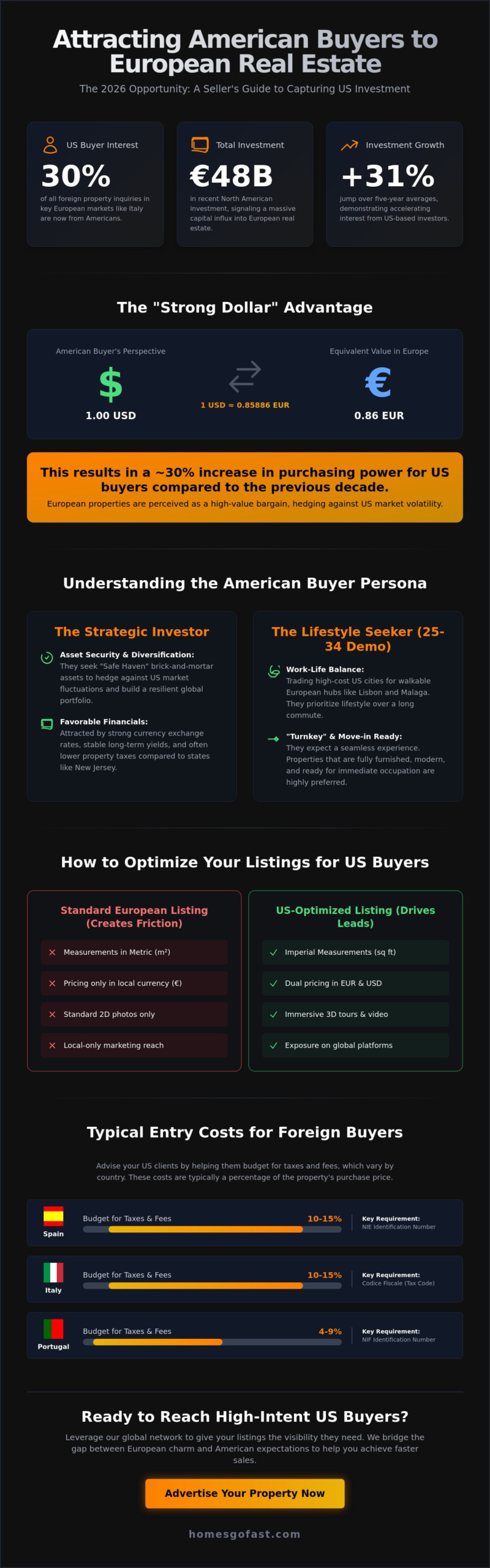
The 2026 market presents a unique window for European sellers. While domestic US real estate faces inventory challenges and price volatility, the European landscape offers a compelling alternative. Investors are attracted by the current strength of the dollar, which has sustained its purchasing power throughout early 2026. This financial advantage allows US buyers to secure premium assets at a significantly lower cost basis than in previous cycles. At the current exchange rate of 1 USD to 0.85886 EUR, the math simply works in their favor.
Successfully attracting american buyers to european real estate is no longer just about selling vacation homes. It’s about positioning these assets as a core part of a diversified wealth strategy. Recent data from Savills shows that North American investment in the region reached €48 billion, a 31% jump over five-year averages. This surge is driven by a desire to hedge against US market fluctuations while capitalizing on stable, long-term yields. For many, it’s a move toward asset security in an unpredictable global economy.
To better understand this concept, watch this helpful video:
Macro-Economic Drivers for American Buyers
The most immediate driver is the currency advantage. Compared to the previous decade, Americans have seen a 30% increase in their purchasing power across the Eurozone. This makes high-end listings on EuropeanProperty.com appear deeply discounted to those holding USD. Beyond the exchange rate, Europe is viewed as a “Safe Haven” for brick-and-mortar assets, offering a level of stability that is hard to find in speculative markets elsewhere.
Many investors are also looking at the fiscal benefits. While US property taxes in states like New Jersey can be prohibitively high, many European regions offer lower recurring costs. However, buyers must still navigate complex regulations on foreign property ownership to ensure their investment is structured correctly. Understanding these rules is essential for anyone looking to build a cross-border portfolio. To help you advise your clients, we’ve summarized the typical entry costs below.
| Country | Budget for Taxes/Fees | Key Requirement |
|---|---|---|
| Spain | 10-15% of purchase price | NIE Identification Number |
| Italy | 10-15% of purchase price | Codice Fiscale (Tax Code) |
| France | 7-8% (existing) / 2-3% (new) | Notary-led process |
| Portugal | 4-9% of purchase price | NIF Identification Number |
The Rise of the American Digital Nomad and Young Investor
We are seeing a massive shift in who is buying. The 25-34 demographic is increasingly active, trading high-cost US cities for “walkable” European hubs. These younger buyers prioritize work-life balance and accessibility. Tech hubs like Malaga and Lisbon have become magnets for US talent, supported by 2024 and 2025 EU remote work legislation that simplified cross-border employment. They aren’t just looking for a place to sleep; they’re looking for a community and a lifestyle that doesn’t require a two-hour commute.
Buyers are increasingly looking for locations with established expat communities and modern infrastructure. Digital Nomad Visas have lowered the entry barriers, allowing young professionals to live and work in Europe before committing to a purchase. This trend creates a pipeline of future buyers who already understand the local lifestyle. If you’re ready to capture this demand, you can advertise properties on our global network to reach these motivated buyers today.
Understanding the American Buyer Persona: What They Really Want
To succeed in attracting american buyers to european real estate, you must understand that they are often fleeing specific domestic frustrations. While the financial logic is sound, the emotional pull is equally strong. Investors are attracted by stable yields, but they also crave a lifestyle that feels increasingly out of reach in the United States. They aren’t just buying a house; they’re buying freedom from car-dependency and high-cost urban living.
Buyers are increasingly looking for a “turnkey” experience. In the US, the culture of “fixer-uppers” is waning among international investors who don’t have the local network to manage a renovation from 4,000 miles away. They want properties that are move-in ready, featuring modern amenities and high-speed internet. If your listing requires structural plumbing or a new roof, you’ll likely lose the lead to a more polished competitor. Efficiency is their primary currency.
Evaluating Top Regions: Pros and Cons for US Buyers
Choosing the right location involves balancing aspirational dreams with practical reality. To help you guide your clients, consider how these popular regions compare for the typical American profile:
| Region | Pros for Americans | Potential Cons |
|---|---|---|
| The Algarve (Portugal) | High English proficiency; affordable luxury lifestyle. | Increasing property prices due to high demand. |
| Costa del Sol (Spain) | Established expat communities; world-class security. | Complex regional tax variations. |
| Tuscany (Italy) | Ultimate aspirational brand; historic charm. | Strict heritage preservation rules for renovations. |
The two most requested features are history and walkability. These are rare in many US suburbs. When comparing homeownership rates and urban structures, it’s clear that Americans value the “village feel” where cafes and markets are accessible on foot. They want to own a piece of history that feels authentic. Security and the presence of established expat communities also rank highly, as these factors reduce the perceived risk of moving abroad.
The ‘Smart Advisor’ Approach to Sales
Americans operate on a “24-hour rule.” They expect high responsiveness and proactive communication. Don’t just act as a salesperson; position yourself as a mentor who simplifies the process. Explain the local rules before they even ask. You can browse current property for sale in Spain to see how high-performing listings are currently structured to meet these expectations. Your goal is to reduce the stress of the cross-border transaction through clear, expert guidance.
To capture these high-intent leads effectively, you can list your properties on EuropeanProperty.com and put your portfolio in front of a dedicated audience of international investors today.
Optimizing Your Listings for US Standards: A Comparison
Americans are accustomed to the highly standardized, data-heavy format of domestic platforms like Zillow. When you are attracting american buyers to european real estate, your listing must bridge the gap between European charm and US-style transparency. If a potential lead has to use a currency converter or a metric calculator just to understand your offer, they will likely move on to a more accessible listing. Efficiency is key to capturing interest from across the Atlantic.
One of the most common friction points is the measurement system. Providing square footage alongside square meters is essential. A 100-square-meter apartment might sound small to a US buyer until they see it is approximately 1,076 square feet. Investors are attracted by clarity, and presenting dimensions in a familiar format demonstrates that you understand their needs. It’s a small adjustment that significantly increases the time spent on your property page.
The US-Style Listing Checklist
Floor plans are often missing from European listings, but they are a non-negotiable requirement for American buyers. They want to see the “flow” of a home before they commit to a flight. Your checklist should also highlight “US-friendly” amenities. Features like air conditioning, modern appliances, and updated electrical systems are major selling points. Buyers are increasingly looking for properties that won’t require immediate, complex renovations.
Transparency in pricing is equally critical. In many European markets, closing costs can be surprisingly high. For example, in Spain or Italy, you should advise buyers to budget between 10% and 15% for taxes and notary fees. Providing a simple “cost of ownership” summary helps build the trust necessary for a cross-border transaction. You can find more about these regional nuances in our section on global market trends.
Visual Storytelling for Remote Buyers
Professional visuals are your most powerful tool for closing the distance. High-resolution video and 3D virtual tours allow buyers to “walk through” the home from their office in New York or Los Angeles. Drone footage is also vital for showing the property’s context. Use it to highlight the proximity to international airports, beaches, or those walkable town centers we discussed earlier. It turns a static building into a tangible lifestyle opportunity.
Virtual staging can also help Americans visualize a “turnkey” potential in an older property. It bridges the gap between historic architecture and modern living standards. If you want to ensure your property stands out among international real estate listings, focus on lifestyle shots of the neighborhood. Show the local cafe, the nearby park, and the sunset from the terrace. You aren’t just selling a house; you’re selling the dream of a new life abroad.
To start reaching these high-intent leads today, you can advertise properties on our global network and put your listings in front of millions of North American visitors.
Digital Marketing Strategies to Reach the US Market
Americans don’t search like locals. If your property is only visible on a regional MLS or a local language site, you’re effectively invisible to the North American market. Success in attracting american buyers to european real estate depends on appearing where they already spend their time. Most US investors start their journey on high-authority platforms that offer a familiar user experience and English-language support. You need to be present on global portals that act as a bridge between their current location and your property’s doorstep.
Social media targeting is your next most powerful tool. Instagram is the perfect medium for the aspirational lifestyle features we’ve discussed, such as walkable town centers and historic architecture. Use high-resolution video reels to showcase the “dream” of European living. Conversely, LinkedIn is where you should target the “Investor” persona. Here, the focus should be on practical logic, market stability, and the strong dollar. By tailoring your content to these specific platforms, you ensure that your marketing budget finds high-intent buyers rather than casual browsers.
Don’t underestimate the power of consistent email marketing. Buying property abroad is rarely an impulsive decision; it’s a journey that can take months. By building a newsletter that tracks regional developments and pricing, you nurture long-term leads. This keeps your listings top-of-mind when the buyer is finally ready to move from the research phase to a concrete inquiry. It’s about building a relationship of trust before the first viewing even takes place.
Leveraging Global Market Trends
You can use data to justify European price points by comparing them directly to high-cost US cities like San Francisco or New York. Highlighting rising demand from other foreign buyers creates a natural “Fear of Missing Out” (FOMO) that can accelerate the decision-making process. Investors are attracted by data that shows strong rental yields and long-term capital appreciation. Providing this data upfront positions you as a savvy mentor rather than just another agent.
Targeted Lead Generation for Agents
The challenge for many agents is differentiating between “window shoppers” and serious cross-border buyers. To solve this, you should focus on international real estate listings that pre-qualify interest through global networks. Multi-lingual SEO is also critical. Even though you’re targeting Americans, the US has a massive Spanish-speaking population with significant investment power. Capturing this diverse audience requires a sophisticated, multi-layered digital approach that goes beyond simple keyword usage.
If you’re ready to scale your reach and start receiving high-quality leads, you can explore an Agent Pro Account to automate your visibility to millions of American visitors today.
Scaling Your Reach: Why HomesGoFast is the Key to the US Market
HomesGoFast has spent over 20 years building a global network that bridges the gap between European sellers and North American capital. Based in London, our platform provides the grounded reliability and transparency that US investors demand when looking abroad. Successfully attracting american buyers to european real estate requires more than just a listing. It requires a badge of credibility that only an established tenure can provide to reduce the perceived risk of cross-border transactions.
For large agencies, efficiency is the primary driver of growth. Our Agent Pro Account automates your reach, putting your portfolio in front of millions of high-intent American visitors without the need for manual updates. If you are a private seller, you can sell overseas property directly through our platform. This empowers you to bypass traditional local brokerage fees while maintaining the same global visibility as major firms. We’ve seen European agents increase their North American lead volume by 40% simply by utilizing targeted listing upgrades and featured placements.
Investors are attracted by platforms that simplify their search. By using a centralized hub, you ensure that your property is seen by buyers who are already pre-qualified by their interest in international markets. This specialized focus leads to faster sales cycles and higher closing prices, as you are dealing with dollar-strong buyers who understand the value of the 2026 European market.
The HomesGoFast Advantage for European Sellers
Large agencies benefit from seamless XML feed synchronization, which ensures that every listing is updated in real-time across our entire network. We also offer a “Featured Listing” boost specifically for high-demand regions like Spain, Italy, and France. This ensures your properties stay at the top of search results when Americans are browsing. If you’re managing the process yourself, our for sale by owner guide to selling overseas provides the specific roadmap you need to navigate the complexities of international marketing without an intermediary.
Practical Next Steps to Capture US Interest
Start by auditing your current listings for the “Americanization” gaps we’ve discussed. Ensure your floor plans are clear and your measurements include square footage. Once your content is optimized, set up a professional profile on a global property advertising platform to centralize your lead generation and tracking. The 2026 market is moving fast, and the window of opportunity created by the strong dollar remains a powerful incentive for those ready to act.
Taking action now ensures you are positioned to capture this massive influx of US capital before the competition catches up. You can explore our Agent Pro options to start reaching US buyers today and see how our global perspective can transform your sales results.
Master the 2026 Market and Secure Your First US Lead
Success in this landscape requires more than just a great property; it demands a strategic alignment with American expectations for transparency and efficiency. You’ve seen how currency parity and lifestyle shifts are driving interest, and how simple listing adjustments can bridge the cultural divide. By moving away from local-only platforms and embracing global visibility, you position your assets in front of the world’s most motivated investors.
Mastering the nuances of attracting american buyers to european real estate is the most effective way to shorten your sales cycle. Efficiency wins every time. Established in 2002, our platform offers a specialized network reaching over 50 countries with a focus on high-quality US-buyer lead generation. The dream of European ownership has never been more attainable for Americans, and with the right strategy, you’re the one who can make it a reality.
Start attracting American buyers—list your property on HomesGoFast today!
Frequently Asked Questions
What are the most popular European countries for American buyers in 2026?
Portugal, Spain, Italy, and France continue to lead the market for North American investors. Americans currently account for approximately 30% of all foreign property inquiries in Italy, while Spain’s Costa del Sol remains a primary destination for high-net-worth individuals. These regions offer the specific blend of history and walkable infrastructure that US investors are attracted by when looking for a lifestyle shift.
Do American buyers need a special visa to buy property in Europe?
No, you don’t need a visa simply to purchase property in countries like Portugal, Spain, or Italy. Ownership is legally permitted for non-residents, though it doesn’t automatically grant residency rights. While many “Golden Visa” programs have changed, Americans can still hold real estate assets freely. You will typically need a local tax identification number, such as a Portuguese NIF or a Spanish NIE, to complete the transaction.
How do I calculate square footage from square meters for US buyers?
You multiply the square meter total by 10.76 to provide an accurate square footage estimate for your listing. Since Americans don’t use the metric system, failing to provide this conversion is a common mistake in attracting american buyers to european real estate. Providing both measurements ensures your property is accessible and helps North American leads visualize the space without needing a calculator.
What are the typical closing costs for international buyers in Europe?
Closing costs vary by territory, so you should generally budget between 7% and 15% of the purchase price. In Spain and Italy, taxes and notary fees typically fall between 10% and 15%. France is slightly lower at 7% to 8% for existing homes, while Portugal ranges from 4% to 9%. These figures are essential for buyers to understand upfront to avoid surprises during the final stages of the sale cycle.
Why is the US dollar’s strength so important for the European real estate market?
A strong dollar significantly increases the purchasing power of Americans, making European assets appear discounted compared to domestic US markets. With the May 2026 exchange rate at 1 USD to 0.85886 EUR, buyers can secure premium properties at a much lower cost basis. Investors are attracted by the chance to hedge their wealth in stable brick-and-mortar assets while the currency advantage remains in their favor.
Can Americans get a mortgage from a European bank?
Yes, many European banks provide mortgages to non-resident US citizens, usually requiring a down payment of 30% to 40%. In Spain, fixed rates for Americans are currently between 3.0% and 3.5%, while French banks offer rates from 3.3% to 4.0%. It’s important to remember that US citizens may face additional paperwork due to FATCA regulations when opening the necessary local bank accounts.
How can I advertise my European home directly to Americans without an agent?
You can list your property on a global property advertising platform like HomesGoFast to reach millions of North American visitors directly. This “For Sale By Owner” approach allows you to bypass local brokerage fees while maintaining professional visibility. By optimizing your listing with US-style standards and high-quality visuals, you can efficiently manage lead generation and connect with serious cross-border buyers on your own terms.
What do American buyers consider ‘essential’ amenities in a European home?
Buyers are increasingly looking for modern comforts like air conditioning, high-speed fiber internet, and updated kitchen appliances. While they value historic architecture, they often prefer “turnkey” properties that don’t require immediate, complex renovations. Highlighting these features alongside proximity to international airports and walkable city centers will make your home far more appealing to the modern American buyer profile.