

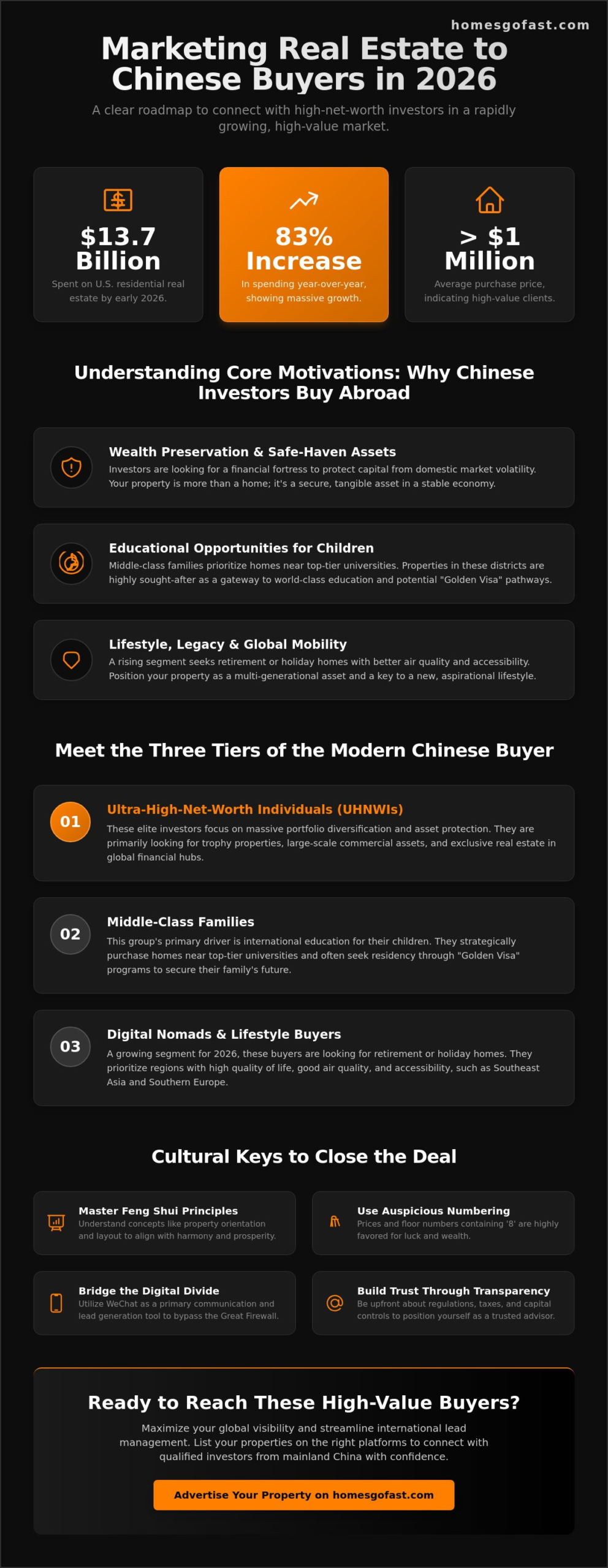
Did you know that Chinese buyers spent a staggering $13.7 billion on U.S. residential real estate in early 2026, marking a massive 83% increase in just one year? You likely recognize the incredible potential of this demographic, but you’ve also felt the frustration of trying to reach them through the Great Firewall. It’s a high-stakes environment where the average purchase price exceeds $1 million; yet many agents struggle with cultural nuances like Feng Shui or managing leads across difficult time zones. Effective real estate marketing to chinese buyers requires more than just a simple translation. It demands a total digital and cultural bridge.
You want to connect with investors who are increasingly looking for wealth preservation and educational opportunities for their children. We’ll show you exactly how to navigate the new 2026 financial regulations and state-level ownership restrictions while building trust with international prospects. This guide provides a clear roadmap for listing your properties on the right platforms and mastering the cultural communication needed to close deals. We’ll break down the digital ecosystem of WeChat and Douyin, explain how to handle capital controls, and help you attract higher-quality leads from mainland China with confidence.
Key Takeaways
- Identify why buyers are increasingly looking for safe-haven assets and how proximity to elite schools drives high-value property acquisitions.
- Learn to bypass the Great Firewall by utilizing WeChat as a primary gateway for search and lead generation in mainland China.
- Master the cultural nuances of real estate marketing to chinese buyers, including the critical application of Feng Shui and the power of auspicious numbering.
- Discover how to maximize your global visibility and streamline international lead management through automated property syndication.
- Gain practical insights into the 2026 investment landscape to better align your property offerings with the wealth preservation goals of high-net-worth investors.
The Evolving Landscape of Chinese Overseas Property Investment in 2026
By March 2026, Chinese buyers spent an estimated $13.7 billion on residential real estate in the United States alone. This represents a massive 83% year-over-year increase in spending. While the U.S. remains a primary target, the broader strategy for real estate marketing to chinese buyers has shifted toward a more diverse global portfolio. Buyers are increasingly looking for safe-haven assets outside of mainland China to protect their wealth from domestic market volatility and developer debt. You’ll notice that the modern investor is less focused on speculative “flipping” and more concerned with long-term capital preservation.
Investors are attracted by stable yields and the legal protections offered in Western markets. This shift is deeply rooted in the current state of Chinese overseas property investment trends, where the desire to move capital into hard assets has never been higher. To succeed in this market, you must recognize that your property isn’t just a building; it’s a financial fortress and a lifestyle upgrade for the buyer’s family. Understanding these motivations allows you to tailor your messaging to meet the specific needs of different buyer segments.
The Three Tiers of the Modern Chinese Buyer
- Ultra-high-net-worth individuals (UHNWIs): These investors seek massive portfolio diversification. They prioritize asset protection and often look for trophy properties or large-scale commercial assets in global hubs.
- Middle-class families: This group is primarily driven by international education. They want homes near top-tier universities and often utilize “Golden Visa” opportunities to secure residency for their children.
- Digital nomads and lifestyle buyers: A rising segment in 2026, these individuals look for retirement or holiday homes in regions like Southeast Asia or Southern Europe, prioritizing air quality and accessibility.
Global Regulatory Shifts Affecting 2026 Transactions
Success in 2026 requires a firm grasp of the evolving regulatory environment. China’s annual USD 50,000 foreign exchange quota remains in place, but new “know your customer” (KYC) rules effective January 1, 2026, have intensified bank scrutiny. These regulations extend record-keeping for transactions to 10 years, making transparency vital. Buyers now lean heavily on international real estate listings that originate from trusted, vetted platforms to ensure their cross-border transfers remain compliant.
Taxation also plays a decisive role in where these investors choose to park their money. For instance, the way capital gains tax on sale of property is handled in different jurisdictions can make or break an investment’s ROI. By providing clear data on these costs upfront, you position yourself as a savvy mentor rather than a salesperson. This transparency is the key to building the confidence required to facilitate high-value international acquisitions in today’s complex market.
Understanding Core Motivations: Why Chinese Investors Buy Abroad
Chinese investors aren’t just buying houses; they’re buying security, legacy, and opportunity. The domestic market in China has faced significant challenges recently, including developer debt and oversupply. This has pushed capital toward more stable environments. Understanding China’s Investment Climate reveals why moving wealth into tangible, overseas assets remains a top priority for high-net-worth families. They view international property as a financial fortress that protects their capital from local market volatility.
Effective real estate marketing to chinese buyers focuses on these underlying anxieties and aspirations. It’s about positioning a property as a multi-generational asset that provides more than just a roof. You’re selling a hedge against inflation and a gateway to a different lifestyle. Whether it’s a luxury condo in New York or a vineyard in Europe, the primary goal for these buyers is the long-term preservation of their family’s wealth.
The “Education First” Strategy
Education is often the single most important factor driving a purchase. Proximity to elite universities or top-tier secondary schools can increase a property’s value by up to 20% in the eyes of a Chinese buyer. When you’re crafting your marketing copy, don’t just mention a nearby school. List its specific global rankings, such as the QS World University Rankings, and the exact distance to the campus in minutes. Buyers are increasingly looking for homes that guarantee a smooth path for their children’s academic and professional success in the West.
Diversification Beyond the Domestic Market
Wealth preservation is the second pillar of this investment strategy. With the volatility of Asian metropolitan hubs, investors are looking for stable rental yields and long-term capital growth. For example, the steady returns found in French homes for sale offer a stark contrast to the high-risk developments often found closer to home. Diversifying into overseas real estate provides a necessary hedge against currency fluctuations and local economic downturns.
Heritage and status still hold weight, but the “freedom” of space has become a luxury in its own right. Chinese buyers are increasingly looking for properties that offer clean air and high-quality private healthcare. This is a significant shift from the crowded urban centers that dominated their previous search criteria. Prestige now includes the ability to live in a low-density environment while maintaining a connection to global financial hubs. If you’re ready to reach these motivated investors, you can browse international property listings to see how successful sellers are highlighting these lifestyle benefits.
Navigating the Digital Divide: Portals, WeChat, and the Great Firewall
Standard Western marketing strategies often fail in China because of the Great Firewall. You can’t rely on Facebook, Instagram, or Google to reach this audience; these platforms are essentially invisible to users in mainland China. Successful real estate marketing to chinese buyers requires a specialized digital bridge that respects local internet regulations and user habits. If your property website takes more than a few seconds to load from a Beijing server, you’ve already lost the lead. Speed and mobile optimization aren’t just features; they’re the foundation of your visibility.
Baidu is the dominant search engine here, and its algorithms prioritize different factors than Google. While Google values global backlinks, Baidu places a heavy emphasis on localized hosting and simplified Chinese metadata. You need to ensure your digital presence is “Baidu-friendly” to capture organic search traffic from mainland investors. Buyers are increasingly looking for professional, fast-loading interfaces that feel local and secure, even when the property is thousands of miles away. This technical alignment is what separates successful global agents from the rest.
The Power of the WeChat Ecosystem
WeChat is far more than a messaging app; it’s a search engine, a social feed, and a payment gateway rolled into one. You should integrate QR codes into all your marketing materials to move prospects from a physical brochure or a desktop site directly into your official WeChat channel. Many top agencies use WeChat Mini Programs to host 3D virtual tours. These allow buyers to walk through a penthouse in London or a villa in Portugal without ever leaving the app. Consistently updating your feed with high-value market insights in Mandarin builds the trust necessary for high-stakes international transactions.
Leveraging International Portals for Visibility
While local social media is vital, advertising properties on established global platforms provides a layer of institutional credibility that social media alone cannot match. Chinese buyers often use these portals as a starting point for their search, trusting the vetted nature of the listings. Choosing a platform that offers multilingual support and robust lead generation tools ensures that language barriers don’t stall your momentum. By combining the reach of international real estate listings with the intimacy of WeChat, you create a seamless journey that guides the buyer from their first search to a final enquiry.
Cultural Competency: Optimising Your Property Listings for Chinese Appeal
Cultural intelligence is the bridge that turns an enquiry into a transaction. While digital visibility gets you noticed, cultural alignment is what truly closes the deal. Successful real estate marketing to chinese buyers requires an intimate understanding of belief systems that influence multi-million dollar decisions. You aren’t just selling a floor plan; you’re selling harmony, prosperity, and legacy.
Numbers hold immense psychological weight in this market. Avoid using the number “4” in your pricing or listing descriptions, as it sounds like the word for “death” in Mandarin. Conversely, highlight the number “8” whenever possible, as it is synonymous with wealth. If a property is located on the 4th floor or has a house number containing 4, focus your marketing on the “elevated views” or “private corner position” to shift the focus away from the unlucky digit. Professional transcreation, which adapts the message rather than just the words, ensures these nuances aren’t lost in a robotic Google translation.
The Feng Shui Checklist for Real Estate Agents
- Avoid T-junctions: Properties at the end of a T-junction are often seen as receiving “poison arrows” of negative energy. If your listing has this layout, emphasize soundproofing and solid perimeter walls to mitigate concerns.
- Prioritize Orientation: South-facing homes are highly coveted for their natural light and symbolic connection to growth. Mention the “lucky” orientation early in your description.
- Front Door Flow: Ensure the front door doesn’t align directly with the back door. This is believed to let wealth flow straight out of the home. Use staging, like a well-placed screen or plant, to “trap” the energy and wealth inside.
Visual Storytelling for the Asian Market
Your visual assets must speak to specific lifestyle priorities. Drone photography is essential for showing the relationship between the “dragon” (the rolling landscape or mountains) and the “tiger” (the protective surroundings). This bird’s-eye view helps buyers assess the environmental balance of the site. Inside the home, focus your lens on the kitchen and dining areas. These spaces are viewed as the heart of family prosperity. Showcasing high-end appliances and spacious seating areas signals that the home is ready for multi-generational gatherings.
Safety and security are non-negotiable for investors moving capital abroad. Highlight gated community features, smart home security systems, and private entrances. Since many buyers cannot travel for every viewing, high-quality virtual reality tours are the gold standard for closing deals. If you’re ready to showcase your listings to a global audience with these cultural optimisations, you can advertise properties on our platform to reach motivated international investors today.
Scaling Your Reach: How HomesGoFast Bridges the Gap to Chinese Investors
You’ve mastered the cultural nuances of Feng Shui and understood the digital barriers of the Great Firewall. Now, you need a powerful vehicle to deliver your message. Scaling your real estate marketing to chinese buyers requires a platform that combines 20 years of global authority with cutting-edge syndication technology. HomesGoFast acts as your savvy mentor in this space, providing the infrastructure to turn your international listings into high-intent leads without the technical headache.
The Agent Pro Account is designed for maximum efficiency. With a single click, your properties are syndicated across a vast network of international portals, ensuring your listings are visible where buyers are actually searching. Investors are attracted by the grounded reliability of an established marketplace that has spent two decades building trust across borders. By leveraging our established tenure, you gain immediate credibility with a Chinese audience that prioritizes reputation and verified platforms over unproven social media ads.
Streamlining Lead Generation
Managing international enquiries can be overwhelming when you’re dealing with different time zones and language barriers. Our centralised dashboard simplifies this process, allowing you to track and respond to leads with the speed that the 2026 market demands. Successful agents know that selling overseas property effectively requires a platform that understands global market trends and buyer psychology. We provide the tools to ensure your communication is professional, prompt, and culturally aligned, helping you close the gap between an initial click and a final contract.
Getting Started with Your 2026 Strategy
Upgrading your listings for the modern Chinese investor doesn’t have to be complicated. Start by reviewing your current portfolio and identifying properties that meet the “Education First” or “Wealth Preservation” criteria we discussed earlier. Once you’ve selected your top assets, focus on transcreating your descriptions and adding the high-quality drone shots that showcase the “dragon” and “tiger” of the location. Buyers are increasingly looking for this level of detail before they even consider an enquiry.
You can explore our flexible owner pricing options to find a package that suits your current inventory and growth goals. Whether you’re a solo agent or a large firm, our platform is built to scale with you. The 2026 market is moving fast, and the demand for safe-haven assets is only increasing. Don’t let your properties remain invisible to the world’s most active buyer group. Take the first step toward global visibility and advertise your first property on our platform today.
Master the Global Bridge to Chinese Investment
You now have the strategic framework to navigate the complex world of real estate marketing to chinese buyers in 2026. Success in this high-stakes arena requires a balance of technical agility to bypass the Great Firewall and the cultural intelligence to align with Feng Shui principles. By focusing on the core motivations of wealth preservation and international education, you position your properties as essential safe-haven assets. These investors are attracted by stability; and your ability to provide clear, culturally relevant data is what builds that vital foundation of trust.
Efficiency is your greatest asset in this fast-moving international market. You don’t need to be a digital specialist to achieve massive global visibility when you have a seasoned partner. With over 20 years of global lead generation expertise, our network is trusted by thousands of international agents and developers. We handle the complexities of multilingual listing syndication across a global network so you can focus on closing deals. It’s time to turn these market insights into a concrete competitive advantage.
Start reaching Chinese investors today with a HomesGoFast Agent Pro Account and put your listings in front of the world’s most active buyer group. The international property market is waiting for your next move; let’s make it a successful one together.
Frequently Asked Questions
Do I need to speak Mandarin to sell real estate to Chinese buyers?
You don’t need to be fluent; however, you must provide high-quality localized content. Successful real estate marketing to chinese buyers relies on transcreation rather than simple translation to ensure cultural nuances are respected. Utilizing platforms that offer multilingual syndication allows you to present your properties professionally without needing a translator on staff for every initial enquiry.
What is the most important Feng Shui rule for property listings?
The orientation of the front door and the overall flow of energy are the most critical factors. A south-facing entrance is highly prized for its association with prosperity and light. You should also ensure the property isn’t located at a T-junction; as this is often a deal-breaker for traditional investors who view it as a path for negative energy.
How do Chinese buyers typically pay for overseas property in 2026?
Most buyers utilize offshore accounts or funds already held outside of mainland China to bypass the annual $50,000 foreign exchange quota. Since the new banking regulations took effect on January 1, 2026, transactions are subject to stricter “know your customer” rules. Buyers often work with specialized financial intermediaries who can navigate these capital controls while maintaining full legal compliance.
Which countries are currently most popular with Chinese investors?
The United States remains the top destination, with buyers spending $13.7 billion in early 2026. However, investors are increasingly looking for higher rental yields in Southeast Asian markets like Thailand and Vietnam. Southern European countries also remain popular for those seeking residency through investment programs; which offer a gateway to the broader Western lifestyle and educational systems.
Is WeChat necessary for marketing property to the Chinese market?
Yes, WeChat is an essential tool for building trust and maintaining direct communication. It acts as a search engine and a digital portfolio where you can share 3D tours and property updates. Because standard Western social media is blocked by the Great Firewall; WeChat is the primary platform where you can establish a personal connection and manage leads effectively.
How can I verify the source of funds for a Chinese buyer?
You should work with experienced international compliance officers who understand China’s specific financial documentation. Under the 2026 regulations, financial institutions must now keep transaction records for 10 years. Verifying a buyer’s “Proof of Funds” involves reviewing offshore bank statements or documentation of liquidated assets held in international jurisdictions to ensure a smooth closing process for all parties.
Do Chinese buyers prefer new builds or historic properties?
There is a strong preference for new builds because they offer a “clean slate” from a Feng Shui perspective. New properties are seen as having no previous negative energy and typically require less maintenance; which appeals to buy-to-let investors. While historic properties in cities like London or Paris have status; the modern amenities and security of new developments are often the primary drivers.
What is the best way to handle time zone differences during negotiations?
Using a centralized lead management dashboard allows you to respond to enquiries at the start of your business day while it’s still evening in China. Scheduled updates on WeChat are also effective; as they ensure your content reaches the buyer when they’re most active. Providing clear, pre-recorded video tours and comprehensive digital brochures helps the buyer review information at their own pace; reducing the need for real-time calls.