

Did you know that foreign buyers recently injected over $56 billion into the U.S. housing market in a single year? While that growth is exciting, it also means the old playbook for closing international deals is officially dead. You’re likely dealing with more “window shoppers” from different time zones and a maze of new cross-border financial rules that make even simple transactions feel risky.
It’s natural to feel uneasy about wire fraud or wasting weeks on a lead that lacks verified funds. You want the high yields of the global market without the stress of international scams. This guide teaches you exactly how to vet international property buyers using the latest 2026 standards, ensuring your transaction is both secure and efficient.
We’ll explore a clear process for verifying identity and proof of funds while navigating the newest AML requirements in the UK, US, and Canada. By the end of this article, you’ll have the tools to boost your lead-to-close ratio and move forward with remote buyers with total authority.
Key Takeaways
- Investors are attracted by transparency; learn how to separate serious global buyers from casual “dreamers” to avoid deal fatigue.
- Master how to vet international property buyers by requiring specific Proof of Funds (POF) documents that go beyond standard bank letters.
- Streamline your screening process with a professional two-phase workflow designed to confirm buyer intent and financial readiness quickly.
- Protect your transaction from fraud by using digital footprint analysis to verify the professional credibility of remote leads.
- Discover how specialized property advertising platforms help you attract pre-qualified prospects and increase your closing ratio in the global market.
The Importance of Vetting International Property Buyers
Selling across borders is a high-stakes game where the excitement of a global reach meets the reality of complex regulations. You aren’t just looking for a buyer; you’re looking for a successful closing. International transactions often carry a higher risk of abandonment because buyers might underestimate the friction of moving money or complying with local tax laws. If you don’t know how to vet international property buyers, you risk leaving your home off-market for weeks only to have the deal collapse at the eleventh hour.
Qualified investors are attracted by efficiency and transparency. They come prepared with documentation and a clear investment strategy. On the other hand, “dreamers” often lack a realistic understanding of current price ranges or the practicalities of cross-border finance. For agents, failing to filter these leads doesn’t just waste time; it damages your professional reputation with sellers who expect you to bring them “closing-ready” prospects.
To better understand the buyer’s perspective and the due diligence questions they are asking before they commit, watch this helpful video:
Avoiding the “Margarita Effect” and Time-Wasters
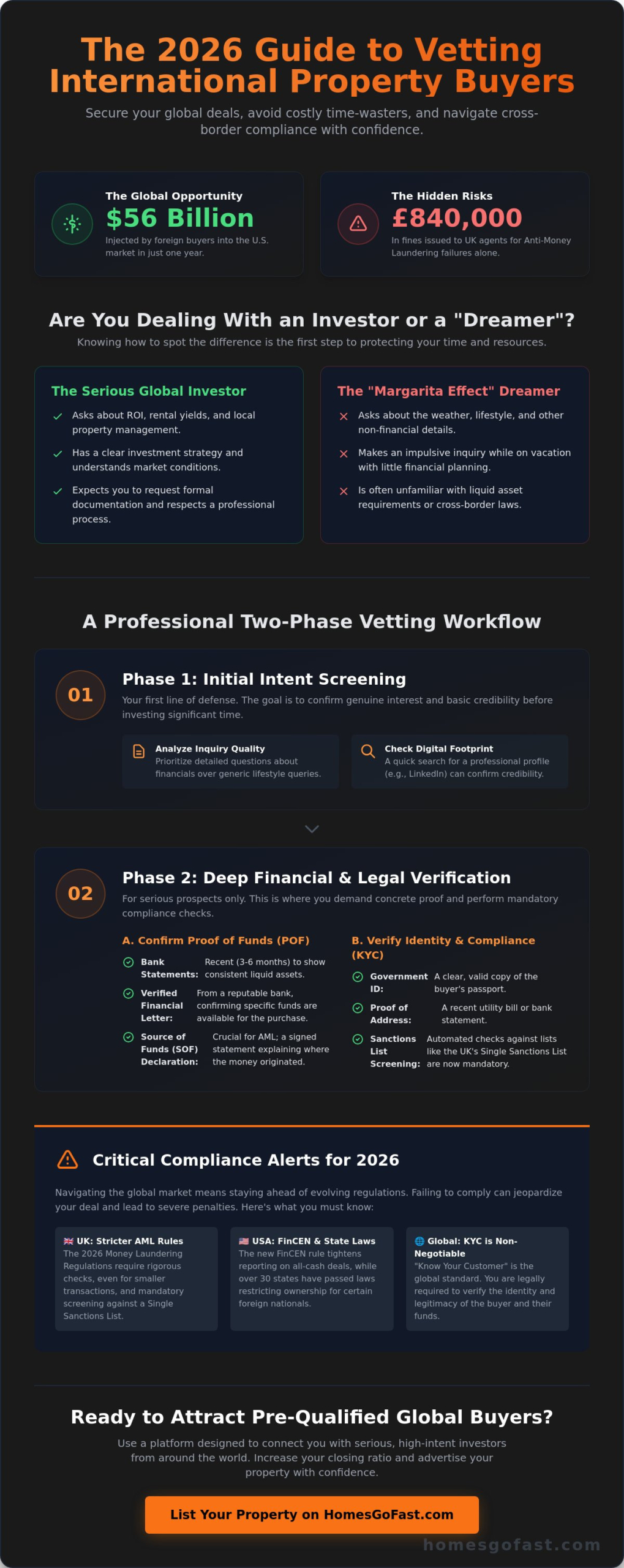
Many inquiries are impulsive. A buyer might be on vacation, feeling the “Margarita Effect,” and decide they want a coastal villa without checking their liquid assets. You must identify these “window shoppers” early by analyzing the quality of their initial contact. Serious investors ask about yields, accessibility, and local management. Impulsive buyers ask about the weather. When you advertise properties to a global audience, you need a system to handle high volumes without burning out. Ask for specific documentation before granting virtual tours to protect your time.
Legal and Compliance Risks in Cross-Border Sales
Compliance is no longer optional; it is a legal necessity. In early 2026, 170 UK estate agents were fined nearly £840,000 for anti-money laundering failures. The stakes are incredibly high for both sellers and their representatives. You must adhere to Know Your Customer (KYC) standards to verify identities and the legitimate source of funds. With the UK’s Money Laundering and Terrorist Financing Regulations 2026 coming into force this summer, the threshold for occasional transactions is shifting to £800, requiring even more rigorous checks on small deposits.
Sellers also face risks from shifting international sanctions. As of January 2026, the UK requires automated screening against a Single Sanctions List for every transaction. In the United States, 30 states have now passed 54 bills restricting property ownership for certain foreign nationals. Proper vetting ensures you aren’t entering a contract that is legally impossible to complete, keeping your transaction safe and your professional standing intact.
Financial Verification: Confirming Proof of Funds (POF)
A Proof of Funds (POF) is a document that demonstrates a buyer has the liquid assets to cover the purchase. In 2026, establishing this early is a non-negotiable prerequisite for serious negotiations. While a domestic bank letter might suffice locally, it often falls short in the global market. You need to know if the capital is accessible and compliant with the FinCEN anti-money laundering rule. Knowing how to vet international property buyers means looking past a simple statement and demanding verifiable readiness.
Investors are attracted by professional rigor. They expect you to ask for detailed financial backing because it protects the integrity of the deal. To help you compare different buyer profiles, here is a breakdown of what you should expect to see during the verification phase:
| Buyer Type | Typical POF Requirement | Down Payment Expectation |
|---|---|---|
| International Cash Buyer | Full liquid balance statement | 100% of price + costs |
| Foreign National Mortgage | VOD + Mortgage Pre-approval | 30% to 40% (Verified) |
| Corporate/Trust Entity | Certified balance sheet + LOI | Varies by deal structure |
Accepted Forms of Financial Documentation
Don’t accept just any PDF. Look for recent bank statements or brokerage account summaries that clearly show the buyer’s name and a liquid balance. Buyers are increasingly looking for ways to prove their solvency without oversharing, so a Verification of Deposit (VOD) letter from a reputable international bank is a great middle ground. It’s helpful to weigh the pros and cons of different documentation types:
- Bank Statements: High reliability but some buyers feel they are a privacy risk.
- Brokerage Accounts: Good for high-net-worth individuals, though assets may need time to liquidate.
- Bank Comfort Letters: Professional and standard, but sometimes too vague for final due diligence.
Navigating Currency and Transfer Hurdles
Confirming a buyer has the money is only half the battle. You also need to know they can move it. Currency fluctuations can wipe out a buyer’s budget if they haven’t planned ahead. Ask if they are working with currency exchange specialists who can lock in rates. To protect the transaction, always insist on using professional escrow services for deposits. Red flags include resistance to using third-party escrow or bank documentation with inconsistent names. If you want to reach serious investors who already have their finances in order, you can advertise properties on a platform that specializes in the global marketplace.
Identity and Intent: Screening the Buyer Profile
Once you’ve confirmed the money exists, you must confirm the person behind it. Serious international real estate buyers rarely act alone; they usually have a local lawyer or representative already in place. If a lead claims to be ready to spend millions but hasn’t spoken to a single local professional, your guard should go up. Learning how to vet international property buyers requires you to analyze their digital footprint and professional standing long before you sign a contract.
Start with the “First Contact” test. Does the inquiry feel like a template, or does it reference specific features of your property? Serious investors don’t send generic messages to fifty listings at once. They’ve done their homework. You can often verify their credibility by cross-referencing their details on professional networks like LinkedIn. A buyer with a twenty year career in a visible industry is a much lower risk than an anonymous profile with no social proof. You’ll find that National Association of REALTORS® guidance on international clients provides a solid foundation for these human-centric checks.
Digital Verification Techniques
Don’t stop at a Google search. Look for public records and professional history in the buyer’s home country. If they’re purchasing through a company, you must verify that corporate entity in its local jurisdiction to ensure it’s in good standing. Technology makes this easier than ever. A quick video call is often the best way to establish a face-to-face connection and gauge sincerity. It’s much harder to maintain a scam when you’re looking someone in the eye via a screen. This step helps you build the trust necessary to move forward with a remote transaction while keeping your property secure.
Assessing Buyer Urgency and Knowledge
Identify if a buyer is “ready, willing, and able” through specific, strategic questioning. Use the “Three Whys” technique: ask them why they chose this country, why this specific area, and why they want to buy right now. Their answers will reveal their level of commitment. A buyer who already understands local ownership laws and mentions proximity to local airports or expat communities is likely a serious contender. If they can’t explain their timeline or ROI expectations, they might just be exploring possibilities rather than making a move. Serious investors are attracted by sellers who value their time, so don’t be afraid to ask the hard questions early. Mastering how to vet international property buyers means knowing when to lean in and when to walk away from a non-viable lead.
A Step-by-Step Vetting Workflow for Sellers
Establishing a repeatable sequence is the only way to manage global interest without losing your mind. You need a process that moves from broad curiosity to legal commitment. By following a structured workflow, you transform a chaotic inbox into a pipeline of qualified leads. If you want to know how to vet international property buyers efficiently, you must stop treating every enquiry as equal and start using a tiered verification system.
Your workflow should follow these five distinct phases to ensure maximum security:
- Phase 1: Initial enquiry filter using an automated questionnaire to gauge budget and intent.
- Phase 2: A discovery call to establish the buyer’s specific timeline and motivation.
- Phase 3: A formal request for Proof of Identity and Proof of Funds (POF) before sharing sensitive data.
- Phase 4: Introduction to legal and tax experts to verify foreign documentation and compliance.
- Phase 5: Moving to a formal Letter of Intent (LOI) or a Reservation Agreement to secure the deal.
Standard Questions for Every International Lead
Investors are attracted by professional boundaries. When a lead reaches out, reply with a “Smart Advisor” template that asks about their tax residency and financing plans. Don’t be afraid to ask, “Will this purchase be contingent on selling another asset?” or “Do you have an international mortgage pre-approval in place?” Asking these questions early doesn’t cause offense; it signals that you are a serious seller who values transparency. Buyers are increasingly looking for sellers who provide clear requirements, as it gives them confidence in the property’s legitimacy.
Engaging Professional Gatekeepers
You shouldn’t have to verify every document yourself. A buyer’s solicitor is often your most effective vetting tool. If a buyer is serious, they will have already engaged a legal representative in your jurisdiction. You can also coordinate with local agents who might have encountered the buyer in previous searches. For complex cross-border deals, use legal experts to authenticate foreign passports or corporate registration papers. This layer of professional scrutiny ensures that by the time you reach Phase 5, the risk of deal fatigue is virtually eliminated. To start attracting leads that are ready for this level of professional screening, you can advertise properties on a platform built for global reach.
Leveraging HomesGoFast for High-Quality Global Leads
The most effective way to simplify how to vet international property buyers is to ensure the leads you receive are already of a higher caliber. When you use a dedicated advertising platform, you aren’t just casting a wide net; you’re positioning your property where serious investors look. These buyers are increasingly looking for platforms that provide verified data and transparent listings, which naturally discourages “window shoppers” from wasting your time. Professional platforms act as an invisible first filter, ensuring that those who reach out are already familiar with the costs and requirements of cross-border ownership.
By utilizing a global reach, you diversify your buyer pool across different territories, reducing your dependence on a single local market’s economic fluctuations. In 2026, scaling your real estate business requires targeted marketing that speaks to the specific needs of overseas investors. An Agent Pro Account allows you to manage this international lead flow with precision, giving you the tools to prioritize high-intent enquiries that have already passed through initial platform filters. This level of efficiency is what separates top-performing agents from those struggling with deal fatigue.
Why Quality Listings Attract Quality Buyers
Investors are attracted by data-driven listings that include realistic price ranges and clear ROI potential. When you provide detailed descriptions and high-quality visuals, you pre-qualify leads before they even click “enquire.” This transparency builds immediate trust, which is essential for remote transactions. For FSBO sellers, HomesGoFast provides the framework to professionalize your approach. It ensures your listing looks just as credible as those from major international agencies, helping you compete on a global scale without a massive marketing budget.
Taking Action: Your Next Steps in Global Sales
Start by reviewing your current lead management process and identifying where the bottlenecks occur. Are you spending too much time on manual vetting? If so, it’s time to upgrade your strategy and focus on high-value activity. Mastering how to vet international property buyers becomes much easier when you have the right technology supporting you. You can sign up for an Agent Pro Account to access premium lead generation tools that streamline your workflow. Don’t let your property sit on the market while waiting for the right buyer to stumble upon it. Take control of your transaction and start reaching a vetted global audience today.
Mastering Global Sales with Confidence
Vetting isn’t about creating barriers; it’s about building a secure bridge between you and a qualified investor. By verifying Proof of Funds early and analyzing the digital footprint of your leads, you protect your time and your assets. You now have a clear, step-by-step workflow for how to vet international property buyers that aligns with the strict 2026 compliance standards across the US, UK, and Europe.
Success in the global market requires more than just a listing; it requires visibility and trust. HomesGoFast has been a leader in the international sector since 2002. With over 20 years of global property marketing expertise and a network of multilingual listings reaching 100+ countries, we specialize in connecting sellers with high-intent prospects who are ready to move forward.
Don’t leave your transaction to chance. List your property and reach qualified global buyers today. The international market is full of potential. With the right screening process and a professional platform behind you, you’re ready to close your next deal with absolute efficiency.
Frequently Asked Questions
How do I ask an international buyer for proof of funds without offending them?
Frame the request as a standard compliance requirement rather than a personal doubt. You can say, “To comply with international anti-money laundering standards and move to the next stage, our protocol requires a recent proof of funds.” Serious investors are attracted by this level of professionalism. It signals that the transaction is being handled with the rigor necessary for a secure cross-border deal.
What are the most common red flags when dealing with overseas property leads?
Watch for buyers who refuse to participate in a video call or those who pressure you to bypass standard legal channels. Evasive answers regarding the source of wealth or inconsistent identity details across different documents are also major warning signs. If a lead seems uninterested in the practicalities of the property, such as tax residency or local rules, they may not be a viable candidate.
Can I legally refuse to sell to someone who won’t provide identity verification?
Yes, you can and often must refuse to proceed if a buyer fails to provide required identification. Many jurisdictions now have strict Know Your Customer (KYC) laws that mandate identity verification to prevent illicit activity. In the United States, for example, several states have passed bills that specifically restrict property ownership for certain foreign nationals, making identity checks a legal necessity for a valid sale.
Do I need a different vetting process for cash buyers versus mortgage buyers?
You must prioritize source of wealth verification for cash buyers to meet global banking standards. While mortgage buyers are partially vetted by their lending institution, you still need to confirm they have the 30% to 40% down payment typically required for international loans. Understanding how to vet international property buyers involves recognizing that “cash” does not mean “no checks” but rather requires deeper due diligence on where that cash originated.
How long does it typically take to verify a buyer from another country?
The verification process usually takes between 48 hours and one week depending on the buyer’s home country and the complexity of their financial structure. If the buyer uses a digital identity wallet or has documents already authenticated by a global bank, the process is much faster. Delays often occur when dealing with corporate entities or trusts that require extra layers of jurisdictional verification.
What role does my solicitor play in the buyer vetting process?
Your solicitor acts as the ultimate professional gatekeeper by performing formal AML and sanctions list screenings. They authenticate foreign passports and corporate registration papers to ensure the buyer is legally allowed to purchase the asset. While you perform the initial screening, your legal representative provides the final layer of protection that ensures the contract is enforceable and compliant with 2026 regulations.
Are there automated tools to help vet international property buyers in 2026?
Yes, the industry is increasingly moving toward automated sanctions screening software and reusable digital identity verification. These tools allow you to check leads against global databases instantly. By using a professional advertising platform, you also benefit from built-in filters that help how to vet international property buyers by ensuring only high-intent enquiries reach your inbox, saving you hours of manual research.
Should I accept a deposit before the buyer is fully vetted?
No, you should never accept funds until the buyer has cleared initial identity and compliance checks. Accepting money from an unverified source can trigger bank freezes or legal investigations into your own accounts. Always ensure the buyer is fully vetted and that the funds are handled by a professional escrow service to maintain the financial security of the transaction.