Here’s the thing you have to grasp about the cost of living in Dubai vs the US: while your daily coffee or weekly shop might feel pricier in Dubai, the complete absence of income tax can dramatically boost your disposable income compared to living in a major US city. It’s this financial leverage that’s catching the eye of American and European property investors looking for both returns and a better quality of life.
A Definitive Financial Comparison For Global Investors
For any serious international property buyer, digging into the financial nuances of Dubai versus the Homes for Sale in the United States is non-negotiable. A quick glance at restaurant menus or rental ads just won’t cut it and can be seriously misleading. The real picture only comes into focus when you look at the whole board—taxation, housing costs per square metre, and genuine long-term investment potential. This guide breaks it down with the hard data you need to frame your decision.
Key Differences At A Glance
Choosing between investing in Homes for Sale in Dubai or the United States means weighing two fundamentally different economic philosophies. Dubai is built to attract foreign talent and capital with powerful tax incentives. The U.S., on the other hand, offers a massive, diverse economy but comes with a notoriously complex tax structure.
Here’s a high-level look at the core financial differences that really shape the cost of living in Dubai vs US.
| Metric | Dubai | United States (Major Cities Average) |
|---|---|---|
| Personal Income Tax | 0% | 10-37% (Federal) + State Taxes |
| Property Purchase Tax | 4% (DLD Fee) | Varies (e.g., Mansion Tax, Transfer Tax) |
| Annual Property Taxes | None | 0.25% – 2.5% of property value annually |
| Average Rental Yield | 6-8% | 2-4% |
| Healthcare System | Mandatory Private Insurance | Mix of Private & Public (often costly) |
| Education | Primarily Private/International (fee-paying) | Public (free for residents) & Private options |
The table makes the biggest differentiator crystal clear: the tax burden. For a high-earning professional or investor, the savings from zero income tax in Dubai aren’t just a small perk—they can fundamentally reshape your entire financial standing and ability to invest. This single factor makes the emirate a hugely compelling option for anyone searching for International Property For Sale.
Comparing The Core Financial Landscape
To get a real sense of the cost of living in Dubai vs US, you have to look past the price of a coffee and dig into the core economic differences. The big picture is shaped by average salaries, currency stability, and, most critically, taxation. These fundamentals are what truly define an investor’s net worth and buying power.
Dubai’s entire financial appeal is built on its famous zero-tax policy for personal income. This isn’t just a small perk; it’s a massive incentive that lets professionals and investors keep 100% of what they earn.
This is a world away from the complicated, multi-layered tax system in the United States. There, you’re looking at federal income tax, state income tax, and sometimes even local city taxes chipping away at your salary. For high-earning expats, this one difference is often the deal-maker.
Salaries and Earning Potential
While the US has a much larger and more diverse economy, Dubai punches above its weight by offering highly competitive, tax-free salaries to lure the best global talent. This creates a fascinating financial dynamic. Your gross salary might look similar to a role in New York or Los Angeles, but the net pay that actually hits your bank account in Dubai is substantially higher.
This flood of disposable income has a direct knock-on effect on your ability to invest in property, build savings, and handle day-to-day living costs with ease. If you want to see how economic factors are playing out in key American markets, check out our guide on what’s happening in Florida, Texas, and California.
For buyers from the UK weighing up an international move, the salary difference in Dubai is particularly stark. The average monthly salary after tax in Dubai is around £4,006—a whopping 77% higher than the UK average of £2,260. Yes, daily expenses in Dubai might be 15–18% higher than back home, but that huge income gap usually means residents enjoy far greater financial freedom. You can see a full breakdown from Clear Currency comparing the costs between Dubai and the UK.
Core Economic Indicators Dubai Vs US
To put it all into perspective, the table below gives a quick, at-a-glance summary of the key financial metrics that shape the real cost of living in Dubai vs US for anyone considering an investment.
| Metric | Dubai | United States (Major Cities Average) |
|---|---|---|
| Personal Income Tax | 0% | Federal (10-37%) + State (0-13.3%) |
| Currency | UAE Dirham (AED) | US Dollar (USD) |
| Currency Peg | Pegged to USD | Free-floating |
| Average Salary (After Tax) | High (Tax-Free Advantage) | Varies greatly by city and state |
| Corporate Tax | 9% (on profits over AED 375,000) | Federal (21%) + State Taxes |
These numbers really tell the story. The tax burden alone creates two completely different financial realities, heavily influencing disposable income and the potential for wealth accumulation.
A Tale Of Two Property Investment Climates
For any savvy international investor, the cost of living in Dubai vs US really boils down to one thing: property. Housing is more than just an expense; it’s the foundation of any relocation or investment plan. When you dig into the real estate markets of Dubai and major US hubs like New York or Los Angeles, you uncover two completely different worlds for investors.
The first thing you’ll notice is the price of admission. While snapping up prime real estate in Manhattan or Miami requires some serious capital, Dubai often provides a much more accessible entry point for high-end properties. This isn’t just a feeling; the market data backs it up.
Purchase Price And Rental Yields: A Clear Divergence
Look at the numbers. The average price per square metre for a city-centre apartment in Dubai is significantly lower than what you’d pay in a comparable US city. This affordability has a direct impact on the most important metric for any investor: rental yield.
Dubai’s property market is famous for its strong rental returns, often hitting gross yields between 6-8%. In sharp contrast, prime US markets typically hover in the 2-4% range, a direct result of much higher purchase prices chewing into the rental income.
Nick Marr, founder of HomesGoFast.com, notes, “Global investors are increasingly drawn to Dubai’s high yields and tax efficiency, which contrast sharply with the high entry costs in many prime US markets.”
This visual data chart gives you a quick snapshot of the key financial differences, including salary, income tax, and living costs.
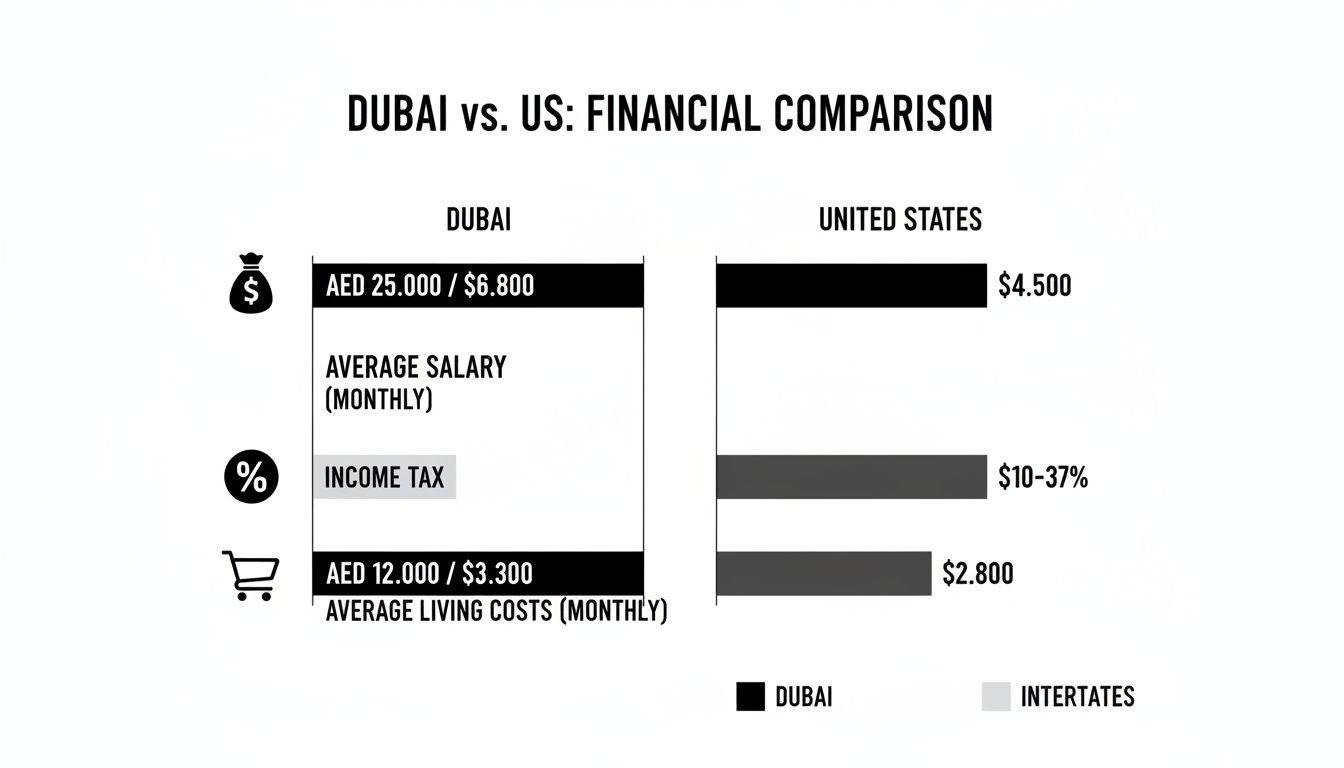
As you can see, while day-to-day costs might feel similar, the big picture—shaped by taxes and salaries—creates wildly different financial realities for residents.
Understanding The Transaction Landscape
It’s not just about the sticker price. The costs of actually buying and holding onto a property are worlds apart. One of the biggest financial wins for investors in Dubai is the tax situation. Before you dive in, it’s worth reading this ultimate guide to property taxes in the UAE.
Here’s the deal: Dubai charges a one-time 4% Dubai Land Department (DLD) transfer fee when you buy. After that? Nothing. There are no annual property taxes.
This is a game-changer compared to the US, where homeowners are hit with ongoing annual property taxes that can run anywhere from 0.25% to over 2.5% of the property’s value. Over a decade, that tax bill adds up to a massive chunk of your returns.
For buyers coming from the Homes for Sale in the UK, the value proposition is even more stark. Data shows the average price per square metre in a city-centre apartment is about £4,200 in Dubai. In the UK? A staggering £13,800. That’s a difference of more than 230%. It’s a clear signal of the incredible value Dubai offers right from the start.
Analysing Daily Lifestyle And Living Expenses
Beyond the big-ticket items like property, the real story of the cost of living in Dubai vs US is told in the day-to-day expenses. It’s the weekly grocery bill, the utility costs, and the price at the petrol pump that truly shape your budget and ultimately, your lifestyle. Let’s break down these routine costs to paint a realistic financial picture for anyone considering a move.

While Dubai is often seen through a lens of luxury, many essentials are surprisingly competitive. A weekly shop for a family, for instance, can feel much lighter on the wallet than in a major US hub like Homes for Sale in Chicago, particularly for staples like fresh produce and poultry.
Crowd-sourced data backs this up. An individual in Dubai might budget around $455 for monthly groceries, a noticeable saving compared to the $589 average in the US.
Utilities And Connectivity
One of the biggest wins for Dubai is in home utilities. This is a recurring expense that hits your bank account every month, so any savings here really add up and boost the financial appeal of relocating.
To give a clear example, a comparison with the UK shows that basic utilities for an 85 m² flat cost about £165 per month in Dubai. That’s a significant 41% cheaper than the £280 you’d expect to pay in the UK.
But there’s a trade-off. Connectivity is where the tables turn. A mobile phone plan with 10GB+ of data is listed at a hefty £50 in Dubai, while a similar plan in the UK is just £15. It’s a classic case of give and take. You can dig deeper into these UK-specific comparisons in this excellent guide from Gerson Relocation.
Transportation And Personal Mobility
Getting around is another area with a stark contrast. Fuel costs in Dubai are substantially lower than in the US and Europe, which makes driving a far more economical choice. For families or professionals who depend on a car, the consistently cheaper price of a gallon of petrol is a major financial advantage.
Here’s a quick side-by-side of key lifestyle costs:
- Groceries: Generally more affordable in Dubai for staple items.
- Dining Out: A mid-range three-course meal for two in Dubai costs around $72. In New York, you’d be looking at something closer to $108.
- Petrol: Significantly cheaper in Dubai, which directly cuts down your commuting and travel budget.
- Internet & Mobile: This is one area where Dubai is often more expensive than US and European plans.
For an investor, this level of detail is critical. While you might pay more for things like high-speed internet or certain electronics, the huge savings on utilities and fuel—compounded by the complete absence of income tax—create a powerful financial argument. It frees up capital, allows for a higher standard of living, and ultimately, gives you more capacity for property investment. This really tips the scales on the cost of living in Dubai vs US debate.
Navigating Healthcare And Education Costs
For families and long-term investors, healthcare and education are two of the biggest expenses that can make or break a budget. Getting a clear handle on these costs is critical when comparing the cost of living in Dubai vs US, because the systems couldn’t be more different. Honestly, these two categories are often the deciding factor for families weighing up a move.
In Dubai, health insurance is mandatory for every single resident. Employers must provide it for their staff, but covering family members often falls on you. The good news is the market is competitive, with plenty of private providers to choose from.
The US healthcare system, on the other hand, is a notoriously complex and expensive beast. Even with employer-subsidised plans, many people get hit with high monthly premiums, steep deductibles, and co-pays for even basic care. It’s a constant financial headache for millions of American households.
A Look At Healthcare Premiums
The difference in cost can be eye-watering. A solid private health plan in Dubai might set a 30-year-old back around $125 a month. For similar coverage in the United States, that same person could easily be paying an average of $453 per month.
Anyone trying to manage the financial weight of the American system would be wise to explore practical strategies to lower health insurance costs. It’s a vital step. While the quality of care is excellent in both locations, getting access to it in the US often comes with much bigger financial hurdles.
Comparing Education Systems And Fees
Education is another area where the two locations diverge sharply, hitting family budgets hard. The US has a strong public school system that’s free for residents, though the quality can be a postcode lottery, varying hugely from one district to another. If you opt for private school, you’re looking at hefty tuition fees that can easily top $25,000 a year in major cities.
Dubai operates almost entirely on a private and international school model. Public schools are available, but they are predominantly for Emirati citizens. This means expat families have to factor private school fees into their budget—it’s a significant and unavoidable cost.
For relocating families, schooling is a massive financial consideration. The decision often boils down to a trade-off: paying high tuition fees in Dubai or paying sky-high property taxes in the US just to live in a top-rated public school district.
Here’s a quick snapshot of the educational landscape:
- Dubai: The scene is dominated by fee-paying international schools offering British, American, or IB curriculums. You can expect to pay anywhere from $10,000 to over $30,000 per child, per year.
- United States: Offers free public education funded by taxes. Private schools are everywhere but come at a premium, with costs often matching or even exceeding those of Dubai’s international schools.
For international investors and their families, these ongoing costs for healthcare and education are just as important as property prices when calculating the true cost of living in Dubai vs US.
Which Location Offers Better Value For Your Goals
Choosing between Dubai and the United States isn’t really about finding the ‘cheaper’ option. It’s about matching a location’s financial personality with your own personal and investment goals. The final call in the cost of living in Dubai vs US debate comes down to what you’re trying to achieve—whether you’re an investor chasing returns, a professional climbing the career ladder, or a family putting lifestyle first.
For international property buyers focused squarely on maximising cash flow and keeping tax bills to a minimum, Dubai often presents the most direct path to value.
Think about it: zero income tax, no annual property taxes, and strong rental yields that frequently sit between 6-8%. This combination creates a powerful financial engine for building wealth. The entire environment is engineered to attract foreign capital, making it a hotspot for anyone whose main goal is to build a high-performing real estate portfolio.
Tailoring Your Investment Strategy
On the other hand, the US market tends to attract a different kind of investor. Yes, you’re dealing with higher taxes and generally lower rental yields (think 2-4%), but certain American cities offer deep, stable markets with excellent potential for long-term capital growth.
An investor looking to build generational wealth within a mature, highly regulated legal system might find more value in places like Miami or Austin.
The real key is to define what ‘value’ actually means to you.
- For High Rental Yields and Tax Efficiency: Dubai is the clear frontrunner.
- For Long-Term Capital Growth in a Mature Market: Specific US cities could be a much better fit.
Ultimately, you need a nuanced understanding of what each market does best. For a deeper dive into the local dynamics, you can explore our overview of Dubai’s emerging real estate trends. By weighing these distinct advantages against your own financial ambitions, you can make a strategic choice that delivers real value for your goals.
FAQs: Cost of Living in Dubai vs US
Here we tackle some of the most common questions from investors and expats weighing up the cost of living in Dubai vs the US.
Is it really cheaper to live in Dubai than a big US city?
It’s a common question, and the answer isn’t a simple yes or no. While your weekly grocery bill might feel similar, the real game-changer for high-earners in Dubai is the 0% income tax. That alone can make a huge difference. When you start adding up the numbers, things get even more interesting. Property prices per square metre are often lower, and you won’t be paying annual property taxes. For many, this means their disposable income shoots up, even when comparing Dubai to notoriously expensive cities like New York or Los Angeles, where prime rental costs can be neck and neck.
What are the hidden costs of moving to Dubai from the US?
It’s easy to focus on the big savings like tax, but there are definitely other costs to factor in. Mandatory private health insurance is one, and if you have children, the fees for international schooling can be substantial. Mobile and internet plans can also feel pricier than what you’re used to back home. Don’t forget the one-off expenses, either. Things like visa processing, chunky rental deposits, and the cost of shipping your life across the world all add up. These are crucial details in the cost of living in Dubai vs US equation that are all too easy to overlook in the initial excitement.
Where can I expect better property investment returns: Dubai or the US?
This really boils down to your investment goals. Are you after immediate cash flow or long-term growth? Dubai generally shines when it comes to rental yields, with many investors seeing gross returns in the 6-8% range. This is largely because purchase prices are more accessible relative to what you can charge for rent. On the other hand, the US market, especially in high-growth cities, often offers a better shot at long-term capital appreciation. The trade-off is that rental yields are typically much lower, hovering around 2-4%. Of course, tax implications in both locations will play a massive role in what you actually take home, so that’s a key piece of the puzzle.
How do healthcare costs compare for an expat in Dubai vs the USA?
This is one of the starkest differences. In Dubai, every resident is required to have private health insurance, but the premiums are generally far more affordable than what you’d pay in the US for similar coverage. The American healthcare system is notorious for its eye-watering costs, from high premiums to hefty deductibles and co-pays. While the quality of care is excellent in both places, the financial weight of staying healthy is typically much, much heavier for residents in the United States. It’s a major factor that significantly tips the scales when you’re looking at long-term affordability.
About Homesgofast.com
HomesGoFast.com is a leading international property website, established in 2002, helping homeowners, real estate agents, and developers reach overseas buyers. Featuring thousands of listings from over 50 countries, the platform connects global property seekers with homes, apartments, villas, and investment opportunities worldwide.
Looking for expert mortgage guidance? Get international property mortgage advice here:
https://homesgofast.com/mortgages-overseas/
Explore more overseas homes for sale at our global partner site:
https://homesgofast.com/overseas-property/
Looking to sell real estate to foreign buyers? Go to
https://homesgofast.com/sell-overseas-property/