For discerning international investors and expatriates weighing a move abroad, one critical question underpins the decision-making process: how does the cost of living in Cyprus compare to a major economic hub like the UK? The answer is compelling. Cyprus offers more than just marginal savings; it provides a significantly more affordable lifestyle, enabling a higher quality of life on a sun-drenched Mediterranean island. This isn’t about fiscal restraint—it’s about unlocking superior value for your capital.
Unpacking the Financial Advantages of Cyprus
A side-by-side analysis reveals the stark financial advantages of residing in Cyprus, particularly for those accustomed to the inflated expenses of the United Kingdom. We are not discussing trivial savings. This is a fundamental shift in day-to-day affordability that impacts everything from weekly grocery expenditure to fine dining.
This economic edge is primarily driven by lower costs across several key sectors:
- Real Estate: Whether renting or acquiring property, prices are substantially more reasonable than in the UK’s prime urban centres.
- Daily Expenses: Your monthly budget is less constrained by the cost of groceries, utilities, and transportation.
- Leisure & Lifestyle: Dining, entertainment, and social activities are far more accessible, allowing for a richer social life without constant financial oversight.
Let’s examine a direct comparison of estimated monthly expenditures. This provides a clear snapshot of the significant savings potential for both individuals and families contemplating a move.
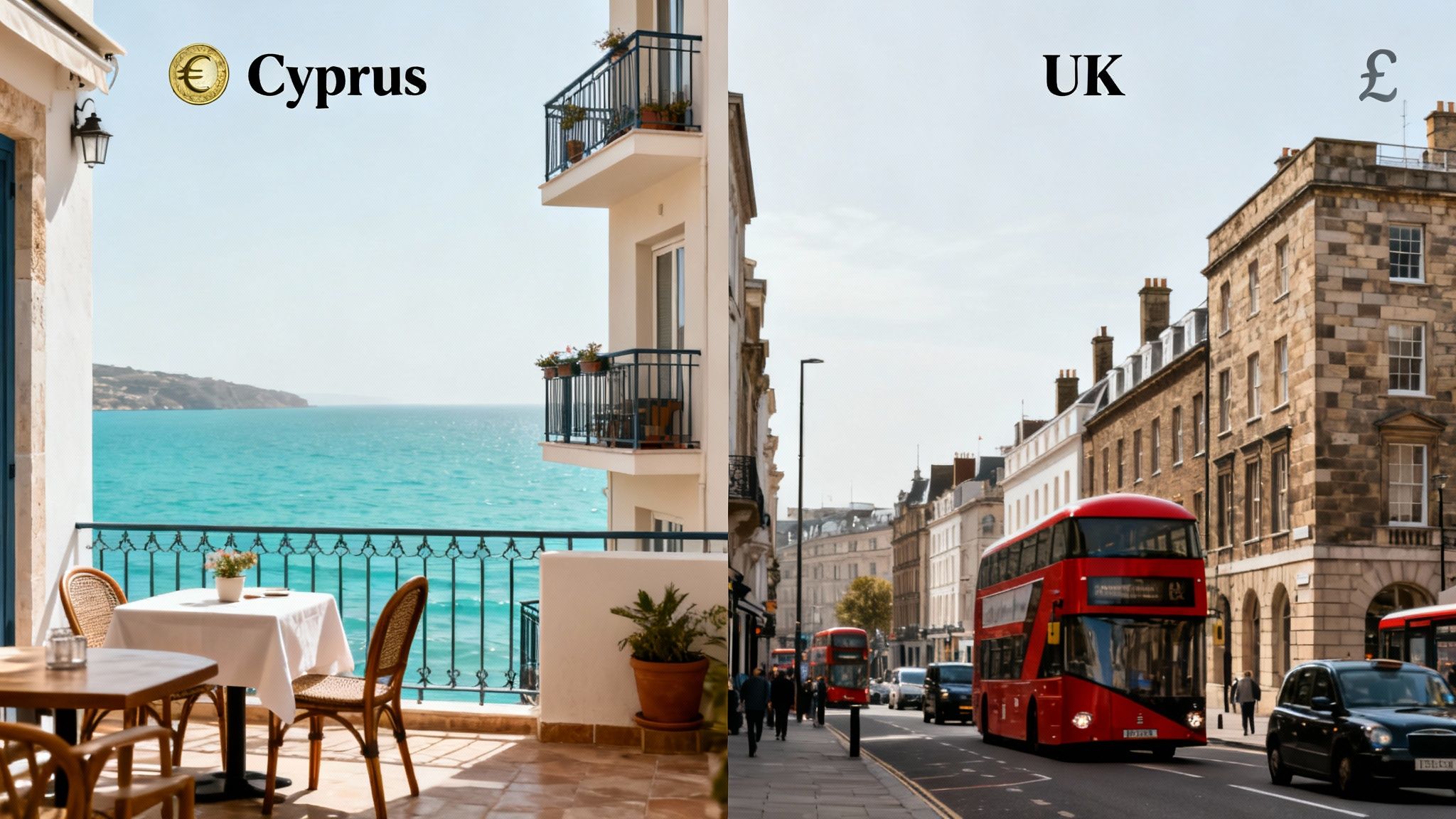
Cyprus vs UK: A Monthly Cost of Living Snapshot (Excluding Rent)
To truly illustrate the difference, let’s break down the typical monthly outgoings for an individual and a family in both nations, momentarily setting aside accommodation costs.
| Expense Category | Single Person (Cyprus) | Single Person (UK) | Family of Four (Cyprus) | Family of Four (UK) |
|---|---|---|---|---|
| Groceries & Dining | ~ €750 | ~ £850 (€1,000) | ~ €1,500 | ~ £1,800 (€2,120) |
| Utilities (Basic) | ~ €180 | ~ £250 (€295) | ~ €300 | ~ £350 (€412) |
| Local Transport Pass | ~ €40 | ~ £80 (€94) | ~ €120 (for two adults) | ~ £160 (€188) |
| Leisure & Entertainment | ~ €250 | ~ £300 (€353) | ~ €500 | ~ £600 (€706) |
| Total Estimated Monthly Costs | ~ €1,220 | ~ £1,480 (€1,742) | ~ €2,420 | ~ £2,910 (€3,426) |
Note: These figures are estimates intended to provide a comparative overview. Actual costs will vary based on location, lifestyle, and consumption patterns. Exchange rates are approximate.
The data presents a powerful case. The lower cost of living in Cyprus isn’t merely about capital preservation; it’s about redeploying financial resources to achieve a superior standard of living. This pattern of affordability is not isolated; other attractive European markets present similar advantages, as detailed in our guide to the cost of living trends in France for 2025. Next, we will delve into the specific costs that define the Cypriot financial landscape.
A Look at the Cypriot Property Market for Investors
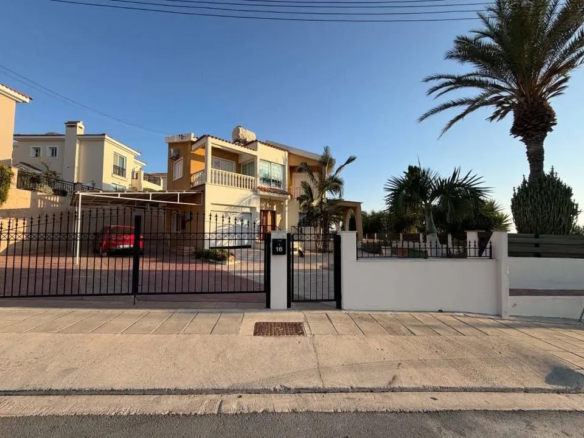
For most individuals, housing represents the largest portion of their budget when calculating the cost of living Cyprus. However, for astute investors and those seeking a second home, the island’s property market presents a narrative of exceptional value. The sustained interest from international buyers, particularly from the UK, USA, and other European nations, is a direct response to Cyprus’s potent combination of a high-quality lifestyle and attractive property valuations.
Unlike certain overheated European markets, Cyprus offers a stable and far more accessible entry point. To make intelligent investment decisions and identify prime opportunities, a rigorous commercial real estate market analysis is non-negotiable. The island’s property portfolio is impressively diverse, featuring everything from sleek urban apartments to expansive coastal villas that align with a wide range of investment strategies.
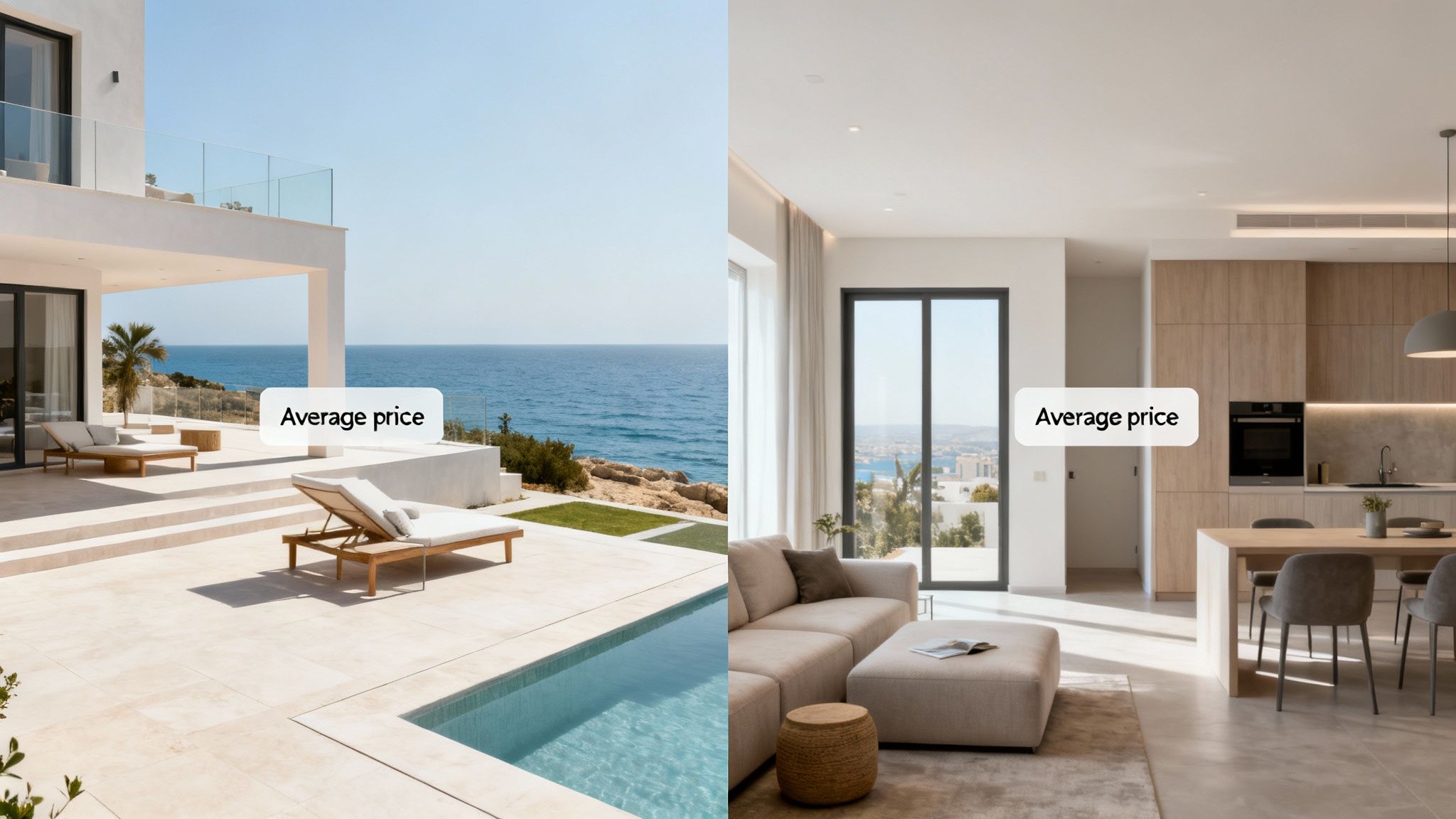
Unpacking Rental Costs Across Key Cities
Whether you’re an investor targeting rental yields or an individual planning a relocation, a comprehensive understanding of the rental market is essential. The disparity between Cyprus and major UK cities is stark, revealing substantial savings that directly enhance monthly cash flow and purchasing power. This affordability is a cornerstone of the island’s appeal.
The data speaks for itself. In the capital, Nicosia, a one-bedroom apartment in the city centre commands a monthly rent of approximately £467. By comparison, a similar property in London would demand a staggering £1,729. The savings extend further—a monthly transport pass is just £36 versus £150 in London.
This trend holds across the island’s primary urban centres:
- Nicosia: As the capital, it offers stable, balanced rental prices, making it a reliable choice for long-term lets.
- Limassol: This cosmopolitan business centre commands the highest rents, attracting corporate tenants and delivering premium returns for investors.
- Paphos & Larnaca: These coastal cities are highly favoured by expatriates and retirees. They offer lower rental costs and a more relaxed lifestyle, making them ideal for lifestyle-focused investments.
The Investment Case for Buying a Property
Beyond renting, the rationale for acquiring property in Cyprus is incredibly compelling. Modern apartments and villas are available at prices significantly below those in other Mediterranean hotspots, creating a clear pathway to ownership for a broader pool of international buyers. The cost of living in Cyprus is further reduced when mortgage payments are often lower than rental outgoings.
Consider the entry points for desirable properties:
- Apartments: High-quality, two-bedroom apartments in sought-after locations like Paphos or Larnaca can be acquired from around €200,000.
- Villas: For those desiring more space, modern three-bedroom villas with private pools often start at approximately €350,000—a price point almost inconceivable in comparable locations in the UK or other prime European destinations.
This exceptional value has not gone unnoticed by industry experts.
Nick Marr, founder of Homesgofast.com and the luxury real estate platform EuropeanProperty.com, points out, “The sustained demand from UK and European buyers is driven by the exceptional value Cyprus offers—it’s not just a lifestyle purchase, it’s a sound financial one.”
This insight from a seasoned professional underscores the core proposition: the Cypriot market delivers on both quality of life and investment potential. For those looking to capitalise on these opportunities, now is the time to explore property for sale in Cyprus and witness first-hand how the affordable cost of living Cyprus translates into a brilliant investment.
Budgeting for Your Daily Life in Cyprus
Once accommodation is secured, the next critical consideration is day-to-day expenditure. This is where the lower cost of living in Cyprus transitions from an abstract concept to a tangible reality. The savings on weekly groceries or utility bills translate directly into an enhanced quality of life.
We now move beyond broad comparisons to dissect the specific, recurring expenses that will shape your monthly budget on the island. The positive news is that from groceries to transport, these costs are considerably lower than in the UK, freeing up capital for what matters most—whether that is saving, investing, or simply enjoying a more fulfilling lifestyle.
Core Utilities: Electricity, Water, and Connectivity
Managing essential services is a key component of any budget. While utilities in Cyprus are generally cheaper than in the UK, it is prudent to understand the expected costs, particularly for electricity.
- Electricity: This is likely to be your largest utility expense, driven by air conditioning during the hot summer months and heating in winter. Bimonthly bills can be as low as €150 in milder seasons but can exceed €500 for larger homes during peak summer or a cold winter. Opting for a modern, well-insulated property can significantly mitigate these costs.
- Water: Water is far more affordable. Bills are typically issued quarterly, with a fixed charge around €20-€30 plus consumption. For most households, it remains a very manageable expense.
- Internet: A reliable, high-speed broadband connection is essential, particularly for remote professionals. It is widely available and competitively priced, typically costing between €30 and €50 per month.
In aggregate, these core costs contribute significantly to the favourable monthly cost of living in Cyprus, especially as utility prices continue to rise elsewhere in Europe.
Now, let’s examine how these day-to-day expenses break down for a single person residing in one of Cyprus’s main cities.
Average Monthly Lifestyle Expenses in Cyprus (Per Person)
This table provides a snapshot of what an individual might spend each month on everyday essentials and leisure, serving as a useful baseline for building a personal budget.
| Expense Item | Average Monthly Cost (€) | Notes |
|---|---|---|
| Utilities (Elec., Water, Internet) | €150 – €250 | Electricity is the primary variable, heavily dependent on AC/heating usage. |
| Groceries | €350 – €500 | Based on a mix of local produce and select imported goods. |
| Transport (Public/Fuel) | €50 – €150 | Covers a public transport pass or fuel for a small vehicle for daily commutes. |
| Leisure & Socialising | €150 – €300 | Includes dining out, coffee meetings, cinema visits, and a gym membership. |
As illustrated, the costs are reasonable, permitting a comfortable and active lifestyle without the financial pressures felt in other major European nations.
The Weekly Shop: Groceries and Dining Out
One of the genuine pleasures of living in Cyprus is its culinary scene. The island benefits from an abundance of fresh, locally grown produce year-round, which not only elevates the dining experience but also keeps grocery bills surprisingly low.
A couple can comfortably budget €700 to €1,000 per month for groceries, including both local specialities and familiar imported products. The key to optimising this budget is to shop like a local, embracing seasonal fruit and vegetables to significantly reduce expenditure.
To provide context, here are some typical supermarket prices:
| Grocery Item | Average Price (€) |
|---|---|
| Milk (1 litre) | €1.10 – €2.50 |
| Loaf of Fresh Bread | €1.00 – €2.80 |
| Chicken Fillets (1kg) | €5.00 – €10.00 |
| Apples (1kg) | €1.49 – €4.00 |
| Local Beer (0.5l) | €1.00 – €2.86 |
Dining out is equally affordable. A superb meal for one at a traditional taverna can cost as little as €15, while a three-course dinner for two at a quality mid-range restaurant is typically between €50 and €100. This accessibility is integral to the island’s social culture, making it easy to enjoy its vibrant food scene without it feeling like an extravagance.
Getting Around: Transport Costs
While Cyprus has a public bus network, a private vehicle is essential for convenient travel and proper exploration of the island. Public transport is inexpensive—a single urban bus ticket is €2.40, and a monthly pass is around €50.
However, for genuine freedom and flexibility, the cost of a car must be factored in.
If you are relocating for professional reasons, negotiating a company car into your employment package is a strategic move. It can substantially reduce your monthly cost of living in Cyprus. For all others, purchasing a vehicle or arranging a long-term rental is a practical necessity for expatriate life.
Petrol prices are competitive within the EU, currently hovering around €1.40 per litre. Taxis are also readily available, with a short 5km trip across town costing approximately €15 to €20.
Leisure and Lifestyle Costs
This is where the low cost of living in Cyprus truly enables a superior lifestyle. With greater disposable income each month, residents can fully embrace the Mediterranean way of life.
A monthly gym membership costs approximately €50-€70, a cinema ticket is around €10, and a coffee at a seaside café will only set you back €3-€4. These are not luxury prices; they are everyday costs that make a rich, active social life completely accessible. This is a significant component of the island’s appeal for the thousands of international buyers and investors who choose to make Cyprus their home.
A City by City Cost Breakdown
While Cyprus as a whole is an attractive destination for living and investment, the island is not a uniform market. The cost of living in Cyprus varies significantly between cities, a crucial factor for any prospective resident to understand before committing. Aligning your budget with your desired lifestyle is key to a successful relocation.
Each major city possesses a distinct economic character. Limassol stands as the cosmopolitan business and technology hub, with a corresponding price point. Nicosia, the capital, offers a more balanced, professional environment. Meanwhile, Paphos and Larnaca are celebrated as affordable coastal towns, ideal for families and retirees seeking a more relaxed pace.
Limassol: The Cosmopolitan Hub
As the island’s main port and a vibrant centre for international business and technology, Limassol is undeniably the most expensive city in Cyprus. It offers the most dynamic job market and a thriving international community, but this comes at a premium.
Rental costs here are in a different league, often 30-50% higher than for a comparable property in Nicosia. This reflects its status as the premier destination for high-earning professionals and corporate headquarters. For investors, this translates to higher potential rental income, but for residents, it means a larger portion of the monthly budget is allocated to housing. You can get a feel for the market by looking at properties like this modern family bungalow for sale in the Limassol countryside.
Nicosia: The Balanced Capital
Nicosia presents a more stable and moderate financial landscape. As the capital city and the nation’s administrative heart, it provides a robust, professional environment without the premium coastal price tags seen in Limassol. The cost of living in Cyprus here strikes an optimal balance.
Housing is much more affordable, and day-to-day expenses are generally lower. This equilibrium makes it an excellent choice for those seeking city amenities and strong job prospects without paying top-tier prices. To put it in perspective, while island-wide expenses are largely on par with European averages, they are comfortably lower than in the UK. A single person in Nicosia can expect to need around €880 per month before rent, a notable saving compared to the UK baseline.
Paphos and Larnaca: Affordable Coastal Living
If lifestyle and affordability are your primary objectives, Paphos and Larnaca are the clear front-runners. These coastal cities deliver the quintessential Mediterranean experience—stunning beaches, a relaxed atmosphere, and a significantly lower cost of living in Cyprus.
- Paphos: A long-standing favourite for British expatriates and retirees, Paphos is renowned for its laid-back ambiance and exceptional value for money. Both rent and property prices are considerably cheaper than in Limassol or Nicosia.
- Larnaca: Combining affordability with the convenience of hosting the island’s main international airport, Larnaca is a smart, budget-friendly choice for families and frequent travellers.
This quick breakdown illustrates a typical budget allocation. Groceries often constitute the largest share, followed by transport and utilities.
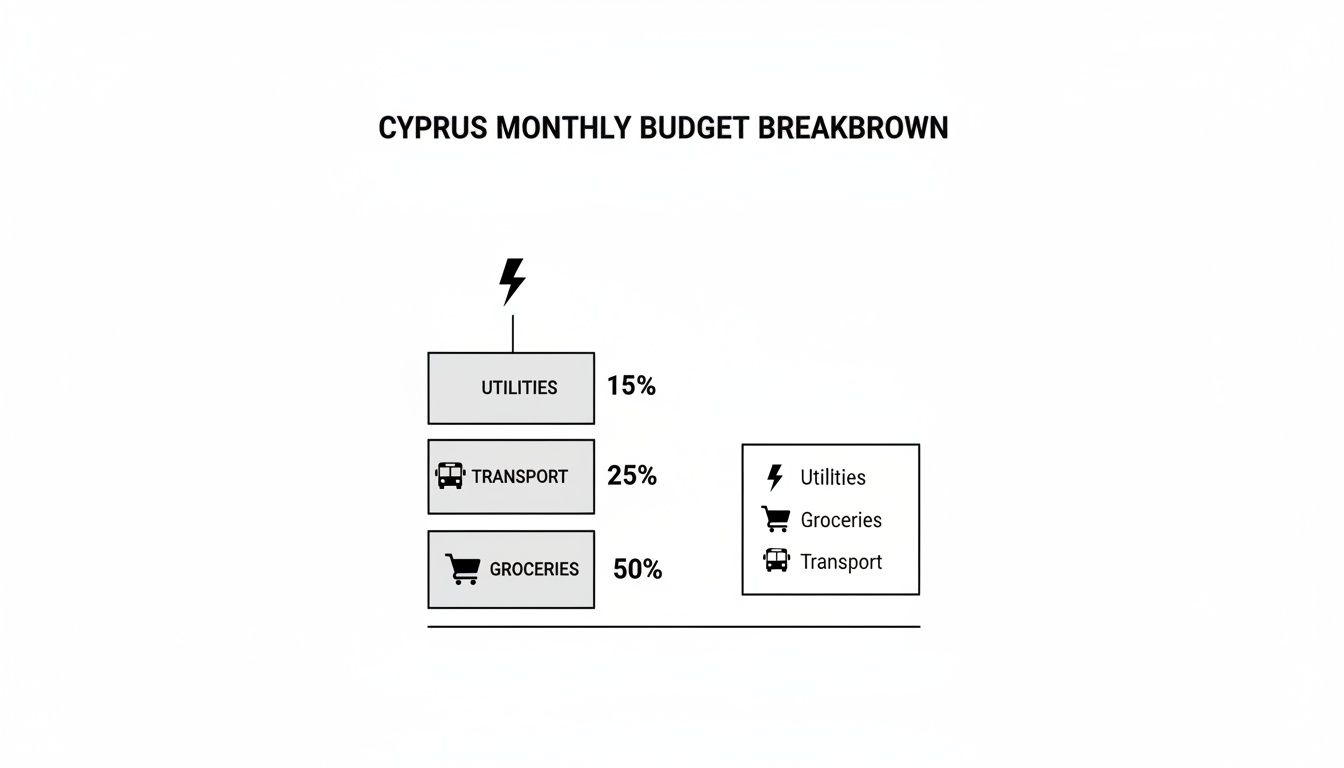
This highlights that while essential costs are present, the overall affordability provides more discretionary income for leisure and savings than in many other European countries.
Healthcare and Education Costs for Expats
When considering an international relocation, particularly with family or for retirement, the focus invariably shifts beyond property prices and climate. The quality and cost of essential services like healthcare and education are paramount for long-term well-being. A lower cost of living in Cyprus is a significant draw, but only if it does not come at the expense of these critical provisions. Fortunately, Cyprus excels in this regard, offering robust systems that provide genuine peace of mind for expatriates.
The island’s healthcare framework is a prime example of this intelligent balance, featuring a two-tiered system that provides comprehensive options.
Navigating the Healthcare System in Cyprus
Cyprus operates both a public and a private healthcare sector, placing choice and flexibility in the hands of residents. The public system, known as GESY (General Healthcare System), is accessible to foreign residents who are legally living and working on the island and contributing to social security. It is comprehensive and makes routine medical care extremely affordable, with only minimal co-payments required.
However, many expatriates and international residents find the private sector offers exceptional convenience and value. It is characterised by modern facilities, English-speaking physicians, and virtually non-existent waiting times. If you are planning a long-term move, it is wise to secure comprehensive international health insurance for expats.
Private health insurance is often a prerequisite for residency permits and provides access to top-tier care. Policies typically range from €150 to €400 per month—a manageable cost for access to the best facilities and specialist consultations, which might cost €50-€70 out-of-pocket.
Investing in Education: International Schools
For families, their children’s education is the highest priority. Cyprus is home to an excellent network of private international schools, the majority of which follow the British curriculum and offer globally recognised qualifications such as IGCSEs and A-Levels. This ensures a seamless academic transition for children from the UK, the US, or elsewhere in Europe and provides a clear pathway to universities worldwide.
While private education represents a significant investment, the fees in Cyprus are often far more competitive than in other major European hubs.
- Primary School: Annual tuition fees typically range between €5,000 and €8,000.
- Secondary School: Fees generally increase to between €8,000 and €15,000 per year, depending on the school’s reputation and location.
Understanding these costs upfront facilitates effective financial planning, reassuring families that they are investing in a first-class future for their children. When viewed holistically, the numbers remain highly favourable. Even with these school fees, the overall affordability of life on the island makes a substantial difference. For instance, a single person’s monthly living costs (excluding rent) average €880 in Cyprus versus €960 in the UK. A family of four is looking at €3,100 compared to €3,270—a saving that helps to offset educational expenses. This blend of affordable living and premium services is precisely what cements the island’s reputation as a premier destination for families and investors alike.
Gaining a Financial Edge with Cyprus’s Tax System
Beyond the island’s everyday affordability, Cyprus offers a powerful strategic advantage that astute investors and high-net-worth individuals find irresistible: its incredibly favourable tax system. This is not a minor perk; it is a core financial incentive that dramatically enhances the low cost of living, transforming a lifestyle choice into a sophisticated wealth preservation strategy.
The island’s tax regime is specifically engineered to attract foreign capital and talent, creating a financial environment where wealth can grow with minimal friction. This makes the cost of living in Cyprus just one component of a larger, more intelligent financial picture, positioning the island as a top-tier European hub for both business and personal finance.
Understanding Key Personal Tax Benefits
At the heart of Cyprus’s appeal is a personal income tax structure designed for simplicity and efficiency. It begins with a generous tax-free allowance, which immediately establishes a welcoming fiscal environment for new residents.
The tax advantages are considerable. Cyprus offers a personal allowance of €19,500 that is completely tax-free. Income above this threshold is taxed progressively, starting at a modest 20% for income up to €28,000 and capping at 35% for earnings over €60,000. This is a highly competitive structure, particularly when compared to the heavier tax burdens in many other Western European nations.
For a more detailed examination of the figures, you can review this breakdown of Cypriot living expenses.
The Power of Non-Domiciled Status
For international entrepreneurs and investors, the ‘non-dom’ status is arguably the single most compelling feature of the Cypriot tax system. This special designation is available to foreign nationals who relocate to Cyprus, provided they were not tax residents previously.
Holding non-dom status unlocks significant exemptions, most notably on worldwide dividend and interest income. In simple terms, this means that income generated from investments outside of Cyprus is not subject to local taxation, allowing for incredibly efficient wealth accumulation. It is a powerful tool that makes the cost of living in Cyprus even more attractive for anyone with an international portfolio.
Nick Marr, founder of Homesgofast.com, observes, “Investors are increasingly looking beyond just property value; they’re analysing the entire financial ecosystem. Cyprus’s non-dom status is a game-changer, turning a beautiful island into a tax-efficient haven for preserving global wealth.”
A Hub for International Business
The advantages extend beyond personal finance into the corporate sphere. Cyprus boasts one of the most competitive corporate tax rates in the European Union, fixed at a low 12.5%. This flat rate, combined with an extensive network of double taxation treaties, makes it an ideal location for establishing a holding company or a regional headquarters.
For real estate professionals aiming to sell overseas property to foreign buyers, this pro-business environment generates a steady pipeline of motivated, high-calibre clients moving to the island. It reinforces Cyprus’s reputation not just as an excellent place to live, but as a strategic base for global operations. This dynamic business climate is a key reason why so many are exploring International Property For Sale on the island.
Frequently Asked Questions (FAQs)
To conclude, let’s address some of the most common questions from investors and prospective expatriates regarding the cost of living in Cyprus.
How Much Money Do You Need to Live Comfortably in Cyprus Per Month?
For a comfortable lifestyle, a single individual should budget between €1,800 and €2,200 per month. A couple would likely require €2,500 to €3,000. This covers not only rent, utilities, and groceries but also allows for leisure activities and enjoying the island’s amenities. A family of four should aim for approximately €4,000 to €5,000 per month, particularly if factoring in international school fees. Note that costs in Limassol are at the higher end of this range, while Paphos and Larnaca offer greater affordability.
Is It Cheaper to Live in Cyprus Than the UK?
Yes, significantly so. Day-to-day consumer prices in Cyprus are approximately 10% lower than in the UK, but the primary advantage lies in housing. Rental costs are, on average, over 20% cheaper. This financial benefit extends to most areas of expenditure, including groceries, public transport, and dining out. In practical terms, your income and savings have greater purchasing power in Cyprus, enabling a higher quality of life for less expenditure.
What Is a Good Salary in Cyprus?
The average monthly salary in Cyprus, after tax, is approximately €2,100. While this figure may appear lower than in other major EU nations, it must be assessed in the context of the lower cost of living in Cyprus. This salary supports a very comfortable standard of living for residents. For international professionals, investors, or retirees with foreign income streams, their funds often translate into an exceptionally high quality of life on the island.
Which Is the Cheapest City to Live in Cyprus?
Paphos and Larnaca consistently rank as the most affordable cities for both expatriates and investors. These locations offer substantially lower costs for rent and daily expenses compared to the primary business hubs of Limassol and Nicosia. Paphos is a long-established favourite among British retirees for its relaxed lifestyle, while Larnaca combines excellent value with the convenience of hosting the island’s main international airport. Limassol remains the most expensive city, reflecting its status as a cosmopolitan business and financial centre.
For retirees, the incentives are particularly compelling. The Category F permit requires only €10,000 in annual pension funds (plus €5,000 per dependent), while a Golden Visa is achievable with a €300,000 property investment. This aligns perfectly with the listings on HomesGoFast, where villas with private pools start from €350,000—often 50% cheaper per square metre than a comparable property in the UK. You can see more direct cost comparisons on Expatistan’s Cyprus page.
About Homesgofast.com
HomesGoFast.com is a leading international property website, established in 2002, helping homeowners, real estate agents, and developers reach overseas buyers. Featuring thousands of listings from over 50 countries, the platform connects global property seekers with homes, apartments, villas, and investment opportunities worldwide.
Looking for expert mortgage guidance? Get international property mortgage advice here:
👉 https://homesgofast.com/mortgages-overseas/
Explore more overseas homes for sale at our global partner site:
👉 https://homesgofast.com/overseas-property/
Looking to sell real estate to foreign buyers? Go to
https://homesgofast.com/sell-overseas-property/