
Making your first mortgage payment is a significant financial milestone, marking the true beginning of your property ownership journey. However, the timing, costs, and processes involved can be complex, particularly for those purchasing property overseas. Understanding these nuances is critical for a smooth transition into your new investment.
Typically, your initial payment is not due immediately after closing. Lenders usually schedule the first mortgage payment for the first of the month after you have occupied the property for a full calendar month. This often provides a welcome grace period of more than 30 days between receiving the keys and making your first transaction, allowing you to manage relocation costs and settle in.
Navigating Your First Mortgage Payment
Finalising an international property purchase is exhilarating, but the financial obligations are just beginning. Comprehending the mechanics of your first mortgage payment is absolutely crucial for a seamless start to homeownership. This is not merely another bill; it is the official commencement of a long-term financial commitment.
For many investors, especially first-time overseas buyers, the interval between closing and the initial payment is filled with questions. When is it due? What is ‘interim interest’? What does the payment cover? These uncertainties are normal. To build a solid foundation, our guide on what every first-time buyer should know about mortgages provides essential context.
Key Elements to Understand
Before delving into the figures, it is vital to familiarise yourself with the core components of that initial payment. A proactive approach is essential. An international investor, for example, must account for currency exchange fluctuations and differing banking timelines, which can impact when and how a payment is processed. Diligent preparation helps avoid late fees and establishes a positive start to your property investment.
Here is a summary of what to monitor:
- The Welcome Letter: This is a critical document from your mortgage servicer containing your loan number, the precise payment amount, and the official due date. Safeguard it carefully.
- Interim Interest: This is the interest that accrues from the day you close until the end of that month. It is often paid upfront at closing, resolving it before your first regular payment.
- Payment Due Date: While the 1st of the month is standard, this is not a universal rule. Always verify the specific date your lender has stipulated.
- Payment Methods: Lenders offer various payment options, from automatic debits to online portals. These can differ significantly, particularly between countries.
To gain a clearer perspective on how your loan amortises over time, using a comprehensive mortgage repayment calculator and guide is a prudent step. It provides valuable insight into the allocation of your funds each month.
Breaking Down Your Initial Payment Costs
Your first mortgage payment is rarely a single, flat figure. It is a carefully calculated sum of several distinct parts. Understanding these components is vital for any buyer, particularly when managing a property investment from another country.
The acronym commonly used in the industry is PITI, which stands for Principal, Interest, Taxes, and Insurance.
Each element plays a specific role in your monthly liability. This is a key stage in the buying journey, and our broader guide on the financial considerations when buying a property offers additional context.
The Core Components of PITI
Let’s dissect what each letter in PITI signifies for your finances. This structure is particularly prevalent for buyers financing Homes for Sale in the USA.
- Principal: This is the portion of your payment that reduces your outstanding loan balance. In the early years of a mortgage, this amount is relatively small but grows steadily over the loan’s term.
- Interest: This is the cost of borrowing the capital. Initially, the interest component constitutes the largest part of your payment.
- Taxes: These are the local property taxes levied by your municipal authority. Your lender typically collects a portion of this each month into an escrow account, paying the tax bill on your behalf when due.
- Insurance: This covers your homeowner’s insurance (or building insurance) and, in some cases, Private Mortgage Insurance (PMI). Like taxes, these funds are typically held in escrow by the lender.
Understanding Interim Interest
One of the most frequently overlooked costs associated with a first mortgage payment is interim interest. This is the interest that accrues on your loan from the closing date until the end of that month.
For example, if you close on your new home on the 15th of the month, the lender will charge daily interest for the remaining days of that month. This amount is almost always paid upfront at closing and will be itemised on your settlement statement.
This ensures that your first full mortgage payment covers a complete, clean month’s worth of interest. To better understand how these rates are calculated, it is worthwhile to review a snapshot of current mortgage types and interest rates.
The financial pressure of initial payments is a growing concern globally. In the UK, for instance, first-time buyer mortgage payments have risen from 16.2% of income in 2020 to 20.5% by 2024—a significant increase reflecting market pressures. You can find more insights in the latest Statista report.
Understanding Your Payment Timeline
One of the first questions on every new homeowner’s mind is, “When do I actually have to make my first mortgage payment?” The answer is often a pleasant surprise, as there is a beneficial grace period between receiving your keys and the first payment due date.
This gap exists because mortgage interest is paid in arrears—you pay for the interest from the month that has just passed, not the month ahead. This is the standard methodology and shapes your entire initial payment schedule.
For example, a payment made on 1st July covers the interest that accrued during June. This keeps each payment cycle neat, aligning perfectly with a full calendar month.
Mapping Out a Typical Timeline
Let’s illustrate this with a practical example. This timeline is common in North America and much of Europe, but always be aware that local customs can introduce variations.
Imagine you close on your new home on 15th May. Here is what to expect:
- At Closing (15th May): You will pay interim interest or prepaid interest. This one-off cost, included in your closing funds, covers the loan interest for the remainder of May—from the 15th to the 31st.
- June: You will have no mortgage payment due this month. This is your “payment holiday,” offering financial breathing room for moving expenses.
- First Due Date (1st July): Your first full mortgage payment is now due. This payment covers your principal contribution plus all the interest that accrued for the entire month of June.
This structure provides a full calendar month after closing without a mortgage payment, a significant relief for most new homeowners managing the expenses of a move.
International Variations to Consider
While paying in arrears is the dominant model, it is not a global standard. When buying property abroad, it is essential to be aware of how different markets operate.
For instance, if you’re looking at Homes for Sale in Spain, the payment system is often similar, with payments due at the end of the month or the beginning of the next. However, the exact calculation of interim interest at closing can vary between banks and regions.
The cardinal rule is to always confirm the precise payment schedule with your lender well before your closing date to avoid confusion or last-minute financial stress.
How Mortgage Payments Vary Globally
When investing in property across different countries, the familiar process of making your first mortgage payment can feel entirely foreign. Procedures taken for granted in one’s home market often change abroad, impacting everything from closing costs to monthly cash flow.
For serious investors considering International Property For Sale, understanding these differences is non-negotiable.
For example, US buyers are accustomed to the PITI model, where Principal, Interest, Taxes, and Insurance are bundled into one monthly payment. In the UK and much of Europe, the approach differs. UK homeowners typically pay their property taxes (Council Tax) and building insurance separately and directly to the relevant authorities and insurers. The absence of a lender-managed escrow account necessitates more hands-on budgeting from the outset.
This timeline gives you a clear picture of the journey from closing the deal to making that very first mortgage payment.
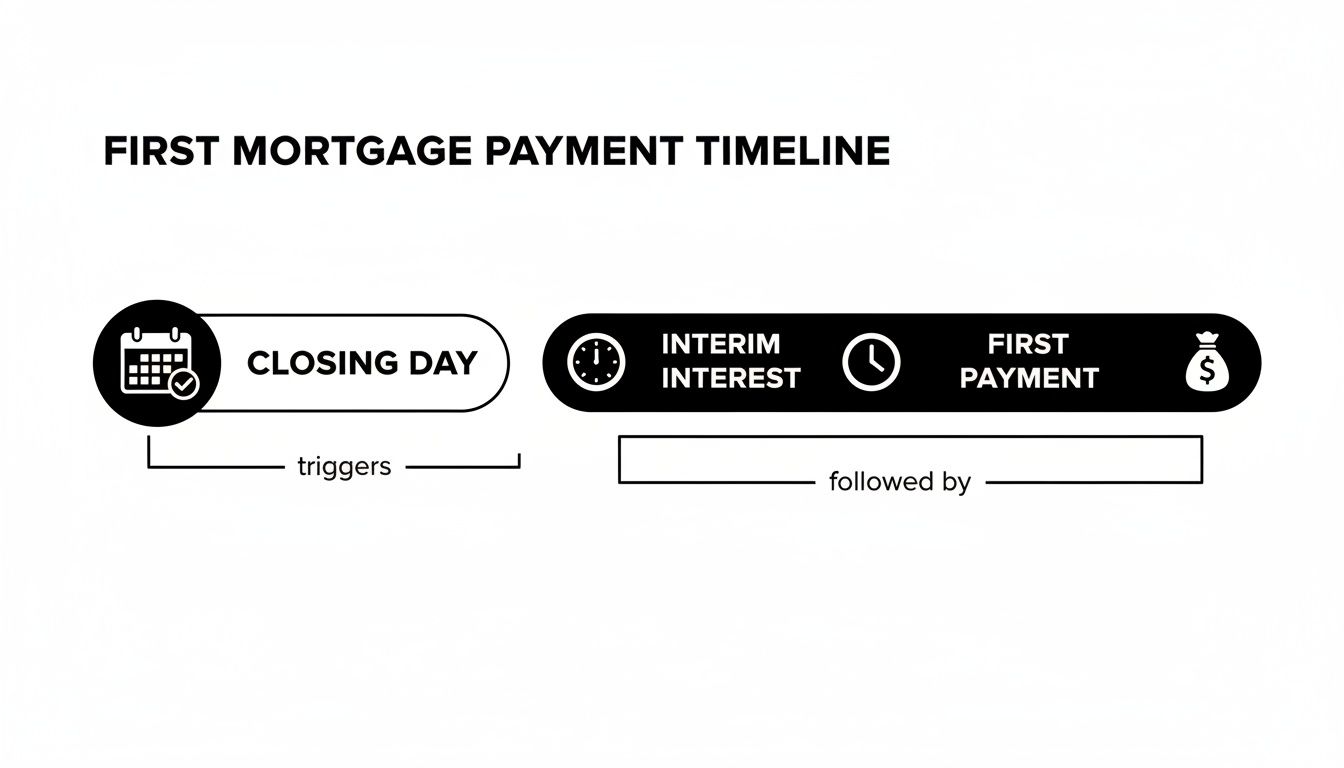
As you can see, the prepaid interest you pay at closing is what covers the gap, giving you a full month before that first regular payment is due.
Key Regional Differences
The further you venture, the more pronounced the variations become. Whether exploring Homes for Sale in Portugal or high-growth emerging markets like Brazil, local nuances are paramount.
Across most of Europe, an escrow account for taxes and insurance is rare. You are expected to manage these funds and pay the bills yourself.
In Homes for Sale in Brazil, the mortgage system, SFH (Sistema Financeiro da Habitação), has its own distinct regulations. Payments and insurance can be linked to national inflation indices, a critical detail for investors to comprehend before committing. These local quirks directly affect the true cost of your first mortgage payment and all subsequent payments.
For perspective, UK first-time buyers in 2000 faced average mortgage rates of 6.50%. By Q1 2024, the average first mortgage had reached £184,445, with first-time buyers accounting for 27% of all new lending, demonstrating market resilience. You can explore these historical trends in mortgage rates here.
This demonstrates that what is standard practice in one country can be a costly oversight in another. Local expertise is not just advantageous; it is essential.
A Global Comparison of First Mortgage Payments
This table provides a snapshot of how initial mortgage payment procedures differ across key international property markets, helping you prepare for your next global acquisition.
| Feature | USA Practice | UK Practice | Typical European Practice |
|---|---|---|---|
| Tax & Insurance | Often bundled into the payment and managed via an escrow account (PITI). | Paid separately by the homeowner directly to the council and insurer. | Almost always paid separately by the homeowner. |
| Interim Interest | Paid at closing to cover the period from closing to the end of the month. | Often calculated similarly but may be referred to as an “initial payment.” | Varies by lender; typically paid at closing or with the first payment. |
| Payment Frequency | Almost exclusively monthly. | Almost always monthly. | Monthly is standard, but some local variations may exist. |
| Grace Periods | A 15-day grace period before a late fee is applied is very common. | Grace periods are standard, though the exact length can vary. | Varies significantly by country and individual lender terms. |
Ultimately, while the objective is the same—to amortise your property loan—the journey to the first payment can look very different depending on the location. Researching these regional practices will prevent surprises and facilitate a smoother investment experience.
Your Pre-Payment Action Plan
Closing on a new property is a major achievement, but the financial diligence continues. Maintaining control of your finances from day one is critical, especially for international investors navigating different banking systems. This action plan outlines the essential steps to ensure your first mortgage payment is executed flawlessly.
As Nick Marr, founder of HomesGoFast.com, advises, “International buyers must be exceptionally organised. The period between closing and the first payment is critical for setting up systems that will prevent stress and costly errors down the line. A seamless start builds a strong foundation for a successful property investment.”
Essential Steps After Closing
Once the contracts are signed, your focus must shift to preparing for the first payment. Follow this checklist to stay organised and avoid last-minute complications.
- Await Your Welcome Packet: Monitor your post and email. Your mortgage lender or a new mortgage servicer will send a welcome letter. This packet is invaluable—it contains your new loan number, detailed instructions for account setup, and official confirmation of your due date. Do not attempt to make a payment until you receive this.
- Set Up Online Payments: As soon as you have your loan number, register on the lender’s online portal. Establishing automatic online payments is the most effective way to ensure you never miss a deadline. This is non-negotiable for overseas buyers who cannot rely on international mail. For more strategies, review our guide on 5 tips to stay on top of monthly mortgage payments.
- Confirm the Amount and Due Date: Your welcome letter will specify the exact payment amount, including any funds allocated for taxes and insurance (escrow). Verify this figure against your closing documents and immediately mark the due date in your calendar with reminders.
- Review Your Amortisation Schedule: Your lender should also provide an amortisation schedule. This document details every payment over the entire life of the loan, showing how early payments are heavily weighted towards interest. Understanding this helps you see how each first mortgage payment is the starting point on the long journey of building equity.
This first payment is more than a bill; it is a major life event. In the first quarter of 2024, the average UK first-time buyer mortgage was £184,445, with over £51.5 billion in new lending activity. This underscores the monumental step homeowners take with that initial payment. You can find more UK mortgage statistics from Uswitch based on Bank of England data.
Laying the Groundwork for a Smart Investment
Mastering the intricacies of the first mortgage payment is more than a procedural task; it is one of the foundational steps of property ownership, whether at home or abroad. Terms like PITI, interim interest, and payment schedules may seem like dry financial jargon, but they are the operational mechanics of your investment from day one.
Understanding these concepts early is your best defence against common financial pitfalls that can ensnare even experienced investors. It is about effectively managing cash flow and eliminating unforeseen liabilities.
Once you comprehend how payments are managed in different countries—from the escrow-centric approach in the USA to the more direct systems common across Europe—you are in a much stronger position to make astute financial decisions. A process that once seemed confusing becomes a predictable, manageable component of your investment strategy.
Ultimately, a firm grasp of your first mortgage payment sets the tone for your entire ownership experience. It provides the confidence to navigate the global property market with clarity, secure in the knowledge that you have started on a sound footing. Consider it the cornerstone of your real estate portfolio—getting this right ensures your entire investment is built on solid ground.
FAQs: Your First Mortgage Payment
Finalising a property purchase often raises last-minute questions. To help you proceed with confidence, here are straightforward answers to common queries from international investors and new buyers about their first mortgage payment.
Why is my first mortgage payment higher than expected?
This is a common surprise, typically due to the initial funding of your escrow or impound account. To establish this account, lenders often need to collect several months of property tax and homeowners’ insurance premiums at the outset. This creates a financial buffer to ensure these critical bills are paid on time. This initial collection, bundled with your standard principal and interest, can make the first payment seem larger than subsequent ones. Your final closing disclosure statement will provide a detailed itemisation of all components.
Can I make my first mortgage payment early?
Yes, you can. Once your loan is officially transferred to the mortgage servicer and your account is active, you can submit the payment. However, paying early does not typically advance the due date or alter the interest period it covers. For example, if your payment is due on 1st July, paying on 15th June will still be credited for the July payment. While there is no major financial benefit, it can provide significant peace of mind, particularly for those managing finances from overseas.
What happens if I miss my first mortgage payment?
Missing any mortgage payment is a serious matter, but a default on the very first one can negatively impact your relationship with the lender. Most lenders offer a grace period, typically 15 days, before a late fee is charged. The real issue arises if a payment becomes more than 30 days late. At this point, it is highly likely to be reported to the major credit bureaus, which can significantly damage your credit score. If you anticipate difficulty making a payment, contact your lender immediately to discuss your options before it becomes a problem.
Will I receive a bill for my first payment?
Yes, you will. After closing, the lender or their mortgage servicer will send you a ‘welcome packet’ via post or email. This packet is crucial, as it contains your new loan number, instructions for setting up your online account, and your first payment statement or coupon. It will specify the exact amount due, the PITI breakdown, and the official due date. It is advisable not to send any payment until you receive this official communication to ensure your funds are credited to the correct account.
About Homesgofast.com
HomesGoFast.com is a leading international property website, established in 2002, helping homeowners, real estate agents, and developers reach overseas buyers. Featuring thousands of listings from over 50 countries, the platform connects global property seekers with homes, apartments, villas, and investment opportunities worldwide.
Looking for expert mortgage guidance? Get international property mortgage advice here:
https://homesgofast.com/mortgages-overseas/
Explore more overseas homes for sale at our global partner site:
https://homesgofast.com/overseas-property/
Looking to sell real estate to foreign buyers? Go to
https://homesgofast.com/sell-overseas-property/