

Many aspiring investors believe buying commercial property abroad mirrors domestic transactions, a costly misconception. In reality, 60% of novice investors remain unaware of fundamental foreign legal and market differences. This guide demystifies commercial property investments overseas, covering definitions, legal frameworks, financial implications, market dynamics, and actionable strategies. You’ll gain clarity on navigating complex international deals confidently and avoiding common pitfalls that drain budgets and delay returns.
Table of Contents
- Understanding Commercial Property Abroad: Definitions and Types
- Legal and Regulatory Considerations
- Market Dynamics and Investment Returns
- Financial and Tax Implications for International Buyers
- Practical Challenges and Due Diligence
- Common Misconceptions and Their Corrections
- Analytical Framework for Buyers
- Explore Expert Resources for International Commercial Property Buyers
Key Takeaways
| Point | Details |
|---|---|
| Property types vary globally | Office, retail, industrial, and hospitality properties each carry unique risks and classifications abroad. |
| Foreign ownership restrictions exist | At least 30 countries impose legal limits on foreign commercial property ownership. |
| Transaction costs exceed expectations | Hidden fees and taxes typically add 10% to 15% beyond the purchase price internationally. |
| Due diligence takes longer | International processes require 20% to 40% more time than domestic deals due to complexity. |
| Market yields differ by region | Emerging markets may offer 12% yields but carry higher risks than mature markets with 5% to 7% returns. |
Understanding Commercial Property Abroad: Definitions and Types
Commercial property abroad refers to buildings and land used primarily for business purposes outside your home country. These properties generate income through leasing to tenants or businesses, distinguishing them from residential real estate. Understanding these classifications helps you identify opportunities matching your investment goals and risk tolerance across diverse markets.
Four core categories dominate international commercial markets. Office buildings house corporate operations and professional services, from downtown towers to suburban business parks. Retail spaces include shopping centers, storefronts, and malls leased to merchants. Industrial properties encompass warehouses, distribution centers, and manufacturing facilities serving supply chains. Hospitality assets like hotels and resorts cater to travelers and generate revenue through room bookings and services.
Terminology and property classifications shift significantly across borders. What Europeans call “high street retail” Americans term “main street commercial.” Asian markets often categorize mixed use developments differently than Western counterparts. Some countries distinguish between freehold and leasehold commercial properties with varying ownership rights. Others classify properties by zoning codes unfamiliar to foreign buyers.
Practical examples clarify these concepts. A beachfront hotel in Thailand represents hospitality commercial property. A logistics warehouse near Rotterdam’s port qualifies as industrial real estate. A shopping plaza in Dubai falls under retail commercial classification. An office tower in Singapore’s financial district exemplifies premium commercial space. Each type carries distinct tenant profiles, lease structures, and market dynamics you must understand before investing.
Core commercial property types:
- Office spaces ranging from Class A towers to suburban flex spaces
- Retail properties including shopping centers, standalone stores, and restaurants
- Industrial assets like warehouses, factories, and distribution facilities
- Hospitality venues such as hotels, resorts, and serviced apartments
Legal and Regulatory Considerations
Navigating foreign legal frameworks presents your biggest challenge when buying commercial property internationally. Each jurisdiction maintains unique ownership rules, registration processes, and compliance requirements that differ dramatically from your domestic experience. Misunderstanding these regulations triggers costly delays, unexpected fees, or complete transaction failures.
Foreign ownership restrictions affect commercial real estate in at least 30 countries worldwide. Some nations prohibit foreign ownership outright in strategic sectors or border regions. Others require forming local legal entities, partnerships with domestic investors, or obtaining special permits. Thailand, for instance, restricts foreign land ownership but allows condominium purchases under specific conditions. Mexico requires fideicomiso trusts for foreigners buying in restricted zones. The Philippines caps foreign ownership in corporations owning land at 40%.
Licensing and registration obligations multiply complexity further. Most countries mandate property registration with government agencies, often requiring notarized documents, translated paperwork, and substantial filing fees. Some jurisdictions impose occupancy permits, environmental clearances, or heritage approvals before completing transactions. Tax identification numbers, corporate registrations, and banking documentation consume weeks or months to secure.
Title issues represent critical legal risks you cannot ignore. Undisclosed liens, disputed ownership claims, or fraudulent documentation plague properties in markets with weak governance. Transfer restrictions may limit your ability to sell or lease freely. Zoning changes can suddenly devalue commercial assets. Inheritance laws might affect ownership succession differently than expected.
Key legal factors to investigate:
- Ownership restrictions specific to foreigners and commercial property types
- Required legal entity structures and corporate governance obligations
- Title verification processes and land registry reliability
- Zoning regulations and permitted commercial uses
- Transfer taxes, stamp duties, and registration fee structures
Pro tip: Engage qualified local legal counsel specializing in commercial real estate before signing any preliminary agreements. Their expertise identifies red flags early, negotiates protective clauses, and ensures compliance with evolving regulations. This upfront investment prevents far costlier problems later.
Our detailed guide to buying international property walks you through jurisdiction specific legal requirements and documentation checklists.
Market Dynamics and Investment Returns
Commercial property markets abroad exhibit vastly different performance characteristics than your domestic experience suggests. Rental yields, liquidity levels, and economic cycles vary dramatically by region, property type, and local demand factors. Understanding these dynamics helps you select markets matching your return expectations and risk capacity.
Typical rental yields range from 5% to 12% annually depending on location and market maturity. Established European and North American markets generally deliver 5% to 7% yields with greater stability and predictability. Emerging markets in Southeast Asia, Latin America, and Eastern Europe offer 8% to 12% yields but carry higher volatility and political risks. Prime urban office towers command lower yields but appreciate faster in growing cities. Secondary market properties may generate higher immediate income with limited capital appreciation potential.
Mature versus emerging market distinctions shape investment strategies significantly. Mature markets feature transparent legal systems, reliable data, established tenant bases, and easier exit strategies. Property values move steadily with lower risk of dramatic corrections. Emerging markets present opportunities for outsized gains as economies develop and urbanization accelerates. However, liquidity constraints, legal uncertainties, and currency fluctuations magnify downside risks.
Economic cycles profoundly impact commercial real estate performance internationally. Recessions reduce tenant demand, increase vacancy rates, and pressure rental income across all property types. Retail spaces suffer most during consumer spending contractions. Office markets weaken when corporations cut space or delay expansions. Industrial properties prove more resilient due to e commerce growth driving warehouse demand. Hospitality assets fluctuate wildly with tourism patterns and economic confidence.
Liquidity considerations vary enormously by market depth and buyer demand. Properties in major global cities like London, New York, or Singapore sell relatively quickly to diverse investor pools. Secondary cities and emerging markets may require 12 to 24 months to find qualified buyers. Specialized properties like data centers or cold storage facilities target narrow buyer segments, extending sale timelines further.
| Market Type | Typical Yield Range | Liquidity Level | Primary Risk Factors |
|---|---|---|---|
| Mature Markets | 5% to 7% | High | Lower returns, high competition |
| Emerging Markets | 8% to 12% | Medium to Low | Political instability, currency risk |
| Prime Urban | 4% to 6% | High | High entry costs, market saturation |
| Secondary Markets | 7% to 10% | Medium | Limited buyer pool, economic dependence |
Market analysis essentials:
- Research historical rental trends and vacancy rates over multiple economic cycles
- Assess demographic shifts and urbanization patterns driving tenant demand
- Evaluate infrastructure investments and development pipelines enhancing property values
- Monitor interest rate environments affecting financing costs and cap rates
Financial and Tax Implications for International Buyers
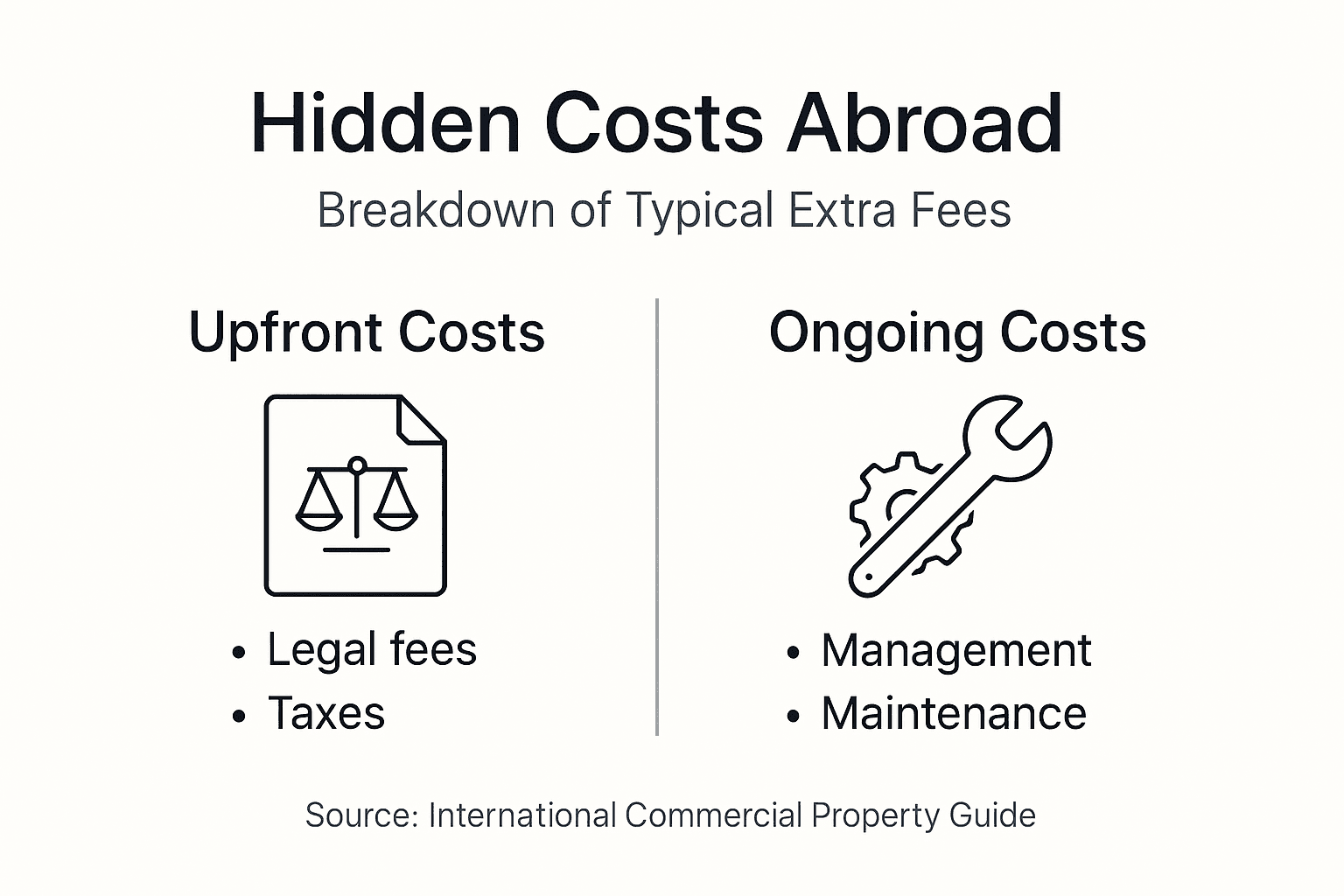
Transaction costs abroad typically add 10% to 15% beyond the purchase price, shocking investors accustomed to lower domestic fees. These expenses include legal fees, notary costs, registration charges, stamp duties, and currency conversion spreads. Some jurisdictions levy value added taxes on commercial transactions. Agent commissions may reach 3% to 6% depending on market norms. Survey fees, environmental assessments, and due diligence reports add thousands more.

Financing commercial property internationally presents substantial hurdles for foreign buyers. Local banks often refuse loans to non residents or impose stringent conditions. When available, foreign buyer mortgages carry interest rates 2% to 4% higher than domestic rates. Loan to value ratios rarely exceed 60% to 70%, requiring larger down payments. Some lenders demand personal guarantees, offshore collateral, or corporate structures adding legal complexity. Cross border financing through international banks provides alternatives but involves higher fees and extensive documentation.
Withholding taxes and tax treatment vary dramatically by jurisdiction, potentially consuming 10% to 30% of rental income or sale proceeds. Many countries tax foreign property owners at higher rates than residents. Rental income faces withholding at source before reaching your accounts. Capital gains taxes apply when selling, with rates and exemptions differing widely. Some nations impose wealth taxes on real estate holdings. Double taxation treaties between countries may reduce but not eliminate these burdens.
Currency exchange risks threaten returns when rental income or sale proceeds convert back to your home currency. Exchange rate fluctuations of 10% to 20% can erase years of rental profits or capital appreciation. Repatriating income involves bank fees, conversion spreads, and sometimes capital controls limiting outflows. Hedging strategies using forward contracts or currency options add costs but protect against adverse movements.
Financial planning priorities:
- Budget 10% to 15% above purchase price for transaction costs and fees
- Secure financing pre approval understanding interest rates and loan terms
- Model net returns after all taxes, management fees, and currency impacts
- Consult tax advisors in both property location and your residence country
- Establish banking relationships and payment mechanisms before bidding
Pro tip: Plan realistic budgets including hidden fees like annual property taxes, management costs, insurance, and maintenance reserves. Many buyers underestimate ongoing expenses, turning profitable investments into cash drains. Experienced investors add 20% contingency buffers to initial projections.
Explore our strategic guide for global investors covering financial structuring options. Review financing options for foreign buyers and understand capital gains tax on foreign property implications before committing capital.
Practical Challenges and Due Diligence
Due diligence for international commercial property takes 20% to 40% longer than domestic processes due to documentation complexity, translation needs, and verification challenges. Rushing investigations invites catastrophic mistakes. Thorough analysis protects your capital and prevents years of legal battles or financial losses.
Language barriers create immediate obstacles when reviewing contracts, title documents, zoning approvals, and tenant leases. Subtle translation errors change meanings dramatically. Legal terms lack direct equivalents across languages, causing misunderstandings. Professional translators specializing in real estate and legal terminology become essential team members, adding costs but preventing far greater problems.
Local expertise proves indispensable for navigating unfamiliar systems and uncovering hidden risks. Qualified attorneys verify title clarity, identify encumbrances, and ensure compliant purchase structures. Tax advisors model after tax returns and optimize holding structures across jurisdictions. Real estate agents with commercial expertise provide market comparables, tenant quality assessments, and negotiation support. Property managers evaluate building conditions, estimate renovation costs, and project operational expenses. Surveyors and engineers conduct technical inspections revealing structural issues or code violations.
Due diligence best practices:
- Verify clear title through comprehensive land registry searches and owner background checks
- Review all existing leases, tenant financials, and rental payment histories thoroughly
- Conduct professional building inspections assessing structural integrity and systems functionality
- Confirm zoning compliance and investigate any pending regulatory changes affecting use
- Analyze comparable sales and rental rates validating asking price reasonableness
- Obtain independent property valuations from accredited local appraisers
- Research neighborhood development plans and infrastructure projects impacting future value
- Verify all permits, licenses, and certificates required for legal operation
Successful investors engage local advisors 60 to 90 days before making offers. One Singapore based buyer avoided disaster when attorneys discovered undisclosed liens totaling 40% of a Bangkok property’s value. Another investor in Poland uncovered tenant lease forgeries through forensic accountant review, saving hundreds of thousands. A German fund manager sidestepped environmental cleanup obligations in Romania after engineers identified soil contamination the seller concealed.
Our guide to buying international property abroad provides jurisdiction specific due diligence checklists. Follow our how to buy property abroad expert guide for step by step processes minimizing risks.
Common Misconceptions and Their Corrections
Myths about international commercial property investment lead countless buyers into expensive mistakes. Correcting these false beliefs aligns your expectations with reality and prevents costly errors.
Buying abroad mirrors domestic investment: False. Legal systems, market customs, financing structures, and tenant expectations differ fundamentally across borders. Assuming similarity causes compliance failures, negotiation blunders, and financial miscalculations. Each market requires dedicated research and local expertise.
Transaction costs are minimal: False. Fees typically add 10% to 15% beyond purchase prices internationally. Legal charges, registration duties, taxes, currency conversion, and advisory fees accumulate quickly. Underestimating these costs depletes budgets and threatens deal completion.
Legal systems and market stability are uniform: False. Each country maintains unique property laws, court systems, and enforcement mechanisms. Political stability, economic governance, and regulatory transparency vary enormously. Markets you perceive as similar often operate under completely different frameworks.
Emerging markets are too risky and not worth considering: False. While emerging markets carry higher risks, they can deliver yields up to 12% compared to 5% to 7% in mature markets. Proper due diligence, local partnerships, and diversification strategies make these markets accessible to informed investors with appropriate risk tolerance.
Due diligence abroad resembles domestic processes: False. International investigations take 20% to 40% longer due to language barriers, documentation translation, verification complexities, and unfamiliar legal systems. Rushing due diligence or applying domestic standards invites disaster.
Analytical Framework for Buyers
A structured decision framework helps you evaluate international commercial properties systematically, balancing opportunity against risk across multiple dimensions. This model synthesizes insights from previous sections into actionable decision criteria.
Classify properties first by asset type and ownership restriction levels. Office and retail properties in unrestricted markets offer straightforward ownership. Industrial assets in restricted zones require entity formation. Hospitality properties may face foreign ownership caps or licensing requirements. This classification immediately reveals legal complexity and entry barriers.
Assess market liquidity and risk profiles distinguishing emerging from mature markets. Mature markets provide transparent pricing, reliable data, and faster exits but deliver moderate returns. Emerging markets offer higher yields and appreciation potential alongside political risks, currency volatility, and limited buyer pools. Your investment timeline and risk capacity determine suitable market types.
Evaluate financial feasibility considering financing availability, transaction cost burdens, and tax implications. Properties requiring 40% down payments and facing 15% transaction costs demand substantial capital. High withholding tax rates reduce net returns significantly. Currency risks may necessitate hedging costs. Run detailed pro forma projections modeling all scenarios.
| Evaluation Axis | Mature Markets | Emerging Markets | High Restriction Zones |
|---|---|---|---|
| Legal Complexity | Low to Medium | Medium to High | High |
| Ownership Structure | Direct ownership | Entity formation often required | Complex structures mandatory |
| Typical Yields | 5% to 7% | 8% to 12% | Varies widely |
| Liquidity | High | Medium to Low | Low |
| Due Diligence Time | Standard | Extended 20% to 40% | Extended plus legal reviews |
Risk and reward balancing strategies:
- Diversify across multiple markets and property types reducing concentration risk
- Start with mature markets gaining international experience before tackling emerging opportunities
- Partner with experienced local investors sharing knowledge and connections
- Maintain adequate capital reserves covering unexpected costs and vacancy periods
- Use professional advisors extensively rather than learning through expensive mistakes
Discover opportunities through our guide to international city property for sale featuring vetted listings across diverse markets.
Explore Expert Resources for International Commercial Property Buyers
Applying the frameworks and insights from this guide requires reliable information sources and trusted market intelligence. HomesGoFast connects you with curated commercial property listings across 50+ countries, comprehensive buying guides, and expert resources tailored for international investors like you.

Access our strategic guide for global investors covering advanced strategies for portfolio diversification and risk management. Browse property for sale international listings featuring opportunities matched to your investment criteria. Utilize our international city property guide spotlighting prime urban markets worldwide. Start your investment journey equipped with professional insights and expert support.
FAQ
What legal restrictions should I check before buying commercial property abroad?
Confirm whether your target country restricts foreign ownership of commercial real estate or requires forming local legal entities. At least 30 nations impose such limitations. Check licensing and registration obligations specific to your property type and location, as non compliance triggers penalties or transaction cancellations.
How do transaction costs affect my investment budget internationally?
Transaction costs typically add 10% to 15% to the purchase price through legal fees, registration duties, taxes, and currency conversion charges. These expenses are substantially higher than domestic deals. Budgeting accurately for these costs prevents funding shortfalls that delay or derail transactions.
What are the risks and rewards of investing in emerging markets?
Emerging markets may deliver rental yields reaching 12% compared to 5% to 7% in mature markets, offering superior return potential. However, they carry greater legal uncertainties, political instability, and currency volatility. These investments suit investors with higher risk tolerance and longer time horizons who conduct extensive due diligence.
How can I streamline the due diligence process abroad?
Engage local legal counsel, tax advisors, and market experts early in your search process, ideally 60 to 90 days before making offers. Use professional translators for all documentation review ensuring accuracy. Plan for timelines 20% to 40% longer than domestic deals, allowing adequate investigation without rushing critical verifications that protect your investment.
Recommended
- How to Buy Property Abroad: An Expert Guide for Global Investors
- Blog – International Property For Sale | Homesgofast
- A Savvy Investor’s Guide to Finding Property for Sale International
- Your Guide To International Property For Sale