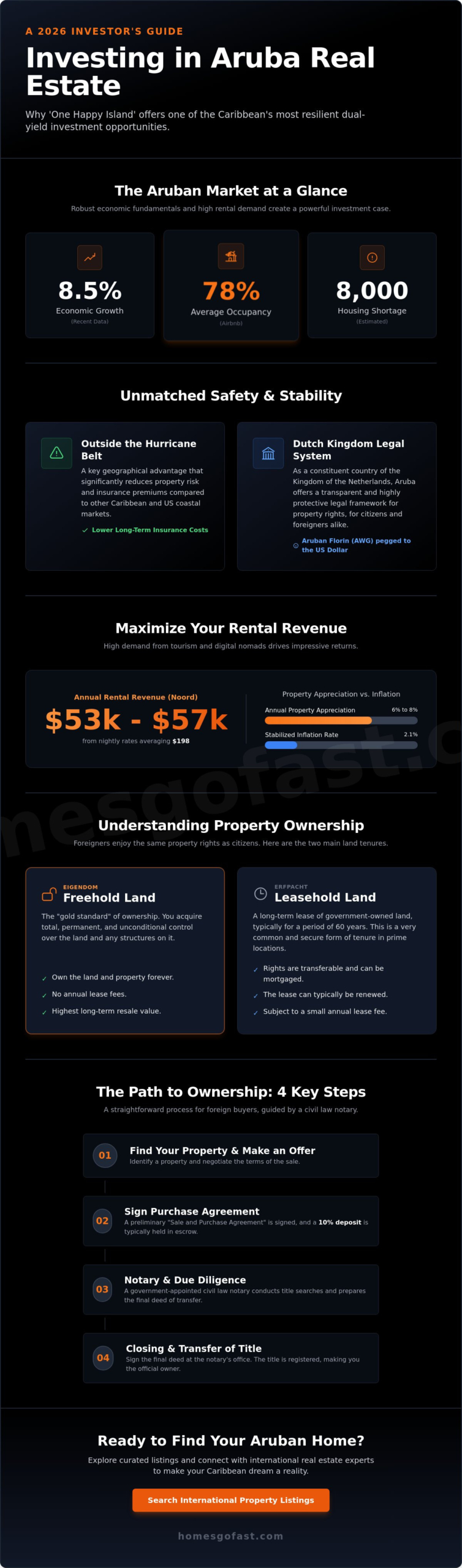
With an estimated shortage of 8,000 homes and an average Airbnb occupancy rate of 78%, the market for aruba homes for sale is currently offering one of the Caribbean’s most resilient “dual-yield” investment opportunities. Investors are attracted by the 8.5% economic growth recorded recently and the stability of the Aruban florin, which is pegged directly to the US dollar.
You’ve likely dreamed of owning a slice of “One Happy Island,” but the leap from vacationer to property owner often feels daunting. Buyers are increasingly looking for clarity on Dutch-Caribbean property laws and the long-term implications of 60-year leasehold land. This guide simplifies the journey, showing you how to navigate the market while avoiding hidden closing costs and maximizing your ROI.
We’ll break down the latest 2026 market data, from the $138,889 transfer tax threshold to the neighborhoods generating US$57,000 in annual rental revenue. Whether you want to search international property listings or compare overseas real estate markets, this guide ensures your Caribbean investment is both safe and profitable.
Key Takeaways
- Learn how Aruba’s position outside the hurricane belt protects your property and lowers long-term insurance costs.
- Identify the critical differences between freehold and leasehold land to secure the right ownership structure for your goals.
- Pinpoint the highest-performing neighborhoods, such as Noord, to maximize your potential vacation rental income.
- Navigate the legal process with confidence by understanding the 10% deposit rules and local banking requirements for foreigners.
- Explore a curated selection of aruba homes for sale to compare market values and find the best international deals.
Why Aruba Homes for Sale are Topping International Wishlists in 2026
Investors are attracted by more than just white sand and turquoise water. The “One Happy Island” maintains the highest repeat-visitor rate in the Caribbean, which creates a deep, reliable pool of potential renters for those exploring aruba homes for sale. This unique brand loyalty means your property isn’t just a vacation home; it’s a high-demand asset in a market where 78% occupancy rates are the standard for well-located villas.
Safety remains a primary concern for any international buyer, and Aruba offers a geographical advantage that few neighbors can match. The island sits comfortably outside the hurricane belt, which significantly reduces the risk of storm damage and keeps insurance premiums much lower than in Florida or the Virgin Islands. This environmental security, combined with a 2024 economic growth rate of 8.5%, makes the island a strategic hedge against the volatility found in other overseas property markets.
To visualize the potential of these island investments, watch this helpful video:
Understanding Aruba’s economic profile is essential for any savvy buyer. The island holds a high-income status with a stabilized inflation rate of 2.1% as of early 2026. This fiscal health is anchored by a sophisticated tourism sector that has successfully pivoted to attract higher-spending travelers and long-term remote workers, ensuring that property values in tourist zones continue to see annual appreciation of 6% to 8%.
The Safety and Stability Factor
Buyers are increasingly looking for the political and legal certainty offered by the Dutch Kingdom. Since Aruba is a constituent country within the Kingdom of the Netherlands, you benefit from a legal system that is transparent and highly protective of property rights. Beyond the courtrooms, the island’s infrastructure is some of the best in the region. Expats often cite the reliable utility grid and high-quality road networks as deciding factors for choosing Aruba over other Caribbean destinations. Crime rates remain remarkably low, allowing for a relaxed lifestyle that feels secure for both families and solo retirees.
Investment Potential and Rental Yields
The financial logic for buying here is bolstered by a 22% increase in Caribbean rental demand over the last year. In high-demand zones like Noord, properties frequently command nightly rates of US$198, translating to annual revenues between US$53,000 and US$57,000 for savvy owners. The “digital nomad” trend has also created a lucrative niche for mid-term rentals, as professionals seek the island’s 2026 connectivity and safety for months at a time. Aruba’s 2026 market growth is consistently resilient.
Understanding Ownership: Freehold vs. Leasehold Land in Aruba
Foreigners enjoy the exact same property rights as Aruban citizens. You won’t need a local partner or a complex residency status to hold a title here. When you begin searching for aruba homes for sale, the most significant factor in your purchase isn’t just the view, but the legal foundation of the land itself. Aruba operates under a Dutch-based legal system that offers two primary forms of land tenure: Eigendom and Erfpacht.
Investors should consult a comprehensive investment guide for Caribbean real estate to see how Aruba’s stability compares to other regional markets. While both land types are secure, they carry different implications for your annual budget and long-term resale value. Buyers are increasingly looking for properties that offer the simplest path to full ownership, but the reality of island geography often makes leasehold land the more common option in high-demand areas.
The Pros and Cons of Eigendom (Freehold)
Eigendom is the “gold standard” of ownership. It gives you total, permanent control over the land and any structures built upon it. You own it forever. This makes it highly desirable for those seeking maximum autonomy and the highest possible capital growth.
- Pros: No annual lease fees, complete control over the property, and generally higher resale appeal.
- Cons: High scarcity in prime coastal zones like Noord and Malmok, which often leads to a higher initial purchase price.
Navigating Erfpacht (Leasehold) Terms
Erfpacht is land owned by the Aruban government and leased to you for a 60-year term. This is incredibly common; many of the island’s most luxurious villas in gated communities sit on leasehold land. You pay an annual fee called a “canon,” which is calculated based on the land’s value.
The renewal process is straightforward. At the end of the 60-year term, the lease is typically renewed for another 60 years. While the annual fee may increase upon renewal, the rights of the leaseholder are strongly protected. Local banks regularly provide mortgages for Erfpacht properties, though non-residents should expect a down payment requirement between 40% and 50%.
Investors are attracted by the lower entry price points often found with leasehold properties, which can boost initial rental yields. If you’re ready to compare these options across the island, you can browse current international property listings to see how land type influences market pricing. Understanding these nuances ensures you secure a home that fits your financial goals and lifestyle aspirations.
Top Neighborhoods and Property Types for International Buyers
Choosing the right location is the difference between a stagnant asset and a high-performing investment. In 2026, the search for aruba homes for sale is split between high-traffic tourist zones and quiet residential escapes. Buyers are increasingly looking for neighborhoods that offer specific lifestyle benefits, whether that’s proximity to the “High Rise” hotel strip or the rugged beauty of the island’s interior.
The High-Yield Tourist Zone: Palm Beach and Eagle Beach
Noord remains the epicenter of the island’s rental market. If your goal is to secure a property with a 78% occupancy rate, walking distance to the beach is the single most important factor. Properties in Malmok offer the highest prestige, often featuring luxury villas on freehold land, while lower Noord neighborhoods provide more accessible entry points for townhomes and condos.
- Condos: Best for hands-off investors. They offer on-site management, security, and communal pools.
- Villas: Preferred by families and larger groups. Private pools and outdoor kitchens significantly drive up nightly rates.
- Market Insight: Investors are attracted by the “walkability factor” in areas like Bakval and Salina Cerca, where rental demand remains high year-round.
Quiet Residential Retreats: Santa Cruz and Paradera
Don’t ignore the island’s interior. Neighborhoods like Santa Cruz and Paradera offer a different kind of value. Here, you can find larger lots and more square footage for your dollar compared to the coastal strips. These areas are perfect for retirees or long-term expats who want to be near Arikok National Park and enjoy a more traditional Aruban atmosphere.
The rustic, peaceful vibe of inland Aruba is a great lifestyle comparison for those who have previously looked at Italian homes for sale in the countryside. You trade the immediate beach access for mountain views and a sense of community that feels authentic rather than tourist-centric.
Emerging Trends: Urban Living and Eco-Homes
Oranjestad is currently undergoing a revitalization. We see a rise in luxury condos that blend historic Dutch-Caribbean architecture with modern urban amenities. This is ideal for buyers who want to be near the cruise terminal, high-end shopping, and the airport. Further south, Savaneta and San Nicolas are attracting off-the-beaten-path investors who want to get in early on the next wave of coastal development.
A significant 2026 trend is the rise of modular and eco-friendly gated communities. These projects focus on solar energy and sustainable water management, appealing to the growing demographic of environmentally conscious buyers. If you are ready to find your place on the island, you can search international property listings to compare these emerging neighborhoods side-by-side.
The Step-by-Step Buying Process for Foreigners in 2026
Starting your search for aruba homes for sale is exciting, but the transaction itself follows a strict legal sequence designed to protect your investment. You’ll begin by securing a local bank account and providing proof of funds. Aruban banks require thorough “Know Your Customer” (KYC) documentation, so prepare your tax returns and professional references early to avoid delays in the banking system.
Once you’ve selected a property, you’ll sign a preliminary Purchase Agreement. This contract is legally binding and usually requires a 10% deposit. This sum isn’t paid to the seller; it’s held in a secure escrow account by a licensed notary. This deposit secures the home while the formal legal checks are completed, typically within a 60 to 90-day closing window.
The Critical Role of the Aruban Notary
In Aruba, the Civil Law Notary is the central figure in any property transfer. Unlike some markets where buyers and sellers hire separate attorneys, the Aruban notary is a government-appointed official who acts as an impartial third party. They’re responsible for performing the title search, verifying that the property is free of liens, and ensuring the deed of transfer is executed according to Dutch-Caribbean law. You can’t bypass this step, as only a notary can legally register the transfer at the Land Registry.
Understanding Closing Costs and Taxes
You should budget between 5% and 8% of the purchase price for total closing costs. The largest portion of this is the Transfer Tax (Overdrachtsbelasting). For properties valued up to AWG 250,000 (approximately USD $138,889), the rate is 3%. Any amount above this threshold is taxed at 6%. Notary fees typically add another 2%, which covers the preparation of both the transfer deed and the mortgage deed if you’re financing. To stay organized, use our international real estate listings checklist to track these expenses during your search.
Financial Planning and Currency
One of the biggest advantages for North American buyers is the currency stability. The Aruban florin is pegged to the US dollar at a fixed rate of 1.79, which eliminates the risk of sudden price fluctuations during your closing period. You can explore how this stability impacts long-term ROI in our report on global market trends. If you require a mortgage, local banks offer financing to non-residents, though you’ll typically need a down payment of 40% to 50%.
Ready to move from research to reality? Explore current international real estate listings to find the latest aruba homes for sale and start your journey toward island ownership today.
Maximize Your Search: How HomesGoFast Connects You to Aruba
Finding the right property on a 70-square-mile island requires more than a simple search engine. It requires a gateway to local expertise. HomesGoFast has spent over 20 years refining the process of buying property abroad, acting as a bridge between motivated international buyers and the island’s most reputable agents. By centralizing aruba homes for sale, we allow you to perform cross-border price comparisons that ensure you’re paying a fair market rate.
Investors are attracted by our platform’s ability to filter through the noise. Whether you’re looking for a beachfront condo in Noord or a secluded villa in Santa Cruz, our interface prioritizes speed and clarity. We understand that the Caribbean market moves fast. Having access to a global marketplace gives you a distinct advantage over those relying solely on local word-of-mouth.
Leveraging the Agent Pro Network
We don’t just host any listing. Our Agent Pro network consists of vetted professional agencies that understand the nuances of Aruban law and the specific needs of foreign investors. This ensures that every listing on our platform comes with the backing of an expert who can navigate the notary process we’ve already detailed.
If you already own property on the island and want an exit strategy, you can sell overseas property by reaching our massive global audience instantly. We specialize in lead generation that connects sellers with serious, qualified buyers from North America and Europe, significantly reducing the time your home stays on the market.
Expert Guidance Every Step of the Way
Our commitment to a human-first approach means we provide more than just a list of houses. We offer the editorial insights and hard market data you need to make an informed decision. You can use our platform to benchmark owner pricing effectively, comparing current aruba homes for sale against historical trends to identify the best value.
Buyers are increasingly looking for a partner that balances aspirational dreams with practical investment logic. We take pride in being that seasoned global expert. We help you maximize your capital growth while securing a home in one of the world’s most stable regions. Ready to find your island home? Browse our latest international property listings today and take the first step toward your new life in the sun.
Securing Your Future in the Dutch Caribbean
Aruba’s 2026 real estate market offers a rare combination of Dutch legal security and high North American rental demand. By understanding the distinction between freehold land and the 60-year leasehold cycle, you can navigate the market with the confidence of a local. The island’s position outside the hurricane belt and its recorded 8.5% economic growth rate provide a stable foundation for long-term capital appreciation.
Success in finding the best aruba homes for sale depends on a mix of local expertise and global reach. Since 2002, HomesGoFast has connected millions of buyers with trusted agents through our expert-led international property guides. We simplify the complexities of overseas transactions so you can focus on the rewards of island living and the freedom of owning a home in the sun.
Now is the time to act while demand from international buyers remains high and inventory in prime zones like Noord is limited. Explore the latest Aruba homes for sale and secure your investment today. Your dream of owning a slice of “One Happy Island” is closer than you think, and we’re here to help you reach it.
Frequently Asked Questions
Can a foreigner buy property in Aruba?
Yes, you can buy property in Aruba with the exact same rights as a local citizen. There are no restrictions on foreign ownership, and you don’t need a local partner or a residency permit to complete a transaction. The process is transparent and follows Dutch-Caribbean legal standards.
What are the property taxes like in Aruba for non-residents?
Non-residents pay a flat annual property tax rate of 0.6% of the property’s appraised value. This predictable rate makes it easy to calculate the total cost of ownership when you’re comparing different aruba homes for sale. Residents follow a tiered system, but for international investors, the 0.6% flat rate applies across the board.
Is it better to buy freehold or leasehold land in Aruba?
Freehold land (Eigendom) offers permanent ownership, while leasehold land (Erfpacht) involves a 60-year renewable government lease. Freehold is often preferred for long-term security, but leasehold land is very common in high-demand tourist areas. Both types are fully transferable and are recognized as secure collateral by local mortgage lenders.
How much is the closing cost when buying a home in Aruba?
You should budget between 5% and 8% of the purchase price for total closing costs. This includes a transfer tax of 3% for properties valued under approximately USD $138,889 and 6% for anything above that threshold. Notary fees typically add another 2% to the final bill, covering the legal transfer and registration of the deed.
Can I get a mortgage in Aruba as a US or UK citizen?
Yes, local Aruban banks offer mortgage financing to US and UK citizens. You’ll typically need to provide a down payment between 40% and 50% of the purchase price. While specific 2026 rates depend on the lender, the World Bank reported a benchmark interest rate of 5.8% recently, providing a solid reference point for your financial planning.
What is the average rental yield for a vacation home in Palm Beach?
Vacation homes in the Palm Beach area currently see an average occupancy rate of 78%. With an average nightly rate of US$198, many properties generate annual revenues between US$53,000 and US$57,000. These strong figures continue to drive interest in aruba homes for sale among investors seeking high-yield short-term rentals.
Do I need to live in Aruba to own a business or rental property there?
No, you don’t need to be a resident to own or operate a rental property on the island. Many international owners manage their investments entirely from abroad. While property ownership allows you to stay in Aruba for up to 180 days per year, it’s important to remember that it doesn’t automatically grant permanent residency status.
What happens if I want to sell my Aruba home in the future?
Selling your home in Aruba is a straightforward process with no restrictions on foreign sellers. You can choose to market your property locally or use global platforms to reach a wider audience of international buyers. The island’s consistent 6% to 8% annual value growth in tourist zones ensures that well-maintained homes remain highly liquid assets.