

Selling a property abroad is exciting, but it brings a tricky financial question to the table: how do you handle the capital gains tax on foreign property? This guide is here to cut through the jargon and give you a clear, straightforward look at what this tax really means for your international investments.
Here’s the simple truth: when you sell an overseas asset for a profit, both your home country and the country where the property is located might want a slice of the pie. What you ultimately owe comes down to three things: your tax residency, where the property is, and the fine print of any double taxation treaty between the two nations.
Think of this article as your roadmap. We’ll break down these rules step-by-step, giving you the confidence to plan effectively. The goal is to help you legally minimise what you owe and make smart decisions, turning you from a worried owner into a savvy global investor.
Understanding Capital Gains Tax on Foreign Property
When you decide to invest in property overseas, the day you sell is a critical financial moment that demands smart planning. The profit you make—the ‘capital gain’—is often taxable in two places at once. It’s a regulatory web that can feel overwhelming at first.
This is the heart of the capital gains tax foreign property challenge: keeping the tax authorities happy in both the country where the property sits (the source country) and your home country (your country of residence).
The Fundamental Principles at Play
At its core, this all boils down to a couple of key ideas. First, most countries that charge a capital gains tax will claim the right to tax profits from any property sold within their borders, no matter where the seller lives. This is what’s known as source-based taxation.
At the same time, countries like the UK and the Homes for Sale in the USA tax their residents on their worldwide income. This is residency-based taxation, and it means they also expect a share of the profit from your property sale, even if that home is thousands of miles away. It’s this overlap that creates the potential for being taxed twice.
For a deeper dive into the strategic side of buying abroad, our guide on investing in foreign real estate provides some essential background.
Key Factors Determining Your Tax Liability
A few different elements come together to figure out your final tax bill. Getting a handle on them is the secret to good tax planning.
- Your Tax Residency Status: This is always the starting point. Where are you officially considered a tax resident? Your home country’s rules on worldwide income are the first piece of the puzzle.
- Property Location: The laws in the country where you own the asset will always come into play. Every nation has its own tax rates, exemptions, and reporting deadlines.
- Double Taxation Treaties: These agreements between countries are your best friend. They set out which country gets the first shot at taxing you and provide relief, usually through foreign tax credits, to make sure you don’t pay the full whack twice on the same gain.
To really get to the bottom of your liabilities, you have to look at specific country rules. For instance, understanding the details of regulations like the Foreign Resident Capital Gains Tax in Australia is absolutely vital for anyone investing there. Getting to grips with these local nuances is what separates a good investor from a great one.
The Two Pillars of International Tax Law
To get your head around your obligations for capital gains tax foreign property, you first need to understand the two bedrock principles that govern all international tax: residency-based and source-based taxation. These concepts are the rulebook for deciding which country gets to tax your profits.
Think of residency-based taxation like your home country having a global reach. If you’re a tax resident there, it claims the right to tax your worldwide income, and that includes any profit you make selling a property anywhere on the planet. This is exactly why a UK citizen selling a holiday home in Homes for Sale in Spain must declare that gain back home.
On the flip side, source-based taxation gives the country where your property is physically located the first bite of the apple. The logic is simple: the profit was generated, or ‘sourced,’ from an asset within its borders. So, a US citizen selling an apartment in Lisbon will find that Homes for Sale in Portugal has the primary right to tax that profit.
This flowchart maps out the decision-making journey to help you figure out which rules might apply in your specific situation.
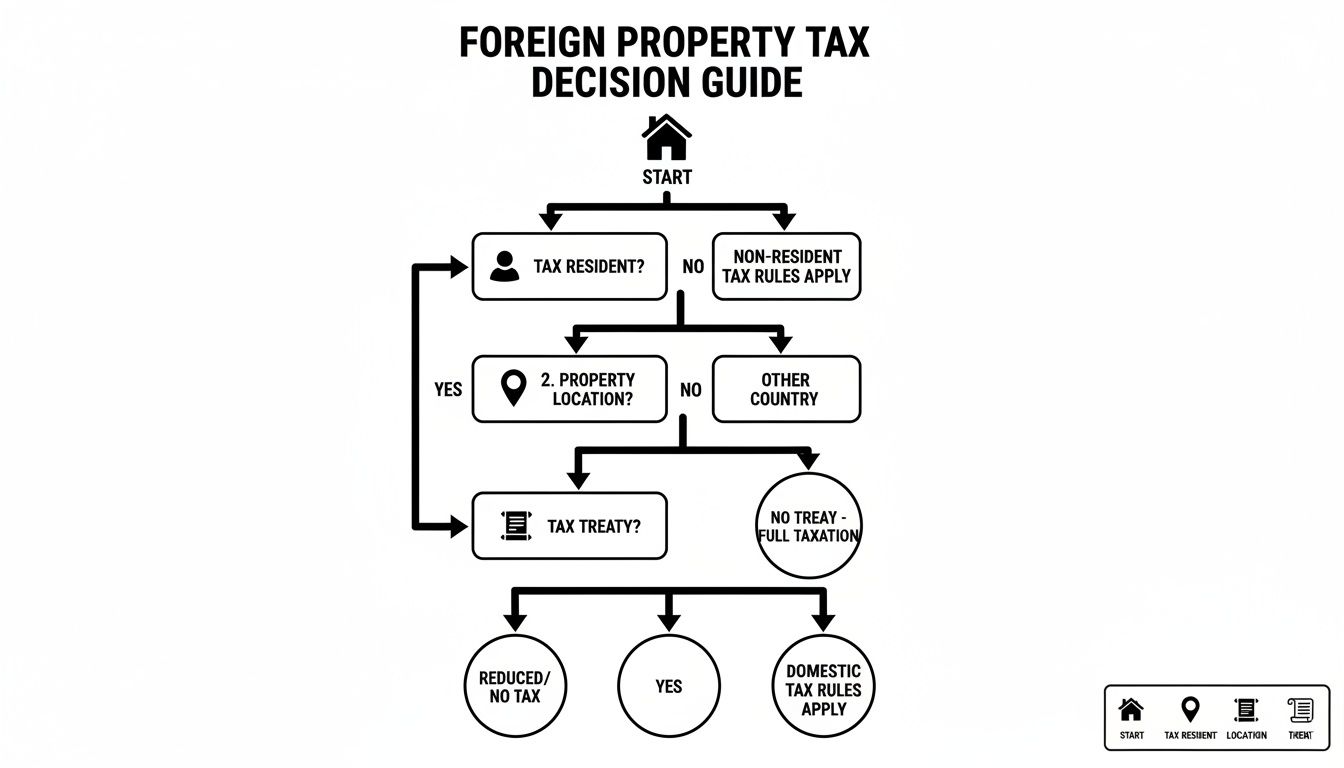
The key thing to take from this is that your tax journey always starts with establishing residency, then looking at the property’s location, and finally, seeing if a tax treaty is in play.
The Inevitable Clash and the Risk of Double Taxation
This is where it gets tricky. The natural conflict between these two principles creates the biggest headache for international investors: the very real risk of double taxation. This happens when both your home country (under its residency rules) and the property’s location (under its source rules) decide to tax the exact same capital gain.
Without a system to sort this out, your investment returns could be seriously hammered. Imagine paying a 20% tax in the source country, only to be hit with another 20% tax in your home country on the same profit. It’s a scenario that would put almost anyone off investing abroad.
This is precisely where Double Taxation Treaties (DTTs) come to the rescue. These agreements between countries act as the official referee, setting out a clear hierarchy for taxing rights and providing mechanisms to make sure you don’t end up paying tax twice. If you’re just starting out, our guide on how to buy property abroad offers great context for the initial purchase journey.
The whole concept of taxing capital gains has a fascinating history. Capital Gains Tax (CGT) first landed in the UK back in 1965. It was brought in to tackle a post-war property boom where developers were leaving office blocks empty just to maximise untaxed capital growth instead of rental income. Today, UK residents must report their worldwide gains, including those from foreign property, with current rates hitting 24% for higher-rate taxpayers on residential assets.
Residency vs Source Taxation at a Glance
To make these concepts crystal clear, let’s put them side-by-side. Getting this fundamental dynamic right is the first major step towards building a smart cross-border tax strategy and protecting your returns when dealing with capital gains tax foreign property.
This table breaks down the core principles of residency-based and source-based taxation on foreign property gains.
| Taxation Principle | Who is Taxed? | What is Taxed? | Example Scenario |
|---|---|---|---|
| Residency-Based | Tax residents of the country, no matter where they are. | Worldwide income and gains, including profits from property sold in another country. | A UK resident sells a villa in Tuscany and must report the gain on their UK tax return. |
| Source-Based | Anyone, resident or not, who makes a profit within the country’s borders. | Gains arising from sources within that country, such as the sale of local real estate. | A Canadian resident sells a condo in Miami and must pay US capital gains tax on the profit. |
Ultimately, understanding whether you’re being taxed based on where you live or where your property is located is the foundation for navigating international tax successfully.
How Tax Treaties Prevent Paying the Same Tax Twice

When the taxman from two different countries wants a piece of the same profit, investors get caught in the middle. This clash between residency and source rules creates the very real risk of double taxation—paying tax on the same gain, twice. It’s a scenario that could seriously eat into your returns.
To stop this from happening and keep global investment flowing, countries sign formal agreements called Double Taxation Treaties (DTTs). For anyone dealing with capital gains tax on foreign property, these treaties are your best defence.
Think of a DTT as a rulebook that decides who gets first dibs on the tax. It ensures the profit from your overseas property sale isn’t unfairly hit by two different tax authorities.
“Savvy international buyers always investigate the tax treaty between their home country and their target market; it’s as crucial as checking the property’s title deeds.” — Nick Marr, founder of HomesGoFast.com
Getting your head around how these treaties work is key. They typically offer relief in one of two ways: the credit method or the exemption method.
The Foreign Tax Credit Method
This is the most common approach you’ll find in DTTs. The foreign tax credit method doesn’t wipe out your home country’s tax bill, but it does give you a direct way to reduce it.
It works like a discount. First, your home country figures out the tax you owe on the foreign property gain using its own rules. Then, it lets you subtract the tax you’ve already paid to the source country. It’s often a pound-for-pound reduction.
Let’s look at a quick example. A US resident sells a villa in Spain.
- Gain on Sale: $100,000
- Spanish CGT Paid: $19,000 (at Spain’s 19% rate)
- US CGT Owed (e.g., at 20%): $20,000
- Credit Applied: $19,000
- Final US Tax Due: $1,000 ($20,000 – $19,000)
Without the treaty, that investor could have been looking at a painful $39,000 tax bill. With the credit method, the total tax paid is capped at the higher of the two countries’ rates. Simple.
The Exemption Method Explained
Less common, but a huge win if you can get it, is the exemption method. It’s exactly what it sounds like: your home country simply agrees to ignore the profit you made from the foreign property sale.
Under this model, the source country gets the sole right to tax your capital gain. Your country of residence completely exempts that profit from its tax calculations. This means you only have to deal with one tax authority for that particular transaction. You’ll usually find this method in treaties between countries with very tight economic relationships.
The Evolving Global Tax Landscape
Tax laws are never set in stone. They shift with economic winds and government policies. A perfect example is the UK, which completely overhauled its rules for non-residents.
Since April 2015, the UK’s CGT net was thrown much wider to catch non-residents selling UK residential property. This closed a long-standing loophole that let overseas owners sell up tax-free. It’s a stark reminder of just how vital it is to stay on top of the tax rules in any country you invest in.
Ultimately, tax treaties are there to bring certainty and fairness to international investors. By figuring out whether a credit or exemption method applies between your home country and investment destination, you can properly forecast your tax liabilities and make much smarter decisions for your property portfolio.
Calculating Your Capital Gain and Applying Reliefs
This is where the rubber meets the road. Nailing down your taxable profit is the most critical step in managing your capital gains tax foreign property bill. The formula itself looks simple enough, but the devil is in the details—especially when you factor in allowable costs and the ever-shifting world of currency exchange rates.
At its heart, the calculation is straightforward:
Sale Price – (Purchase Price + Allowable Costs) = Capital Gain
The real art lies in understanding what counts as an “allowable cost.” This is how you legally and significantly shrink your taxable gain. These aren’t your day-to-day running expenses; they are specific, substantial costs tied directly to buying, improving, and selling the property.
Identifying Your Allowable Costs
Your cost basis isn’t just the price you paid for the property. It’s a bigger number, and that’s good news for you. It includes a whole range of legitimate expenses that beef up the base value of your property for tax purposes, ultimately reducing the final profit figure.
Here’s what you can typically include:
- Acquisition Costs: Think back to when you first bought the place. All those upfront expenses—legal fees for conveyancing, surveyor’s reports, and any stamp duty or transfer taxes—get added to your cost base.
- Capital Improvement Costs: This is a big one. It covers any major spending that genuinely enhances the property’s value. We’re talking about adding an extension, putting in a brand-new central heating system, or a complete kitchen remodel. Crucially, this isn’t for routine maintenance like a lick of paint or fixing a leaky tap.
- Selling Costs: When it’s time to sell, the costs don’t stop. The fees you pay to get the deal done can be deducted from your gain. This usually includes estate agent commissions, legal fees for the sale, and any money spent on advertising.
A word of warning: keep meticulous records. Every invoice, every receipt for these expenses is non-negotiable. If you can’t prove it, tax authorities will simply disallow the claim.
The Critical Impact of Currency Fluctuations
Here’s a classic trap for international investors dealing with capital gains tax foreign property: forgetting about currency fluctuations. What looks like a healthy profit in the local currency can easily shrink—or even turn into a loss—once you convert it back into your home currency for tax reporting.
Your home country’s tax authority doesn’t care about the profit in Euros, Dollars, or Reais. They want to see the gain or loss in their own currency. This means you must convert the purchase price using the exchange rate on the day you bought it, and the sale price using the rate on the day you sold it. The difference between those two figures is what determines your taxable gain, not the local currency profit.
Worked Example: A Brazilian Property Sale
Let’s see this in action with a UK resident selling a property abroad. Imagine an investor who bought one of the fantastic Homes for Sale in Brazil a decade ago and has just sold it.
- Purchase Year: 2014
- Purchase Price: BRL 500,000 (at an exchange rate of £1 = BRL 3.80, this was £131,579)
- Sale Year: 2024
- Sale Price: BRL 800,000 (at an exchange rate of £1 = BRL 6.30, this is now £126,984)
Look closely at those numbers. Despite making a tidy BRL 300,000 profit in the local currency, the pound strengthened significantly against the real. When converted back to sterling for HMRC, the investor has actually realised a capital loss of £4,595. This loss could even be used to offset other capital gains, proving just how central currency is to your final calculation.
Applying Reliefs and Exemptions
Once you’ve calculated your net gain, don’t stop there. You can often trim your final tax bill even further by applying reliefs and exemptions. The rules vary massively from one country to another, but here are a couple of common examples:
- Annual Exempt Amount (UK): UK residents get a tax-free allowance for capital gains each year. If your total gains fall below this threshold, you pay nothing.
- Primary Residence Exclusion (USA): An American citizen might be able to exclude a huge chunk of the gain from tax if the foreign property was their main home and they meet very strict ownership and use tests.
These reliefs are powerful, but they always come with strings attached. Always double-check that you’re eligible before assuming a relief applies to your capital gains tax foreign property situation.
A Snapshot of Tax Rules in Key Global Markets
The theory behind residency, source, and tax treaties really hits home when you see how different countries put them into practice. The global landscape for capital gains tax foreign property is anything but consistent; every nation has its own rulebook, shaped by its economy and how it wants to treat international investors.
To put some real-world meat on these bones, let’s take a quick tour of a few markets popular with people hunting for International Property For Sale. Think of this less as legal advice and more as a field guide to the wildly different approaches you’ll find out there.
The United States and FIRPTA
If you’re not a US citizen and you’re selling property there, you’ll get very familiar with one acronym: FIRPTA. That’s the Foreign Investment in Real Property Tax Act, and it’s the IRS’s way of making sure it gets its cut right from the start.
Under FIRPTA, the buyer has to withhold 15% of the total sale price and send it straight to the IRS. This isn’t your final tax bill—it’s more like a down payment. You, the seller, still have to file a U.S. tax return to calculate the actual gain. You’ll either owe more or get a refund if that 15% was too much.
European Variations
Europe is a patchwork of tax systems. Even with some EU harmonisation, capital gains tax is one area where countries do their own thing, and the differences can be huge.
- France: Selling your French property as a non-resident? You’re typically looking at a capital gains tax of 19%, plus social charges that can bump the final rate up. However, for those with Homes for Sale in France, the system offers a big incentive for long-term ownership. The longer you hold the property, the smaller the taxable gain becomes, until it disappears completely after 30 years.
- Portugal: Famous for its Non-Habitual Resident (NHR) scheme, Portugal plays by different rules. Non-residents usually pay a flat 28% tax on the entire profit from selling Portuguese property. For EU residents, there’s sometimes an option to be taxed under Portugal’s standard income tax brackets if it works out better for them.
South America and Emerging Markets
As investors cast their nets wider, getting a handle on the rules in growing economies is non-negotiable. Places like South America and Asia offer exciting opportunities, but they come with their own unique tax frameworks.
Colombia, for instance, operates a system that feels a bit like FIRPTA, where a withholding tax is taken at the point of sale. The final tax bill is then worked out based on your actual net gain. For a deeper dive into how these rules can differ across the region, a resource like this expat tax guide for US citizens in Mexico can be incredibly useful.
Non-Resident Capital Gains Tax Rates in Key Markets
To give you a quick overview, here’s a table comparing the typical capital gains tax (CGT) treatment for non-resident property sellers in several popular countries. This isn’t exhaustive, but it highlights just how much the rules can vary from one border to the next.
| Country/Region | Typical Non-Resident CGT Rate | Key Considerations |
|---|---|---|
| United States | 15% withholding (FIRPTA) | This is a prepayment, not the final tax. A U.S. tax return is required to settle the actual liability. |
| United Kingdom | 18% or 24% (on residential property) | Non-residents must report disposals within 60 days. The Annual Exempt Amount is very low. |
| France | 19% + social surcharges | Tapering relief applies, potentially reducing the tax to zero after 30 years of ownership. |
| Spain | 19% (for EU/EEA residents) | Non-EU residents may face a higher rate. Various deductions and allowances may apply. |
| Portugal | 28% flat rate | EU residents can opt for progressive rates. Different rules may apply under the NHR scheme. |
| Australia | Up to 45% (as ordinary income) | The main residence exemption is generally not available for non-residents. A clearance certificate is needed to avoid withholding tax. |
As you can see, the headline rate is just the beginning. The real story lies in the exemptions, reliefs, and reporting deadlines that come with it.
The UK Perspective on Overseas Gains
For anyone resident in the UK, the rules are brutally simple: you owe UK Capital Gains Tax (CGT) on profits from selling an overseas property, no matter where it is. This worldwide taxation system means you can’t afford to be sloppy with your records.
The numbers show just how many people this affects. In a recent tax year, a record 163,000 UK taxpayers filed CGT returns for UK property sales, bringing in gains of £10.3 billion. But the key thing to remember is that gains on overseas properties are caught too. With the Annual Exempt Amount (AEA) recently slashed to a tiny £3,000, even a small profit from selling a foreign holiday home now needs to be declared.
Nick Marr says, “International buyers are increasingly focused on lifestyle-led markets with long-term value fundamentals. However, they are also becoming more astute about the tax implications, realising that a country’s CGT regime is a critical part of the investment equation.”
This quick world tour drives home one crucial point: when it comes to capital gains tax foreign property, making assumptions is the most expensive mistake you can make. The rules in one country mean absolutely nothing in the next. Proper, location-specific research and professional advice aren’t just a good idea—they’re essential.
Your Compliance Checklist for Selling Foreign Property

Successfully selling your overseas property isn’t just about finding a buyer; it’s about navigating the final stages with meticulous care. Getting the compliance wrong can lead to serious financial penalties, potentially wiping out your hard-won gains.
This checklist is designed to keep you on the right side of the tax authorities—both where you live and where the property is located.
Your absolute top priority? Impeccable record-keeping. This is non-negotiable. Every document from the property’s lifecycle is essential for proving your cost base and, ultimately, minimising your taxable gain.
Key Documentation to Preserve
Think of this as building your case for the tax office. You need a solid paper trail.
- Purchase Records: Dig out the original purchase contract, proof of all payments, and receipts for every related cost like legal fees and stamp duties.
- Capital Improvements: Keep every single invoice for major upgrades that genuinely added value—think a new roof or a kitchen extension. Remember, routine maintenance like painting a wall doesn’t count.
- Selling Expenses: Gather all receipts for the costs you incurred to sell the property. This includes estate agent commissions, legal fees, and any advertising costs.
Without this evidence, tax authorities can simply disallow your claimed costs. This artificially inflates your profit on paper and leads to a much bigger bill for capital gains tax foreign property.
Navigating Deadlines and Professional Advice
Knowing your numbers is only half the battle; meeting the deadlines is just as critical. The country where the property is located and your home country will each have their own timetables for declaring the gain and paying the tax. Miss one, and you could be hit with automatic fines and interest charges.
This is not a DIY job. Engaging tax professionals with proven expertise in both jurisdictions isn’t a luxury—it’s an essential investment. An advisor in the property’s location can handle the local filings, while your home advisor ensures you correctly claim any foreign tax credits to avoid double taxation. This dual-expert approach is the safest way to prevent costly mistakes.
For a broader look at the entire sales journey, our comprehensive guide for international sellers offers more valuable insights.
Common Pitfalls to Avoid
Steering clear of common slip-ups is key to a smooth, profitable sale. Be especially wary of these classic mistakes:
- Misinterpreting Residency Rules: Many people assume the “183-day test” is the only thing that matters, but residency rules can be far more complex. Getting your status wrong can have massive tax consequences.
- Ignoring Local Inheritance Laws: Be aware of how local inheritance or gift taxes might affect your plans, especially if you co-own the property. These laws can interact with your estate in unexpected ways.
- Failing to Report Back Home: This is the most damaging error. Many sellers mistakenly believe that paying tax in the country of sale is the end of it. You absolutely must declare the gain in your country of residence to avoid severe penalties for non-disclosure.
FAQs on Capital Gains Tax Foreign Property
Can I use a loss on a foreign property to offset other gains?
In many jurisdictions, such as the UK, a capital loss from selling an overseas property can often be used to offset other capital gains you realise in the same tax year. This can be a powerful tool for reducing your overall tax liability. However, you typically cannot offset a capital loss against your regular income. It is critical to formally report the loss to your tax authority within the specified timeframes to ensure it is recognised.
Does my main home exemption apply to a property I own abroad?
This depends entirely on your country of residence and the specific property location. For instance, a US citizen living abroad may be able to apply their primary residence exclusion to a foreign home if they meet stringent ownership and use criteria. Similarly, a UK resident can elect a foreign property as their main home for Principal Private Residence (PPR) Relief, but the rules are complex and require a formal declaration to HMRC. Always seek professional advice before assuming an exemption applies.
How does currency fluctuation affect my capital gains tax on foreign property?
Currency fluctuations are a critical, and often overlooked, factor. Your home country’s tax authority will require you to calculate the gain in your local currency. This means converting the original purchase price at the exchange rate on the date of acquisition and the sale price at the rate on the date of disposal. A significant shift in exchange rates can dramatically alter your taxable gain, potentially turning a local currency profit into a loss in your home currency, or vice versa.
What happens if there’s no tax treaty between my country of residence and the property’s location?
The absence of a Double Taxation Treaty (DTT) creates a significant risk of double taxation. The source country (where the property is) will likely tax the gain, and your home country may also tax the same gain under its worldwide income rules. While some countries offer unilateral relief as a fallback, it’s not guaranteed and often less generous than treaty provisions. Investing in a country without a DTT requires extremely careful financial planning to mitigate potentially paying tax twice.
Are capital improvements and selling costs deductible everywhere?
Generally, yes, most tax systems allow you to deduct legitimate costs associated with acquiring, improving, and selling a property. This includes initial legal fees, stamp duty, costs of major capital works (like an extension, not routine repairs), and final selling costs like estate agent commissions. However, the definition of an “allowable cost” can differ. Meticulous record-keeping with invoices and receipts is essential, as tax authorities will disallow any expenses you cannot prove.
About Homesgofast.com
HomesGoFast.com is a leading international property website, established in 2002, helping homeowners, real estate agents, and developers reach overseas buyers. Featuring thousands of listings from over 50 countries, the platform connects global property seekers with homes, apartments, villas, and investment opportunities worldwide.
Looking for expert mortgage guidance? Get international property mortgage advice here:
https://homesgofast.com/mortgages-overseas/
Explore more overseas homes for sale at our global partner site:
https://homesgofast.com/overseas-property/
Looking to sell real estate to foreign buyers? Go to
https://homesgofast.com/sell-overseas-property/