 by
by 
Did you know that nearly half of all international property buyers are now paying in 100% cash? With foreign investment in residential real estate surging by 44% this year, leaving your client’s listing off the global stage isn’t just a missed opportunity; it’s leaving money on the closing table. You’ve likely felt the pressure of a seller who wants world-class results on a local-only budget. It’s frustrating when clients focus on the immediate cost of a listing package instead of the massive pool of capital waiting across borders.
We understand that explaining the value of “invisible” reach is a common hurdle. This guide will show you exactly how to justify international marketing spend to sellers by reframing global exposure as a liquidity strategy rather than a simple expense. Buyers are increasingly looking for safe haven assets, and investors are attracted by the stability of high-visibility properties. We’ll provide a clear, data-backed framework to help you secure premium marketing fees and demonstrate real ROI. You’ll learn how to use current market demand to turn a “no” into a signed agreement for a global campaign.
Key Takeaways
- Reframe international marketing as a competition multiplier that can drive the final sale price up by 5-10% through global bidding wars.
- Learn how to justify international marketing spend to sellers by demonstrating the shift toward cash-rich global investors and remote workers.
- Differentiate between local “tyre-kickers” and serious overseas buyers through a data-driven lead quality and reach comparison.
- Counter the “high cost” objection by proving that global exposure significantly reduces the total days a property sits on the market.
- Leverage automated tools and global property portals to provide the transparent “proof of work” and international visibility that today’s sellers expect.
Why International Exposure is No Longer Optional in 2026
To better understand how global reach transforms property sales, watch this helpful video:
The Rise of the Borderless Buyer
Buyers aren’t just looking for specific postcodes anymore. They’re looking for lifestyle freedom, security, and currency diversification. The legacy of “Digital Nomad” visas and “Golden Visa” programs has fundamentally changed buyer intent. Today’s investors are attracted by “lifestyle regions” that offer sun, culture, and connectivity, regardless of national borders. This trend is driven by the ongoing globalization of real estate, which has turned local homes into international assets.
Currency fluctuations also play a massive role. If the seller’s local currency is currently weaker against the Dollar or Euro, their home suddenly looks like a bargain to an overseas investor. By choosing to sell overseas property through global channels, you’re helping your client capitalize on these financial windows. This is especially true in high-demand areas like property for sale in Spain, where foreign interest often outpaces local demand.
The Cost of Invisibility
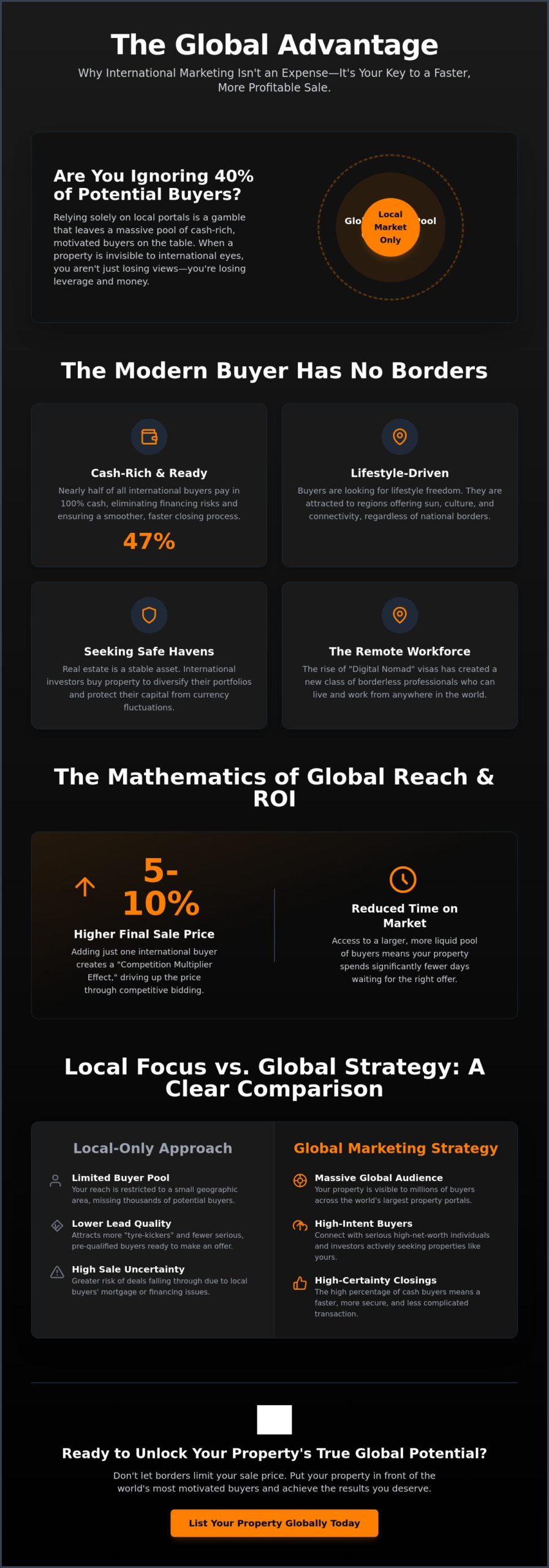
Relying solely on local portals is a gamble that leaves roughly 40% of the potential market untouched. When a high-value property is invisible to international eyes, you aren’t just losing views; you’re losing leverage. There’s a direct, measurable correlation between the number of unique enquiries and the final closing price. Market reach is the primary driver of competitive bidding.
You should position international marketing as a “liquidity insurance policy” for the seller. It ensures that the property isn’t sitting on the market waiting for a local buyer who might need a complex mortgage. Instead, it puts the home in front of cash-rich investors who can move quickly. If you want to know how to justify international marketing spend to sellers, remind them that the cost of a global campaign is a fraction of the price drop they might face if the property stagnates on the local market for six months.
The Mathematics of Global Reach: ROI and Buyer Pools
Numbers don’t lie. When you sit down with a seller, don’t just talk about “exposure” in vague terms. Talk about the size of the qualified buyer pool. In 2026, foreign buyers aren’t just a niche segment; they represent a massive, liquid portion of the market. Recent data shows that international buyers often pay significantly higher median prices, with a record $494,400 median purchase price recorded in the U.S. market alone. This is the first step in how to justify international marketing spend to sellers: showing them the size of the prize.
Investors are attracted by stability and growth. When 47% of international buyers are paying in all cash, they aren’t just another lead; they are a high-certainty closing opportunity. By expanding your reach, you aren’t just adding more names to a list. You’re specifically targeting high-net-worth individuals who have the capital ready to deploy immediately, reducing the risk of a deal falling through due to financing issues.
The Competition Multiplier Effect
The “Competition Multiplier” is a powerful concept to explain to your clients. It only takes one extra international bidder to fundamentally change the negotiation dynamics. Adding a single overseas buyer to the mix can raise the final sale price by 5-10% because it creates an intense sense of urgency for local buyers. If a local buyer knows they are competing against global capital, they are much more likely to submit their best offer early.
You can use the global market trends glossary to show sellers the specific terminology and data points that drive these cross-border decisions. International leads typically have a higher “intent to buy” than local browsers. While a local neighbor might be “just looking,” an international buyer searching from thousands of miles away is usually a serious investor or someone planning a major lifestyle move.
Targeting High-Value Territories
Effective marketing means following the money. For example, if you know that Canada accounts for nearly 38% of international online home shopping traffic in certain regions, that’s where the budget should go. This data-backed approach ensures every pound or dollar spent is optimized for the highest possible return. It’s about precision, not just volume.
When a seller questions the cost, put it in perspective. A £500 marketing fee is negligible compared to a £5,000 price increase driven by a global bidding war. You are helping them make a sound financial decision by investing a small percentage of the property’s value to unlock a much larger potential yield. If you are looking to expand your reach today, you can browse international property listings to see how top-tier agents are positioning their assets for a global audience.
Local vs. International: A Comparative Framework for Sellers
Most sellers assume that a listing on a major local portal is enough to capture the entire market. While local sites are excellent for domestic visibility, they often fail to reach the most liquid segment of modern real estate: the global investor. To understand how to justify international marketing spend to sellers, you must show them that local reach is the floor, not the ceiling. In 2026, limiting a property to a single country’s audience is like trying to sell a rare piece of art only to people in the same neighborhood.
Lead Volume vs. Lead Quality
Local portals typically generate a high volume of traffic, but much of it consists of “tyre-kickers” or curious neighbors with no real intent to buy. In contrast, global platforms attract a lower volume of leads that carry significantly higher purchase intent. Investors are attracted by the stability of cross-border assets, and they often begin their search with the capital already liquid and ready for deployment. These buyers have usually cleared financial hurdles, such as tax planning and currency conversion, before they ever hit “enquire.”
When you focus on selling overseas property, you’re shifting the conversation from quantity to quality. Overseas buyers are often less sensitive to local interest rate hikes because they’re looking at the property as a long-term hedge or a lifestyle upgrade. This “pre-qualified” nature of international leads means fewer failed viewings and a much higher probability of a cash closing.
The Prestige Factor
There is a undeniable “Halo Effect” that comes with international marketing. When a property is featured on a global stage, its perceived value increases in the eyes of both local and foreign buyers. Buyers are increasingly looking for homes that offer more than just four walls; they want a global asset that carries prestige. Positioning a home alongside luxury listings in Dubai, London, or New York frames it as a premium opportunity rather than just another local listing.
| Feature | Local-Only Strategy | Global-First Strategy |
|---|---|---|
| Market Reach | Immediate region only | Worldwide visibility |
| Buyer Profile | Mixed intent; price-sensitive | High intent; lifestyle-driven |
| Financial Status | Often mortgage-contingent | Frequently 100% cash buyers |
| Negotiation Leverage | Limited to local demand | High (Global competition) |
Sellers who attempt a “For Sale By Owner” approach often fail because they lack access to these specialized global networks. They might save on commission, but they lose out on the 5-10% price premium that international competition creates. By explaining this framework, you’re not just asking for a marketing budget; you’re offering a strategy to maximize the seller’s final net proceeds.
Overcoming the “High Cost” Objection with Market Data
Sellers often view marketing fees as an optional expense rather than a strategic investment. When a client pushes back on the price of a premium package, they’re usually missing the bigger picture: the cost of a property sitting stagnant. Understanding how to justify international marketing spend to sellers requires shifting the focus from the invoice to the impact on the final net proceeds. You aren’t just selling a house; you’re selling a lifestyle to a global audience that’s willing to pay a premium for it.
The “Days on Market” Argument
Every month a property remains unsold, it “decays” in value in the eyes of the market. Local buyers start to wonder what’s wrong with the listing, leading to low-ball offers and increased pressure to discount. Global exposure acts as a hedge against this decay. By casting a wider net immediately, you increase the probability of finding that one specific buyer who sees the property as their dream home rather than a bargain to be haggled over.
Data shows that 96% of homebuyers now start their search online, with mobile devices accounting for 63% of those initial sessions. If your seller’s home isn’t appearing where these global shoppers are looking, it effectively doesn’t exist for a massive portion of the market. You can use current owner pricing data to show them that the cost of a global campaign is significantly lower than the standard 5% price reduction they’ll likely face after three months of local-only exposure.
Addressing the “Local Buyer” Myth
Many sellers believe that “only locals buy here,” but the data in 2026 tells a different story. With the rise of remote work and established expat communities, foreign interest often drives the market even in traditionally domestic areas. Investors are attracted by the long-term yields of stable regions, and they often use international real estate listings to shortlist properties months before they even set foot in the country.
When a seller says the marketing is too expensive, use this three-point script to reframe the conversation:
- “I understand the cost is a consideration, but our goal is to find the buyer who values this home the most, not just the one who lives closest.”
- “By investing in global reach, we’re creating competition that doesn’t exist on local portals, which is what protects your final sale price.”
- “Would you rather save a few hundred today on marketing, or lose several thousand later in a price reduction because we lacked enough bidders?”
Showing the seller the “Agent Pro” dashboard provides the transparency they need. It moves the conversation from abstract promises to concrete “proof of work” by showing real-time global reach and enquiry levels. To start building your own data-backed pitch, compare listing packages and secure your marketing budget today.
Streamlining the Pitch with HomesGoFast Agent Pro
Technology is your best ally when explaining how to justify international marketing spend to sellers. An Agent Pro account provides the tangible evidence clients need to feel confident in their investment. It moves the conversation away from abstract promises and toward a systematic, global distribution strategy that sellers can actually see and track.
One of the most powerful features to highlight is the use of automated XML feeds. You can explain to your sellers that their property will “travel the world” while they sleep. Their listing doesn’t just sit on one site; it’s broadcast across a network of international portals. This ensures it reaches active buyers in different time zones and markets without any extra manual effort from you or the client.
Global Visibility as a Service
Buyers are increasingly looking for properties that are presented with professional, high-visibility flair. The HomesGoFast network extends your reach to over 20 countries, putting your seller’s home in front of a truly diverse audience. For high-value listings, “Top of Search” upgrades ensure the property stays prominent, cutting through the noise of local competition to find the right investor.
You are providing more than just an ad; you’re providing a localized experience. Multilingual listings are essential for attracting non-English speaking investors who might otherwise overlook a property. Learning how to advertise properties to a global audience effectively means speaking the buyer’s language, both literally and figuratively, to build immediate trust.
Transparency and Reporting
Transparency is what ultimately closes the deal on a marketing budget. The lead management dashboard allows you to show sellers real-time interest from abroad. When a seller sees enquiries coming in from Germany, the US, or China, it creates a powerful “fear of missing out” (FOMO). You can use this global interest to motivate local buyers to act faster and submit stronger offers.
Investors are attracted by the long-term yields of stable regions, and they want to see that an agent has a professional platform to manage their enquiries. Make the international marketing fee a standard, non-negotiable part of your premium service. By framing it as a necessary component of a successful sale, you position yourself as a savvy mentor. It’s time to move beyond local limitations and embrace a borderless approach. To get started, you can upgrade to Agent Pro today and start winning more listings with a proven global strategy.
Elevate Your Listing Strategy for the Global Stage
Success in 2026 requires moving beyond local boundaries and embracing the “Competition Multiplier” that only global reach provides. By reframing marketing as a liquidity insurance policy rather than a simple expense, you protect your client’s final sale price and reduce total days on market. Mastering the conversation on how to justify international marketing spend to sellers is the difference between a stagnant listing and a record-breaking cash sale. You’ve seen the data; now it’s time to put it into action.
Since 2002, we’ve built a reputation for connecting agents with high-intent foreign buyer leads across a network that now spans over 50 countries. With 20+ years of global expertise, we provide the transparency and reporting tools you need to prove your value to every client. Don’t let your listings remain invisible to the world’s most liquid investors. It’s time to secure your Agent Pro Account and dominate the global market today. Your next high-value closing is waiting just across the border.
Frequently Asked Questions
How do I explain the ROI of international marketing to a skeptical seller?
Explain that international marketing is a liquidity strategy designed to drive up the final price by introducing cash-rich competition. You can point to the fact that 47% of international buyers pay in all cash, which significantly reduces the risk of the deal falling through. This is the core of how to justify international marketing spend to sellers; it’s about trading a small upfront cost for a higher certainty of a premium closing.
What is a reasonable marketing budget for an international property sale?
A reasonable budget is typically a small fraction of the first price reduction the seller would otherwise face. If a property sits on the local market for months, a 5% price drop is common. Investing a portion of that potential loss into global reach early on is a sound financial decision that protects the property’s equity from market decay.
Do international buyers really pay more for properties?
Yes, statistics show that international buyers often target higher price points and are less price-sensitive than local residents. In the U.S. market, the median purchase price for foreign buyers reached a record $494,400 between 2024 and 2025. These buyers are often attracted by “safe haven” assets and lifestyle freedom rather than just the lowest possible price per square foot.
How can I prove that foreign buyers are looking in my specific area?
You can use digital search data and platform analytics to show exactly where the demand is coming from. For example, if you are in the U.S., you can mention that Florida captures 21% of all foreign buyer purchases. Showing a seller the specific traffic from countries like Canada, which accounts for 37.8% of international online shopping traffic, provides the concrete proof they need.
Should the seller or the agent pay for international portal listings?
This depends on your business model, but many agents now offer international reach as part of a premium, non-negotiable service tier. If the seller is hesitant, you can offer it as an optional upgrade. This allows them to see the direct correlation between the marketing fee and the increased volume of high-intent enquiries from abroad.
What are the best countries to target for international property leads in 2026?
Canada remains a primary source of demand, particularly for North American and European markets. However, the U.S. and various European territories are also massive sources of capital for lifestyle regions. Investors are attracted by stable economies and clear legal frameworks, so targeting these high-wealth zones ensures your marketing spend is optimized for the best results.
How does currency exchange affect a seller’s willingness to market abroad?
Currency fluctuations can be a powerful tool when you know how to justify international marketing spend to sellers. If the local currency is weak, the property effectively goes “on sale” for foreign investors without the seller having to lower their asking price. This creates a unique window of opportunity to attract buyers who are looking for maximum value for their capital.
Can I justify international spend for lower-priced properties?
Absolutely, because the goal is often speed and certainty regardless of the price point. Even for more affordable homes, a global audience increases the chances of finding a cash buyer who can close quickly. Since 96% of homebuyers now start their search online, being visible to the 1.6% of shoppers looking from overseas is a smart way to outpace local competition.