 by
by 
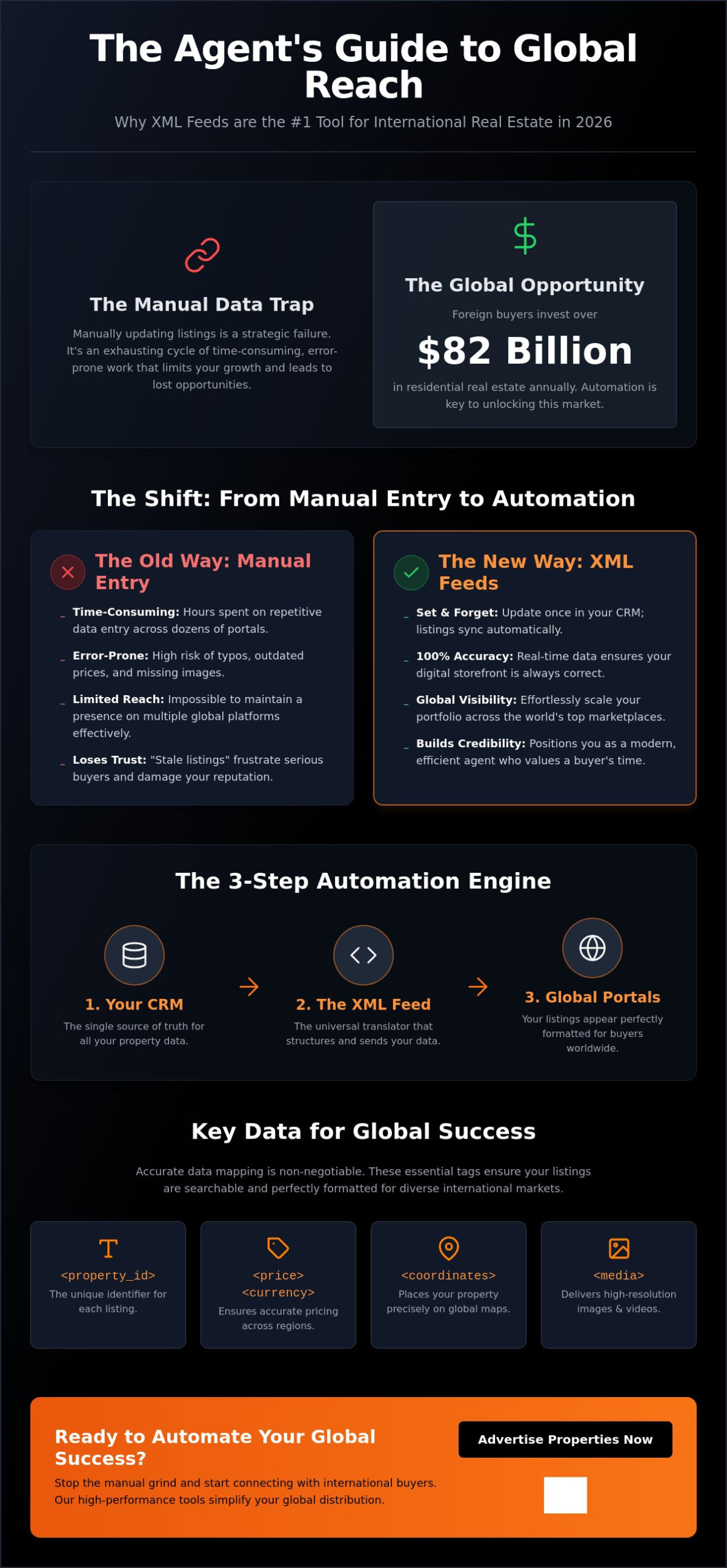
In 2026, manually entering property data isn’t just a chore; it’s a strategic failure that costs you thousands in lost international leads. With foreign buyers investing over $82 billion in residential real estate annually, learning how to use XML feeds for real estate listings is no longer optional for the modern agent. You’ve likely felt the frustration of spending hours updating descriptions across multiple portals, only to find outdated prices or missing images on half of them. It’s an exhausting cycle that limits your growth.
This guide will help you reclaim your time and reach buyers from Dubai to New York without the manual grind. You’ll master the technical logic behind feed synchronization and learn to maintain a “set and forget” system that ensures your data remains accurate across every global platform you use. It’s about turning your property portfolio into a high-speed engine for international acquisition and visibility.
We’ll break down the specific tags you need, explain how to manage international data standards, and show you how to scale your agency’s reach across the world’s most influential property marketplaces. By the end of this guide, you’ll have a clear roadmap to automate your marketing and focus on what truly matters: your clients.
Key Takeaways
- Understand the shift from manual entry to automated synchronization and how it can exponentially scale your agency’s international reach.
- Master the technical requirements of how to use XML feeds for real estate listings, including the specific 2026 tags needed for accurate global mapping.
- Learn the strategic data mapping techniques that ensure your listings are perfectly formatted for search filters in diverse international markets.
- Discover how to troubleshoot common synchronization pitfalls, from malformed syntax to missing property images, to maintain a professional online presence.
- Explore how high-performance tools like the Agent Pro Account can automate your global distribution and simplify the entire listing process.
Understanding XML Feeds: The Engine of Scalable Real Estate Marketing
XML (Extensible Markup Language) acts as the universal translator of the property world. It allows different software systems to talk to each other without human intervention. In 2026, the shift from manual data entry to automated synchronization is complete. Top-performing agents understand that mastering how to use XML feeds for real estate listings is the only way to maintain a competitive edge in a fast-moving market.
The system relies on three core components: your CRM (the source), the XML feed (the messenger), and the property portal (the destination). This structure is the foundation of web syndication, ensuring your data flows seamlessly across borders. Without this technical bridge, achieving global visibility is nearly impossible. You simply can’t manually update dozens of platforms every time a price changes or a home sells.
To better understand this concept, watch this helpful video:
Why Agents are Increasingly Looking for Automation
Manual listing entry is a relic of the past. It’s time-consuming and prone to human error, which can lead to significant issues in a more regulated 2026 market. Buyers are increasingly looking for real-time accuracy and instant updates. If a property in Portugal is sold but still appears active on a portal, you lose trust instantly.
Automation allows you to focus on high-value tasks like closing deals while your international real estate listings update themselves in the background. There’s a powerful psychological benefit to this. You can rest easy knowing your digital storefront is always accurate, reflecting your professional standards to every potential buyer who clicks on your link.
XML vs. Manual Entry: A ROI Comparison
Investors are attracted by efficiency and transparency. When you manage a portfolio of 50, 100, or 500 properties, the ROI of an XML feed becomes undeniable. Manual entry for a portfolio of that size would require a dedicated team member, significantly increasing your overhead costs.
With an XML feed, data syncs instantly across your entire network. This reduces lead response times because you aren’t stuck fixing typos or re-uploading photos. It also eliminates the “stale listing” problem that frustrates serious buyers. By providing real-time data, you position yourself as a savvy mentor who values the buyer’s time, making it easier to convert international interest into a closed sale.
Setting Up Your XML Feed: Technical Standards and Data Mapping
Setting up your feed is where strategy meets software. To truly master how to use XML feeds for real estate listings, you must treat your data with the same care as a legal contract. It starts with your tags. In 2026, portals require high-precision data to serve the right properties to the right buyers. If your technical foundation is weak, your global reach will suffer.
Essential tags like <property_id>, <price>, <currency>, and <coordinates> are non-negotiable. These elements ensure your listing is searchable and accurately placed on a map. Data mapping is the process of aligning your internal CRM fields with these specific portal requirements. By following standards set by the Real Estate Standards Organization (RESO), you ensure your listings remain compatible with major platforms worldwide.
Don’t overlook the <media> tag. High-resolution image URLs are essential because low-quality thumbnails simply won’t convert in a competitive market. Finally, consider your sync frequency. While daily updates were once the norm, today’s fast-paced market often demands hourly “pings” to ensure availability is always current. This prevents the frustration of buyers inquiring about homes that have already sold.
Essential Tags for International Listings
Global buyers are increasingly looking for transparency and ease of use. The <currency> tag is vital because it allows portals to convert prices into the buyer’s local currency instantly. Similarly, <description_lang> tags let you serve content in multiple languages, such as English, French, or Italian. This removes friction for those browsing international real estate listings from abroad. Using <geo_location> tags ensures your properties appear in hyper-local searches, even if the buyer is searching from another continent.
Choosing the Right Feed Provider or CRM
Your CRM is the heart of your operation. When selecting a provider, look for “push” technology. This sends updates to portals immediately, rather than “pull” systems that wait for the portal to request data. This keeps your data fresh and your leads hot. Security is also paramount; ensure your provider uses modern encryption to protect sensitive property information. If you’re ready to scale your reach, you can advertise properties across a global network using these automated tools to save hours of manual work every week.
Maximizing Global Visibility: How Feeds Power International Lead Generation
One of the most powerful aspects of learning how to use XML feeds for real estate listings is the ability to broadcast your portfolio to the world with a single click. Instead of managing individual accounts on various sites, a single optimized feed can syndicate your data to dozens of international portals simultaneously. This “one-to-many” distribution model is the backbone of global scaling, allowing you to reach buyers in markets you might never have considered.
Buyers are increasingly looking for highly specific features, and international real estate listings rely heavily on structured data to appear in these filtered searches. When your XML feed is correctly mapped, your properties don’t just sit on a page; they become searchable assets. This structured data also powers “Rich Snippets” in search engine results. These enhanced listings show prices, ratings, and key features directly on Google, significantly increasing your click-through rates.
Investors are attracted by data-rich descriptions that provide a clear picture of potential ROI. By utilizing the standards maintained by the Real Estate Standards Organization (RESO), you ensure your data is clean, professional, and trustworthy. This technical precision builds immediate credibility with high-net-worth individuals looking for their next overseas acquisition, whether they are searching for coastal villas or city apartments.
Syndicating to Global Portals
Leveraging a professional property advertising platform provides a centralized hub for your syndication efforts. You shouldn’t just blast your listings everywhere; instead, choose portals that align with your property type. For instance, a luxury villa in Marbella requires a different audience than a high-yield apartment in Panama. Maintaining brand consistency across these diverse markets is vital to building a recognizable global presence that buyers can trust.
Handling Multilingual Content and Local Nuances
Scaling globally means speaking the buyer’s language, both literally and technically. While automated translation tools have improved, the best XML feeds allow for manual overrides to ensure local nuances aren’t lost. When you understand how to use XML feeds for real estate listings, you can easily automate the conversion of measurements within your feed logic. A buyer in the US looks for square footage, while a European investor expects square meters. Addressing foreign ownership rules directly within your description tags can also help pre-qualify leads, saving you time and reducing friction.
Avoiding Common XML Feed Pitfalls: Troubleshooting and Optimization
Even the most sophisticated automated systems encounter technical hurdles. Understanding how to use XML feeds for real estate listings effectively means knowing how to spot and fix errors before they impact your lead volume. The most frequent culprit behind a failed sync is malformed XML syntax. A single broken tag or a missing closing bracket can halt the entire data transfer, leaving your portal profile empty and your properties invisible.
Image synchronization is another common pain point for agents in 2026. If your high-resolution photos aren’t appearing, it’s often because the portal cannot “fetch” the files from your server. This usually happens when image URLs are not public or if the server response time is too slow. Additionally, the “Ghost Listing” problem—where sold properties remain live on portals—can damage your reputation. This occurs when your CRM’s status updates aren’t correctly mapped to the portal’s specific requirements, frustrating buyers who find their dream home is already off the market.
You can’t manage what you don’t monitor. Successful agents regularly check feed health by reviewing log files from their CRM or using portal dashboards to identify rejected listings. These logs provide specific error codes that tell you exactly which tag is failing. If you want to ensure your properties are seen by the right audience, you can advertise properties through a platform that offers robust feed monitoring and support.
Optimizing for Lead Quality
Detailed data in your XML feed acts as a natural filter for low-quality inquiries. By providing comprehensive details about local rules and amenities, you ensure that only serious buyers reach out. The <agent_contact> tag is vital here; it ensures leads are routed directly to your phone or inbox rather than a generic office email. Smart agents also use unique tracking IDs within their feed logic to measure exactly which portals are delivering the best ROI for their international real estate listings.
Technical Checklist for Feed Health
Maintaining a healthy feed requires consistent oversight. Buyers are increasingly looking for professional, secure listings, so ensuring all your image URLs use SSL/HTTPS is essential to prevent security warnings on major portals. You should also make a habit of testing your feed updates whenever you update your CRM software to prevent unexpected data breaks. For a deeper dive into the technical requirements, try validating your feed against the HomesGoFast glossary standards to ensure your data mapping remains current with 2026 industry expectations.
Automating Your Global Success with HomesGoFast Agent Pro
Understanding the technical side of how to use XML feeds for real estate listings is only half the battle. To truly scale your agency, you need a partner that handles the heavy lifting of global syndication. The Agent Pro Account is designed specifically for this purpose, acting as a bridge between your local CRM and a massive audience of international buyers. It transforms your property data into a high-performance marketing engine.
Buyers are increasingly looking for properties in specific lifestyle hubs across Europe and beyond. Whether you are marketing French homes in the countryside or luxury Italian villas, our platform ensures your listings appear exactly where they need to be. We simplify the import process, meaning you don’t need to be a developer to achieve professional results. You can focus on closing deals while we ensure your listings remain synchronized and accurate.
Investors are attracted by the efficiency and reliability of our network. If you’re ready to take your property marketing to the next level, you can explore our owner pricing for professional listing packages. These tools provide the visibility required to compete in a crowded 2026 marketplace, ensuring your portfolio stands out to high-net-worth individuals and serious overseas investors alike.
Why Choose HomesGoFast for Your XML Syndication?
With over 20 years of experience in international lead generation, we understand the nuances of the global market. Our platform offers robust multilingual support that ensures your feed reaches the right audience in their preferred language. This isn’t just about translation; it’s about cultural resonance and trust. We offer seamless integration with major real estate CRM platforms, making it easier than ever to manage your international real estate listings without manual intervention.
Getting Started: Your Path to Global Exposure
Taking your first step toward automation is simpler than you might think. Follow these three steps to begin your journey toward global scaling:
- Step 1: Preparing your CRM for export. Ensure your property data is clean and that your tags align with the standards we discussed in previous sections.
- Step 2: Connecting your feed to the HomesGoFast network. Our team assists with the initial mapping to ensure your images, prices, and descriptions flow perfectly.
- Step 3: Monitoring your international leads and optimizing your strategy. Use our dashboard to track performance and adjust your listings based on buyer interest and market demand.
The global real estate market moves fast. By mastering how to use XML feeds for real estate listings through our professional platform, you position yourself as a savvy mentor and a leader in your field. Don’t let manual entry hold your growth back; embrace automation and start reaching the world today.
Future-Proof Your Agency with Global Automation
Mastering how to use XML feeds for real estate listings is the most effective way to transition from a local agent to a global competitor. By eliminating manual entry and adopting standardized data mapping, you ensure your properties are visible to millions of international buyers in real-time. This isn’t just about technical efficiency; it’s about building a scalable business that operates while you sleep. Investors are attracted by the accuracy and speed of automated listings, and buyers are increasingly looking for agents who provide real-time availability.
Since 2002, HomesGoFast has acted as a savvy mentor for professionals managing the complexities of the international market. We provide the expert technical support you need for seamless XML integrations and a reach that connects your portfolio with millions of potential leads across the globe. Don’t let technical hurdles or time-consuming data entry hold your agency back from reaching its full potential. Upgrade to an Agent Pro Account and automate your global reach today. The world is searching for their next dream home or high-yield investment. Make sure your listings are the first ones they see.
Frequently Asked Questions
What is the difference between an XML feed and an API for real estate?
An XML feed is a structured document that portals fetch at scheduled intervals to update their listings. An API provides a real-time, two-way connection between your database and the portal. While APIs offer instant updates, XML feeds remain the industry standard for bulk distribution because they are easier to implement across dozens of different global platforms simultaneously.
How often should my real estate XML feed be updated?
You should aim for at least one update every hour to stay competitive in the 2026 market. Buyers are increasingly looking for real-time accuracy, and outdated data leads to missed opportunities. When you learn how to use XML feeds for real estate listings, you can automate these frequent “pings” to ensure your portfolio always reflects current prices and availability.
Can I include videos and 360-degree tours in my XML feed?
Yes, most modern property portals support rich media through specific tags like <video_url> or <virtual_tour>. Including these links in your feed logic significantly boosts engagement from overseas buyers who can’t visit in person. Just ensure these URLs are hosted on a reliable, public server so the portals can fetch the data without errors.
Will using an XML feed hurt my SEO on my own website?
Using an XML feed won’t damage your SEO if handled correctly. Portals typically link back to the original source or use canonical tags to show search engines that your website is the primary owner of the data. Syndicating your listings actually builds brand authority and drives more direct traffic to your agency as your global footprint grows; for a practical example of this in the Australian market, check out realestate.com.au.
How do I handle different currencies in a single XML feed?
You handle multiple currencies by using the <currency> tag alongside the <price> tag for each individual listing. This allows the portal’s internal system to convert your local price into the buyer’s currency based on real-time exchange rates. It’s a vital feature for attracting international investors who want to see costs in their own familiar financial terms.
What should I do if my images are not showing up on the property portal?
Check your image URLs for SSL/HTTPS encryption and ensure they aren’t blocked by your server’s firewall. Portals use automated bots to “fetch” your photos, and if your server requires a login or has slow response times, the sync will fail. Validating your feed syntax usually reveals if the image tags are formatted incorrectly.
Is it possible to exclude specific properties from my XML feed?
Yes, you can easily exclude properties by using a “filter” or “flag” within your CRM. Most systems allow you to check a box that tells the XML generator whether to include a listing in the export. This gives you total control over which homes are marketed globally and which remain for local eyes only.