While most international investors still default to buying property in Tuscany, the most savvy buyers in 2026 are looking across the border to Umbria for better yields and authentic “quiet luxury.” You likely believe that the prestige of a Chianti address is the only way to secure a solid Italian asset, but current market data suggests a more profitable story is unfolding in the “Green Heart” of Italy.
We know that navigating Italian bureaucracy or worrying about hidden renovation costs can make any cross-border transaction feel daunting. This guide will show you why Umbria has become the premier choice for international buyers, offering the same rolling hills and medieval charm as its neighbor but with significantly more value for your money. It’s about making a decision that balances aspirational lifestyle with practical investment logic.
You’ll gain expert insights into the 2026 buying process, identify high-growth towns like Terni and Perugia, and discover how to leverage current tax deductions to protect your investment. We’ll break down the essential steps to ensure you approach the market with the confidence of a seasoned global expert.
Key Takeaways
- Understand why investors are increasingly looking for value in Umbria as a high-yield, authentic alternative to buying property in Tuscany.
- Learn the essential administrative steps for international buyers, including securing your Codice Fiscale and opening an Italian bank account.
- Identify the top-performing locations for 2026, from the professional rental hub of Perugia to the lifestyle-driven market of Lake Trasimeno.
- Navigate the 2026 tax landscape with clarity on registration taxes and the significant savings available through ‘Prima Casa’ residency benefits.
- Discover how to streamline your search by leveraging global property platforms to connect with verified, multi-lingual real estate experts.
Why Buying Property in Umbria Beats Buying Property in Tuscany in 2026
Investors are shifting their focus. While many still consider buying property in Tuscany as the traditional gold standard, the 2026 market shows a clear pivot toward the “Green Heart of Italy.” Umbria offers a stable alternative to volatile global markets, providing a sanctuary of tangible real estate assets that hold their value. Your Euro simply goes further here. You can often acquire a restored farmhouse with acreage for the price of a cramped, noisy apartment in Florence or Siena.
Umbria represents a high-potential, undervalued asset for the 2026 buyer, offering the prestige of Central Italy without the inflated entry costs of its neighbors. Buyers are increasingly looking for authenticity, and this region delivers it in spades. The 2026 market trend reveals a major shift toward these less-crowded European regions where the “slow life” isn’t just a marketing slogan but a daily reality.
Umbria vs. Tuscany: The 2026 Comparison
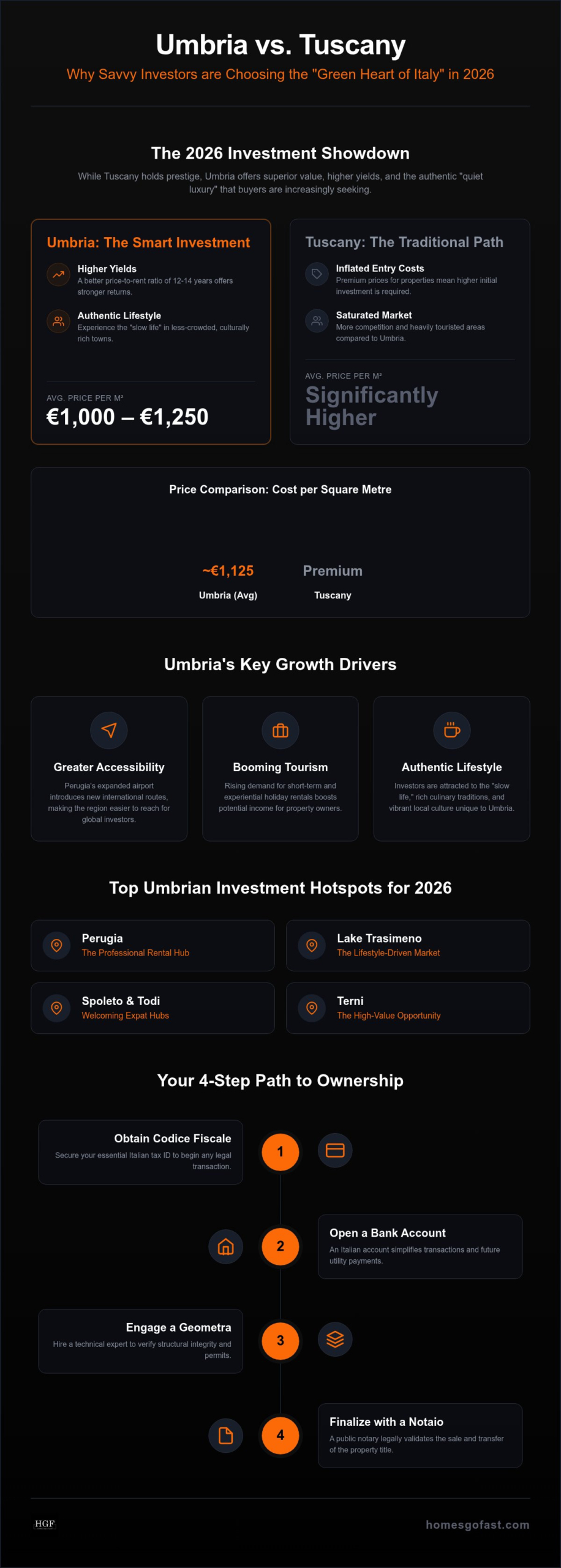
The price per square metre analysis tells a compelling story. As of June 2026, average residential property prices in Perugia sit around €1,250 per square metre. In the province of Terni, that figure drops even further to approximately €1,000. When you compare this to the premium prices required for buying property in Tuscany, the investment logic becomes undeniable. You aren’t just buying a home; you’re securing a better price-to-rent ratio, which currently sits between 12 and 14 years in most Umbrian hubs.
Tourism growth is another key driver. Experiential tourism is boosting demand for short-term rentals, particularly for “move-in-ready” villas. Accessibility has also seen a massive upgrade. The expansion of Perugia’s San Francesco d’Assisi Airport has introduced new international routes, making Italian homes for sale in this landlocked region more reachable than ever before for global investors.
The Lifestyle Factor: Beyond the Investment
It’s not just about the ROI. Umbria’s culinary traditions, specifically its world-renowned olive oil industry, offer a sensory experience that defines the region. Learn more about the Umbria region to understand how its geography shaped a culture that remains fiercely local and high-quality. From the black truffles of Norcia to the crisp Orvieto Classico wines, the lifestyle here is rich and rewarding.
Cultural heritage remains a primary draw for expats. Whether it’s the world-class performances at Perugia Jazz or the spiritual history of Assisi, there’s always a reason to engage with the community. You’ll find expat-friendly hubs in towns like Spoleto and Todi that maintain a deeply Italian soul while being welcoming to newcomers. It’s a place where you can build a life among locals rather than living in a tourist bubble.
The Italian Purchase Process: A Step-by-Step Guide for Foreigners
Navigating the administrative side of an international acquisition doesn’t have to be stressful. Your first step is obtaining a Codice Fiscale, a tax identification number essential for any legal transaction in Italy. You’ll also need a local bank account. While you can technically pay from abroad, having a domestic account simplifies ongoing utility payments and annual tax settlements. It’s a practical move that builds your local financial footprint from day one.
Investors are attracted by the transparency of the 2026 market, but you shouldn’t proceed without a Geometra. This professional acts as your technical advisor, verifying structural integrity and ensuring all planning permissions are strictly in order. The Italian Notary (Notaio) functions as the neutral public official who legally validates the transfer of title and ensures the entire transaction complies with national law.
While you might have initially considered buying property in Tuscany, you’ll find the Umbrian process follows the same rigorous national framework but often with less local competition. This allows for a more focused and efficient transaction. If you’re ready to see what’s available, you can browse Italian homes for sale to gauge current market availability and price points.
From Proposal to Completion: The Three Key Stages
The journey begins with the Proposta d’Acquisto. This formal offer includes a small deposit to demonstrate your intent. If the seller accepts, you move to the Preliminare di Vendita, or Compromesso. This is the legally binding point of no return. You’ll pay a larger deposit, typically between 10% and 30%. If you withdraw after this, you lose your deposit; if the seller backs out, they’re often legally required to pay you double that amount back.
The process concludes with the Rogito, or the final deed. You’ll meet at the Notary’s office to sign the documents, settle remaining taxes, and receive your keys. It’s an efficient meeting that marks the official change of ownership and the start of your new venture.
Foreign Ownership Rules and Legal Protections
Italy maintains reciprocity agreements with many nations. This means UK, US, and EU citizens can buy property freely because Italians enjoy similar rights in those territories. However, always secure independent legal advice. A dedicated lawyer ensures that no local pitfalls, such as undisclosed liens or complex inheritance claims, derail your plans. This is especially important as more buyers recognize Why Umbria is the ‘new Tuscany’ and competition for prime assets increases.
Before committing to a specific region, it’s wise to explore international property listings to compare regional value and ROI potential. Understanding the broader market helps you negotiate with the confidence of a seasoned global investor.
Where to Invest: Top Umbrian Locations for 2026
Investors are attracted by the diverse micro-markets within Umbria, each offering a distinct financial profile. While many buyers begin their journey by researching buying property in Tuscany, the 2026 data shows that Umbrian towns often provide superior rental yields and lower entry costs. Choosing the right location depends on whether you prioritize capital growth, holiday rental income, or a permanent lifestyle change.
Perugia stands out as a vibrant capital with strong long-term rental demand from professionals and international students. Its status as a regional hub ensures a liquid market with median selling times often falling between 3 to 6 months. For those seeking the “Umbrian Sea,” Lake Trasimeno is the primary destination for holiday home seekers. Towns like Castiglione del Lago offer high seasonal occupancy rates driven by water-sports enthusiasts and summer tourism.
The “Golden Triangle” formed by Todi and Spoleto remains the premier choice for luxury villas and high-end restorations. Buyers are increasingly looking for move-in-ready estates here, where the prestige of the address rivals any Chianti hilltop. If you need a commuter-lifestyle hybrid, Orvieto is exceptional. Its high-speed rail links to Rome make it possible to enjoy a medieval lifestyle while maintaining a professional presence in the capital.
Pros and Cons of Rural vs. Urban Umbria
Choosing between a secluded farmhouse and a historic town center involves balancing privacy with practicality. Rural farmhouses offer unmatched charm and acreage, but they require higher maintenance budgets and a car for every errand. In contrast, town centers provide walkability and a built-in community, though you may face stricter renovation regulations and limited parking.
| Town | Yield Potential | Lifestyle Score | Primary Market |
|---|---|---|---|
| Perugia | High | 8/10 | Long-term Rental |
| Orvieto | Medium | 9/10 | Rome Commuters |
| Todi | Medium | 10/10 | Luxury Expat |
| Castiglione del Lago | High | 9/10 | Holiday Let |
| Città di Castello | Medium | 7/10 | Value Seekers |
The Emerging North: Città di Castello and Beyond
The northern border with Tuscany is the new frontier for value in 2026. This area offers the same rolling landscapes as its famous neighbor but at a fraction of the cost. The Tiber Valley is seeing increased interest from investors who recognize that prices here haven’t yet peaked. It’s a strategic move for those who want the proximity of buying property in Tuscany without paying the associated premium.
This region is perfect for buyers who want to secure a significant asset before the secret is fully out. To understand how these opportunities compare to other Mediterranean markets, you can explore broader overseas real estate options to see why Umbria’s northern valley is currently a standout for 2026 acquisition.
Financial Realities: Taxes, Fees, and Renovation Costs
Understanding the total cost of acquisition is critical for a successful investment. While you might be familiar with the premium costs associated with buying property in Tuscany, Umbria’s financial landscape offers a different value proposition. The primary tax you’ll encounter is the Imposta di Registro (registration tax). For a second home, this is 9% of the property’s cadastral value, but it drops to just 2% if you qualify for the ‘Prima Casa’ (primary residence) benefit.
To qualify for these significant tax savings, you must become a resident in the municipality where the property is located within 18 months of the purchase. You should also budget between 1% and 2.5% of the declared value for notary fees, plus 22% VAT. The ‘Catastale’ value is the property’s official book value registered with the tax authorities, which is typically significantly lower than the actual market price and serves as the basis for calculating your purchase taxes.
Renovating in Umbria: Subsidies and Challenges
Investors are attracted by the potential of restoring historic stone houses, but you must plan for realistic costs. In 2026, the Bonus Ristrutturazioni (Renovation Bonus) for second homes provides a 36% tax deduction on renovation expenses. General restoration costs in Italy currently range from €350 to €2,000 per square metre, depending on the finish quality and structural requirements. Working with local artisans ensures authenticity, but it requires clear contracts and oversight.
Managing currency risk is equally important for international buyers. If you’re transferring GBP or USD to EUR, small fluctuations can add thousands to your renovation bill. Using a dedicated currency specialist rather than a high-street bank can protect your budget. Before committing to a project, it’s wise to search Italian homes for sale that are already renovated to compare the cost of “move-in-ready” options versus total restoration projects.
Ongoing Costs of Ownership
Ownership entails annual responsibilities that you must factor into your ROI calculations. The IMU (municipal property tax) for a second home typically ranges from €600 to €2,500 per year for standard properties. You’ll also pay the TARI (waste tax), which is calculated based on the property size and the number of occupants. These costs are generally lower than those found when buying property in Tuscany, particularly in the province of Terni where market averages remain competitive.
If you purchase an apartment in a historic town centre, expect condominium fees for the maintenance of shared spaces and roofs. These fees vary widely, so always ask for the last two years of meeting minutes before signing. You can check international real estate listings to see how these carrying costs compare with other global markets, ensuring your Italian venture remains a sound financial decision.
How to Secure Your Dream Property in Umbria
Execution is everything. Once you’ve analyzed the financial benefits of Umbria over buying property in Tuscany, you need a clear strategy to secure the right asset. Start with a wide search across the region to establish the 2026 price floor. This prevents you from overpaying in high-demand pockets. Investors are attracted by properties that offer immediate value, so use professional tracking tools to identify listings with recent price adjustments or those that have remained on the market beyond the typical three-month window.
Your search should be followed by a focused viewing trip. Don’t limit yourself to a single hilltop town. We recommend visiting at least three distinct sub-regions, such as the northern valley, the lakeside, and the southern commuter belt. This first-hand experience allows you to feel the community rhythm and assess the practicalities of each location. It’s the only way to move from being an observer to a confident buyer.
Why Use an International Property Portal?
Global marketplaces act as a bridge between your aspirations and local reality. By using an international portal, you access verified listings that allow you to compare Umbria directly with other high-performing regions. You’ll connect with multi-lingual experts through the Agent Pro network who understand the specific needs of foreign buyers. If you’re on the other side of the transaction, you can learn how to advertise properties to reach our established audience of over 20 years.
Final Checklist for 2026 Buyers
Due diligence is your best protection. Before you sign the Compromesso, ensure your geometra has verified all building permits, known locally as the Sanatoria. This prevents future legal headaches regarding non-compliant extensions or renovations. You should also have your currency specialist on standby to manage the initial deposit transfer, protecting you from sudden exchange rate shifts.
The 2026 market is moving quickly as more buyers recognize the “quiet luxury” of the Green Heart. Taking these practical steps ensures you secure a sound investment while others are still busy buying property in Tuscany at a premium. Ready to take the next step? You can browse our latest Umbria property listings today to find your perfect Italian retreat.
Secure Your Future in the Green Heart of Italy
Investors are attracted by Umbria’s rare combination of lifestyle appeal and investment logic. By focusing on this region, you’re choosing an undervalued asset with stable growth potential and authentic culture. While many still focus on buying property in Tuscany, the 2026 data confirms that your capital secures significantly more value and charm in the Umbrian hills.
You now have the roadmap to navigate the Italian purchase process, from obtaining your tax code to leveraging the latest renovation subsidies. Success comes down to using the right tools and local expertise to avoid the common pitfalls of international acquisition. It doesn’t have to be a stressful experience when you have the right support. To help manage the personal transition of your move, including home life and wellness, you can find out more through specialized digital guides.
As a trusted global platform since 2002, we connect you with an expert network of professional Italian agents and verified international property listings. Our goal is to simplify your journey and ensure you move forward with total confidence. Start your search for property in Umbria on HomesGoFast today and turn your Italian dream into a productive reality. Your perfect home is waiting.
Frequently Asked Questions
Can foreigners buy property in Umbria Italy without a visa in 2026?
Yes, foreigners can legally purchase property in 2026 if their home country has a reciprocity agreement with Italy. Citizens from the US, UK, and EU can buy freely under these long-standing rules. However, you must remember that property ownership does not automatically grant a visa or residency. You’ll still need to follow standard immigration procedures for stays exceeding 90 days.
How much are the closing costs when buying a house in Italy?
You should budget between 10% and 15% of the purchase price to cover all closing costs. This total includes the registration tax, which is 9% for second homes, and notary fees that typically range from 1% to 2.5%. You’ll also need to account for real estate agency commissions, which generally fall between 2% and 5% plus 22% VAT.
Is Umbria safe from earthquakes when buying older properties?
Italy has various seismic zones, but modern building codes are designed to maximize safety. When you’re looking at older stone farmhouses, it’s essential to hire a geometra to conduct a structural survey. They’ll verify if the property has received anti-seismic reinforcements, as buyers are increasingly looking for homes that meet these rigorous 2026 safety standards.
What is the difference between a Prima Casa and a second home tax?
The main difference lies in the registration tax rate applied to the property’s cadastral value. A Prima Casa (primary residence) qualifies for a discounted 2% tax rate, whereas a second home is taxed at 9%. To benefit from the lower rate, you must officially move your residency to the municipality within 18 months of the purchase.
Do I need to speak Italian to buy property in Umbria?
You don’t need to be fluent, but the legal process requires clear communication. If you don’t speak Italian, the law mandates that a qualified translator must be present during the final signing at the notary’s office. Many international investors prefer working with multi-lingual agents who can handle the day-to-day negotiations and explain complex legal terms simply.
Can I get a mortgage in Italy as a non-resident in 2026?
Yes, non-residents can still access Italian mortgages, though the requirements are stricter than for locals. Most banks will offer a maximum loan-to-value (LTV) ratio of 50% to 60% for foreign buyers. You’ll need to provide extensive documentation of your overseas income and open a local Italian bank account to manage the loan repayments.
Is it better to buy property in Umbria or Tuscany?
It depends on whether you prioritize prestige or value. Umbria currently offers similar landscapes and culture at a lower entry price, often 20% to 30% less than its neighbor. Many investors find that buying property in Tuscany requires a much higher capital outlay, which can lower your overall ROI compared to the emerging Umbrian market.
How do I find a reliable English-speaking notary in Umbria?
The most reliable method is to use an established international property portal to connect with verified professionals. Our specialized Agent Pro network includes local experts who regularly assist international buyers and can recommend English-speaking notaries. These professionals are experienced in cross-border transactions and understand the specific legal protections you’ll need as an overseas buyer.