
Owning a slice of the French Riviera or a luxury Parisian apartment is more accessible in 2026 than the complex legal jargon suggests. If you’re wondering how to buy property in France as a non-resident, the process is remarkably secure once you understand the role of the notary and the latest tax updates. Investors are attracted by the fact that France offers non-residents the same ownership rights as local citizens, making it a premier destination for international wealth.
It’s common to feel a bit of anxiety about post-Brexit rules or the 18.6% social charges on rental income. You want to ensure your investment is sound without getting caught by hidden wealth taxes or shifting energy efficiency regulations. This guide will help you master the financial and regional nuances of the market so you can secure your dream home with total confidence.
We’ll break down the 2026 notary fee structures, explain the new capital gains taper relief, and identify the top regions for both lifestyle and ROI. From understanding the 2026 Finance Act to calculating your total acquisition cost, you’ll find a clear roadmap to ownership right here.
Key Takeaways
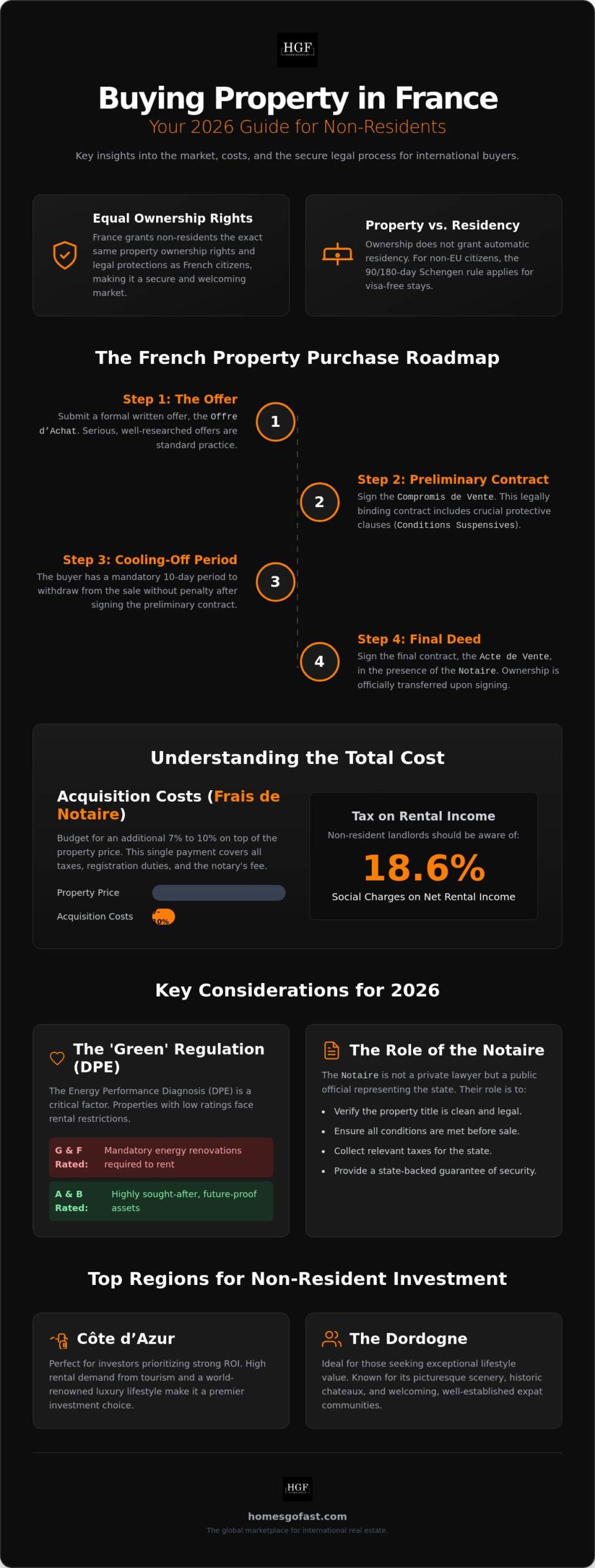
- France remains one of the most accessible international markets, granting non-residents the same property ownership rights as French citizens.
- Discover exactly how to buy property in France as a non-resident by following a clear roadmap from the initial offer to the final deed.
- Budget effectively by accounting for the “Frais de Notaire” and other acquisition costs, which typically add 7% to 10% to the purchase price.
- Identify high-growth regions like the Côte d’Azur for rental demand or the Dordogne for exceptional lifestyle value and expat communities.
- Streamline your purchase by understanding essential legal protections like “Conditions Suspensives” and the practical necessity of a French bank account.
Can You Buy Property in France as a Non-Resident in 2026?
France remains one of the most open and reliable real estate markets for international investors in 2026. Unlike some European neighbors that have introduced restrictions on foreign buyers, the French government maintains a welcoming stance. If you are exploring how to buy property in France as a non-resident, you’ll find that the legal framework provides the same protections to you as it does to a local citizen. This stability is a major reason why the country continues to lead in global property demand.
It’s essential to understand that property ownership is a financial investment, not a residency shortcut. Owning a home doesn’t grant you a long-stay visa or residency rights automatically. For non-EU citizens, the “90-day rule” remains the standard; you can spend up to 90 days in any 180-day period within the Schengen Area. If you plan to stay longer, you’ll need to apply for a specific visa separately from your property purchase. Many buyers find that a long-stay visitor visa is the perfect companion to their new home.
To better understand the financial side of this process, watch this helpful video:
Legal Rights for EU vs. Non-EU Buyers
The purchase process is highly regulated and secure for everyone. EU citizens enjoy a slightly more streamlined path due to shared financial regulations, but the core steps remain identical for buyers from the UK, US, or Australia. Every transaction in the country is anchored in the French civil law system, which prioritizes consumer protection and clear title transfer. This legal structure is vastly different from common law systems, but it offers a high degree of certainty.
A key figure in your journey is the “Notaire.” Unlike a private lawyer, the Notaire is a public official who represents the state. They are responsible for verifying the property’s title, ensuring all “Conditions Suspensives” are met, and collecting the relevant taxes. This centralized system reduces the risk of fraud and provides a clear paper trail for your investment. Investors are attracted by this transparency, which makes overseas property acquisition in France feel remarkably safe and efficient.
The 2026 “Green” Regulation Impact
In 2026, the Diagnostic de Performance Énergétique (DPE) has become a primary consideration for any buyer. This energy efficiency rating system dictates whether a property can be legally rented out. Properties with low ratings, specifically those in the G and F categories, now require mandatory energy renovations before they can hit the rental market. This shift has changed how people approach older, traditional homes.
Buyers are increasingly looking for “B-rated” or “A-rated” homes to future-proof their assets. If you’re considering a traditional stone cottage, you must factor in the cost of insulation and modern heating systems. Taking the time to browse verified French homes for sale with high DPE ratings can save you thousands in immediate renovation obligations. High-demand rural and coastal “safe havens” are currently seeing the most competition for these energy-efficient units as buyers prioritize long-term sustainability.
The French Property Purchase Process: A Step-by-Step Roadmap
The French legal system is designed to protect you, provided you follow the sequence of events precisely. If you’re researching how to buy property in France as a non-resident, you’ll find the process is structured around two main legal documents and a mandatory state representative. This rigid structure is actually a benefit, as it removes much of the guesswork often found in other international markets.
It begins with the Offre d’Achat. This is your formal written offer. In France, negotiation etiquette is generally polite and direct; low-ball offers are often dismissed quickly. Once an offer is accepted, you move to sign the preliminary contract. This document must include “Conditions Suspensives.” These are protective clauses that allow you to withdraw without penalty if specific criteria aren’t met, such as failing to secure a mortgage or finding a major legal issue during the search process.
Compromis de Vente vs. Promesse de Vente
Investors are attracted by the choice between two types of preliminary contracts. A Compromis de Vente is a reciprocal agreement where both you and the seller are legally bound to complete the sale. In contrast, a Promesse de Vente acts as a unilateral option. The seller is bound to hold the property for you for a set period, while you have the option to buy. This can suit international buyers who need extra time to finalize complex currency transfers or corporate structures.
Regardless of the contract type, you’ll typically pay a 10% deposit. You must ensure this is held securely in the Notaire’s escrow account rather than paid directly to the seller. Once the signed contract is returned to you, a 10-day statutory cooling-off period begins. During this window, you can walk away for any reason and receive a full deposit refund, providing a vital safety net for overseas buyers.
The Critical Role of the Notaire
The conveyancing period usually takes about three months. During this time, the Notaire performs exhaustive background checks to ensure the property is free of “hypothèque” (mortgages) or other legal encumbrances. While one Notaire can handle the whole transaction, you have the right to appoint your own representative at no additional cost. The standard fee is simply split between the two professionals, giving you dedicated guidance.
The official role of the notaire is central to your security as a foreign buyer. The Notaire is legally bound to remain an impartial public official, ensuring the transaction adheres strictly to national law for both parties. The process concludes with the Acte de Vente, where you sign the final deed and the Notaire transfers the funds. Before you reach this final stage, it’s a smart move to browse verified French homes for sale to understand the current market pace and pricing.
Navigating Costs, Taxes, and Mortgages for Foreign Buyers
Understanding the total financial commitment is the most critical step in learning how to buy property in France as a non-resident. Many buyers focus solely on the sticker price, but the “all-in” cost includes significant state taxes and professional fees. Analyzing the French property market trends in 2026 shows that while prices in some regions have stabilized, the transaction costs remain a fixed part of your investment logic.
The most substantial upfront cost is the Frais de Notaire. Although commonly called “notary fees,” the notary actually keeps only a small fraction, usually around 1%. The remaining 6% to 7% consists of stamp duty, land registry fees, and various disbursements. For a resale property, you should budget between 7% and 8% of the purchase price for these fees. If you opt for a new-build property, these costs drop significantly to approximately 2% to 3%.
Ongoing ownership taxes also require careful planning. You’ll encounter the Taxe Foncière, an annual land tax paid by the owner. While the Taxe d’Habitation was abolished for primary residences in 2023, it still applies to secondary residences. In high-demand cities like Paris, municipalities often apply a surcharge; in 2026, the Parisian surcharge for second homes sits at 60%. Additionally, the Wealth Tax (IFI) applies to non-residents whose French real estate holdings exceed a net value of €1.3 million.
Financing Your Purchase: French Mortgages for Non-Residents
French banks are generally open to lending to foreigners, though they apply strict criteria. In 2026, Loan-to-Value (LTV) ratios for non-residents typically range from 70% to 80%. A unique feature of the French system is the 33% Debt-to-Income rule. Banks will not allow your total monthly debt payments, including your new French mortgage, to exceed one-third of your gross monthly income. This conservative approach protects both the lender and the buyer.
You must also factor in Assurance Emprunteur. This mandatory life and disability insurance is a legal requirement for all French mortgages. The cost varies based on your age and health, but it’s an essential component of your monthly budget. Buyers are increasingly looking for properties that already meet high energy standards to satisfy bank valuations, as low DPE ratings can sometimes impact loan approval or require a larger renovation buffer in your savings.
Currency Exchange and International Transfers
Transferring large sums of money through high-street banks can be a costly mistake due to poor exchange rates and hidden fees. When you’re managing a cross-border transaction, even a 1% difference in the rate can mean thousands of Euros lost. Using a specialist currency broker allows you to utilize forward contracts. These agreements let you lock in an exchange rate during the three-month conveyancing period, protecting your budget from market volatility.
Investors are attracted by the transparency of the French system, but managing the timing of these transfers is vital. Before you commit to a specific financial structure, it helps to browse international real estate listings to compare entry prices across different regions. This research ensures your budget aligns with the current market reality before you engage with lenders or currency specialists.
Choosing the Right Location: Top Regions for Non-Resident Investment
Selecting the right region is the most personal part of learning how to buy property in France as a non-resident. Your choice should balance your lifestyle goals with the cold logic of resale liquidity and rental yields. In 2026, the market shows a clear divide between high-growth urban hubs and rural retreats that offer significant character value.
Provence and the Côte d’Azur remain the perennial favorites for high-end luxury. Investors are attracted by the consistent rental demand from a global audience and the region’s unmatched prestige. If you are looking for better value, Occitanie and the Dordogne offer the iconic “Chateau” lifestyle at a fraction of the cost. A practical starting budget for a habitable home in these areas typically ranges between €150,000 and €200,000, making them highly accessible for first-time overseas buyers.
The French Alps continue to draw interest for their dual-season rental potential. Focus on the “Big Three” ski domains to ensure your property remains attractive for both winter skiing and summer hiking. Meanwhile, buyers are increasingly looking for properties in Brittany and Normandy. These northern regions offer cooler summer climates and exceptional accessibility via ferry ports like St Malo and Caen, which is a major draw for UK and Northern European investors.
Pros and Cons of Rural vs. Urban Purchases
Urban centers like Paris, Lyon, and Bordeaux offer high liquidity and strong capital growth prospects. While entry prices are higher, these cities provide a stable exit strategy. For example, the 2026 global rate for Taxe Foncière in Paris is approximately 13.5%, which is relatively competitive for a major world capital. However, urban apartments often come with strict co-ownership rules and higher monthly service charges.
Rural areas in the “Empty Quarter” provide incredible space and historic charm but come with slower resale times. You should also be aware of local administrative powers. The Mairie holds a legal right of first refusal, known as the Droit de Préemption, which allows the local municipality to step in and purchase a property at the agreed price if the sale serves a specific public interest.
Accessibility and Infrastructure for Expats
Proximity to infrastructure is the “secret sauce” of a successful French investment. You should prioritize homes within an hour’s drive of international airports like Nice, Toulouse, or Lyon. Proximity to TGV stations is equally vital, as the high-speed rail network connects rural outposts to Paris in just a few hours. This connectivity is a primary driver of property value in the current market.
For “work-from-anywhere” buyers, high-speed fiber internet and local healthcare facilities are non-negotiable. Many rural villages have seen a resurgence in services due to the influx of international remote workers. Before you settle on a specific department, you should browse French homes for sale to compare how price points shift as you move further from these key transport hubs. Comparing regional data now will help you identify which areas offer the best balance of tranquility and modern convenience.
Final Checklist and Securing Your French Property
To successfully master how to buy property in France as a non-resident, you must finalize your financial planning with a realistic buffer. Beyond the purchase price and the notary fees discussed earlier, savvy investors set aside a “hidden” 10% for immediate renovations and professional fees. This ensures that your transition into French homeownership is smooth and avoids the stress of unexpected liquidity issues during the first year of ownership.
Setting up a French bank account is practically essential for your day to day operations. While you can technically manage some payments from abroad, most French utility providers and tax authorities require a local IBAN for direct debits. Having a local account also simplifies the payment of annual taxes like the Taxe Foncière, ensuring you remain in good standing with the local authorities without the hassle of international wire fees for small monthly bills.
In the French system, the mandatory diagnostic reports focus on specific risks like lead, asbestos, and energy efficiency. However, a comprehensive structural survey, known as an “Expertise,” is not a standard legal requirement. If you are purchasing an older stone property or a historic chateau, commissioning your own independent surveyor is a vital step to protect your investment from hidden structural defects that the standard diagnostics might miss.
Post-Purchase Essentials
Before the final keys are handed over at the Notaire’s office, you must organize Assurance Habitation (home insurance). French law requires the property to be insured from the moment of transfer; the Notaire will often ask for proof of coverage before signing the Acte de Vente. This protects your asset against fire, water damage, and theft from the very first minute you own it.
Understanding “Succession” laws is another critical task for non-residents. French inheritance laws are quite rigid and prioritize direct descendants. Many international buyers utilize a Société Civile Immobilière (SCI) to manage this. This specialized property holding company can offer more flexibility in how the asset is passed to heirs and can provide tax advantages for larger portfolios. You can find more definitions and insights on these structures in our global market trends glossary.
Starting Your Search Today
When communicating with French estate agents (Immobiliers), remember that the market moves quickly for high quality, energy efficient homes. Be clear about your “Conditions Suspensives” and your financing status to build credibility with sellers. Creating a shortlist of properties on global platforms allows you to compare multiple listings and filter for those that specifically meet non-resident criteria, such as proximity to TGV stations and high speed internet availability.
The journey to owning your dream home starts with accurate market research and verified listings. Use professional tools to streamline your search and connect directly with agents who understand the nuances of international transactions. Explore our latest French property listings and take the first concrete step toward securing your future in France today.
Secure Your Future in the French Market
Mastering the nuances of the French property landscape is about balancing your lifestyle aspirations with sound investment logic. You now have the essential knowledge regarding the Notaire’s role, the 2026 tax updates, and the importance of energy efficiency ratings. Whether you’re seeking a high-yield urban apartment or a peaceful rural retreat, the legal roadmap is clear and designed to protect your interests at every turn.
Understanding exactly how to buy property in France as a non-resident empowers you to act decisively in a market that values transparency and security. Investors are attracted by the stability of the French civil law system and the country’s enduring appeal as a global safe haven. By following these practical steps, you can move from the dream of ownership to a successful acquisition with total confidence.
Since 2002, HomesGoFast has served as a trusted global platform, providing access to thousands of verified international listings and expert guides for cross-border buyers. We simplify the complexities of the global marketplace to help you achieve your property goals faster. Find your perfect French home on HomesGoFast today and take the final step toward your new life in France.
Frequently Asked Questions
Is it difficult for UK citizens to buy property in France after Brexit?
No, the legal right to purchase property remains unchanged for UK citizens after Brexit. While the purchase process remains the same as for any other non-resident, the main difference lies in residency rights. You are now limited to stays of 90 days within any 180-day period unless you apply for a long-stay visa. UK buyers continue to be a dominant force in the French market, particularly in rural and coastal regions.
Do I need a French bank account to buy a house in France as a non-resident?
Yes, having a French bank account is practically essential for managing your property after the purchase. While you can transfer the initial deposit and final funds from an international account, local utility companies and tax authorities almost always require a French IBAN for direct debits. Most major French banks offer dedicated non-resident accounts designed specifically for international second-home owners to simplify these recurring payments.
What are the average “Notaire fees” when buying a French home?
You should budget between 7% and 8% of the purchase price for resale properties and approximately 2% to 3% for new-build homes. These “Frais de Notaire” are state-regulated and primarily consist of stamp duty and land registry taxes. The Notaire’s actual professional fee is only about 1% of the total. These costs are mandatory and must be paid in full at the final signing of the Acte de Vente.
Can I rent out my French property if I am not a resident?
Yes, you can legally rent out your property, provided you comply with the 2026 tax and energy regulations. Non-residents are subject to a minimum income tax rate of 20% on rental income up to €29,315. Additionally, you must pay social charges, which sit at 18.6% for non-residents in 2026. You must also ensure the property has a sufficiently high energy rating to be legally eligible for the rental market.
How long does the legal process take to buy a house in France?
The standard timeframe for a property transaction in France is approximately three months from the signing of the preliminary contract. This period allows the Notaire to perform exhaustive legal searches, verify the property title, and ensure no outstanding mortgages exist. This window also provides you with the necessary time to finalize your mortgage application and organize the international transfer of your final completion funds.
Are there any restrictions on non-residents buying agricultural land in France?
There are no specific bans, but any sale involving agricultural land is subject to oversight by SAFER, the rural land agency. When you are learning how to buy property in France as a non-resident with significant land, your Notaire must notify this agency. SAFER has a statutory two-month period to exercise a right of first refusal if they believe the land should be preserved for local professional farming.
What is the “Diagnostic de Performance Énergétique” and why does it matter to me?
The DPE is a mandatory energy efficiency rating ranging from A to G that every seller must disclose. It matters significantly because the 2026 regulations impose strict rental restrictions on properties with F or G ratings. Buyers are increasingly looking for A or B-rated homes to avoid the mandatory renovation costs required to bring older buildings up to modern environmental standards, which directly impacts long-term ROI.
Do I need to pay French taxes if I only own a holiday home there?
Yes, owning a holiday home in France triggers several annual tax obligations regardless of your residency status. You will be responsible for the Taxe Foncière, an annual land tax, and the Taxe d’Habitation, which still applies to secondary residences. If the net value of your French real estate portfolio exceeds €1.3 million, you will also be liable for the Impôt sur la Fortune Immobilière, the national wealth tax.