
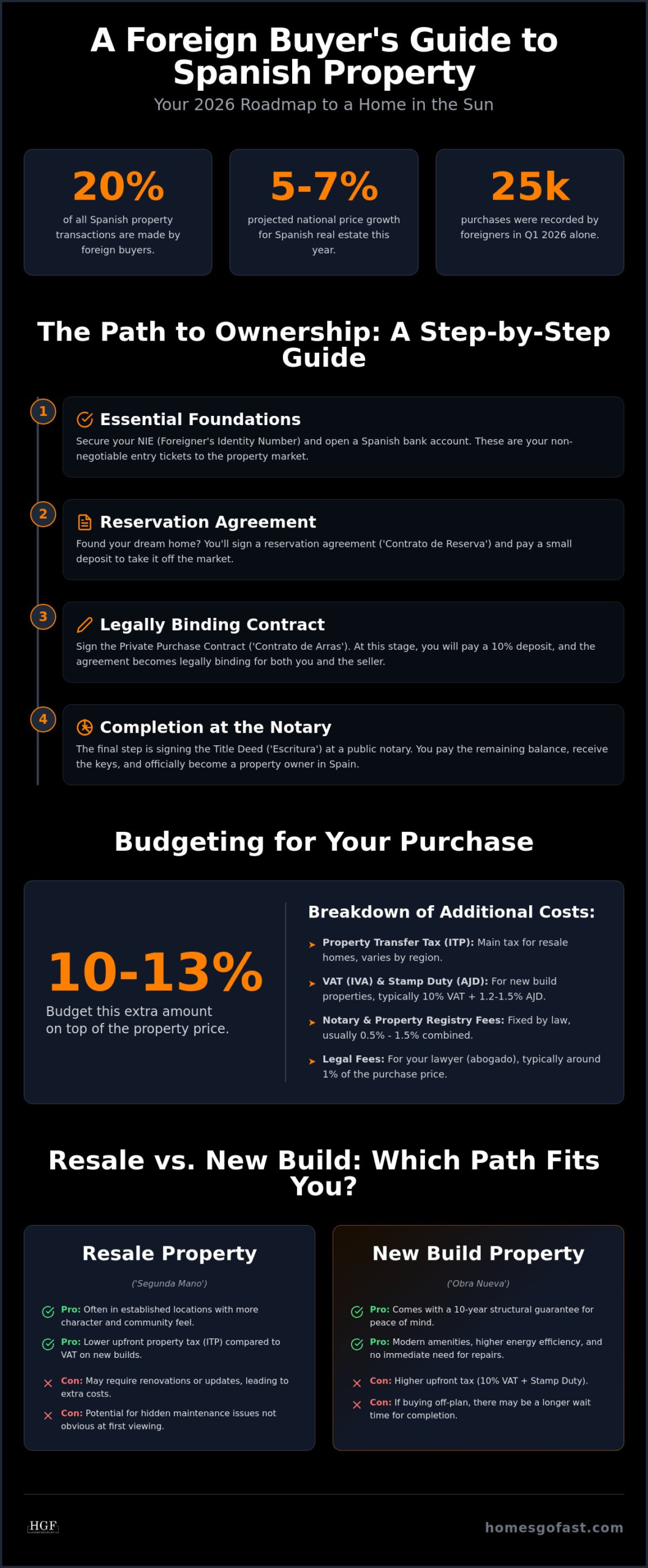
Did you know that foreign buyers accounted for 20% of all Spanish real estate transactions last year, with nearly 25,000 purchases recorded in the first quarter of 2026 alone? It’s clear that the dream of owning a home in the sun remains as strong as ever. However, understanding the property buying process in Spain for foreigners has become more complex following the abolition of the Golden Visa and the introduction of Royal Decree-Law 2/2026.
You likely feel the pull of the Spanish lifestyle but worry about hidden property debts or regional tax variations that could derail your budget. It’s a common concern when you’re dealing with language barriers and unfamiliar legal systems. Buyers are increasingly looking for transparent guidance, while investors are attracted by the projected 5% to 7% national price growth expected throughout the year.
This guide acts as your savvy mentor, helping you master the legal and financial steps required in today’s market. You’ll gain a clear roadmap of the total costs, from the mandatory NIE to the final notary signing. We’ll break down the 2026 tax landscape across different regions to ensure your investment is legally secure and financially sound.
Key Takeaways
- Secure your NIE and a Spanish bank account early, as these are the essential gateways for every transaction in the country.
- Understand the two-stage contract system, moving from an initial reservation agreement to a legally binding 10% deposit contract.
- Navigate the property buying process in Spain for foreigners by budgeting an additional 10% to 13% for taxes and fees.
- Recognize that while the Golden Visa program has ended, non-residents still maintain the same property ownership rights as locals.
- Leverage international listing platforms to compare regional price variations and identify high-growth investment zones before you visit.
The Landscape of Property Buying in Spain for Foreigners in 2026
The Spanish property market entered 2026 with remarkable momentum. Despite global economic shifts, foreign interest remains a primary driver of the national real estate sector. International buyers now account for roughly 20% of all transactions, a figure that highlights Spain’s enduring appeal. Investors are attracted by steady price growth, which experts project will settle between 5% and 7% this year. The property buying process in Spain for foreigners is built on a foundation of transparency and equal rights, making it one of the most accessible markets in Europe.
Since the abolition of the Golden Visa in April 2025, the profile of international buyers has evolved. We’re seeing a shift away from those seeking residency purely through investment toward digital nomads and lifestyle seekers who prioritize quality of life. Buyers are increasingly looking for overseas property that offers a balance of high-speed connectivity and authentic Mediterranean culture. This demand is particularly high in coastal regions, though inland “authentic” villages are seeing a surge in interest from those seeking better value for money.
To better understand the practical steps of this journey, watch this helpful video:
Market Trends and Foreign Ownership Rights
Ownership rights in Spain are exceptionally robust for non-residents. You don’t need a residency permit to own a home here. Spanish law grants you the same legal protections as a local citizen regarding property tenure and disposal. Understanding the Essential Legal Foundations of real property is vital before you commit to a purchase. While traditional hubs like the Costa del Sol remain popular, current hotspots like Valencia and Malaga are significantly outperforming the national average. These cities offer a mix of tech-driven growth and high rental yields that savvy investors find hard to ignore.
Resale vs. New Build: Which Path Fits Your Goals?
Choosing between a resale home and a new build depends on your timeline and financial goals. Resale properties, or segunda mano, often offer established neighborhoods and immediate occupancy. New builds, frequently marketed as llave en mano (key-ready), provide modern energy efficiency and structural warranties. You should consider these factors:
- New Build Pros: Modern amenities, 10-year structural guarantee, and higher energy ratings.
- New Build Cons: Higher initial tax (IVA) and potentially longer wait times if buying off-plan.
- Resale Pros: Lower Transfer Tax (ITP) in many regions and established community feel.
- Resale Cons: Potential for hidden maintenance issues or the need for immediate renovations.
‘Obra Nueva’ refers to brand-new properties and typically carries a 10% VAT (IVA) rate across most of Spain. To get a feel for what your budget can achieve in today’s market, you can browse current property for sale in Spain to compare these options side-by-side.
Essential Legal Foundations: NIE, Bank Accounts, and Representation
Before you start touring villas, you must prepare your legal toolkit. The property buying process in Spain for foreigners relies on a few non-negotiable items that prove your identity and financial standing to the Spanish state. Handling these steps early ensures that when you find the perfect home, you can move with the efficiency that today’s fast-paced market demands.
Securing Your NIE (Número de Identidad de Extranjero)
The NIE is your tax identification number and acts as your essential gateway to every Spanish transaction. You can’t buy a house, sign for utilities, or pay taxes without it. In 2026, you can apply through a Spanish consulate in your home country or at a National Police station once you arrive in Spain.
Appointments at police stations can be scarce and often require booking weeks in advance. Get your NIE early so you don’t lose a property to a buyer who already has their paperwork in order. Digital certificates are now more widely used, allowing your legal representative to handle many filings online, which streamlines the timeline significantly for overseas buyers.
A Spanish bank account is also non-negotiable. While you might use international transfer services for the initial purchase, you’ll need a local account for ongoing property taxes, community fees, and utility direct debits. Most banks require your NIE to open a non-resident account, though some offer “pre-NIE” accounts for a higher fee.
Why an Independent Lawyer is Your Best Investment
Spanish property law is regional and complex. An independent lawyer performs the “Nota Simple” check, a critical document from the Land Registry that confirms the current owner and ensures the property is free of hidden debts or liens. They also verify the building’s legality, ensuring there are no past planning infractions that could lead to future fines.
Your lawyer should never be recommended by the seller because an independent professional’s sole loyalty must lie with protecting your interests and capital. To start your search with a clear understanding of regional options, you can browse current international property listings and see how prices differ across the provinces.
If you cannot be in Spain for the final signing, you can grant an Escritura de Poder (Power of Attorney). This legal document allows your lawyer to sign the title deeds at the notary on your behalf. It’s a standard practice for international investors, allowing you to complete your acquisition without the need for multiple international flights.
The Step-by-Step Spanish Purchase Process
Once you’ve identified your dream home, the property buying process in Spain for foreigners moves into a structured legal sequence. It’s a brisk journey that requires quick decision-making and clear communication with your legal team. You’ll start with the Contrato de Reserva. This reservation agreement involves a small deposit, typically between €3,000 and €6,000, which secures the property and takes it off the market. Whether you’re negotiating through an agency or exploring a for sale by owner listing, this step protects you while your lawyer begins the heavy lifting of due diligence.
From Reservation to the Arras Contract
The transition from a simple reservation to a binding commitment happens through the Contrato de Arras. This private purchase contract usually requires a 10% deposit. Investors are attracted by the clear legal consequences of the Arras Penitenciales, which is the most common contract type in Spain. Under this agreement, if you withdraw from the deal, you forfeit your deposit. However, if the seller pulls out, they must pay you back double the amount you deposited. This creates a powerful incentive for both parties to reach the finish line.
Your lawyer must confirm several critical factors during this 14 to 30-day window:
- Ownership Verification: Confirming the seller has the legal right to transfer the title.
- Debt Clearance: Ensuring no outstanding mortgages, local taxes (IBI), or community fees remain.
- Planning Compliance: Verifying that any extensions or renovations were legally permitted.
Completion at the Notary (The Escritura)
The final act of your acquisition takes place at the office of the Notario. In the Spanish system, the Notary is a public official who witnesses the transaction to ensure it meets all legal requirements. They verify the identities of both parties, confirm the payment has been made, and read the Escritura de Compraventa (Title Deed) aloud. Buyers are increasingly looking for multilingual notaries or ensuring their lawyer is present to translate every clause of the document before signing.
Managing the final payment requires coordination with your Spanish bank. You’ll typically use a cheque bancario (guaranteed bank cheque) to settle the remaining balance. Once the deed is signed and the keys are in your hand, the Notary sends an electronic notification to the Land Registry. Your lawyer will then handle the final registration at the Registro de la Propiedad, a process that can take several weeks but officially cements your status as the new owner.
Financial Realities: Taxes, Fees, and 2026 Budgeting
One of the most common mistakes in the property buying process in Spain for foreigners is underestimating the “on-the-road” costs. While the advertised price of a villa in Marbella or an apartment in Valencia might fit your budget, you must account for the secondary expenses that accompany the deed. A reliable rule of thumb for 2026 is the “12% Rule.” You should budget between 10% and 13% on top of the purchase price to cover taxes, notary fees, and legal representation.
Investors are attracted by the long-term yields in Spain, but failing to calculate these entry costs can significantly impact your initial ROI. If you are also considering the exit strategy for your investment, it’s helpful to understand the capital gains tax on sale of property from a seller’s perspective. This global perspective ensures you’re prepared for the full lifecycle of your asset.
ITP vs. VAT: Understanding Purchase Taxes by Region
The type of tax you pay depends entirely on whether the property is a new build or a resale. For new builds (Obra Nueva), you’ll pay a flat 10% VAT (IVA) plus a Stamp Duty (AJD) that varies by region, such as 1.4% in the Valencian Community. For resale properties, you pay the Property Transfer Tax (ITP), which is where regional variations become massive. Buyers are increasingly looking for tax-efficient regions to maximize their purchasing power.
- Madrid: Offers the lowest general ITP at 6%.
- Andalusia: Currently sits at a competitive 7%.
- Valencia: Effective June 1, 2026, the rate is 9% for properties up to €1 million and 11% for those above.
- Catalonia: Generally 10%, rising to 11% for luxury properties over €1 million.
Hidden Costs and Ongoing Ownership Expenses
Beyond taxes, you’ll encounter Notary and Land Registry fees. These are based on a sliding scale set by the government, typically ranging from 0.1% to 0.6% of the property value. Don’t overlook the cost of currency exchange. Using a high-street bank to move your funds into Euros can cost you up to 4% in poor exchange rates and hidden fees. Specialist currency brokers can often save you thousands on a typical transaction.
Once the keys are yours, you’ll face ongoing costs like the IBI (Impuesto sobre Bienes Inmuebles), which is the annual municipal property tax. If your home is part of an urbanization, you’ll also pay Gastos de Comunidad for the maintenance of shared pools and gardens. To ensure you’re looking at properties that fit your total financial plan, you can browse current Spanish listings to compare prices and estimated community fees across different provinces.
Finding Your Ideal Property and Avoiding Common Pitfalls
Finding the right home is the most exciting part of the property buying process in Spain for foreigners, but it’s also where you’ll face the steepest learning curve. While you should start by browsing property for sale in Spain to benchmark prices, the real work begins when you filter for quality and legality. Buyers are increasingly looking for a mix of global visibility and local boots-on-the-ground expertise to ensure they don’t fall into common regional traps.
Maximizing Global Listings and Local Expertise
Global portals offer a broader perspective than local-only sites, allowing you to compare yields and price points across different provinces simultaneously. This is particularly useful when navigating the “For Sale By Owner” (FSBO) dynamic, which is becoming more common in Spain. If you’re working with an agent, always vet their professional credentials and ask for references from previous international clients. In the high-end market, investors are attracted by buyer’s agents who represent your interests exclusively rather than the seller’s.
You must watch for specific red flags that can complicate a purchase. Properties on “Rustico” land often face stricter building regulations or lack proper residential status, which can lead to legal issues. Always verify the Cedula de Habitabilidad (Habitation Certificate), as this document proves the property meets living standards and is required to connect utilities. Additionally, the Spanish Coastal Law (Ley de Costas) can restrict ownership rights for homes built too close to the shoreline, potentially affecting your long-term investment security.
Remote Buying: Can You Purchase From Abroad?
In 2026, digital tools make it entirely possible to manage a purchase from your home country. High-definition video viewings and 3D tours provide an excellent initial filter, though “walking the neighborhood” remains the gold standard for understanding local amenities and noise levels. If you can’t travel for the completion, you can assign Power of Attorney to your lawyer to sign the deed at the notary on your behalf.
Even for brand-new builds, we still recommend a professional survey to catch any snagging issues before the final payment is released. This proactive approach ensures the property buying process in Spain for foreigners remains a streamlined and secure experience. To begin your journey with a wide-reaching view of the market, you can explore overseas property for sale to see how Spain’s current growth compares to other top-tier destinations.
Take the Next Step Toward Your Spanish Home
Master the property buying process in Spain for foreigners by prioritizing legal security and regional tax planning. You’re now equipped to handle the 10% arras deposit and the final notary signing with absolute confidence. Whether you’re targeting a high-yield apartment in Valencia or a coastal retreat in Malaga, remember that a “legal-first” mindset is your greatest asset in today’s competitive market.
At HomesGoFast, we specialize in connecting you with the right opportunities through our global network. With over 20 years of international property expertise, we offer access to thousands of diverse listings from established agents and private owners. Our platform provides the professional guidance for overseas buyers that makes cross-border transactions feel effortless and secure.
Start your search for property for sale in Spain today to find a home that matches your lifestyle and investment goals. Your future in Spain is waiting, and we’re here to help you navigate the path to the keys. Embrace the confidence of a well-planned investment and start your Mediterranean journey now.
Frequently Asked Questions
Can a foreigner buy property in Spain without a visa?
Yes, you can buy property in Spain without a visa or residency permit. Property ownership is a separate legal process from immigration, allowing you to invest in a holiday home or rental asset regardless of your nationality. You only need a valid passport and an NIE number to complete the transaction and register the home in your name.
How much deposit do I need for a Spanish mortgage as a non-resident?
Non-residents typically need a deposit of 30% to 40% of the property value. Spanish banks generally offer a maximum Loan-to-Value (LTV) of 60% to 70% for international buyers, which is lower than the rates offered to residents. You’ll also need to provide proof of income and financial stability through bank statements and tax returns from your home country. For those looking to optimize their financial standing or manage existing commitments before applying, resources like I Need Cash can offer essential guidance on debt management and credit health.
What is the NIE number and why is it mandatory for property buyers?
The NIE is a mandatory tax identification number for all foreigners conducting financial business in Spain. It’s essential for the property buying process in Spain for foreigners because you can’t pay the required taxes, register the deed at the Land Registry, or even set up utility contracts without it. Obtaining this number early is vital to avoid delays during the purchase.
Are there any restrictions on Americans or Brits buying property in Spain in 2026?
There are no restrictions preventing Americans or Brits from purchasing Spanish real estate in 2026. While the Golden Visa program was abolished in 2025, British and American citizens remain among the most active international buyer groups. They follow the same standard purchase procedures as EU citizens, though they must manage their length of stay under standard 90-day visa-free rules.
What are the total closing costs for a property in Spain?
You should budget between 10% and 15% of the purchase price for total closing costs. This includes the Property Transfer Tax (ITP) for resales or VAT (IVA) for new builds, alongside notary fees, Land Registry costs, and your lawyer’s fees. These costs vary by region, with Madrid offering some of the lowest tax rates while Valencia and Catalonia sit at the higher end.
How long does the property buying process in Spain typically take?
The timeline for the property buying process in Spain for foreigners typically ranges from 6 to 12 weeks. This period covers everything from the initial reservation agreement to the final signing at the notary’s office. Factors like obtaining your NIE, securing a mortgage, and the complexity of the property’s legal checks can influence the total duration of the transaction.
Do I need to be in Spain physically to complete the purchase?
You don’t need to be physically present in Spain to complete your purchase. By granting Power of Attorney to your lawyer, they can sign all necessary documents and the final title deed on your behalf at the notary. This is a common and secure practice that allows international investors to manage their acquisition remotely without multiple international flights.
What happens if I pull out of the purchase after signing the Arras contract?
If you withdraw from the purchase after signing a standard Arras contract, you’ll forfeit your 10% deposit. However, if the seller pulls out of the deal, they’re legally required to pay you back double the amount of your deposit. This system provides a strong financial guarantee for both parties, ensuring that everyone remains committed to reaching the final completion.