
Did you know that bank appraisal values for Portuguese homes surged by 16.5% year-on-year by early 2026? While the market is thriving, the rules of engagement have shifted. Investors are attracted by the lifestyle, yet many feel overwhelmed by the “post-Golden Visa” reality and new tax structures. This comprehensive guide to buying a holiday home in Portugal helps you cut through the noise. It ensures you understand the 2026 market before you commit your capital.
It’s natural to feel cautious about hidden legal pitfalls or the complexity of obtaining a NIF. You want a home that offers both personal joy and long-term value, not a bureaucratic headache. Buyers are increasingly looking for clarity on how to manage properties from abroad while staying compliant with evolving local regulations and the “Construir Portugal” housing package.
We promise to simplify your journey by providing a clear roadmap from search to keys. This guide covers the 7.5% flat IMT rate for non-residents, the latest municipal restrictions on rental licenses, and a comparison of regional yields. You’ll gain the financial and legal insights needed to secure your Portuguese retreat with confidence and efficiency.
Key Takeaways
- Follow our expert guide to buying a holiday home in Portugal to master the 5-step process from your initial viewing to receiving the keys.
- Understand the 2026 IMT tax brackets and hidden closing costs to ensure you have a realistic “out-the-door” price before making an offer.
- Learn why hiring an independent lawyer (Advogado) is essential for protecting your interests and navigating the local property registry.
- Compare the lifestyle benefits and investment yields of the sunny Algarve against the more affordable and authentic Silver Coast.
- Get up to speed on the latest 2026 Alojamento Local (AL) licensing regulations to ensure your holiday home remains a legal and profitable rental.
Understanding the Portuguese Property Market Landscape in 2026
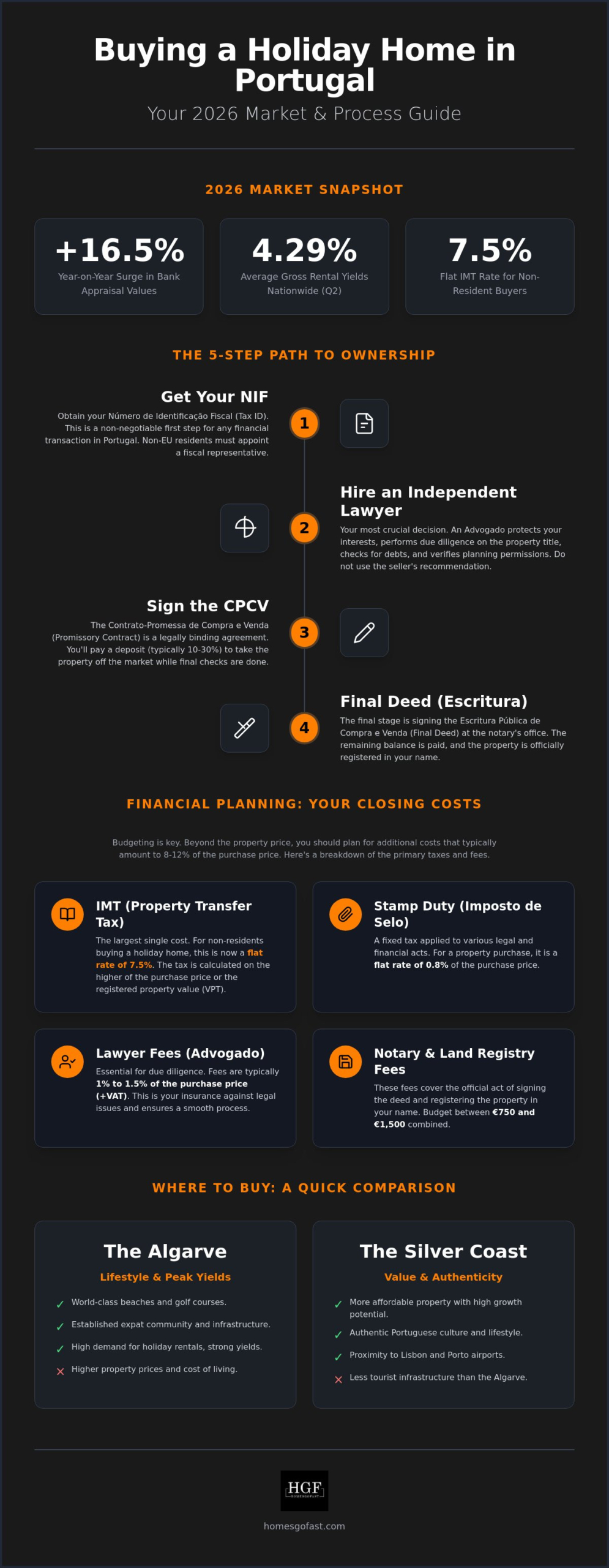
Portugal’s real estate market remains a powerhouse in 2026. Bank appraisal values jumped 16.5% year-on-year by April, proving that demand still outstrips supply across the country. This guide to buying a holiday home in Portugal helps you understand why this corner of Europe attracts so much international capital. While the 2023 removal of the real estate Golden Visa changed entry strategies, the underlying strength of Portugal’s economic landscape continues to offer a stable environment for international assets.
To better understand the common hurdles you might face, watch this helpful video:
The “Construir Portugal” program, passed in February 2026, has introduced new layers to the market. While it aims to boost long-term housing, it also set a flat 7.5% IMT rate for non-resident buyers. This shift means you need to be sharper with your financial planning. Buyers are increasingly looking for properties that offer high utility, moving away from “visa-hunting” and toward genuine global market trends that favor community integration and lifestyle value.
Investors are attracted by the quality of life, airport accessibility, and gross rental yields that averaged 4.29% nationwide in Q2 2026. Unlike some neighboring territories, Portugal maintains an open-door policy for foreign ownership. Non-residents face no legal restrictions on purchasing residential property, regardless of their nationality.
The NIF: Your Essential First Step
You can’t buy a property or even set up a utility bill here without a tax number. The Número de Identificação Fiscal (NIF) is your first hurdle. The Número de Identificação Fiscal is the primary requirement for any financial transaction in Portugal. If you’re a non-EU resident, you’ll need to appoint a fiscal representative to handle your application. This ensures the tax authorities have a local point of contact for your records.
Ownership Rights for Non-EU Citizens
Whether you’re coming from the UK, the US, or within the EU, the actual buying process remains largely identical. The main difference lies in residency options. With the Golden Visa now focused on regulated funds, many buyers are pivoting to the D7 visa or Digital Nomad permits to secure their stay. For those purely seeking an investment, the market remains a “safe haven” due to consistent price appreciation and high demand for overseas property for sale.
The 5-Step Buying Process: From Viewing to Completion
Once you’ve identified a property that fits your vision, the transition from browser to owner requires a structured approach. Investors are increasingly looking for transparency in the negotiation phase to avoid the common pitfalls of cross-border deals. This guide to buying a holiday home in Portugal ensures you move through each phase with the grounded reliability of a seasoned pro.
Your first move after an offer is accepted should be hiring an independent lawyer (Advogado). Don’t rely on a recommendation from the seller or the agent. An independent legal expert performs essential due diligence, checking for outstanding debts, planning permissions, and clear title deeds. It’s the only way to ensure your capital is protected from the start.
While you refine your search, it’s helpful to browse international real estate listings to compare market prices and property types across different regions. This helps you enter negotiations with a data-driven perspective and realistic expectations of the local market rhythm.
Securing the Property: The CPCV
The ‘Contrato-Promessa de Compra e Venda’ (CPCV) is the legally binding promissory contract. At this stage, you’ll typically pay a deposit between 10% and 30% of the purchase price. This document sets the timeline for completion and outlines the responsibilities of both parties. It effectively takes the property off the market while final checks are completed.
- Deposit Security: If you withdraw without a legal reason, you lose your deposit. If the seller withdraws, they must pay you double the deposit amount back.
- Protective Clauses: Ensure your lawyer includes “subject to survey” or “subject to mortgage” clauses. These protect you if structural issues arise or if your 2026 financing falls through.
The Final Deed and Registration
The ‘Escritura’ is the final act of the purchase. This takes place at a Notary’s office, where the public deed is signed and the remaining balance is paid. The Notary verifies the identities of all parties and confirms that all taxes, such as the flat 7.5% non-resident IMT, have been settled. Once the deed is signed, you officially hold the keys to your new home.
The final step is ensuring the property is registered at the Land Registry (Conservatória do Registo Predial). While the Notary handles the deed, your lawyer must confirm the registry reflects you as the new owner. This step is vital for your legal security and future resale potential. If you’re ready to start your journey, you can browse overseas property for sale to find the right investment for your 2026 goals.
Financial Planning: Taxes, Fees, and Hidden Costs
Buyers are increasingly looking for a transparent “out-the-door” price before they commit to a purchase. In the 2026 market, the excitement of finding a villa can quickly be dampened by unexpected tax invoices. This guide to buying a holiday home in Portugal ensures you account for every euro from the start.
Investors are attracted by Portugal’s capital growth, yet they must navigate a tax landscape that has recently become more streamlined for non-residents. Under the 2026 “Construir Portugal” rules, non-residents face a flat IMT rate for residential purchases. You should budget for total closing costs ranging between 9% and 11% of the property price.
| Fee Type | Estimated Cost (2026) |
|---|---|
| IMT (Non-Resident) | 7.5% (Flat rate) |
| Stamp Duty (Imposto do Selo) | 0.8% |
| Legal and Notary Fees | 1% to 2% |
| Total Closing Costs | ~9.3% to 10.3% |
Calculating the IMT and Stamp Duty
The Imposto Municipal sobre as Transmissões Onerosas de Imóveis (IMT) is your largest transaction cost. For a holiday home, you’ll face that flat 7.5% rate if you’re a non-resident. You must also factor in the Imposto do Selo (Stamp Duty), which is fixed at 0.8% of the property value.
Ongoing costs also require careful planning. The IMI (Municipal Property Tax) varies by municipality, generally ranging from 0.3% to 0.45% for urban properties. If your total property holdings in Portugal exceed €600,000 for individuals, you may also face the AIMI wealth tax.
Mortgages for Foreign Buyers
Portuguese banks remain active in the international sector, though they’ve maintained conservative lending standards into 2026. For non-residents, the typical Loan-to-Value (LTV) ratio sits between 60% and 70%. This means you’ll need a significant cash deposit to secure your investment.
Variable mortgage rates in Q2 2026 are hovering between 3.4% and 4.5%. Fixed rates are slightly higher, reaching up to 5.2%. Obtaining an “Agreement in Principle” is a powerful tool in a competitive market, as it shows sellers you’re a serious contender with verified backing.
When planning your long-term exit strategy, it’s wise to review the Capital Gains Tax on Sale of Property: The 2026 Global Seller’s Guide. Understanding how your eventual ROI might be affected by 2026 tax regulations is essential for a sound financial decision.
Where to Buy: Top Portuguese Regions for Holiday Homes
Choosing the right location is the most critical decision in this guide to buying a holiday home in Portugal. While we’ve discussed the national market strength, your daily experience depends on regional nuances. Investors are attracted by the Algarve’s established infrastructure, but the Silver Coast offers a distinct, rugged charm.
| Region | Median Price (2026) | Investment Profile |
|---|---|---|
| Greater Lisbon | €3,233/m² | High-end luxury & capital growth |
| Algarve | €2,817/m² | Strong rental yields & tourism |
| Madeira | €2,448/m² | Remote-work hub & stable demand |
| Alentejo | €1,333/m² | High value & renovation potential |
Algarve vs. Silver Coast: Pros and Cons
The Algarve remains the perennial favorite for sun and golf, with Faro (Algarve) yielding a strong 4.48% in 2026. However, the Silver Coast (Costa de Prata) is gaining ground as a more affordable, authentic alternative. Buyers are increasingly looking for the Silver Coast’s natural beauty and its proximity to Lisbon’s airport connectivity.
- Algarve Pros: Year-round tourism, high English proficiency, and established expat communities.
- Algarve Cons: Higher entry prices and more crowded tourist zones.
- Silver Coast Pros: Lower property costs, authentic culture, and world-class surfing.
- Silver Coast Cons: Cooler Atlantic weather and more seasonal rental demand.
The Rise of Central Portugal and the Islands
Investors are attracted by the Alentejo and Central Portugal for their space and historic renovation projects. These regions fit the “D7” lifestyle perfectly, offering peace at a fraction of the cost of the Setúbal Peninsula. You can find unique opportunities in these lower-density areas by scanning international property listings that feature rural estates and village homes.
Madeira and the Azores also represent unique value in 2026. Madeira’s thriving remote-work community supports year-round occupancy, while the Azores offer untouched landscapes and unique tax incentives. If you’re weighing these options against other Mediterranean markets, checking property for sale in Spain can help you benchmark the value you’re getting in Portugal.
Maximizing Your Investment: Management and Rentals
Securing the keys is a major milestone, but the long-term success of your investment depends on how you manage the property. Investors are attracted by Portugal’s average gross rental yield of 4.29%, yet achieving these figures requires proactive oversight. This guide to buying a holiday home in Portugal focuses on turning your property into a high-performing asset while you’re thousands of miles away.
You must also stay current with your tax obligations. Non-residents are taxed on their Portuguese rental income, and while certain expenses like management fees and insurance are deductible, the rules are strict. Engaging a local accountant ensures you remain compliant with the latest 2026 fiscal regulations while maximizing your net ROI.
The Rental License (AL) in 2026
The legal landscape for short-term rentals has tightened significantly. As of May 20, 2026, new EU regulations require booking platforms to automatically remove any listing that doesn’t display a valid Alojamento Local (AL) license number. While the national government has made these licenses permanent and transferable, individual municipalities have the power to create “high-pressure” zones where new licenses are prohibited.
Lisbon, for example, has closed most of its historic center to new AL registrations to prioritize long-term housing. This has led many savvy owners to pivot toward medium-term rentals. By targeting digital nomads and professionals on three-month assignments, you can often bypass the need for an AL license while maintaining high occupancy rates. You can explore how these shifts influence property values in our analysis of Global Market Trends.
Exit Strategy and Resale Value
A smart investor always looks at the exit before they enter. With national property prices growing 16.5% year-on-year by early 2026, the potential for capital appreciation is strong. However, to preserve international appeal, you must maintain the property to a high standard. Buyers in the resale market prioritize homes that are “turnkey,” meaning they are ready for immediate use or rental without further renovation.
Understanding the market cycle is vital. While the “Construir Portugal” program has increased the focus on long-term rentals, the demand for high-quality holiday homes from foreign buyers remains a primary driver of the luxury segment. Keeping your property modern and well-managed ensures you can capitalize on this demand when you eventually decide to sell. Ready to start your search? Browse the latest listings in Portugal to find a property with the best management and rental potential for your 2026 investment.
Secure Your Portuguese Property Future with Confidence
Navigating the 7.5% flat IMT rate and understanding regional yield variations are the keys to a successful 2026 acquisition. By prioritizing independent legal advice and exploring emerging value spots like the Silver Coast or Central Portugal, you position yourself for both personal enjoyment and long-term capital growth. This guide to buying a holiday home in Portugal has provided the roadmap you need to move from a casual search to a confident purchase in a competitive market.
Investors are attracted by the stability of the Portuguese market, but success requires the right data and direct access to opportunities. You can find better value and skip unnecessary hurdles by browsing direct listings on a platform that understands cross-border complexities. Start your search for the perfect Portuguese holiday home on HomesGoFast today!
As an established global platform since 2002, we provide access to listings from verified agents and private sellers alongside expert guides for international buyers. The Portuguese market is moving quickly, and there’s never been a better time to secure your place in the sun. Take the first step toward your new lifestyle today with the reliability of a seasoned global partner.
Frequently Asked Questions
Can I buy a house in Portugal after Brexit?
How much deposit do I need for a Portuguese holiday home?
You typically need a deposit of 10% to 30% of the purchase price when signing the promissory contract (CPCV). This payment secures the property and is legally binding for both parties. If you’re applying for a non-resident mortgage in 2026, banks generally require a 30% to 40% down payment, as Loan-to-Value ratios for international buyers are typically capped at 70%.
What is a NIF and how do I get one from abroad?
The NIF is your Portuguese tax identification number and is essential for every step of the property transaction. You can obtain one from abroad by appointing a fiscal representative, such as a local lawyer or a specialized service provider. They’ll apply to the tax authorities on your behalf, ensuring you have the necessary documentation to open a bank account and sign the initial purchase contracts.
Are there restrictions on renting out my holiday home in Portugal?
Restrictions on short-term rentals apply in “high-pressure” zones, particularly in the historic centers of Lisbon and Porto. This guide to buying a holiday home in Portugal recommends verifying AL license availability with the local municipality before you commit to a purchase. As of May 2026, EU regulations require all rental platforms to verify valid license numbers, making strict legal compliance essential for all investors.
Do I need a Portuguese bank account to buy property?
Yes, you’ll need a local bank account to complete the transaction and manage your property effectively. It’s required for the transfer of funds during the final deed and for setting up direct debits for utilities and municipal taxes. Most buyers open an account at the same time they obtain their NIF, often using a power of attorney to allow their lawyer to assist with the paperwork.
What are the ongoing taxes for a second home in Portugal?
Ongoing taxes include the IMI (Municipal Property Tax), which typically ranges from 0.3% to 0.45% of the property’s tax value for urban homes. If your total property holdings in Portugal exceed €600,000, you may also face the AIMI wealth tax. Don’t forget to budget for annual condominium fees if you’re buying in a shared complex, as these cover essential maintenance and communal services.
Is it possible to get a mortgage in Portugal as a non-resident?
Non-residents can certainly access Portuguese mortgages, though banks maintained conservative standards throughout 2026. Expect a maximum Loan-to-Value (LTV) ratio of 60% to 70%, meaning you’ll need to fund at least 30% of the purchase price yourself. In Q2 2026, variable rates for international buyers are between 3.4% and 4.5%, while fixed rates for the same period are offered between 4.0% and 5.2%.
How long does the buying process typically take in Portugal?
The process usually takes between three and six months from the moment your offer is accepted. This timeline includes the due diligence period, the signing of the CPCV, and the final completion at the Notary’s office. If you’re using a mortgage, the timeline can stretch toward the six-month mark due to the bank’s appraisal requirements and the necessary legal registrations at the Land Registry.