
What if the bustling crowds you usually avoid on vacation are actually the clearest signal of your next high-yield asset? You’ve likely felt that spark of excitement when visiting a vibrant coastal town, only to wonder if the window for a sound investment has already closed. It’s natural to feel anxious about buying in a destination that might be past its prime or getting tangled in shifting local rental laws.
Understanding the impact of tourism on overseas property investment is no longer just about counting hotel beds; it’s about analyzing how visitors transform into stakeholders. Buyers are increasingly looking for regions where infrastructure and visitor demand align to create long-term capital appreciation. Whether you are looking at international property listings or specific regional hubs, the data shows that tourism acts as a global showroom for real estate.
This guide will help you decode 2026 trends to predict property values and rental yields with professional precision. You will discover a clear framework to identify safe, tourism-driven markets and understand the vital link between infrastructure and growth. We will move quickly from market theory to actionable insights, giving you the confidence to browse overseas real estate with an expert eye.
Key Takeaways
- Learn how the “Showroom Effect” drives demand and the specific impact of tourism on overseas property investment regarding long-term capital growth.
- Discover why short-term rental yields in tourist hubs often outperform traditional long-term lets, especially during seasonal peaks.
- Identify the warning signs of market volatility and learn how to navigate local regulations regarding short-term rentals and over-tourism.
- Use our 2026 checklist to evaluate critical infrastructure factors like international airport connectivity and year-on-year visitor growth.
- Gain professional insights on how to filter high-growth zones and leverage local expertise to secure a sound international asset.
Understanding the Impact of Tourism on Overseas Property Investment
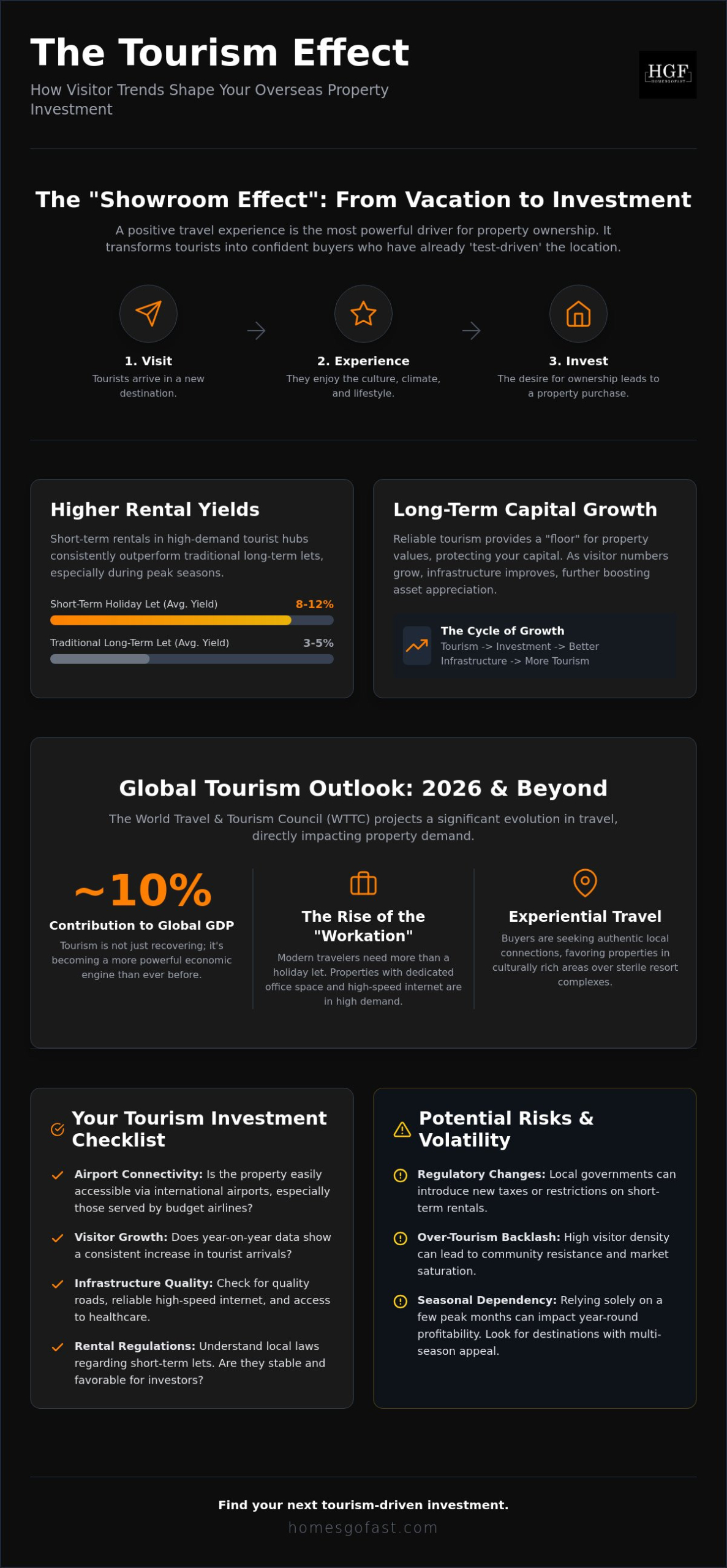
High tourism volumes aren’t just about crowded beaches or busy cafes. They represent a fundamental driver of local real estate demand. When you see a destination thriving with visitors, you’re looking at a live market test of that area’s appeal. The impact of tourism on overseas property investment is profound because it creates a reliable stream of potential buyers and tenants who have already “test-driven” the location.
Investors are attracted by what we call the “Showroom Effect.” A pleasant holiday experience often triggers a deep desire for ownership, moving a visitor from a hotel guest to a property seeker. Buyers are increasingly looking for homes that offer a dual benefit: a personal sanctuary for sun and culture, alongside the practical utility of a high-yield asset.
To better understand this concept, watch this helpful video:
This relationship often creates a cycle of “reverse causality.” As international capital flows into a region, local infrastructure typically improves to meet the needs of new residents. This investment in better roads, high-speed internet, and healthcare facilities makes the destination even more attractive to future visitors. While economic benefits are clear, it’s also vital to consider the socio-cultural impacts of tourism to ensure long-term community support for your investment.
The 2026 Global Tourism Outlook
The World Travel & Tourism Council (WTTC) projects that tourism will contribute nearly 10% to global GDP in 2026. This isn’t just a recovery; it’s an evolution. We’re seeing a massive shift toward experiential travel, where visitors want authentic local connections rather than sterile resorts. This trend directly influences where you should look for overseas property.
The rise of the “workation” has also changed property requirements. A standard holiday apartment no longer suffices for many modern travelers. They need dedicated office space and reliable connectivity. Properties that cater to these professional needs in high-demand tourism zones are seeing significantly higher interest from foreign buyers.
Why Tourism Matters to the Passive Investor
For those seeking hands-off returns, tourism-driven demand provides a crucial safety net. Established tourism corridors tend to maintain high occupancy rates even when other markets soften. This consistent demand provides a “floor” for property values, protecting your capital during broader economic downturns.
Accessibility is the ultimate value multiplier. Proximity to international airports and budget airline routes remains a primary factor in property valuation. If a traveler can reach their destination within a few hours of landing, your property’s appeal increases exponentially. Smart investors prioritize these logistics to ensure their asset remains liquid and desirable in a competitive global market.
How Tourism Drives Real Estate Value and Rental Yields
Tourism revenue acts as a massive engine for local property markets, often detaching high-profile destinations from national economic averages. Investors are attracted by the “Brand Effect” where a location’s global prestige creates a price premium. In regions like the Balearic Islands or the Algarve, the impact of tourism on overseas property investment ensures that land values remain resilient even when secondary inland markets soften.
To help you weigh the potential of different regions, consider this comparison of current market performance across Southern Europe’s top hubs:
| Market | Avg. Gross Yield (Short-Term) | Projected Price Growth (2026) | Primary Driver |
|---|---|---|---|
| Spain (Coastal) | 5.4% – 7.2% | 5% – 9% | Lifestyle & Infrastructure |
| Portugal (Algarve/Coimbra) | 6.1% – 6.9% | 4% – 6% | Expat Demand & Safety |
| Greece (Islands/Athens) | 6.5% – 9.0% | 6% – 8% | Golden Visa Renovations |
Short-Term vs. Long-Term Rental Strategies
Buyers are increasingly looking for properties that offer flexibility between short-term holiday lets and mid-term stays. While traditional tourism peaks drive massive ROI in the summer, the “Digital Nomad” effect is now smoothing out seasonality. In historic or coastal regions, mid-term rentals for remote workers can bridge the gap, ensuring your property generates income for 10 months of the year rather than three.
- Pros: Significantly higher nightly rates; personal use of the property; ability to adjust pricing dynamically based on demand.
- Cons: Higher management fees (typically 20-25%); increased wear and tear; sensitivity to local short-term rental licensing changes.
Capital Appreciation in Emerging vs. Mature Markets
Mature markets offer stability, but “early-stage” tourism zones often provide the most significant capital growth. If a region is slated for a new international airport terminal or a luxury marina, land values typically jump well before the first tourists arrive. You can use a property advertising platform to compare current entry prices in these upcoming zones against established global hubs.
Infrastructure development is the ultimate value multiplier. When governments invest in connectivity, they are essentially subsidizing your property’s appreciation. By identifying these zones early, you can secure overseas property for sale at a lower price per square metre while positioning yourself for the next travel surge.
The Risks: When Tourism Becomes a Volatility Factor
Every high-reward strategy carries specific vulnerabilities. While the growth potential is significant, the impact of tourism on overseas property investment includes a unique set of risks that traditional residential markets rarely face. A destination’s popularity can be cyclical. If a region falls out of fashion or suffers from over-tourism, property liquidity often tightens as buyers look elsewhere for the next “undiscovered” gem.
Local sentiment is another factor you can’t ignore. In 2026, we are seeing a growing backlash against “over-tourism” in several European hubs. This sentiment often translates into stricter local policies that can affect your property’s long-term viability. Sophisticated economic modeling of tourism’s impact on real estate shows that while visitor demand drives initial price surges, it also makes those markets more sensitive to external economic shocks.
Evaluating Tourism-Dependent Markets:
- Pros: Guaranteed visibility through global travel marketing; prioritized government infrastructure spending; high potential for currency-hedged rental income.
- Cons: Vulnerability to global travel restrictions; risk of sudden municipal rental caps; potential for local social friction due to high visitor density.
Regulatory Hurdles and Short-Term Rental Bans
The global trend toward restricting short-term rental platforms is accelerating. Cities like Barcelona and Venice have already implemented strict caps to protect local housing stock. In Spain, for example, the number of registered tourist rentals dropped by 10.7% year-over-year in May 2026. If you’re looking at property for sale in Spain, you must verify municipal zoning laws before assuming a “holiday let” strategy is permitted.
Future-proofing your investment means ensuring the property appeals to local residents as well as tourists. A unit that only works as a short-term rental is a high-risk asset. By choosing properties in areas with diverse demand, you protect yourself against sudden regulatory shifts that could overnight ban short-term platforms in specific districts.
Economic Sensitivity and Global Events
Tourism-dependent economies are the first to feel the sting of global recessions or travel restrictions. When discretionary spending drops, occupancy rates in holiday zones are the first to fall. This sensitivity is why we recommend a balanced approach to your international portfolio. You don’t want your entire net worth tied to a single leisure-driven market.
Understanding broader global market trends is essential for timing your entry and exit. A diversified portfolio that includes both tourism hotspots and stable urban centers provides a buffer against localized volatility. This strategy ensures that a downturn in one region’s visitor numbers doesn’t compromise your overall financial health.
Evaluating a Market: The Tourism Investment Checklist
To maximize the impact of tourism on overseas property investment, you need a structured approach to due diligence. It’s not enough to simply like a location; you must verify that the logistics and the data support a long-term profit motive. Use this five-step checklist to filter the noise and focus on high-value opportunities.
- Step 1: Connectivity. Analyze the proximity to international airports and the frequency of budget airline routes. If a destination is more than 90 minutes from a major hub, your potential rental pool will likely be smaller.
- Step 2: Growth Statistics. Review year-on-year visitor growth and average length of stay. In March 2026, Portugal saw overnight stays from non-residents increase by 2.9%. Consistent growth indicates a healthy demand curve for local housing.
- Step 3: Seasonality Index. Is the area a 3-month summer wonder or a 10-month destination? Markets like the Canary Islands or major European cities are safer than isolated beach resorts that become ghost towns in winter.
- Step 4: Infrastructure Pipeline. Investigate planned developments. New marinas, luxury hotels, or high-speed rail links signal that institutional capital is betting on the area’s future.
- Step 5: Yield Math. Compare local price-to-rent ratios against regional averages. While Greece offers gross short-term yields of up to 9%, you must factor in the higher entry thresholds in prime zones like Athens or Santorini.
Sustainable Tourism as a Value Driver
In 2026, “Green” destinations are no longer a niche; they are a primary growth engine. Investors are attracted by regions that prioritize environmental protection, as these areas often command higher rental premiums and show better long-term desirability. Regenerative tourism is travel that actively improves the local environment and community, creating a virtuous cycle that protects your property value over decades.
The Role of Expat Communities
A strong expat presence acts as a stabilizer for any tourism market. These residents provide a baseline of demand for local services and can serve as a secondary rental market during the off-season. International schools are particularly significant. Their presence often correlates with higher resale values and attracts high-net-worth families who might otherwise only visit as tourists.
Before you commit, it’s helpful to cross-reference your findings with a broader acquisition strategy. You can find more detailed advice in our guide on Navigating International Real Estate Listings. When you’re ready to see what’s available in these high-growth zones, start by browsing our latest overseas property for sale to compare live market prices across different territories.
Taking Action: Finding Your Next Investment with HomesGoFast
The impact of tourism on overseas property investment is most visible when you move from research to acquisition. Choosing the right platform is the first step in bridging the gap between a holiday dream and a high-yield reality. Since 2002, HomesGoFast has acted as a global connector, helping thousands of buyers identify opportunities in the world’s most resilient tourism corridors.
While technology simplifies the search, the importance of local expert guidance remains paramount. We recommend using our platform to build a shortlist of properties, then engaging with local legal and financial professionals to verify zoning laws and tax requirements. This balanced approach ensures that you leverage global visibility while maintaining the security of local expertise.
Exploring Top Tourism Hubs
If you are ready to put your investment checklist into practice, several European markets offer compelling data for 2026. You can find diverse opportunities in Spain, where coastal demand remains a primary driver of capital appreciation. Alternatively, the historical prestige and enduring visitor appeal of Italy provide a stable environment for those seeking long-term value.
For those focused on classic tourism investment, the ease of browsing French homes for sale makes it simple to compare rural gites with chic city apartments. Each of these regions benefits from established infrastructure and a consistent influx of international visitors. Start your search today to capitalize on the 2026 travel surge and secure your position in these high-traffic markets.
Selling a Property in a High-Traffic Area?
If you already own an asset in a tourist hotspot, 2026 is an ideal time to realize your gains. Listing on a global platform is essential for properties in areas where the most likely buyer is sitting in another country. The modern international buyer is tech-savvy and results-driven, looking for properties that offer immediate lifestyle and financial utility.
Professional sellers and agents can gain a significant advantage by using our “Agent Pro” account. This tool is designed to capture the surge in tourism-driven interest by providing maximum visibility across multiple continents. Whether you are an individual owner or a professional, you can advertise your property to a global audience and connect with motivated buyers who understand the market dynamics of holiday regions.
2026 is a pivotal year for tourism-linked property acquisition. The shift toward experiential travel and the rise of the digital nomad have created a more fluid, dynamic market. By combining analytical data with the reach of a global marketplace, you can turn the global tourism rebound into a cornerstone of your investment portfolio.
Securing Your Future in the Global Tourism Market
The impact of tourism on overseas property investment creates a unique opportunity to blend lifestyle aspirations with sound financial logic. You’ve seen how connectivity and visitor demand act as a floor for property values; even in changing regulatory landscapes, these fundamentals remain strong. By focusing on infrastructure-rich zones and emerging sustainable hubs, you position your portfolio for long-term growth and resilient rental yields.
Since 2002, HomesGoFast has acted as the essential bridge for international buyers. Our platform provides global visibility across 50+ countries and offers expert guides on international market trends to simplify your acquisition journey. Whether you are looking for a coastal retreat or a high-yield city apartment, having the right data ensures you buy with confidence and efficiency.
It’s time to turn these 2026 market insights into a tangible asset. Browse international property listings in top tourism hotspots to find your next high-growth opportunity. The global market is moving fast, and there’s never been a better time to expand your horizons and secure a piece of a thriving destination.
Frequently Asked Questions
Is it better to invest in a mature tourism market or an emerging one?
Your choice depends on your specific risk tolerance and financial goals. Mature markets like the Costa del Sol or Tuscany offer grounded reliability and high liquidity, making them ideal for investors seeking stable, predictable returns. Emerging markets often provide higher capital growth potential but require more extensive due diligence regarding future infrastructure and local demand trends.
How do short-term rental regulations impact property resale value?
Strict regulations can create a dual-track market where properties with existing, transferable licenses command a significant premium. If a municipality implements a total ban on new short-term lets, the resale value for ROI-focused investors may dip. However, properties that also appeal to local residential buyers or long-term expats tend to maintain their value more effectively during these regulatory shifts.
Does high tourism always lead to high capital appreciation?
No, high visitor numbers don’t automatically guarantee that property prices will rise indefinitely. While the impact of tourism on overseas property investment is generally positive, factors like over-supply or a lack of local amenities can cause prices to plateau. Smart investors look for areas where tourism growth is matched by meaningful public investment in transport and healthcare to ensure sustainable appreciation.
What are the tax implications of owning a rental property in a tourist zone abroad?
Tax obligations vary significantly by territory and your residency status. In Spain, for example, EU residents are typically taxed at 19% on net rental income, while non-EU residents often face a higher flat rate. You must also account for local municipal taxes, such as the IMI in Portugal, and potential wealth taxes if your property’s value exceeds specific regional thresholds like €600,000.
How can I protect my investment from seasonal tourism fluctuations?
Diversifying your rental strategy is the most effective way to hedge against seasonality. Investors are increasingly looking for properties in “dual-season” locations that offer winter activities or urban culture alongside summer appeal. Targeting the mid-term rental market, such as visiting professionals or academics, can also provide a steady income stream during the quieter months when traditional holiday demand drops.
Which regions are currently showing the strongest link between tourism and property growth?
Southern Europe remains a powerhouse, with Greece seeing some of the largest tourism-linked rent increases in recent years. Estimates suggest tourism has driven annual rent hikes of over €340 in Greece since 2019. Portugal also shows strong performance, with total revenue from tourist accommodation increasing by 6.6% year-on-year as of early 2026, directly supporting residential property demand in coastal hubs.
Can digital nomadism replace traditional tourism as a driver for rental demand?
Digital nomadism acts as a powerful complement to traditional tourism rather than a replacement. While holidaymakers provide high-frequency, short-term yields, nomads offer mid-term stability by staying for one to three months. This shift is changing property requirements, as buyers are increasingly looking for units with dedicated workspaces and high-speed connectivity to capture this growing segment of the global travel market.