
Did you know that the hidden markup on your currency exchange can often exceed your total legal bill? While most buyers focus on the sticker price, the reality of overseas property transaction fees is a complex “cost stack” that can quietly erode 8% to 12% of your investment capital. Whether you’re eyeing a villa in Spain or a penthouse in Dubai, these friction costs are the biggest threat to your immediate ROI. Investors are attracted by global markets for their growth potential, but they often underestimate the impact of regional tax shifts and notary markups.
It’s frustrating to watch your budget stretch thin because of unforeseen levies you didn’t see coming. Buyers are increasingly looking for transparency in these cross-border deals to avoid the sting of hidden expenses. We believe that international acquisition should be about building a legacy, not solving a financial puzzle. This guide empowers you to master the landscape of international costs. You’ll gain a clear breakdown of regional variations, such as Spain’s 14% total transaction cap and Turkey’s 4% Title Deed tax. We also reveal practical strategies to minimize fees on currency transfers, ensuring you keep more of your equity where it belongs: in your new home.
Key Takeaways
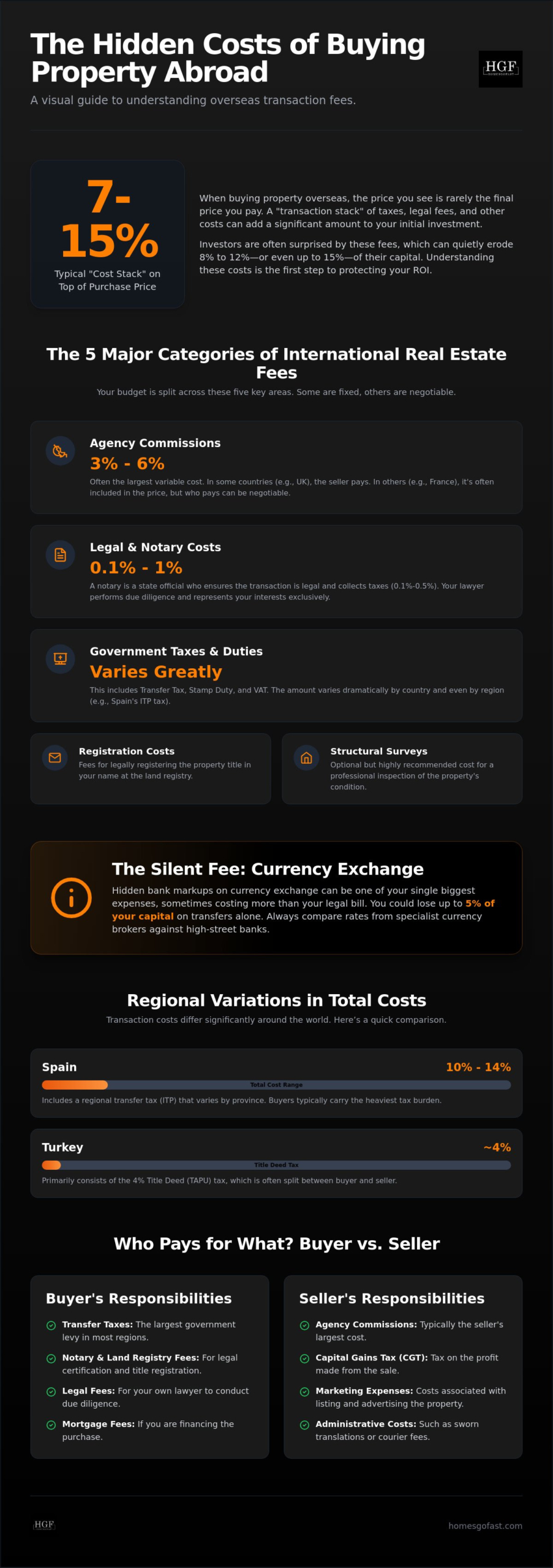
- Break down the five major categories of international costs to understand why typical transaction stacks range from 7% to 15% of the purchase price.
- Master currency exchange strategies to avoid losing up to 5% of your capital to hidden bank markups on cross-border transfers.
- Use a “Gross-to-Net” estimation process to identify and negotiate overseas property transaction fees like agent commissions and legal conveyancing costs early.
- Leverage direct advertising and global property platforms to reduce reliance on high-commission intermediaries and protect your home’s equity.
- Gain clarity on regional tax variations, from Greece’s VAT suspension to Spain’s regional transfer taxes, to make informed investment decisions for maximum yield.
Understanding the Stack: What are Overseas Property Transaction Fees?
When you look at a listing for a villa in Marbella or a condo in Bangkok, the price tag you see is rarely the price you pay. In the world of international real estate, you must account for the “transaction stack.” This is the total sum of taxes, legal fees, agency commissions, and financial costs required to move the title into your name. Understanding overseas property transaction fees is essential because these costs typically range from 7% to 15% of the property value, depending on the jurisdiction. Investors are attracted by high-yield markets, but failing to budget for these closing costs can instantly turn a lucrative deal into a financial headache.
The 2026 market shows a clear trend toward fee transparency, yet local customs still dictate who writes the check. In many European markets, the buyer carries the heavy lifting of transfer taxes. In contrast, other regions might see the seller covering the bulk of the real estate commission. You need to know these rules before you start negotiations. Buyers are increasingly looking for ways to streamline these costs, often by utilizing an Agent Pro Account to find direct listings and bypass some of the traditional intermediary markups.
Regional Variations in Fee Structures
Europe often presents the highest barrier to entry regarding taxes. For instance, if you are looking at property for sale in Spain, you should budget between 10% and 14% for total costs. This includes regional transfer taxes (ITP) that vary by province. Conversely, in the Americas, the focus shifts. You might find lower government taxes but higher agent commissions and a greater reliance on title insurance. Researching these global market trends helps you identify where your capital goes further.
The Difference Between Buying and Selling Fees
It’s a mistake to assume that the exit is as expensive as the entry. Sellers generally face a different set of financial hurdles.
- Seller Costs: These usually include marketing expenses, agency commissions (often 3% to 6%), and Capital Gains Tax (CGT).
Don’t forget to account for “hidden” administrative costs. Sworn translations of documents and international courier fees for physical deeds can add hundreds of dollars to your final bill. By calculating these early, you protect your ROI and ensure a smoother path to ownership.
The 5 Major Categories of International Real Estate Fees
Mastering your budget starts with identifying exactly where your money goes. While every country has its own quirks, overseas property transaction fees generally fall into five distinct buckets. Investors are attracted by markets with low entry costs, but the total “stack” is what determines your true starting equity. These categories include agency commissions, legal fees, government duties, registration costs, and structural surveys. Each plays a role in protecting your investment, though some are more negotiable than others.
Agency Commissions Across Borders
Real estate commissions are often the largest variable in your transaction. The global standard typically sits between 3% and 6% of the purchase price. However, the person responsible for this bill changes depending on where you buy. In the UK, the seller almost always pays the agent. In France, the fee is often included in the listed price (FAI), but buyers can sometimes negotiate who pays to reduce their base for calculating transfer taxes. Buyers are increasingly looking for ways to bypass these high costs. If you want to reclaim the equity often lost to intermediaries, you can explore HomesGoFast owner pricing for direct listing alternatives that cut out the middleman.
Legal and Notary Costs
You must distinguish between a lawyer and a notary, especially in civil law jurisdictions like Spain, Italy, or Portugal. A notary is a public official who represents the state. They ensure the transaction follows the law and collect taxes, usually charging between 0.1% and 0.5%. Your lawyer, however, represents only you. They perform the “due diligence” on the title and building licenses. You should never use the seller’s lawyer to save on costs, as this creates a massive conflict of interest. In 2026, expect to pay around 1% of the purchase price for independent legal representation. For a deeper look at how these rates shift globally, you can consult this data on Real Estate Transaction Costs by Country.
Registration, Taxes, and Surveys
Government stamp duties and transfer taxes are non-negotiable. In Spain, for example, the transfer tax (ITP) for resale homes ranges from 6% to 10% depending on the region. Once the taxes are paid, you’ll face property registration and title fees to officially record your ownership in the local land registry. Finally, don’t skip the survey. Structural surprises can cost far more than the survey fee itself. Protecting your capital means ensuring the roof and foundations are sound before you commit. If you’re ready to start your search, you can browse international property listings to see how these costs compare across different markets.
Currency Exchange: The Silent Transaction Fee
While you might track every notary charge, the largest of all overseas property transaction fees often remains invisible. It’s the currency exchange markup. Most retail banks hide their profit in the “exchange rate spread” rather than a flat fee. You might see a $20 transfer charge and think you’ve got a bargain. In reality, the bank could be taking 3% to 5% of your total purchase price through a poor exchange rate. This hidden cost is why many buyers feel their budget slipping away during the final stages of a deal.
Investors are attracted by the potential for high ROI in emerging markets, but they often lose their first year of growth before they even own the keys. For a $500,000 property, a mere 1% difference in the exchange rate equals $5,000. If your bank charges a 3% spread, you’ve just paid $15,000 in hidden costs. Understanding the “Interbank Rate”, the real price banks use to trade with each other, is your first step toward saving. By focusing on the spread rather than the transfer fee, you protect your capital from unnecessary erosion.
Banks vs. Specialized Currency Brokers
Retail banks are designed for small, everyday transactions, not large-scale property acquisitions. They’re typically the most expensive way to buy foreign currency because they don’t offer competitive rates for one-off transfers. Specialized currency brokers, however, provide personal account managers who understand the nuances of global market trends. These experts provide access to forward contracts. This tool allows you to lock in today’s exchange rate for a future completion date. It’s a vital safety net if you’re buying an off-plan home and don’t want your final payment to skyrocket because of a sudden currency dip.
Timing Your Currency Purchase
Market volatility can change the cost of your home by thousands of dollars in a single afternoon. Leaving your exchange to the last minute is a high-stakes gamble you don’t need to take. Buyers are increasingly looking for automated tools like limit orders to manage risk. You set a target rate, and the broker executes the trade only when the market hits that figure. This proactive approach ensures you maximize your buying power. If you’re currently scouting locations, you can browse international real estate listings to compare how different currency strengths affect your budget. By managing your exchange rate spread, you effectively slash your overseas property transaction fees by thousands.
How to Calculate and Reduce Your Transaction Costs
You’ve identified the hidden markups and the standard categories. Now, you need a strategy to control them. Calculating overseas property transaction fees accurately before you sign a contract prevents budget creep and protects your liquidity. Investors are attracted by markets with clear fiscal rules, but even in the most transparent regions, costs can escalate without a proactive plan. Follow these four steps to build a realistic financial roadmap.
- Step 1: Request a “Gross-to-Net” estimate. Ask your local lawyer for a comprehensive sheet showing the purchase price versus the total cash required to complete. This should include every tax, stamp duty, and administrative charge.
- Step 2: Negotiate agent commissions early. If you’re selling, don’t accept the first percentage offered. Negotiate your rate before signing a listing agreement. Buyers should also clarify if any “finder’s fees” apply to their side of the deal.
- Step 3: Compare three currency exchange providers. Never settle for your bank’s default rate. Get quotes from at least three specialized brokers to find the narrowest exchange rate spread.
- Step 4: Review tax treaty benefits. Consult a cross-border tax expert to see if a treaty exists between your home country and the property’s location. This prevents you from paying tax on the same income or gain twice.
Tax Mitigation Strategies
Reducing your long-term liability starts on day one. Many jurisdictions allow you to deduct overseas property transaction fees, such as legal costs and transfer taxes, from your eventual profit. This increases your “tax basis” and lowers your future bill. For a deeper dive into these rules, refer to our guide on capital gains tax on sale of property. You must keep meticulous records of every invoice. Digital copies are good, but stamped, physical originals are often required by foreign tax authorities years later.
Negotiating Professional Fees
Efficiency often comes down to how you structure your professional relationships. Instead of a percentage-based fee, ask your lawyer or surveyor for a “flat fee” for specific tasks. This gives you budget certainty from the start. You can also save by bundling services. Some firms handle both conveyancing and your initial non-resident tax filing for a reduced package price. However, don’t just hunt for the lowest price. The cheapest professional is often the most expensive in the long run if they miss a critical title flaw or a tax deadline. Quality expertise is an investment in your peace of mind. If you want to bypass high intermediary costs altogether, you can advertise properties directly to our global audience and keep more of your equity.
Maximizing Efficiency with HomesGoFast
Technology has changed how we view overseas property transaction fees. By using a global platform, you bypass the traditional reliance on high-commission local intermediaries who often lack international reach. Since 2002, HomesGoFast has acted as a savvy mentor for thousands of sellers. We help you reclaim the equity that usually disappears into the pockets of multiple sub-agents and uncoordinated marketing efforts.
Global visibility leads to faster results and lower holding costs. The longer your property stays on the market, the more you pay in maintenance, insurance, and taxes. Using an Agent Pro Account allows professionals to manage global leads with high efficiency. For individual sellers, selling overseas property through a specialized portal ensures your listing reaches the right eyes without the need for expensive, multi-layered agency contracts.
The For Sale By Owner (FSBO) Advantage
Cutting out the listing agent is the single most effective way to slash your transaction costs. When you handle the process yourself, you can save between 3% and 6% of the sale price. Buyers are increasingly looking for direct contact with owners to simplify the negotiation phase. If you’re ready to take control, check out the FSBO guide to selling overseas in 2026 for a step-by-step roadmap to managing your own international leads.
Leveraging Global Market Trends
Investors are attracted by markets that offer transparency and data-driven insights. Staying informed is your best defense against unexpected overseas property transaction fees. You can use our glossary and market trends section to master industry terminology before you enter the closing room. 2026 buyers expect clear fee disclosures, and being prepared puts you in a stronger position to close the deal.
Before you finalize your transaction, use this final checklist to ensure a smooth closing:
- Confirm the final “Gross-to-Net” sheet with your independent lawyer.
- Verify that the currency exchange rate is locked via a forward contract.
- Ensure all administrative invoices are stamped and filed for future tax deductions.
- Review the local land registry to confirm the title transfer is pending.
By following this guide, you move from a place of uncertainty to one of confidence. Whether you are buying your first holiday home or selling a luxury estate, managing your costs effectively ensures your international real estate journey is a sound financial success.
Securing Your Global Investment for 2026 and Beyond
Mastering the complexities of overseas property transaction fees is the difference between a stressful acquisition and a savvy investment. By controlling the currency exchange spread and negotiating professional fees upfront, you protect your starting equity from day one. Investors are attracted by the freedom of global ownership, but the most successful ones use data-driven strategies to minimize friction costs at every stage of the closing process.
Whether you’re a private seller or a professional agent, efficiency is your greatest asset. HomesGoFast brings over 20 years of international real estate experience to your fingertips. We provide specialized tools that help you reach motivated buyers in over 50 countries without the heavy burden of multi-agency commissions. It’s time to take control of your financial narrative and maximize your property’s global visibility.
Ready to put your home in front of the right audience? Advertise your property to a global audience today and start your next chapter with confidence. Your international lifestyle is waiting, and we’re here to help you reach it efficiently.
Frequently Asked Questions
What are the typical transaction fees when buying property in Europe?
Typical European transaction costs range from 7% to 15% of the purchase price. In Spain, you should budget between 10% and 14% to cover regional transfer taxes and legal costs. Portugal often exceeds 8% due to Municipal Tax and Stamp Duty. These variations depend heavily on whether the property is a new build or a resale, as VAT or transfer taxes differ significantly between jurisdictions.
How can I avoid paying high bank fees when I buy foreign currency for property?
You can avoid high bank markups by using a specialized currency broker instead of a retail bank. Banks often hide a 3% to 5% profit in the exchange rate spread. Brokers provide access to the interbank rate and tools like forward contracts to lock in prices. This strategy protects your budget from sudden market shifts during the weeks between your initial offer and the final completion.
Who usually pays the real estate agent commission in an international sale?
The responsibility for agent commissions depends on local customs. In the UK and Spain, the seller typically pays the agency fee, which ranges from 3% to 6%. In France, the fee is often included in the listed price, but buyers are increasingly looking for ways to negotiate who covers this cost to lower their tax base. Always clarify the commission structure before you sign a listing agreement.
Are overseas property transaction fees tax-deductible?
Most overseas property transaction fees are tax-deductible against your future Capital Gains Tax liability. You can usually subtract legal fees, transfer taxes, and agent commissions from your eventual sale profit to reduce your tax bill. Investors are attracted by this benefit; therefore, it is vital to keep every original invoice and stamped document from your initial purchase to prove these expenses years later.
What is a “notary fee” and why is it so high in countries like Spain or France?
A notary is a state-appointed official who ensures the transaction is legal and collects government taxes. In countries like Spain or France, their involvement is mandatory to register the deed. Fees typically range from 0.1% to 0.5% in Spain. While the fee itself is relatively small, the notary also handles the collection of much larger transfer taxes, making the total payment at the notary office feel substantial.
Can I negotiate transaction fees with foreign lawyers and agents?
You can negotiate fees with real estate agents and independent lawyers, but government taxes and notary scales are usually fixed by law. Ask for a flat fee for legal work instead of a percentage to gain budget certainty. For agents, negotiate the commission rate before they begin marketing your home. Savvy buyers often bundle services like conveyancing and tax filing to secure a better professional package rate.
How do exchange rate fluctuations affect my transaction fees?
Exchange rate fluctuations can change the total cost of your home by thousands of dollars overnight. If your home currency weakens against the local currency, every fee from taxes to legal costs becomes more expensive. Using a limit order with a currency broker allows you to set a target exchange rate. This ensures you only trade when the market hits your desired price, protecting your overseas property transaction fees from volatility.
What are the hidden costs of selling property abroad as a non-resident?
Non-residents often face unique hidden costs, such as the 3% capital gains withholding tax in Spain. The buyer pays this directly to the tax authorities on your behalf as a guarantee against your final tax bill. You must also account for the cost of obtaining tax certificates, professional translations of deeds, and potential mortgage cancellation fees. These administrative expenses can quickly erode your final net proceeds if not budgeted early.