

What are property management fees? In simple terms, they are the remuneration paid to a professional firm to manage the day-to-day operations of a real estate investment. For sophisticated international investors, these fees are a critical component of portfolio management, ensuring assets in London, Miami, or emerging hotspots like Brazil are meticulously cared for and optimised for return, regardless of the owner’s geographical location. They encompass a suite of services, from tenant procurement to emergency maintenance, safeguarding the asset’s value and income stream.
A Global Investor’s Guide to Property Management Fees
Understanding the architecture of property management fees is fundamental to making strategic decisions for an international portfolio. These costs should not be viewed merely as an expense, but as an investment in professional oversight and peace of mind. This is what ensures your luxury apartment in Lisbon, city-centre condominium in New York, or portfolio in a developing South American market operates at peak efficiency.

Before delving into the specifics of fee structures, it is prudent to establish a baseline by understanding the fundamentals of property management. This foundational knowledge provides context for the services rendered.
The Principal Fee Models Explained
Property management companies typically employ one of three primary fee structures. Discerning the differences is key to accurately forecasting investment returns and understanding the long-tail keyword: property management fee models for international investors.
- Percentage of Monthly Rent: This is the most prevalent model globally. The management company retains a percentage of the collected monthly rent, typically ranging from 8% to 12%. The model’s key advantage is its alignment of interests—the manager is incentivised to maintain high occupancy with quality tenants at market-leading rental rates.
- Flat-Fee Management: Certain firms operate on a fixed monthly rate, irrespective of the rental income. This model provides cost predictability, which is highly beneficial for budgeting, particularly in markets with stable rental yields.
- Hybrid Models: A combination of the two structures may also be offered. This could manifest as a lower fixed monthly fee supplemented by a smaller percentage of the rent. It presents a balanced approach, offering a degree of predictability while retaining a performance-based incentive.
For a more granular understanding of the services included, our comprehensive guide to real estate property management is an invaluable resource. The optimal fee structure is contingent on the specific asset, its location, and the investor’s strategic objectives.
Deconstructing the Core Management Fee Structure
So, what are you paying for when engaging a property manager? For any international investor, a thorough grasp of the standard charges is the first step. These fees are not arbitrary; they directly correlate to essential services that protect the asset and ensure consistent rental income while you operate from afar. Let’s examine the most common charges you will encounter.

The Tenant Placement Fee
Often itemised as a ‘leasing fee’ or ‘letting fee’, this is a one-off charge incurred upon the successful signing of a new lease agreement. It covers the substantial effort involved in securing a reliable tenant for your property.
This single fee encompasses several critical functions:
- Professional Marketing: Strategic placement on major rental portals, professional photography, and management of all property viewings.
- Tenant Screening: This is paramount. It involves rigorous due diligence, including credit history checks, employment verification, and references from previous landlords.
- Lease Administration: Drafting the tenancy agreement, negotiating terms, and ensuring all legal and contractual obligations are met.
Typically, this fee equates to the first month’s rent or a predetermined percentage of the annual rent. The objective is clear: to secure a high-calibre tenant swiftly to minimise income-draining void periods. For a deeper analysis, an excellent in-depth explanation of property management fee structures is available.
The Monthly Management Fee
This recurring charge forms the core of your management agreement. Almost universally calculated as a percentage of the monthly rent collected, it covers the continuous, day-to-day administration of your investment.
“The monthly management fee is your investment in proactive oversight. It’s what ensures small issues are handled before they become expensive problems, a crucial service for an overseas owner.”
This fee facilitates everything from rent collection and arrears management to acting as the primary point of contact for the tenant. It includes coordinating routine maintenance, providing regular financial reporting, and serving as your professional representative on the ground. For a hands-off investor, this service is indispensable.
Lease Renewal Fees
Retaining a high-quality tenant is always more cost-effective than sourcing a new one. A property manager often charges a lease renewal fee—a modest, one-time cost—to negotiate and execute a new lease term with the existing tenant.
This fee incentivises your manager to maintain tenant satisfaction, which is financially prudent. In the UK, fee structures vary significantly between agents. Full management services, which bundle these ongoing tasks, typically range between 10-15% of the monthly rent. Understanding these core fees is crucial for comparing management firms and making an informed decision that aligns with your investment strategy.
Beyond the Headline Rate: Ancillary Property Management Charges
For international investors, the headline management percentage is often just the starting point. To accurately assess what are property management fees, one must look beyond the monthly rate and anticipate ancillary charges that can impact net returns. Many owners are caught unprepared by these ‘extras’ – they are often legitimate, but they must be factored into financial projections from the outset.
Failing to account for these additional expenses can swiftly erode the profitability of an overseas investment. A transparent property manager will disclose these potential costs upfront, but astute investors must know which questions to ask.
Common Add-On Property Management Charges
While the core management fee covers daily operations, specific events will almost invariably trigger separate charges. These typically relate to non-routine services demanding additional time and resources.
Here are some of the most frequent additional fees to anticipate:
- Maintenance Coordination Fees: For repairs, it is standard practice for firms to add a surcharge—often around 10%—to the contractor’s invoice. This covers the administrative overhead of sourcing vetted tradespeople, coordinating property access, and verifying the quality of work.
- Eviction Service Costs: In the unfortunate event of an eviction, the process is legally complex and time-intensive. Property managers will charge a separate flat fee to handle all legal notices, court filings, and liaison with solicitors.
- Property Inspection Fees: While basic oversight is included, detailed periodic inspections (e.g., annually or bi-annually) complete with comprehensive reports and photographic evidence will often incur an additional charge. This is a worthwhile expense for long-term asset protection.
- Legal Notice Fees: If a tenant breaches the lease agreement—for instance, through late rental payments or unauthorised pets—a formal notice must be served. A small administrative fee is typically charged for the preparation and delivery of these legal documents.
Vacancy Period Protocols
A critical inquiry for any international property owner is the policy regarding fees during void periods. Some management companies will suspend their monthly percentage fee when no rent is being collected.
However, others may charge a reduced flat fee or continue to bill based on the projected or last-known rent. This covers their ongoing efforts in marketing the property, conducting viewings, and ensuring its security while unoccupied. Obtaining clarity on this policy is non-negotiable for accurate cash flow forecasting.
How Location and Asset Type Influence Management Costs
When one asks, “what are property management fees,” a single figure is impossible to provide. The cost is heavily influenced by two primary variables: the property’s location and its type. A luxury apartment in central London will have a vastly different cost profile compared to a suburban single-family home in Texas or a beachfront villa in a burgeoning South American market like Colombia.
For international investors curating a diverse portfolio, understanding these variables is essential. Local market dynamics, property specifications, and tenant expectations all converge to determine the final fee structure.

The Influence of Geographical Location
Location is the principal driver of everything from rental demand to regulatory complexity. A property in a prime urban centre like Paris or New York can command higher rents but also faces more intense competition among management firms and stricter local regulations, which can elevate operational costs.
Conversely, a property in a smaller regional town or an emerging hotspot like Portugal might have lower baseline fees due to less competition. However, this must be balanced against the availability of skilled management and the unique challenges of that market.
Key location-specific factors affecting fees include:
- Market Maturity: Established markets like the UK and the USA feature competitive fee structures, typically between 8-12% for long-term rentals. Emerging markets can exhibit wider variance.
- Regulatory Burden: Cities with complex tenant-landlord laws (e.g., rent control) require specialised legal knowledge from a manager, often resulting in higher fees.
- Local Competition: A high concentration of property management companies in a specific area can create downward pressure on pricing—a clear advantage for the property owner.
How Property Type Dictates Management Effort
The nature of the asset is equally critical. A single-family home requires a different management approach than a high-rise apartment or a multi-unit building. Each presents unique challenges that directly influence the cost.
For example, luxury properties demand a superior level of service—concierge-style communication, premium marketing, and impeccable maintenance—justifying a higher management fee. Short-term or holiday lets, prevalent in destinations like the Spanish Costas, command the highest fees, often ranging from 20% to 40% of rental income. This reflects the intensive, hands-on management required for frequent guest turnover, cleaning, and continuous marketing.
A manager’s fee is a direct reflection of the workload involved. Managing a multi-family building with shared amenities is inherently more complex than a single condo, and the price will always reflect that reality.
By analysing both location and property type, investors gain the necessary context to evaluate management proposals for their International Property For Sale portfolio and truly understand the value proposition.
Calculating the True Financial Impact of Management Fees
It is easy to dismiss minor variations in management fee percentages. However, savvy investors understand that a seemingly negligible difference of 1% or 2% can significantly erode returns over the investment’s lifecycle.
To appreciate the stakes, one must project these costs over several years. Let’s analyse two practical scenarios.
European Capital Buy-to-Let Apartment
Consider an apartment in a major European capital generating €2,500 per month in rent. You are evaluating two management firms: Company A charges 8% monthly, while Company B charges 10%.
- Company A (8% Fee): €200 deducted from rental income each month.
- Company B (10% Fee): €250 deducted each month.
A €50 monthly difference may seem trivial. However, over five years (60 months), this small gap results in an additional €3,000 in costs. This calculation only addresses the management fee; it excludes potential markups on repairs or higher tenant placement fees, which could easily double this figure.
As Nick Marr, founder of Homesgofast.com, often notes, “Viewing management fees as an investment in asset protection, not just a cost, is the key to long-term profitability in international real estate.”
US Multi-Unit Property
Let’s scale up the example to a multi-unit property in a major US city generating a combined $6,000 in monthly rent. Here, small percentages have a much larger financial impact.
For this analysis, we will assume a tenant placement every two years, with a fee of one month’s rent ($6,000), and a conservative maintenance markup of 10% on an average of $2,000 in annual repairs.
Here is the five-year cost comparison:
| Fee Component | Company A (8%) | Company B (10%) |
|---|---|---|
| Monthly Management | $28,800 | $36,000 |
| Tenant Placement (x2) | $12,000 | $12,000 |
| Maintenance Markup | $1,000 | $1,000 |
| Total 5-Year Cost | $41,800 | $49,000 |
The $7,200 difference over five years originates solely from the 2% variance in the monthly fee. This illustrates how a lower headline rate directly enhances your net operating income and overall return on investment.
For any serious investor, projecting these long-term costs is essential when you calculate rental yields for your portfolio. It compels you to look beyond the initial sales pitch and assess the true financial implications of the partnership.
Selecting the Right Management Partner for Your Portfolio
For an international investor, a property manager is not merely a service provider; they are a critical business partner and your representative on the ground. The selection process transcends a simple comparison of fee percentages—it is about identifying a competent, transparent, and proactive team to whom you can entrust a high-value asset.
Your choice directly impacts rental income, the asset’s long-term appreciation, and your own peace of mind. The vetting process must be rigorous, particularly when managing investments across different time zones. The objective is to secure genuine value, not just the lowest price. A cheaper fee is a false economy if it results in extended vacancies or poorly managed maintenance.
Vetting Potential Partners
A structured, forensic approach to interviewing potential managers is your best defence. You must probe their experience, communication protocols, and, critically, the fine print within their management agreement.
Here are several non-negotiable questions to ask:
- Fee Transparency: “Can you provide a complete schedule of all potential fees, beyond the monthly management percentage?”
- International Experience: “What are your processes for communication and financial reporting for overseas clients in different time zones?”
- Contractual Clauses: “What are the terms for contract termination? How are fee increases handled, and what is your spending limit for maintenance before requiring my authorisation?”
The following chart illustrates why scrutinising fees is paramount. A seemingly small difference can have a massive impact on your returns over time.
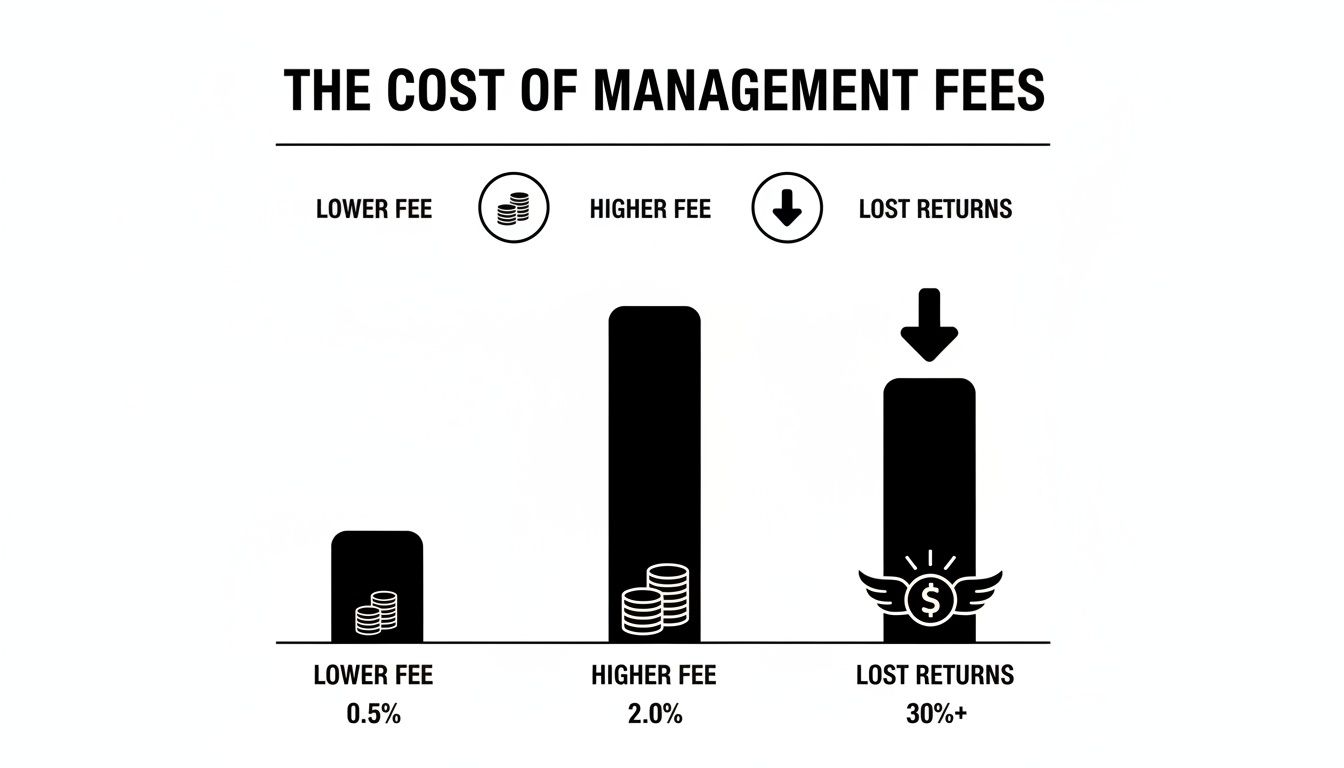
As depicted, a higher fee structure must be justified by demonstrably superior service. If not, it will steadily erode investment profits year after year.
The UK’s property management sector is expanding, having grown at a compound annual rate of 2.4% over the last five years and is projected to reach £37.8 billion in 2025. With 68.3% of agents prioritising managed rentals, the industry is increasingly focused on comprehensive service packages. A superior manager more than justifies their fee by protecting your asset and maximising its revenue, which is one of the key benefits of hiring a competent property management company. When vetting firms, demand complete clarity and a proven track record.
Frequently Asked Questions (FAQs)
What is the average property management fee?
The average property management fee for long-term residential rentals typically ranges from 8% to 12% of the monthly collected rent. However, this can vary significantly based on the property’s location, type, and the scope of services provided. For short-term or holiday lets, fees are much higher, often between 20% and 40%.
Are property management fees tax deductible in the UK?
Yes, in the United Kingdom, property management fees are generally considered an allowable expense for landlords. This means they can be deducted from your rental income when calculating your taxable profit, thereby reducing your overall tax liability. It is always advisable to consult a qualified tax professional who understands both UK tax law and the regulations in your country of residence.
What services are typically included in a monthly management fee?
A standard monthly management fee typically covers day-to-day operational tasks. This includes rent collection, handling tenant communications and routine inquiries, coordinating basic maintenance requests, and providing regular financial statements. It does not usually include costs for finding new tenants, major repairs, or eviction proceedings.
Can I negotiate property management fees?
Yes, property management fees are often negotiable. Owners with a portfolio of multiple properties or a single high-value asset are in a strong negotiating position. You can also discuss specific charges like tenant placement or lease renewal fees. However, be cautious not to negotiate a rate so low that it compromises the quality of service, as this can be detrimental in the long run.
What are some common hidden costs in property management?
Beyond the headline rate, investors should be aware of potential additional charges. Common “hidden” costs include setup fees for new accounts, maintenance coordination surcharges (a percentage on top of the contractor’s bill), fees for property inspections, eviction service costs, and administrative fees for serving legal notices. A transparent management agreement should clearly itemise all potential charges.
About Homesgofast.com
HomesGoFast.com is a leading international property website, established in 2002, helping homeowners, real estate agents, and developers reach overseas buyers. Featuring thousands of listings from over 50 countries, the platform connects global property seekers with homes, apartments, villas, and investment opportunities worldwide.
Checkout our podcast Global Real Estate Insider