
Budgeting for the sticker price of a villa in Spain or a townhouse in Portugal is the quickest way to derail your international investment before you even get the keys. You’ve likely spent hours browsing listings and dreaming of Mediterranean sun, yet the anxiety of unexpected fees or shifting tax laws keeps you from pulling the trigger. It’s a valid concern because the hidden costs of buying property abroad can easily add 10% to 15% to your final bill if you aren’t prepared for the 2026 market shifts.
Investors are attracted by the lifestyle and ROI potential of overseas markets, but the complexity of foreign tax systems often leads to costly surprises. Buyers are increasingly looking for transparency to avoid the “cowboy” fees that can plague cross-border transactions. This guide provides the clarity you need by detailing specific regional expenses and currency risks.
You’ll discover exactly how to calculate a realistic buffer for your budget, from Spanish notary fees to the new 2026 remittance rules. We’ll provide a practical checklist of regional taxes and the financial strategies used by seasoned experts to protect their capital. By the end of this article, you’ll have the grounded reliability required to secure your dream asset without the stress of the unknown.
Key Takeaways
- Budget for a 15% “keys-in-hand” buffer above the listing price to account for regional taxes, administrative fees, and mandatory legal costs.
- Secure independent legal counsel early to navigate complex civil law requirements and the high notary fees common in European markets.
- Mitigate the hidden costs of buying property abroad by using specialist currency providers to avoid the high exchange rate margins found at traditional banks.
- Identify recurring ownership expenses like Spain’s IBI or France’s Taxe Foncière to ensure your long-term ROI remains protected.
- Utilize professional vetting strategies and checklists to filter international listings, ensuring you only engage with transparent and reliable property platforms.
Beyond the Asking Price: Why Your Budget Needs a 15% Buffer
Listing prices are seductive. They represent the dream of a sun-drenched villa or a high-yield apartment; however, they rarely reflect the total capital required to finalize the deal. In the industry, we refer to the “delta” as the gap between that attractive asking price and the actual “keys-in-hand” cost. If you don’t account for the hidden costs of buying property abroad, your investment could stall before it even begins. Investors are attracted by competitive prices in emerging markets, but the total acquisition cost is the only metric that truly matters for your ROI.
To better understand the financial reality of these transactions, watch this helpful video:
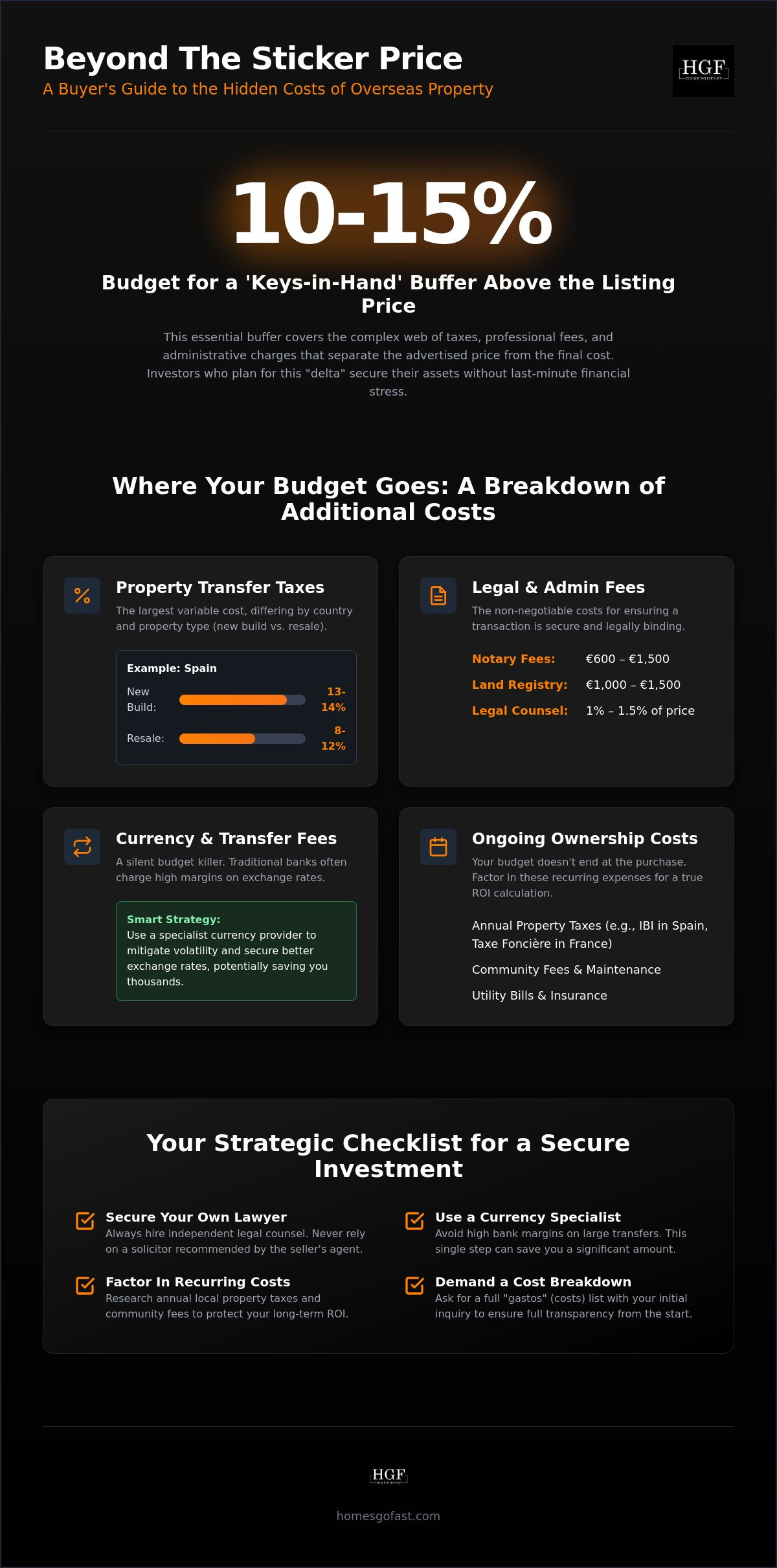
Expert investors typically recommend a 10% to 15% buffer on top of the purchase price. This isn’t a random figure. It covers a complex web of taxes, professional fees, and administrative charges that vary by property type. For instance, buyers should budget approximately 13-14% extra for a new build in Spain to cover VAT and stamp duty. Resale properties are slightly more affordable, generally landing in the 8-12% range. Paradoxically, “cheap” properties often carry the highest percentage of hidden fees. Fixed costs, such as notary charges that range from €600 to €1,500, don’t scale down linearly with the price. A deep dive into understanding international real estate reveals that these overheads are the mandatory price of entry for global asset security.
The Reality of International Real Estate Listings
You shouldn’t take a listing price at face value. In many global markets, the advertised price is the gross amount, excluding the vital “gastos” (costs) that complete the transaction. Buyers are increasingly looking for transparency to distinguish between a genuine bargain and a property burdened by high transfer taxes or unpaid community debt. Smart investors use international real estate listings as a comparative starting point rather than a final budget. Always ask for a full cost breakdown during your first inquiry to ensure your capital remains protected.
Regional Variations: Europe vs. The Americas
Investment landscapes shift dramatically across borders. Europe often presents a high-tax environment where transfer taxes and mandatory notary fees are substantial. In contrast, many markets in Latin America offer lower entry costs and simplified closing procedures. However, specific regions have unique requirements. Mediterranean markets like Italian homes for sale require specific notary budgets because the notary acts as a neutral public official responsible for the legality of the entire transfer. “Closing costs” is a convenient catch-all term, but it hides sub-fees like land registry updates and local stamp duties that vary significantly by province.
Legal and Administrative Fees: The Essential Paperwork Trail
You’ve finalized your budget, but the paperwork trail is where many investors encounter the first real hidden costs of buying property abroad. In civil law jurisdictions, the Notary Public is a mandatory figure who acts as a neutral official to ensure the transaction’s legality. This role is often more expensive than buyers expect because it includes the verification of titles and the collection of government taxes. In Spain, notary fees are legally fixed on a sliding scale, typically ranging from €600 to €1,500 for a standard purchase. Portugal sees similar combined notary and land registry costs between €1,000 and €1,500.
Investors are attracted by the security of these systems, yet they often overlook the necessity of independent legal representation. Never rely on a solicitor recommended by the seller’s agent; you need an advocate who prioritizes your interests alone. In Portugal, legal fees generally hover between 1% and 1.5% of the purchase price, often with a minimum fee of around €3,000 plus 23% VAT. For American investors, it’s also essential to consider the U.S. tax implications of owning foreign assets to ensure compliance with reporting requirements for foreign housing costs.
The “silent” costs of international transactions include document legalization and official translations. If your documents aren’t in the local language, you’ll need certified translators and “apostilles,” which are international stamps of authenticity. These small administrative fees can quickly add several hundred euros to your total before you’ve even reached the registration phase. If you’re currently researching markets, you can browse verified overseas property for sale to see how different regions compare in terms of initial transparency.
Notary Fees and Stamp Duty
Buyers are increasingly looking for clarity on the difference between new build and resale taxes. In Spain, new builds attract 10% VAT plus a regional Stamp Duty (AJD) ranging from 0.5% to 1.5%. Resale properties instead face a Property Transfer Tax (ITP) between 6% and 10%. In France, notary fees for existing properties are significantly higher at 7% to 8%, while new builds offer a substantial saving with fees around 2% to 3%. Understanding these sliding scales is the key to avoiding a last-minute funding gap.
Residency and Visa Administrative Costs
The 2026 market has seen a surge in interest for Digital Nomad permits and Golden Visas linked to property ownership. However, these applications carry their own hidden costs of buying property abroad. Most residency permits now require specific private health insurance mandates and proof of high monthly income. Administrative hurdles, such as obtaining local tax ID numbers or meeting minimum stay requirements, can add months to your timeline and thousands in extra legal fees. Always factor in the cost of a residency specialist if you plan to live in your investment full-time.
Currency Volatility and Transfer Fees: The Silent Budget Killers
Negotiating a €5,000 discount on a property feels like a victory until a sudden currency shift wipes out those savings in a single afternoon. Currency volatility is one of the most significant hidden costs of buying property abroad because it exists outside the control of the buyer and seller. A mere 3% swing in the exchange rate on a €300,000 purchase can alter your final cost by as much as £9,000. For many, this volatility turns a secure investment into a budget crisis during the weeks between the initial offer and the final completion.
High-street banks typically offer exchange rates with a 2% to 4% margin above the interbank rate, which is the “real” price banks use to trade with each other. By contrast, specialist currency providers often charge under 1%. Beyond the rate itself, you must account for “receiving fees” charged by foreign banks. These are often flat fees or percentages deducted from your funds just for accepting the deposit. In 2026, U.S. buyers should also be aware of the new 1% excise tax on international remittances funded by cash or money orders. Using a standard ACH bank transfer or a debit card is a simple way to bypass this specific cost and keep your budget intact.
Timing your transfer is just as critical as negotiating the house price. Waiting until the day of completion to move large sums of money leaves you vulnerable to daily market fluctuations. Buyers are increasingly looking for ways to stabilize their outgoings, recognizing that the price you agree on in January might look very different by the time you sign the deeds in March. Planning your liquidity early is the best way to ensure that “silent” fees don’t erode your capital.
Hedging Your Risk with Forward Contracts
Currency risk is a hidden cost that can be mitigated with planning. A forward contract allows you to lock in today’s exchange rate for a future completion date, often up to 12 months in advance. The primary advantage is certainty; you know exactly how much your property will cost in your home currency regardless of market crashes. While specialist brokers offer these strategic tools and better rates, traditional banks provide the convenience of existing accounts but usually at a much higher premium. Balancing these options is essential for maintaining your projected ROI.
Ongoing Mortgage and Financing Costs
Investors are attracted by competitive interest rates in certain territories, but non-resident mortgages often carry high arrangement fees that aren’t always disclosed in the initial brochure. Many lenders, particularly in France and Spain, also require mandatory life insurance policies that must be paid annually. These premiums add a recurring layer to your overheads. If your loan is in a foreign currency, fluctuating interest rates and exchange movements will impact your monthly yields. You can track these shifts through our global market trends resources to ensure your financing remains sustainable over the long term.
Ongoing Ownership Costs: Maintenance, Management, and Local Taxes
Securing the keys to your international asset is a milestone, but it’s also the moment your recurring overheads begin. Many buyers focus exclusively on the entry price, yet the hidden costs of buying property abroad often manifest as annual obligations that can erode your net yields. Investors are attracted by the potential for capital appreciation, but maintaining that growth requires a clear-eyed understanding of local tax regimes and service charges.
Annual property taxes are a primary consideration. In Spain, you’ll face the IBI (Impuesto sobre Bienes Inmuebles), which typically ranges from 0.4% to 1.1% of the cadastral value. France has its own equivalent, the Taxe Foncière. Perhaps the most overlooked expense is the Non-Resident Imputed Income Tax. In Spain, this “deemed” rental tax applies even if you never rent out the home, with rates set at 19% for EU residents and 24% for non-EU residents. Portugal’s IMI ranges from 0.3% to 0.45% for urban properties, making it a competitive choice for those watching their annual bottom line.
If you’re purchasing in an “urbanisation” or a managed complex, community fees are mandatory. These cover shared pools, gardens, and security, and they can vary wildly based on the level of luxury provided. For those who aren’t on-site, professional property management is a necessity. Expect to pay between 15% and 30% of gross rental income for short-term holiday let management, or a flat monthly fee just for “boots on the ground” security checks. If you’re planning to liquidate an asset to fund a new purchase, you can advertise properties through our global network to reach a wider audience of qualified buyers.
The Cost of Standing Still: Utilities and Insurance
Utility companies in several territories apply higher standing charges to non-resident accounts, meaning your “base” bill remains high even when the property is empty. You’ll also need specialist “unoccupied home” insurance. Standard policies often become void if a property is left vacant for more than 30 days, requiring a premium that accounts for the increased risk of leaks or theft. A general guideline is to budget 1% to 4% of the property’s value annually for general maintenance and emergency repairs.
The ‘Exit’ Strategy: Future Capital Gains
Successful ROI calculations must include the eventual cost of selling. Buyers are increasingly looking for properties with high resale liquidity, but they often forget that agent commissions in cities like Paris can reach 10% of the sale price. To protect your future profits, keep every receipt for renovations and legal fees from day one; these are often deductible against your final tax bill. For a deeper look at protecting your profit margins, consult our Capital Gains Tax on Sale of Property guide to understand the specific 2026 rules for non-resident sellers.
Strategic Planning: How to Navigate the Market with Confidence
Knowledge of the financial landscape is half the battle, but taking action requires a structured strategy. Buyers are increasingly looking for platforms that prioritize data transparency over marketing fluff. Vetting overseas property for sale requires you to look far beyond high-resolution photos and lifestyle descriptions. You need a rigorous approach to identify the hidden costs of buying property abroad before you commit to a viewing trip or a deposit.
The most effective tool for 2026 is a comprehensive checklist for navigating international real estate listings. This ensures you ask the right questions regarding “gastos” and regional tax variations early in the process. While digital transparency has improved significantly, hidden markups can still exist in unregulated markets. Professional agents act as your first line of defense, providing grounded reliability and ensuring that the price you see is a realistic reflection of the total capital required.
Investors are attracted by the idea of a “DIY” purchase to save on commissions, yet this path often leads to the highest hidden costs of buying property abroad. Without a seasoned expert, you’re more likely to overpay for legal services or miss critical regional tax deadlines. Transparency in 2026 is better than ever, provided you utilize the right global platforms to connect with reputable local partners like JSRE Sàrl who understand the nuances of cross-border transactions and property valuation.
Building Your Professional Team
Finding reputable agents and legal experts is the foundation of a stress-free purchase. HomesGoFast simplifies this by providing access to verified professionals who often hold “Agent Pro” status. This badge of credibility ensures you’re working with experts who have an established tenure in the global marketplace. These agents help you navigate the “silent” fees of currency transfers and administrative hurdles, turning a complex international acquisition into a streamlined, efficient process.
Next Steps for the Savvy Buyer
Your journey toward international ownership should be a calculated move rather than a leap of faith. Start your research by browsing our extensive international property listings to compare entry costs and yields across different territories. If you’re already an owner looking to move assets or rebalance your portfolio, take a moment to check owner pricing to understand current market demand. While the administrative logistics require focus, the lifestyle benefits and cultural freedom of owning a home abroad offer a return on investment that far outweighs the initial paperwork.
Secure Your International Future with Confidence
Mastering the financial nuances of international real estate transforms a stressful transaction into a strategic victory. By accounting for the 15% budget buffer and locking in exchange rates early, you protect your capital from the volatile shifts of the 2026 market. Investors are attracted by the long-term yields of overseas assets, but success depends on identifying the hidden costs of buying property abroad before signing the deeds.
Buyers are increasingly looking for reliable partners to simplify these complexities. HomesGoFast has acted as a trusted global platform since 2002, offering access to a vetted network of professional international agents and comprehensive guides on global market trends. This expertise ensures you move forward with the grounded reliability required for a successful cross-border acquisition.
Ready to turn your vision into reality? Explore the latest overseas property for sale and start your journey with HomesGoFast. The world is more accessible than ever; with the right preparation, your dream of international ownership is well within reach.
Frequently Asked Questions
What is the most common hidden cost when buying property abroad?
Taxes and notary fees are the most frequent overlooked expenses in international transactions. Buyers often forget to budget for the “delta” between the listing price and the final keys-in-hand cost. In Spain, for example, these hidden costs of buying property abroad can add up to 12% to your initial budget. Investors are attracted by low prices but must account for these mandatory government duties early.
How much should I budget for legal fees in Europe?
You should typically budget between 1% and 1.5% of the purchase price for an independent solicitor. In Portugal, this often comes with a minimum fee around €3,000 plus 23% VAT. Buyers are increasingly looking for independent representation to ensure their interests are protected. Never skip this step to save money; a good lawyer prevents costly title issues and uncovers unpaid debts linked to the property.
Do I have to pay taxes in both my home country and the foreign country?
You may have tax obligations in both jurisdictions, though double taxation treaties often provide relief. You’ll usually pay property-related taxes in the country where the asset is located. However, you must also report foreign assets to your home tax authority. Consult a specialist to navigate specific 2026 reporting requirements for your residency status to ensure you don’t fall foul of international transparency laws.
What are ‘community fees’ and are they mandatory?
Community fees are mandatory payments for owners of properties within shared developments or “urbanisations.” These funds cover the maintenance of communal areas like swimming pools, gardens, and security. Rates vary significantly based on the level of services provided. Investors are attracted by the convenience of managed complexes, but you should always ask for the previous year’s minutes to check for any planned “special levies.”
Can I avoid exchange rate fees by using my local bank?
Using a local high-street bank is actually the most expensive way to transfer funds for a purchase. Banks often charge 2% to 4% above the interbank rate, which is a major factor in the hidden costs of buying property abroad. Specialist currency providers are a better alternative, often charging under 1%. This simple switch can save you thousands on a large transaction like a villa or apartment.
Is it more expensive to buy a new build or a resale property overseas?
New builds generally carry higher initial taxes, such as VAT, but offer lower long-term maintenance costs. In France, for instance, notary fees for new builds are only 2% to 3%, compared to 7% to 8% for resale homes. While the entry taxes are higher, the energy efficiency and modern standards of a new build lead to lower ongoing ownership costs and better rental yields over time.
What happens if I don’t pay the non-resident property tax?
Failure to pay non-resident taxes can lead to heavy fines and a lien against your property. Tax authorities in countries like Spain and France are increasingly efficient at tracking non-resident owners through utility records and local registries. Unpaid taxes will also block any future sale of the property. The debt stays with the asset rather than the owner, making it impossible to transfer a clean title later.
How do I find a reliable lawyer in a country where I don’t speak the language?
Look for independent, English-speaking solicitors through reputable global property platforms or your national consulate’s list of approved professionals. Ensure they are registered with the local bar association and have no ties to the seller’s agent. Using a verified network helps you avoid “cowboy” fees. A professional team ensures your legal advocate prioritizes your interests throughout the transaction, providing the confidence to move forward.