

In the first quarter of 2026 alone, U.S. commercial real estate investment volume surged by 19% to reach a staggering $117.3 billion, driven largely by a borderless hunt for yield. You likely recognize that your local network is only one piece of the puzzle, yet the thought of navigating opaque foreign regulations or managing currency fluctuations often feels like a barrier to entry. Buyers are increasingly looking for stability and high-performing assets outside their home borders, and right now, the global appetite for quality commercial space is at an all-time high.
Learning how to sell commercial property to international buyers is no longer just an advantage; it’s a necessity for any seller looking to tap into the world’s most liquid capital pools. This guide will help you master the complexities of cross-border transactions and show you how to position your assets for global capital. We’ll break down the 2026 regulatory environment, from FinCEN reporting rules to the EU Data Act, and provide a clear roadmap to secure a higher final sale price through global competition. By the end of this article, you’ll have the practical logic and market insights needed to transform your property into a global investment opportunity.
Key Takeaways
- Discover why global liquidity often outperforms local demand and how to position your asset within the expanding $467 billion international market.
- Learn to create “Investment Grade” documentation and standardized financial reports that satisfy the rigorous scrutiny of overseas institutional investors.
- Master the complexities of how to sell commercial property to international buyers by navigating cross-border tax frameworks and mandatory AML protocols.
- Identify high-value buyer personas and localize your property listings into key investor languages to reach high-net-worth funds in diverse territories.
- Streamline your sales process using automated global networks and XML feeds to ensure your commercial assets maintain maximum visibility worldwide.
In the first quarter of 2026 alone, U.S. commercial real estate investment volume surged by 19% to reach a staggering $117.3 billion, driven largely by a borderless hunt for yield. You likely recognize that your local network is only one piece of the puzzle, yet the thought of navigating opaque foreign regulations often feels like a barrier to entry. Buyers are increasingly looking for stability and high-performing overseas real estate assets, and right now, the global appetite for quality commercial space is at an all-time high.
Learning how to sell commercial property to international buyers is no longer just an advantage; it’s a necessity for any seller looking to tap into the world’s most liquid capital pools. This guide will help you master the complexities of cross-border transactions and discover how to position your assets for global capital. We’ll break down the 2026 regulatory environment and provide a clear roadmap to secure a higher final sale price through global competition. To see how assets are currently performing on the global stage, you can review international property listings to benchmark your own investment logic.
Preparing Your Commercial Asset for International Scrutiny
Selling to a local buyer is often about relationships; selling to an international fund is about data. You must treat your asset as a professional financial product. This starts with “Investment Grade” documentation. In 2026, global capital doesn’t just want to see a physical building; it wants to see a transparent, de-risked opportunity that fits into a global spreadsheet.
Investors are attracted by clarity. Local jargon can mean different things in different jurisdictions. You should scrub your investment memorandum of any terminology that doesn’t translate globally. Additionally, Environmental, Social, and Governance (ESG) compliance is now a prerequisite. Institutional funds often have mandates that prevent them from considering assets that don’t meet modern energy standards.
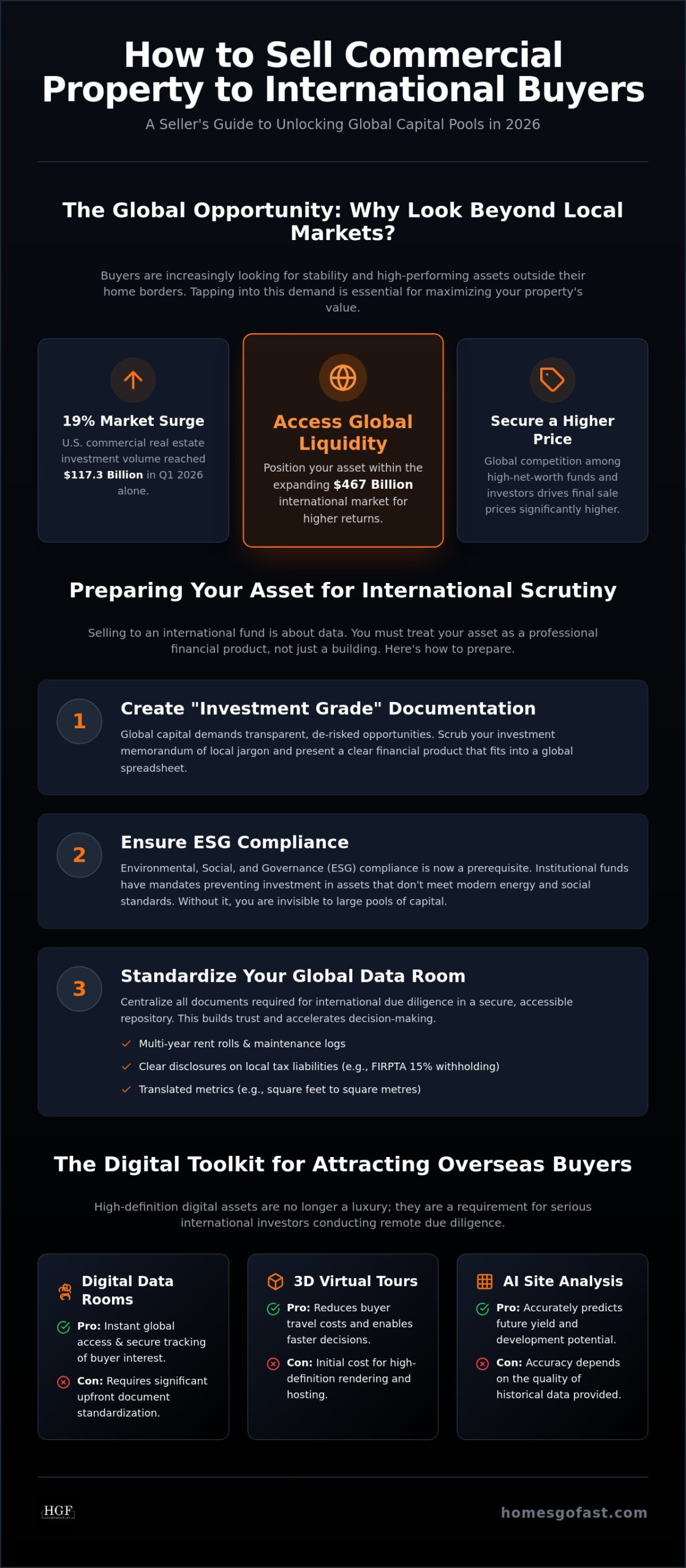
If your building isn’t energy-efficient, you’re effectively invisible to large portions of overseas real estate capital. To help you decide how to package your asset, consider the following comparison of digital-first preparation:
| Strategy | Pros | Cons |
|---|---|---|
| Digital Data Rooms | Instant global access; secure tracking of buyer interest. | Requires significant upfront document standardisation. |
| 3D Virtual Tours | Reduces travel costs; allows faster decision-making. | Initial cost for high-definition rendering and hosting. |
| AI Site Analysis | Predicts future yield and development potential accurately. | Depends on the quality and age of historical data provided. |
Standardising Financial ROI and Data Rooms
A Global Data Room is a secure repository where you centralise every document required for international due diligence. You must include multi-year rent rolls, maintenance logs, and clear disclosures on local tax liabilities. For example, provide the IRS guidelines on FIRPTA so buyers understand the 15% withholding requirement from day one. Don’t forget to translate metrics; a buyer in Dubai thinks in square metres, while a buyer in Chicago thinks in square feet.
The Role of Virtual Tours and Digital Due Diligence
High-definition 3D walkthroughs are no longer a luxury; they’re a requirement for overseas buyers. Use drone footage to provide geographic context, showing the asset’s proximity to logistics hubs and major transport links. Buyers are increasingly looking for future-proofed assets, so leverage AI-driven site analysis to show solar capacity or expansion potential. If you’re ready to package your asset for a global audience, you can advertise properties to reach our network of high-net-worth investors.
Navigating Legal and Tax Frameworks for Cross-Border Sales
Closing a deal across borders involves more than a handshake. You must navigate a maze of regulations that vary wildly from one country to the next. When you’re figuring out how to sell commercial property to international buyers, the legal structure of the deal is just as important as the purchase price. While commercial assets generally face fewer restrictions than agricultural land, some jurisdictions still require government approval for foreign entities or specific industry-related assets.
You’ll encounter strict Anti-Money Laundering (AML) and Know Your Customer (KYC) protocols throughout the process. These aren’t just bureaucratic hurdles. They’re mandatory checks to verify the source of funds and the identity of the ultimate beneficial owner. In 2026, these protocols are more rigorous than ever. Preparing your documentation early ensures that these checks don’t stall your transaction at the eleventh hour. Transparency is your best tool for building the trust needed to move large sums of capital.
Taxation is the most critical variable in your final ROI. Capital gains tax (CGT) often differs significantly for non-residents compared to local citizens. According to Deloitte’s 2026 commercial real estate outlook, investors are increasingly scrutinizing tax-efficient exit strategies before they even commit to a purchase. You can find more detail on how these levies impact your bottom line in our guide on Capital gains tax on sale of property. Managing these expectations early prevents surprises during the final settlement.
Understanding Ownership Structures
You need to decide if you’re selling to a private individual or a foreign Real Estate Investment Trust (REIT). REITs offer massive liquidity but require institutional-grade reporting and strict compliance. Many international deals now use Special Purpose Vehicles (SPVs). These are legal entities created specifically for a single property transaction. They help shield both parties from broader liabilities and can offer significant tax advantages. Using an SPV is a common strategy when learning how to sell commercial property to international buyers who want to isolate their investment from other global holdings.
Managing Currency Risks and Transfer Logistics
Exchange rate volatility can break a deal during the closing period. If the currency shifts by even 2% between the contract signing and the final transfer, it can wipe out millions in value. Avoid using traditional retail banks for these large sums. Specialized currency brokers offer better rates and forward contracts to lock in your price. You must also ensure compliance with local “repatriation of funds” laws. Some countries have strict limits on how quickly or easily you can move sale proceeds across borders after the deal is finalized.
Strategic Marketing: Reaching High-Net-Worth Investors and Funds
Marketing a commercial asset in 2026 requires a shift from local visibility to global dominance. You aren’t just competing with the building down the street; you’re competing with every high-yield opportunity in the world. To master how to sell commercial property to international buyers, you must execute a digital-first strategy that prioritizes precision over broad reach. Investors are attracted by assets that feel accessible, transparent, and professionally “packaged” for their specific needs.
Your execution plan should follow a structured five-step process. First, identify your buyer persona. A boutique hotel attracts a different fund than a suburban logistics center, where highlighting compatibility with essential operational services like Fleetalyse for fleet monitoring can differentiate a UK-based listing for international investors. Second, localize your content. If you’re targeting the $13.7 billion spent by Chinese buyers in early 2026, Mandarin translation is language-essential. Third, distribute your listing through global portals to ensure maximum exposure. Fourth, use LinkedIn to target institutional decision-makers. Finally, implement a rapid lead management system. Global capital moves fast, and a 24-hour delay in responding to an enquiry can kill a deal before it starts.
Leveraging Multilingual Listings and Global Portals
English-only listings often miss a significant portion of the global market. Buyers are increasingly looking for information in their native tongue to reduce the perceived risk of cross-border transactions. You can learn more about how to advertise properties to a global audience by utilizing platforms that offer automated translation and international syndication. For high-value assets, “Top of Search” upgrades are a worthwhile investment. They ensure your property remains at the forefront of investor searches in key territories like the UAE, Singapore, and Germany.
Creating High-Impact Digital Investment Memorandums
A Digital Investment Memorandum (IM) is the primary conversion tool that transforms a casual click into a formal letter of intent. It should move beyond basic specs to tell a compelling story about growth prospects, tenant quality, and the eventual exit strategy. Use data visualizations to simplify complex yield calculations and IRR projections. When you present clear, visual evidence of ROI, you reduce the friction for foreign funds. Ready to launch your campaign? You can advertise properties to our established global network today and start connecting with qualified buyers.
Scaling Your Reach with HomesGoFast Agent Pro
Independent agents and developers often face a significant hurdle: competing with massive, closed-ecosystem brokerages that keep global networks behind a paywall. When you’re determining how to sell commercial property to international buyers, technology is your most powerful ally. The Agent Pro Account provides an instant global network, allowing you to bypass these gatekeepers and connect directly with high-volume lead sources. It transforms a local listing into a global asset by syndicating your data across a vast, multilingual marketplace.
Efficiency is the cornerstone of successful commercial transactions in 2026. Manually updating listings across multiple platforms is a recipe for errors and stale data. Agent Pro solves this by automating XML feeds, ensuring your commercial listings are always up to date with the latest yields, tenant information, and pricing. This automation allows you to focus on closing deals rather than managing spreadsheets. Buyers are increasingly looking for real-time accuracy, and a synchronized feed builds the professional trust required for high-stakes acquisitions.
Maximising Visibility Across International Networks
Visibility is not just about being seen; it’s about being seen by the right people in the right places. HomesGoFast syndicates your listings to partner sites worldwide, ensuring your property appears where your target investors are already looking. For example, if you have a logistics hub in Portugal, our network can specifically target Asian investors looking at European property. This geographic precision is vital because how to sell commercial property to international buyers effectively depends on matching your asset with regional capital trends. You can start this process today and sell overseas property through our established global channels.
Lead Management for Global Commercial Enquiries
Managing international interest requires a different approach than local sales. You’ll likely receive enquiries from different time zones and in various languages. The Agent Pro dashboard is designed to handle this high-volume traffic, providing tools to filter serious institutional investors from “tyre kickers.” Rapid response times are non-negotiable in cross-border deals. If a fund manager in Dubai asks for a data room link, they expect it immediately. Our platform streamlines this communication, ensuring you never miss a window of opportunity.
Investors are attracted by professional responsiveness and data transparency. By utilizing a centralized lead management system, you can nurture foreign enquiries with the same precision you’d use for a local client. If you’re ready to scale your commercial operations and tap into a truly global pool of liquid capital, it’s time to take the next step. Upgrade to an Agent Pro account today to reach global buyers and position your commercial assets for maximum visibility and a higher final sale price.
Secure Your Competitive Edge in the Global Marketplace
The landscape of commercial real estate is shifting rapidly, but the path to success remains clear. By standardizing your financial reporting and embracing “Investment Grade” digital assets, you remove the friction that often stalls cross-border deals. You now have the definitive roadmap for how to sell commercial property to international buyers by leveraging targeted marketing and navigating complex 2026 tax regulations with confidence.
Success in this borderless market requires the right technology and an established partner. HomesGoFast has been a leader in global reach since 2002, providing the multilingual listing technology and Agent Pro lead management features you need to stay ahead of the competition. Don’t let local market fluctuations limit your potential when a world of liquid capital is actively seeking your next asset.
List your commercial property on HomesGoFast to reach global investors today. It’s time to transform your property into a high-visibility global investment opportunity and secure the returns you deserve.
Frequently Asked Questions
What is the best way to find international buyers for commercial real estate?
The most effective way to find international buyers is through a combination of multilingual property portals and targeted digital marketing. Investors are attracted by assets that are visible in their native languages and localized for their specific market. Using a platform with a broad global reach ensures your property is indexed where high-net-worth individuals are already searching. This approach bypasses local limitations and places your asset directly in front of liquid capital.
Do I need a special license to sell property to foreign investors?
You don’t typically need a specific “international license” to sell your property, but you must strictly adhere to the tax and legal requirements of your jurisdiction. For instance, selling a U.S. asset requires following FIRPTA withholding rules, while EU sales must comply with the latest data privacy regulations. It’s essential to consult with a tax professional who understands cross-border transactions to ensure you’re fully compliant with 2026 reporting standards.
How does the “Know Your Customer” (KYC) process work in commercial sales?
The Know Your Customer (KYC) process is a mandatory security check that verifies the identity of the buyer and the legitimate source of their funds. In 2026, this process is largely digital and requires the buyer to provide corporate structure documents and proof of wealth. This step is vital when learning how to sell commercial property to international buyers because it protects you from potential legal issues related to money laundering or sanctioned entities.
Can I sell my commercial property as an individual or do I need an agent?
You can absolutely sell your property as an individual using “For Sale By Owner” platforms, though many sellers choose an agent for their established networks. If you decide to go it alone, you’ll need to handle the “Investment Grade” packaging and lead management yourself. Both options are viable in 2026, provided you use a platform that offers the global visibility required to reach investors outside your local area.
What are the main risks when selling commercial property to an overseas buyer?
The primary risks include currency exchange volatility and sudden regulatory shifts in the buyer’s home country. If the exchange rate moves significantly between the contract signing and the final transfer, it can impact the deal’s viability. Additionally, new reporting rules, such as the FinCEN rules for all-cash deals introduced in March 2026, mean you must stay updated on compliance to avoid heavy fines or transaction delays.
How long does a typical international commercial property transaction take?
A typical international commercial transaction takes between three and nine months to reach completion. This timeline is generally longer than domestic sales because it involves deeper due diligence, international legal reviews, and the coordination of cross-border wire transfers. You can speed up this process by having a “Global Data Room” ready and ensuring all KYC documentation is prepared before the buyer even makes their first offer.
Which countries are currently the biggest investors in global commercial property?
As of early 2026, the most active investors are coming from China, Canada, and the UAE. Chinese buyers alone spent $13.7 billion on U.S. real estate in the first few months of the year, marking an 83% increase from previous years. Canadian investors also remain a dominant force, accounting for nearly 38% of all international property searches. Targeting these specific regions with localized listings can significantly increase your chances of a successful, high-value sale.