

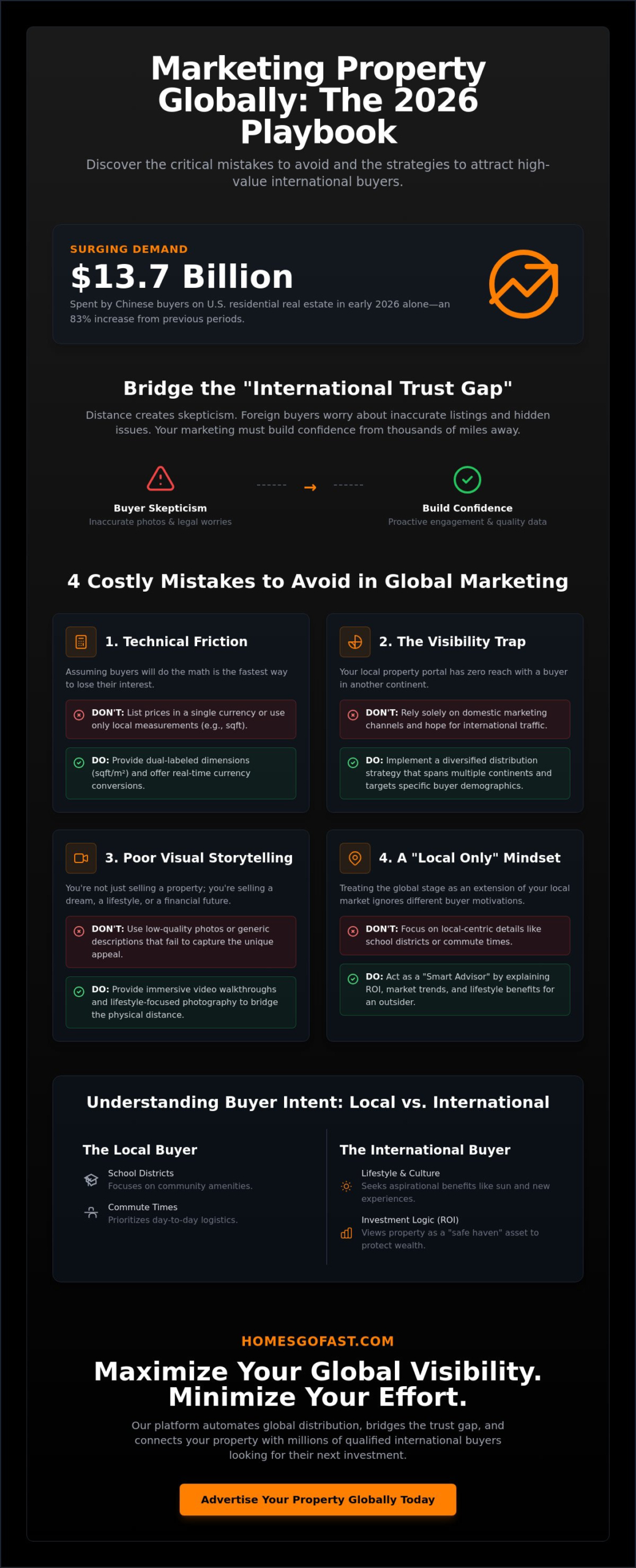
Did you know that Chinese buyers spent $13.7 billion on U.S. residential real estate in early 2026 alone, marking a staggering 83% increase from previous periods? While the appetite for international assets is surging, many sellers find themselves trapped in a cycle of high marketing spend and low lead quality. Understanding the common mistakes to avoid when marketing property globally is the difference between a wasted budget and a successful cross-border transaction. You want your property to stand out, but cultural disconnects and complex regulations often get in the way.
We agree that the international market can feel like a maze of time zones and red tape. That’s why this guide is designed to help you optimize your global marketing strategy for maximum ROI. You’ll discover how to sidestep the critical pitfalls that derail sales and learn why buyers are increasingly looking for transparency and digital-first impressions. We’ll provide a clear overview of the essential shifts for 2026, including the latest International Property Measurement Standards and the impact of residency rule changes in countries like Spain and Greece.
Key Takeaways
- Bridge the “International Trust Gap” by adopting localized intelligence to make your listings more relatable and trustworthy to foreign buyers.
- Identify the specific mistakes to avoid when marketing property globally, such as failing to provide dual-labeled measurements and real-time currency conversions.
- Escape the “visibility trap” of local portals by implementing a diversified distribution strategy that spans multiple continents.
- Understand why buyers are increasingly looking for immersive video walkthroughs and lifestyle-focused photography to bridge the physical distance.
- Streamline your international workflow by utilizing automated platforms that maximize global visibility while reducing administrative friction.
Why Global Real Estate Marketing Fails (And How to Fix It)
Marketing a villa in the South of France requires a completely different mindset than selling a condo in your local neighborhood. One of the biggest mistakes to avoid when marketing property globally is treating the international stage as a mere extension of your local market. Global property marketing is a specialized discipline that demands localized intelligence and a deep understanding of cross-border psychology. When you list a home for an overseas audience, you aren’t just selling bricks and mortar; you’re selling a dream, a financial hedge, or a new lifestyle.
Distance creates a natural “International Trust Gap.” Buyers thousands of miles away often feel skeptical about listings that lack detail or verification. They worry about hidden legal issues or inaccurate photos. To bridge this gap, you must move beyond passive marketing. Simply uploading a listing and waiting for the phone to ring won’t work in 2026. International real estate investors expect proactive engagement and high-quality data before they even consider a flight for a viewing. Buyers are increasingly looking for absolute transparency, including detailed cost breakdowns and verified floor plans.
The Difference Between Local and International Buyer Intent
Local buyers focus on school districts and commutes. International buyers balance aspirational lifestyle elements like sun and culture with cold investment logic. In 2026, we see a significant shift toward “safe haven” assets. Investors are attracted by stable markets where they can protect their wealth against currency fluctuations. If your description is generic, you’ll fail to trigger interest. You need to explain the ROI and the “why” behind the location. If you are promoting overseas property for sale, focus on what makes the territory unique for an outsider.
The Cost of Ignoring Global Market Trends
Failing to track global market trends often results in overpriced listings that sit stagnant for months. This is one of the most expensive mistakes to avoid when marketing property globally. Global real estate investment is projected to increase by 15% in 2026, with total turnover expected to exceed $1 trillion. A “Smart Advisor” doesn’t just show the house; they educate the buyer on the local community and growth prospects. Currently, interest is peaking in the Sunbelt of the United States, coastal Spain, and Greece. By acting as a mentor, you build the authority needed to close high-value deals. To start reaching these high-intent buyers, you can advertise properties on our global platform today.
The Technical Pitfalls: Currency, Measurement, and Translation Errors
Technical friction is the silent killer of overseas deals. One of the most common mistakes to avoid when marketing property globally is assuming your buyer will do the math for you. If you list a luxury apartment in Dubai only in Dirhams, you’ve already lost the attention of a busy investor in London or New York. Investors are attracted by clarity in financial and physical specifications, and they don’t want to spend time on listings that require a calculator just to understand the entry price. Identifying these technical mistakes to avoid when marketing property globally will help you build trust with sophisticated investors from the start.
The same standard applies to physical dimensions. While you might be comfortable with square feet, a buyer from Germany or Japan expects square meters. Failing to dual-label your property dimensions is a simple error that creates immediate mental resistance. Since the International Property Measurement Standards (IPMS) were updated to provide a uniform framework, global buyers expect consistency across all building types. By providing both units, you show that you’re a seasoned expert who understands the needs of an international marketplace.
Currency Volatility and Price Transparency
Currency fluctuations play a massive role in a buyer’s final decision. In early June 2026, 1 Euro was worth approximately 1.1649 US Dollars, but these rates move daily. A Global real estate market outlook often points to currency volatility as a major hurdle for cross-border transactions. You should always provide price ranges in major currencies like USD, EUR, and GBP to give buyers an immediate sense of value. Transparency is key; always mention local taxes and notary fees so there are no surprises during the closing process.
The Language of Global Listings
Relying on automated translation tools is a risky strategy for high-value properties. While AI has improved, it often misses the cultural nuances that sell a lifestyle. Professional translation is vital for your international real estate listings to ensure your message remains persuasive across borders. Avoid local jargon like “conveyancing” or “escrow” without explanation, as these terms don’t always translate globally. Use short paragraphs and bullet points to keep your descriptions readable and engaging for a worldwide audience.
If you want to bypass these technical hurdles and reach high-intent leads, you can advertise properties on our global platform today.
Distribution Blunders: Why Your Local Portal Isn’t Enough
You might dominate your local market, but that visibility often stops at the border. One of the most common mistakes to avoid when marketing property globally is falling into the “Zillow Trap.” While local portals are excellent for domestic sales, they rarely reach the high-net-worth individuals in Shanghai, London, or Dubai. Investors are attracted by platforms that specialize in cross-border transactions, and they expect to find your listing where they already spend their time. If you only list locally, you’re essentially invisible to the very buyers who have the capital and intent to purchase overseas.
A multi-portal strategy is non-negotiable in 2026. Global real estate volumes rose 14% year-over-year recently, and capturing a slice of that $888.6 billion market requires a presence on multiple continents. You should utilize a framework for global market research to identify where your specific property type is in highest demand. Assessing competition and market barriers is vital before you spend a dime on advertising. Without this data, you risk wasting your budget on regions with zero interest in your specific asset class.
Building a Global Digital Footprint
Manual updates across dozens of sites are a recipe for disaster. XML feed synchronization is the only way to keep your international property listings updated in real-time. This ensures that a price change in New York is reflected instantly for a buyer in Tokyo. Buyers are increasingly looking for accuracy, and outdated information kills trust immediately. You also need to prioritize “Featured” placements. In a crowded global market, being on the first page of search results is the difference between a lead and a lost opportunity. Multilingual platforms can then help you bypass language barriers automatically, presenting your property in the buyer’s native tongue without losing the original sales appeal.
Targeted Marketing vs. The ‘Spray and Pray’ Approach
Stop trying to reach everyone. Instead, focus on the demographics that matter. Are investors from Canada looking for vacation homes in Florida, or are Chinese buyers seeking residential assets in the UK? Identifying these patterns allows you to advertise properties with surgical precision. Our Agent Pro Account features empower you to manage these diverse leads efficiently, regardless of the time zone differences. You should always prioritize platforms that offer expert guides to buyers. These resources help foreign investors navigate ownership rules, making them more comfortable with the transaction. If you’re ready to expand your reach, you can advertise properties to a worldwide audience through our specialized network today.
Visual and Cultural Disconnects: Tailoring Your Message
One of the most significant mistakes to avoid when marketing property globally is failing to account for the “Trust Gap.” When a buyer is thousands of miles away, they rely entirely on your digital presentation to bridge the physical distance. If your photography only shows the interior of the house, you’re missing the bigger picture. Buyers are increasingly looking for lifestyle elements like sun, views, and local accessibility. Investors are attracted by clear, data-driven insights into expat communities and proximity to international airports. They need to know how the property fits into the wider world, not just how the kitchen looks.
To act as a smart advisor, you should include a “Pros and Cons” section for the local neighborhood. It might seem counterintuitive to mention a negative, but it builds massive credibility. For example, mentioning that an area is quiet but lacks a major shopping mall helps the right buyer find the right home. This level of honesty reduces the stress of cross-border transactions and filters out unqualified leads before they even contact you. For those specializing in residential sales, professional teams like The FIRE Group provide the localized intelligence and buyer representation needed to navigate these nuances. Correcting these mistakes to avoid when marketing property globally will set your listing apart from the amateur competition.
This commitment to transparency should also include the home’s physical integrity. For instance, in high-demand markets like Florida, professional sellers often explore Slab Leak Detection and Repair to provide certified proof of a sound foundation, which significantly boosts buyer confidence from afar.
Photography Standards for the Global Stage
Drone shots are no longer a luxury; they are a necessity for showing property context. A global investor wants to see the distance to the city skyline, local beaches, or mountain ranges. Staging for a global investor also differs from staging for a local family. While a local buyer might want to see a cozy nursery, an international investor is looking for clean lines and high-end finishes that suggest a solid rental yield. Ensure your visuals are optimized to load quickly. Internet speeds vary significantly across different international territories, and a slow-loading gallery will cause users to bounce.
Addressing Foreign Ownership Rules Upfront
Navigating regulatory shifts is critical. For instance, Greece introduced a new tiered pricing structure for its Golden Visa program in 2026, while Spain has ended its program entirely. Mentioning these changes regarding overseas property ownership upfront prevents you from wasting time on buyers who no longer qualify for residency incentives. You should also provide realistic price ranges that include all “on-the-road” costs, such as local taxes, notary fees, and legal expenses. This transparency ensures the buyer understands the full financial commitment before they start the inquiry process.
If you are ready to showcase your property to a global audience with professional precision, you can advertise properties on our specialized platform today.
Scaling Your Strategy: How HomesGoFast Maximizes Global Visibility
Scaling your international reach shouldn’t mean multiplying your workload. By now, you’ve identified the technical and cultural mistakes to avoid when marketing property globally, but implementation is where most strategies stall. HomesGoFast acts as the essential bridge between your local expertise and a massive global buyer network. Since our establishment in 2002, we’ve refined the process of cross-border visibility, ensuring your assets aren’t just listed, but actively seen by high-intent investors in over 50 countries.
The Agent Pro Account is the engine behind this efficiency. It automates distribution across our international network, allowing you to move beyond simple “listing” and into the territory of high-performance lead generation. Investors are attracted by platforms that offer a streamlined, reliable experience, and our long-standing tenure provides the credibility needed to secure their trust. Buyers are increasingly looking for established marketplaces that verify the quality of their listings, and our platform delivers that grounded reliability.
The Benefits of a Centralized Global Portal
Managing dozens of individual country sites is a logistical nightmare that leads to outdated data and lost leads. When you choose to sell overseas property through a centralized portal, you gain access to a multilingual network that translates your value proposition for diverse audiences automatically. This ensures your property speaks the buyer’s language without you needing a translation team. Developers and larger agencies often utilize our bulk marketing features to achieve large-scale exposure while maintaining a single, manageable point of control.
Next Steps for Your Global Marketing Plan
Your first step is to review your current portfolio for the technical mistakes to avoid when marketing property globally that we identified in this guide. Check that your Italian homes for sale or coastal villas feature dual-labeled measurements and transparent pricing in major currencies. Once your foundations are solid, you can focus on targeted marketing that puts your property in front of the right demographics at the right time.
The global market moves fast, and the window for peak interest can be short. We invite you to browse our current listings to see best-in-class global marketing in action. When you’re ready to experience a more productive, results-driven approach to international sales, our platform is here to help you achieve maximum visibility and a streamlined workflow.
Take Your Property Strategy Beyond Borders
You now have the roadmap to navigate the complexities of the international real estate landscape. By prioritizing technical accuracy, cultural nuance, and high-impact distribution, you can transform a stagnant listing into a high-intent lead generator. Identifying the specific mistakes to avoid when marketing property globally is just the first step; real success lies in implementing a strategy that bridges the trust gap with foreign investors.
Since 2002, we’ve acted as a savvy mentor for agents and owners looking to expand their reach. Our platform offers a powerful multilingual listing network and expert lead generation dashboards that simplify cross-border transactions. It’s time to move beyond local portals and tap into a worldwide audience that is actively seeking new assets. The global market is resilient and full of opportunity for those who act with precision and confidence.
Ready to reach a global audience? Start advertising your property today.
Frequently Asked Questions
What is the biggest mistake agents make when selling property to overseas buyers?
The biggest mistake is treating an international lead like a local one. One of the most critical mistakes to avoid when marketing property globally is failing to bridge the “International Trust Gap.” Overseas buyers require significantly more data, verified floor plans, and neighborhood context than a domestic buyer. If you don’t provide this transparency, you’ll likely lose high-intent leads to competitors who act as smart advisors.
How do I attract international buyers if I don’t speak their language?
You don’t need to be a polyglot to reach a worldwide audience effectively. Investors are attracted by listings that are automatically translated into their native tongue on professional property portals. By using a platform that handles the linguistic heavy lifting, you ensure your property’s value isn’t lost in translation. This allows you to focus on managing incoming leads while the system handles the language barrier.
Do I need to list my property in multiple currencies?
Listing in multiple currencies is highly recommended to improve price transparency for foreign investors. Buyers are increasingly looking for real-time conversions into major currencies like USD, EUR, or GBP to assess value quickly. While you don’t have to manage these manually, using a portal that offers automatic currency conversion reduces mental friction. This simple step makes your listing much more accessible to a geographically diverse demographic.
Why is my property not appearing in international search results?
Your property likely isn’t appearing because it’s only listed on a domestic portal. Local dominance doesn’t equate to global visibility. To fix this, you need a multi-portal strategy that pushes your listing to niche sites specifically catering to overseas seekers. Another common issue is failing to use XML feed synchronization, which keeps your data updated and correctly indexed across various international search engines and property networks.
What kind of photos work best for attracting global investors?
High-quality drone shots and 3D virtual tours work best for bridging the physical distance. Global investors need to see the property’s context, including its proximity to city skylines, beaches, or airports. While local families look for cozy interiors, international buyers often prioritize clean, modern lines that suggest high rental potential. Including these visual elements builds the trust necessary for a buyer to commit to an overseas viewing.
How much does it cost to market a property globally compared to locally?
Marketing costs vary depending on the level of exposure, but global campaigns often provide a better ROI by tapping into wealthier markets. Instead of paying for multiple local ads, a premium account on a global portal can distribute your listing across dozens of countries simultaneously. This centralized approach is often more cost-effective than managing individual campaigns in different territories, especially when you factor in the higher lead quality.
Can I sell my property overseas without a local broker?
You can absolutely sell your property overseas without a traditional local broker by using professional “For Sale By Owner” platforms. These services allow you to advertise properties directly to a global audience while maintaining full control over the process. While you’ll still need legal experts for the final transaction, managing the marketing yourself can save significantly on commission fees. It’s a practical choice for resourceful owners.
What are the legal checks I should mention in a global listing?
You should clearly mention foreign ownership rules and any available residency incentives, such as Golden Visas. For instance, Greece introduced a tiered pricing structure for its residency program in 2026, which is vital information for non-EU investors. Identifying these mistakes to avoid when marketing property globally helps you filter for qualified buyers. Always be transparent about local taxes and notary fees to avoid surprises during closing.