
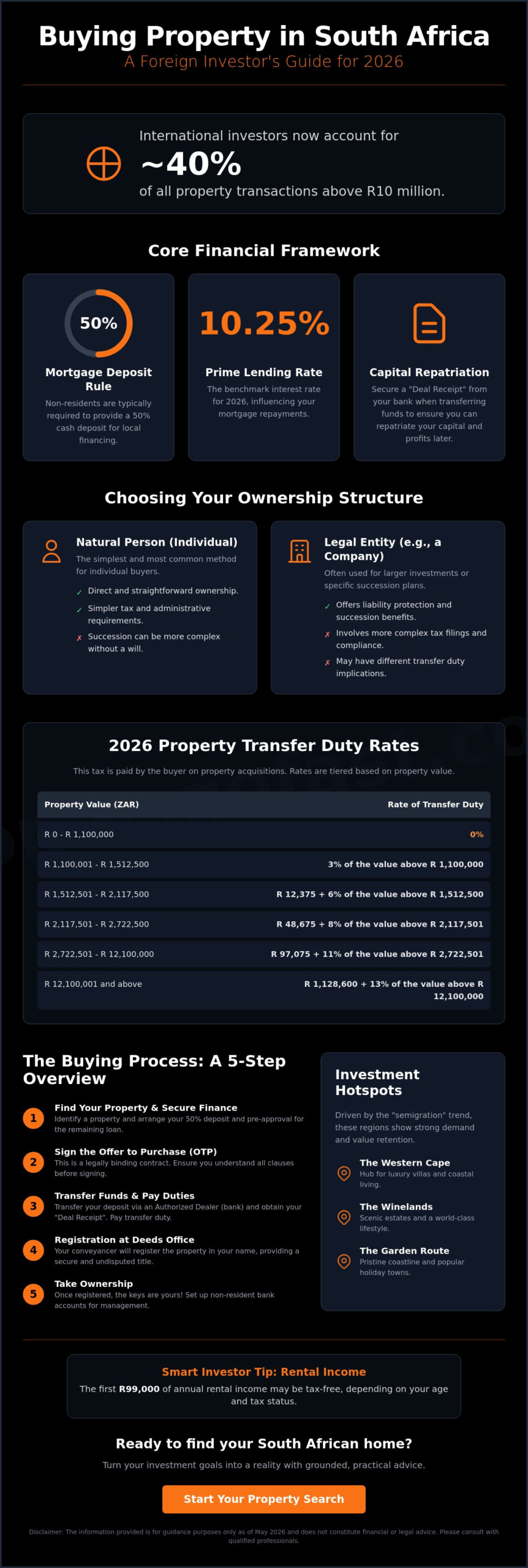
Did you know that international investors now account for roughly 40% of all South African property transactions above R10 million? While the appeal of a sun-drenched lifestyle is obvious, actually buying property in south africa as a foreigner requires a sharp understanding of the 2026 financial landscape. You might feel uncertain about the 50% mortgage requirement or exchange controls, but these hurdles are manageable with the right data.
We understand that you want more than just a holiday home; you want a secure investment that makes sense on paper. This guide helps you master the legal, financial, and practical steps to securing your South African home with confidence. We’ll provide a clear roadmap from your search to holding the keys, including the verified 2026 transfer duty rates and updated tax thresholds.
You’ll discover how to navigate the 10.25% prime lending rate and take advantage of the new R99,000 income tax threshold for rental income. We’ll also explain how to ensure your capital is repatriated by securing a “Deal Receipt” from day one. Let’s turn your property goals into a reality with grounded, practical advice tailored specifically for the international buyer.
Key Takeaways
- Learn how to choose between buying as a natural person or a legal entity to optimize your tax and ownership structure.
- Master the essential financial steps for buying property in south africa as a foreigner, including the 50% deposit rule and mandatory exchange control receipts.
- Pinpoint the best investment locations by analyzing the “semigration” trend toward the Western Cape, the Winelands, and the Garden Route.
- Secure your investment by understanding the binding nature of the Offer to Purchase (OTP) before you sign any documents.
- Simplify your future exit strategy and property management by setting up the correct non-resident banking facilities from the start.
Can Foreigners Buy Property in South Africa? Legal Rights in 2026
You’ll be pleased to know that South Africa remains one of the most accessible markets for international investors in May 2026. There are virtually no restrictions on non-citizens owning land or buildings, though agricultural land often requires specific state consent. This open-door policy is backed by a constitutional framework that protects private ownership for everyone, regardless of nationality.
Much of this security comes from South African property law, which utilizes a world-class Deeds Office system. This registry ensures that once your transfer is registered, your title is undisputed. Investors are attracted by this level of transparency, which often exceeds that of many European jurisdictions. The system is entirely public, meaning anyone can verify ownership, which significantly reduces the risk of fraud or title disputes.
From a “Smart Advisor” viewpoint, May 2026 is a strategic window for buying property in south africa as a foreigner. If you’re holding USD, GBP, or EUR, your purchasing power is significantly amplified due to the favorable exchange rate against the Rand. You can often secure a luxury villa in Cape Town for the price of a modest apartment in London. This currency play allows you to maximize your ROI by entering the market with a strong capital position.
To better understand the practical side of this process, watch this helpful video:
You can choose to buy property in your own name as a “natural person” or through a “legal entity” like a local company. While a company can offer certain succession benefits, it involves more complex tax filings and different transfer duty implications. Most individual buyers prefer the simplicity of direct ownership. If you’re looking for larger commercial investments, a company structure might be more efficient for managing local liabilities.
Foreign National vs. Bona Fide Non-Resident
Your status depends on your physical presence and intent. This distinction is vital because non-residents are typically limited to a 50% loan-to-value ratio when seeking local finance. A ‘non-resident’ for South African Reserve Bank purposes is an individual whose normal place of residence is outside the Common Monetary Area and who has not taken up permanent residency in South Africa. This classification impacts how you bring funds into the country and how you’ll eventually repatriate your capital.
Visa and Residency Requirements for Property Owners
Don’t mistake a title deed for a residency permit. Owning a home doesn’t grant you the right to live in South Africa permanently. Most international owners utilize the 90-day visitor visa, which is available to many nationalities upon arrival. For those looking to stay longer, you’ll need to explore specific retired person or business visas. You can start shortlisting potential homes by browsing international property listings to see which coastal or urban regions suit your lifestyle goals.
Financial Framework: Mortgages, Exchange Control, and Taxes
When you’re buying property in south africa as a foreigner, the financial landscape operates differently than your home market. The most significant hurdle is the “50% Rule.” Under South African Reserve Bank regulations, non-residents can typically only borrow up to 50% of the purchase price from local banks. This means you’ll need to provide a 50% cash deposit upfront. While this might seem restrictive, it ensures the market remains stable and less prone to the debt-driven bubbles seen elsewhere.
Buyers are increasingly looking for currency-hedged investments in the Western Cape to protect their capital. Because the Rand can be volatile, luxury properties in Cape Town often hold their value in international terms. To facilitate your purchase, you must bring funds into the country through an Authorized Dealer, which is a registered bank. Always request a “Deal Receipt.” This document is your golden ticket; it proves the funds originated outside South Africa, which is essential for eventual repatriation.
You should also budget for Transfer Duty, a government tax paid on a sliding scale. For the 2026 tax year, properties priced under R1,210,000 are exempt from this duty. Above this amount, rates begin at 3% and can reach 13% for high-end luxury estates. It’s a transparent cost that applies equally to locals and foreigners. If you’re comparing costs across different markets, you can browse international real estate listings to see how South Africa’s entry costs stack up against other global hubs.
The Critical ‘Non-Resident’ Title Deed Endorsement
One step many buyers overlook is ensuring their Title Deed is endorsed as “Non-Resident” by their bank. This endorsement is the legal proof that you used foreign currency to acquire the asset. Without it, you’ll face significant bureaucratic delays when trying to transfer your sale proceeds back home. You must provide your conveyancer with proof of the foreign origin of your funds during the registration process to secure this status from day one.
Tax Considerations: CGT and Withholding Tax
When you eventually sell, Capital Gains Tax (CGT) will apply. For 2026, the annual exclusion has been increased to R50,000. Be aware of Section 35A withholding tax; if the property sells for more than R2 million, a portion of the proceeds is held back by the conveyancer as a tax “deposit” for the South African Revenue Service (SARS). This isn’t an extra tax, but rather an advance payment against your final CGT liability. Investors are attracted by these global market trends where lifestyle value meets hard financial logic.
How to Buy Property in South Africa: A Step-by-Step Guide
The journey from browsing to ownership follows a structured legal path. Your first phase usually involves narrowing down your search using international property listings to compare yields and lifestyle benefits. Once you identify the right home, you’ll enter Phase 2: the Offer to Purchase (OTP). In South Africa, an OTP is a legally binding contract once signed by both parties. There is no “cooling-off” period for properties priced above R250,000, so ensure your finance is ready before you commit.
Phase 3 is the conveyancing period, a 8 to 12-week journey where attorneys handle the legal transfer. This process culminates in Phase 4: Registration. This is the moment the Deeds Office officially records you as the owner. Buying property in south africa as a foreigner is efficient, but it requires precise timing to ensure funds are available exactly when the registrar is ready to sign the title deed.
Signing Documents from Abroad
You don’t need to be physically present in South Africa to finalize your purchase. If you’re abroad, you can sign documents at a South African Embassy or before a Notary Public. These documents often require an Apostille certificate for international recognition. Alternatively, many buyers choose to grant a Power of Attorney (POA) to a trusted local representative or their attorney. This avoids the common 7-day delay caused by shipping original documents across borders. Just ensure the POA is specific to the property transaction to protect your interests.
The Role of the Conveyancing Attorney
In the South African system, the seller typically chooses the conveyancing attorney, but the buyer is responsible for the fees. This attorney acts as the engine of the transaction. They perform essential due diligence, such as obtaining a rates clearance certificate from the local municipality to ensure no debts are outstanding on the land. They also verify that the seller has provided the necessary compliance certificates for electricity, gas, and electric fences.
You should request a ‘Pro Forma’ invoice from the attorney as soon as the OTP is signed to get a clear breakdown of all costs. This invoice will include the transfer duty, registration fees, and any bank charges. Having this document early helps you manage your currency exchange timing and ensures you have the correct amount of Rand ready for the final transfer. If you’re looking to scale your portfolio, you might even consider how to sell overseas property you already own to fund a larger South African investment.
Where to Invest: Top South African Regions for Foreigners
Investors are attracted by the accelerating “semigration” trend, where wealthy South Africans move from inland cities to the coast. In 2025, the Western Cape captured over 60% of this internal migration, creating a resilient secondary market for your investment. When buying property in south africa as a foreigner, following this local capital is a strategic way to ensure liquidity. If you decide to sell, you aren’t just relying on international demand; you’re tapping into a robust local appetite for high-quality coastal living.
Before committing to a specific province, it is vital to weigh the practicalities of the current market. Buyers are increasingly looking for “Gated Estates” that offer private infrastructure and 24-hour security. While the lifestyle appeal is significant, you must balance these aspirations against the reality of local municipal performance and varying regional yields.
- Pros: High rental yields (up to 9% in Cape Town); Exceptional value for money against USD/GBP; World-class private healthcare and schools.
- Cons: High security requirements for standalone homes; Currency volatility affecting ROI in home terms; Ongoing infrastructure maintenance in smaller municipalities.
Cape Town: The Jewel of the Atlantic Seaboard
Suburbs like Sea Point, Camps Bay, and the V&A Waterfront remain the primary targets for international capital. During the 2025-2026 period, luxury coastal homes in these areas saw price growth of approximately 6.8%. This growth is driven by a limited supply of land and a growing community of “digital nomads” who rent high-end apartments for months at a time. Investors are attracted by these short-term rental yields, which consistently outperform long-term residential leases in the city center.
The Garden Route and Winelands: Lifestyle and ROI
Stellenbosch and Paarl in the Winelands are considered recession-proof hubs due to their prestigious universities and thriving wine tourism. Further east, the Garden Route towns of Knysna and Plettenberg Bay have become magnets for European retirees. These areas offer a temperate climate and a slower pace of life without sacrificing modern amenities. You can explore current market values by browsing international property listings to see how these regions compare.
| Region | Avg. Price per Sqm (2026) | Primary Buyer Profile |
|---|---|---|
| Atlantic Seaboard (CT) | R78,000 – R95,000 | Investors / Holiday Users |
| Winelands (Stellenbosch) | R38,000 – R52,000 | Families / Academics |
| Garden Route (Knysna) | R28,000 – R42,000 | Retirees / Remote Workers |
Whether you prefer a high-yield urban apartment or a secure lifestyle estate, the Western Cape offers a world-class standard of living. As the demand for secure, well-managed properties increases, entering the market now allows you to secure prime real estate before prices move further. Buying property in south africa as a foreigner provides a unique opportunity to blend a lifestyle dream with a sound financial play in one of the world’s most beautiful settings.
Managing Your Investment and Future Exit Strategy
Managing your asset effectively is the final piece of the puzzle after buying property in south africa as a foreigner. Since you likely won’t be on-site year-round, professional management is non-negotiable. A local manager ensures your home stays in peak condition and manages the 9% yields common in high-demand coastal areas. Security remains a top priority for 2026 buyers. Ensuring your property has smart-linked monitoring or sits within a secure perimeter is essential for both peace of mind and future resale value.
You must establish a “Non-Resident” bank account to handle local cash flow. This account acts as the hub for your South African financial life, covering everything from municipal levies to security contracts. It prevents your international accounts from being hit with high transaction fees for small monthly payments. By keeping a clean trail of rental income and expenses, you’ll find the annual tax filing process much smoother and more transparent.
The 2026 market favors a long-term “buy and hold” approach. While the currency advantage provides an attractive entry point, the real wealth is built through capital appreciation in semigration hotspots. When the time comes to move on, you’ll want to leverage international reach to find a buyer who values the lifestyle as much as you do. Listing your home on a global marketplace ensures you aren’t just relying on local demand, which helps you secure a faster sale at a premium price.
Repatriating Your Funds: Getting Your Money Out
The process of moving your sale proceeds back home is highly regulated but efficient. You’ll need to present your original “Deal Receipts” and a tax clearance certificate to your bank’s exchange control department. These documents prove the foreign origin of your capital and confirm that all Capital Gains Tax (CGT) has been settled. It’s vital that you keep every bank record and official document from the initial purchase in a secure digital folder to avoid delays during the exit phase.
Ready to Start Your Search?
You can begin your journey by exploring vetted listings on a property advertising platform designed for the global market. This gives you a bird’s-eye view of the market, from Cape Town penthouses to Garden Route estates. Once you’ve shortlisted a few options, you can easily contact local experts through the portal to arrange virtual tours or ask specific questions about the neighborhood. Discover your South African dream home today and join the growing community of successful international property owners.
Your Path to a Secure South African Investment
South Africa’s 2026 market offers a rare combination of world-class lifestyle and strategic financial growth. You now have the roadmap to navigate the 50% mortgage requirement and the essential non-resident title deed endorsement. By targeting high-growth hubs like the Atlantic Seaboard or the Winelands, you’re positioning your capital in a market backed by a robust legal registry and a transparent Deeds Office system.
Success in buying property in south africa as a foreigner depends on this balance of lifestyle appeal and strict financial compliance. We’ve been connecting global buyers with their dream homes since 2002. With over 20 years of international real estate expertise, our platform helps you reach millions of potential buyers through an expansive global network. We simplify the international search so you can focus on the excitement of your new acquisition.
Browse the latest property for sale in South Africa and take the first step toward your investment today. Your future home in the sun is closer than you think.
Frequently Asked Questions
Can a foreigner get a 100% home loan in South Africa?
No, you cannot get a 100% home loan as a non-resident. South African Reserve Bank regulations limit foreign buyers to a 50% loan-to-value ratio. This means you must provide a 50% cash deposit from funds brought into the country from an external source. If you have permanent residency or a local income, you might qualify for higher leverage, but the 50% rule is the standard for international investors.
What are the hidden costs of buying property in South Africa?
You should budget an additional 8% to 15% of the purchase price for transaction costs. These include transfer duty paid to the government, conveyancing attorney fees, and deeds office registration charges. While the seller usually chooses the attorney, you are responsible for their professional fees. You may also need to pay for a pro-rata share of municipal rates and taxes to get the required clearance certificates for the transfer.
Is property in South Africa a safe investment for foreigners in 2026?
Yes, South Africa offers high security of tenure through its world-class Deeds Office registry. Investors are attracted by the fact that property rights are constitutionally protected for both locals and foreigners. With luxury coastal regions showing a 6.8% price growth in 2025, the market remains a stable choice for those looking for long-term capital appreciation and high-yield holiday rentals.
How long does the property transfer process take?
The standard transfer process takes between 8 and 12 weeks from the moment the Offer to Purchase is signed. This timeline includes the time needed for the bank to approve a mortgage, the municipality to issue a rates clearance certificate, and the Deeds Office to register the new title. Buying property in south africa as a foreigner can take slightly longer if you are signing legal documents at an embassy abroad.
Do I need a South African bank account to buy property?
You don’t need a local account to make the initial purchase, but you’ll need a non-resident account once you own the property. This account is vital for managing local expenses like security fees, municipal rates, and maintenance costs. It also serves as the official channel for receiving rental income and ensures that you can repatriate your funds easily when you eventually decide to sell the asset.
Can I buy property in South Africa and get a residency permit?
No, owning real estate does not automatically grant you residency or a permanent visa. You must still go through the standard immigration channels for a retired person, business, or work visa. However, owning a high-value property can be a strong supporting factor in your application. Most international owners find the 90-day visitor visa sufficient for enjoying their holiday homes during the summer season.
What is the Section 35A withholding tax for non-residents?
Section 35A is a tax “deposit” that your conveyancer must withhold if you sell a property for more than R2 million. This amount is paid directly to the South African Revenue Service (SARS) as an advance against your Capital Gains Tax liability. It’s not an additional tax; it simply ensures that the government collects the tax due before the sale proceeds leave the country. You can claim a refund if the withheld amount exceeds your actual tax bill.
How do I pay for a property from an overseas bank account?
You transfer your funds directly into the conveyancing attorney’s audited trust account. It’s essential that you use a registered bank to act as an Authorized Dealer so you can receive a “Deal Receipt.” This document is the only way to prove the foreign origin of your capital. It is a mandatory requirement for buying property in south africa as a foreigner if you want to move your original investment and any profits back home in the future.