

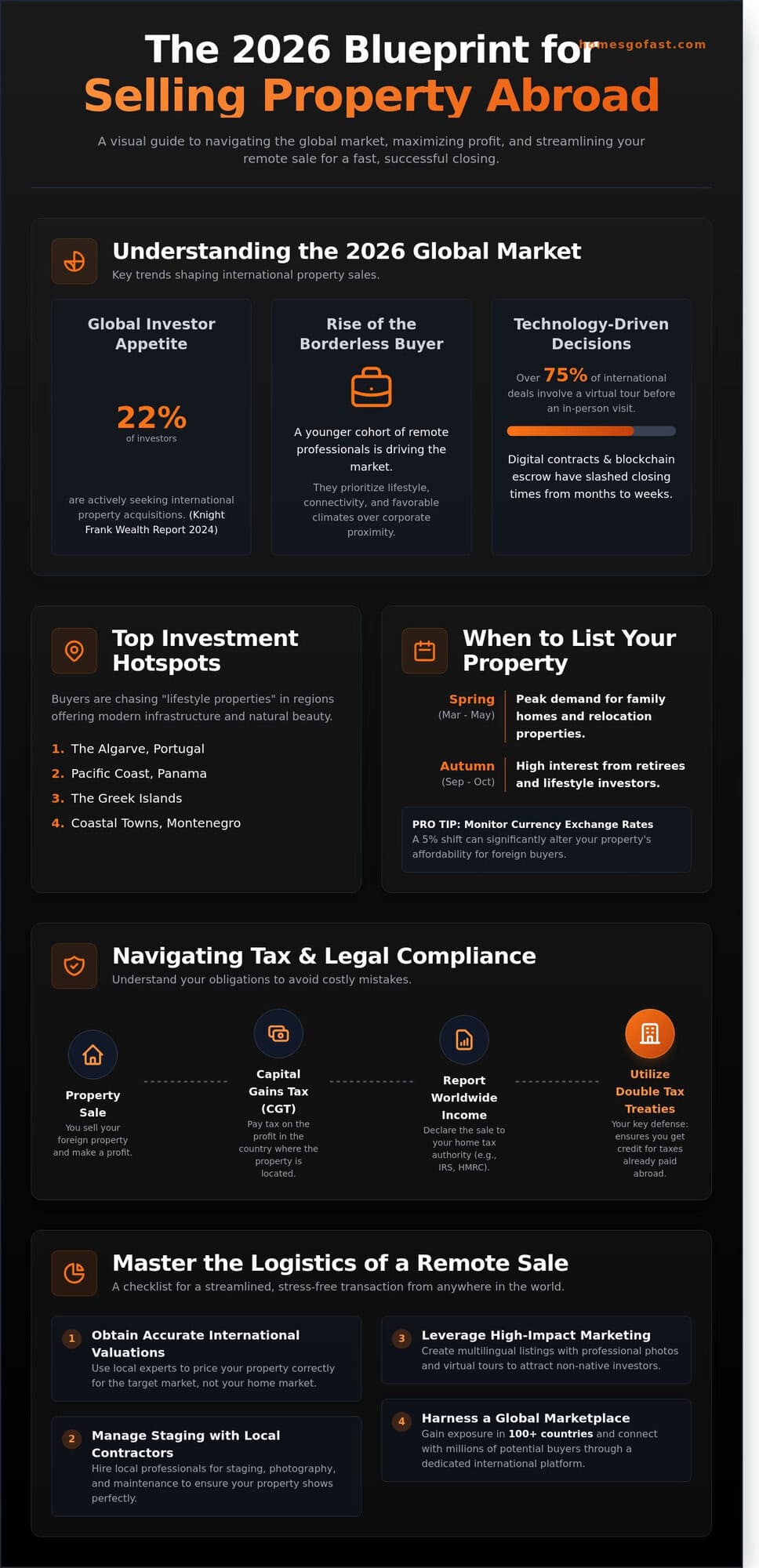
What if the biggest hurdle to your exit strategy isn’t the local market, but the distance? Data from the 2024 Knight Frank Wealth Report shows that 22% of global investors are actively seeking international acquisitions, yet many sellers remain paralyzed by the logistics. You likely feel that trying to sell property abroad from a different country is a recipe for stress, especially with the fear of double taxation or missing out on the right audience. It’s a common concern, but it doesn’t have to be your reality.
We’ve designed this blueprint to help you master the complexities of the 2026 market, ensuring you secure a fast and profitable overseas sale. You’ll gain a clear roadmap for managing a remote transaction while maintaining full compliance with IRS or HMRC regulations. By leveraging international property listings, you can maximize your global visibility and connect with motivated buyers who are increasingly looking for turnkey investments in stable regions.
This guide breaks down essential tax strategies, currency exchange tips, and the marketing tactics needed to stand out. From legal paperwork to final closing, you’re about to discover how to turn a complex international transfer into a streamlined, successful result. We’ll explore why investors are attracted by high-yield opportunities and how you can position your home to meet that growing demand.
Key Takeaways
- Identify high-demand 2026 market trends to position your lifestyle property in front of the most active international buyer segments.
- Navigate complex tax obligations with ease by understanding how Capital Gains Tax and worldwide income rules impact your foreign sale.
- Discover the marketing strategies needed to sell property abroad fast by reaching non-native investors through high-impact, multilingual listings.
- Master the logistics of a remote sale, from obtaining accurate international valuations to managing property staging with local contractors.
- Harness the power of a global marketplace to gain exposure in over 100 countries and connect with millions of potential buyers.
Selling Property Abroad in 2026: Understanding the Global Market
Selling a home in 2026 requires a firm grasp of how global migration has shifted. You’ll find that international buyer demand is no longer restricted to traditional retirement demographics. Instead, a younger cohort of remote professionals is driving the market. These buyers prioritize high-speed connectivity and favorable climates over proximity to corporate offices. If you want to sell property abroad successfully this year, you must align your listing with these lifestyle aspirations.
By Understanding the Global Market, you can see that buyers are chasing “lifestyle properties” in regions like the Algarve or the Pacific coast of Panama. In 2026, these locations have reached a peak because they offer a balance of modern infrastructure and natural beauty. Remote work has increased the velocity of sales, as buyers no longer wait for annual leave to view homes. They’re ready to move as soon as the right digital nomad visa is approved.
To better understand the current landscape of the digital marketplace, watch this helpful video:
The Rise of the Borderless Buyer
Buyers are increasingly looking for properties outside their home countries to diversify their assets and escape rising domestic costs. This new class of borderless buyer relies heavily on technology to make decisions. In 2026, over 75% of international transactions involve a virtual tour before an in-person visit. Digital contracts and blockchain-based escrow services have slashed closing times from months to weeks.
Top regions attracting foreign investment this year include the Greek islands and the coastal towns of Montenegro. These areas offer competitive entry prices and growing expat communities. To maximize your reach, you should list your home where these investors are looking. You can start by checking the latest overseas property listings to see how competitors are positioning their homes.
Market Timing: When is the Best Time to List?
Timing your sale is critical for a high ROI. In popular expat destinations like France and Spain, the market typically swells in the spring. Buyers want to secure their new home before the school year or the summer holiday season begins. If you plan to sell overseas property, you should prepare your marketing materials at least 60 days before these peak windows.
- Spring (March to May): Peak demand for family homes and relocation properties.
- Autumn (September to October): High interest from retirees and lifestyle investors.
- Currency Impact: Monitor the Euro and Dollar closely, as a 5% shift in exchange rates can significantly alter your property’s affordability for foreign buyers.
Listing your property for sale in Spain during a period of Euro weakness can attract a surge of interest from North American and British buyers. Market liquidity varies by region, with established urban hubs moving faster than remote rural retreats.
Navigating Tax Obligations and Legal Compliance
When you decide to sell property abroad, the financial paperwork often proves more complex than the sale itself. You’ll encounter Capital Gains Tax (CGT), which is the tax on the profit you make when the asset’s value increases. For US and UK residents, tax obligations don’t stop at the border. These countries tax “worldwide income,” meaning you must report the sale to your home tax authority even if you already paid tax in the country where the property is located.
Double Taxation Treaties are your best defense against paying twice. These agreements between nations ensure you receive a credit for taxes paid overseas. To manage these complexities, many sellers tap into the NAR global real estate network to find specialized accountants who understand cross-border rules. For US citizens, you’ll typically report the sale on IRS Form 8949. UK residents must report residential property disposals to HMRC within 60 days of completion. Missing these deadlines leads to heavy penalties.
The 2026 Tax Landscape for Overseas Sellers
In 2026, US long-term capital gains rates remain tiered at 0%, 15%, or 20% based on your taxable income. If the property served as your primary residence for at least two of the last five years, Section 121 exclusions may allow you to exclude up to $250,000 of gain from your income. This figure doubles to $500,000 for married couples. You must keep meticulous records of your “basis.” This includes the original purchase price plus capital improvements like a new roof or a swimming pool installed in 2024. These costs reduce your taxable profit when you sell property abroad.
Legal Hurdles: Power of Attorney and Remote Closing
You don’t need to board a flight to finalize your sale. Appointing a local legal representative via a Power of Attorney (PoA) allows a lawyer to sign documents on your behalf. In European markets like France or Italy, a Notary acts as a neutral government official to ensure the transaction’s legality. Before listing, gather your essential documents to avoid delays. You’ll need the original title deeds, local tax IDs, and valid energy performance certificates. If you want to reach a wider audience and sell overseas property efficiently, having this legal pack ready is vital.
- Title Deeds: Proof of ownership and clear title.
- Tax Identification: Such as a Spanish NIE or Italian Codice Fiscale.
- Energy Certificates: Mandatory in most EU countries as of 2026.
- Local Council Clearances: Ensuring no outstanding debts or utility liens exist on the property.
Finding the Right Buyer: Marketing Strategies for Global Exposure
To sell property abroad in 2026, you must think like a global marketer. Local agents often focus on the domestic market, relying on foot traffic and local portals. This approach fails to reach the lucrative pool of international investors searching from thousands of miles away. These buyers are looking for currency advantages or a specific lifestyle change. You need to speak their language. Multilingual listings can increase engagement by up to 40% compared to English-only ads.
Buyers are increasingly looking for a “turnkey” lifestyle rather than just a physical structure. They want to see the “dream” in your marketing materials. This means highlighting the 300 days of annual sunshine, the proximity to international airports, or the strength of the local expat community. Investors are attracted by high rental yields and capital growth, so your marketing should blend these financial facts with aspirational imagery.
To complement your digital presence, premium physical collateral can make a significant impact on serious buyers. Utilizing a professional service like Micro Printing for high-end brochures or targeted direct mail campaigns ensures that your property’s presentation reflects its true value to an international audience.
Digital Visibility: Beyond the Local High Street
Your property shouldn’t stay hidden in a local office. It needs to live on global platforms. Remote buyers rely entirely on what they see on their screens. High-quality, professional photography is non-negotiable. It creates the first emotional connection for someone who cannot visit in person. You can learn more about how to advertise properties to a global audience to ensure your home stands out in a crowded market.
Using international real estate listings allows you to bypass geographical limits instantly. Digital visibility means appearing where the buyers are, whether they are in London, New York, or Dubai. Consider these essential digital elements:
- Virtual Tours: 3D walkthroughs allow buyers to inspect the layout from their own home.
- Drone Footage: This highlights the surrounding landscape and proximity to local amenities.
- Social Proof: Testimonials about the neighborhood can build trust with hesitant foreign buyers.
Agent Pro vs. For Sale By Owner (FSBO)
You have choices when you decide to sell property abroad. A professional agent brings expertise but takes a commission, often ranging between 3% and 7% depending on the region. Many sellers now choose the FSBO route to save costs. Agent Pro accounts are powerful because they use automated XML feeds. This pushes your listing to dozens of international sites simultaneously, maximizing exposure without manual effort.
If you prefer a private sale, owner pricing models offer a cost-effective way to gain the same global reach without the heavy commission fees. This allows you to retain more of your equity while still accessing a massive audience of motivated buyers. Whether you choose a pro or go it alone, the goal is speed and efficiency in a fast-moving global market.
The Logistics of a Remote Sale: From Valuation to Closing
Managing a sale from thousands of miles away requires a disciplined, step-by-step framework. You can’t rely on luck when dealing with different time zones and legal systems. To sell property abroad successfully in 2026, you must treat the process like a professional project manager. Just as an ecommerce business might explore 3PL fulfillment services to streamline global logistics, a property seller must follow a structured path to maintain control without being physically present at every stage.
- Step 1: Secure a valuation that reflects current demand. Don’t rely solely on local tax assessments; instead, request a comparative market analysis from an agent who understands foreign buyer appetites.
- Step 2: Hire local contractors to handle repairs and staging. A property that looks “move-in ready” attracts higher offers and reduces the buyer’s desire to negotiate down for maintenance costs.
- Step 3: Use high-definition virtual viewings. This technology filters for high-intent buyers, saving you time and ensuring only serious prospects proceed to the physical inspection stage.
- Step 4: Secure the deal with an escrow account. This protects both parties by holding the deposit in a neutral third-party account until all conditions are met.
- Step 5: Sign the “Compromis de Vente” or your region’s equivalent. This preliminary contract locks in the price and terms before the final deed transfer.
Pricing Your Property for an International Audience
You should always list your price in the local currency to satisfy legal requirements, but your marketing should lead with USD, GBP, or EUR. This helps international investors quickly calculate their ROI without constantly checking exchange apps. Buyers are increasingly looking for transparency, and providing familiar currency benchmarks makes your listing more accessible.
Smart sellers use global market trends to justify their asking price. Investors are attracted by regions showing steady capital growth, so highlight those figures in your listing descriptions. Avoid the common mistake of overpricing based on emotional value; the market only cares about current data and future yield potential.
Managing Currency Risk During the Transaction
Don’t let high-street banks eat your profits. Traditional banks often charge up to 4% in hidden exchange rate spreads and transfer fees. For a large property sale, this could cost you thousands of dollars in unnecessary losses. Using a specialist service ensures you keep more of your hard-earned equity.
Currency specialists offer “forward contracts” to protect your bottom line. This tool allows you to lock in a specific exchange rate for a period of up to 12 months. If you agree on a sale price today but completion takes three months, a forward contract ensures you get the exact amount you expected, regardless of how the market fluctuates in the meantime.
Ready to reach a global audience of motivated buyers? You can advertise your property to international buyers today and start the process with confidence.
How to Sell Property Abroad Fast with HomesGoFast
HomesGoFast has led the international real estate market since 2002. We’ve spent over two decades refining a platform that simplifies how you sell property abroad. Our reach spans more than 100 countries, connecting your listing with millions of potential buyers who are actively searching for their next investment or holiday home. This long-standing history provides the credibility you need when dealing with high-value overseas assets.
Visibility is the most critical factor in a successful sale. When you list French homes or elegant Italian villas, you aren’t just reaching local buyers. You’re gaining multilingual exposure that targets high-net-worth individuals across the globe. This international presence is what turns a simple listing into a competitive bidding environment. We understand that global buyers have different priorities, and our platform is built to highlight the features they value most.
Why Investors and Sellers Trust Our Platform
Investors are attracted by our “Smart Advisor” approach. We don’t just show them a house; we provide the data and market context they need to make a confident decision. This reliability builds a bridge between you and a buyer who might be thousands of miles away. Our system ensures that every interaction is grounded in practical investment logic.
- Private Seller Ease: You don’t need technical expertise to create a professional-grade listing that stands out.
- Agent Tools: Professional brokers utilize our specialized tools to manage high volumes of leads and track buyer interest efficiently.
- Strategic Connection: We specialize in connecting the right buyer to the right home, regardless of the physical distance or time zone differences.
Our goal is to reduce the friction often associated with international transactions. By providing a clear and authoritative marketplace, we help you sell property abroad with the confidence of a seasoned professional. You get the tools, the audience, and the data-driven support required to close the deal quickly.
Ready to Reach a Global Audience?
The 2026 market is moving fast. Buyers are increasingly looking for opportunities in stable, sun-drenched locations with strong capital growth potential. You can capitalize on this demand by starting your listing process today. Our dedicated network sites for Spain and Greece ensure your property is seen by motivated audiences in the world’s most popular regions.
The HomesGoFast interface is built for speed and simplicity. You won’t get bogged down in complex forms or confusing jargon. We provide the expert guidance you need to secure a successful exit and move on to your next chapter. Take the first step toward a global sale and put your property in front of the world’s most active buyers right now.
Take Command of Your International Real Estate Journey
Selling in 2026 demands a blend of digital precision and local legal expertise. You’ve seen how navigating tax obligations and securing the right marketing exposure can make or break your timeline. Investors are attracted by transparency; ensure your documentation is ready before the first inquiry arrives. When you decide to sell property abroad, the difference between a stagnant listing and a closed deal often comes down to who is seeing your home.
HomesGoFast brings over 20 years of experience in global property marketing to your doorstep. We help you reach motivated buyers in over 100 countries while providing multilingual listing support to ensure your property translates across every border. It’s time to turn your investment into liquid capital with a partner who understands the rhythm of the global market. You don’t have to navigate the complexities of remote closings alone when you have a seasoned global expert in your corner.
Ready to move forward? List your property globally and reach international buyers today to secure the results your investment deserves.
Frequently Asked Questions
Do I have to pay tax in both countries when I sell property abroad?
You typically owe tax in the country where the home is located and your home country, but double taxation treaties usually prevent you from paying twice. The US has treaties with over 60 countries to ensure you receive a foreign tax credit. You’ll use IRS Form 1116 to offset your US liability with the taxes paid abroad. This ensures you maximize your gains when you sell property abroad.
How do I report the sale of a foreign house to the IRS?
You report the transaction on Form 8949 and Schedule D of your federal tax return. It’s essential to convert all figures into US dollars using the official Treasury Department exchange rate from the date of the sale. If the property was a rental, you must also account for depreciation recapture on Form 4797. Accurate record-keeping helps you secure your capital growth without legal delays.
Can I sell my overseas property without traveling there in person?
You can absolutely complete a sale remotely by granting a Power of Attorney (POA) to a trusted legal representative. This document must be notarized and usually requires an Apostille stamp to be recognized under the 1961 Hague Convention. Many sellers find this method reduces stress and travel costs. You can manage the process while viewing international property listings from your own home.
What is the Section 121 exclusion for foreign property?
The Section 121 exclusion allows you to exclude up to $250,000 in gains, or $500,000 for married couples, even on overseas homes. You must have owned and used the property as your primary residence for at least two of the five years before the sale. This tax break is a powerful tool for expats looking to relocate or downsize their portfolio in 2026.
How long does it typically take to sell property to an international buyer?
International transactions usually take between 90 and 180 days to finalize. This timeline accounts for extra steps like international bank transfers and document legalization. Properties in high-demand regions often move faster due to increased interest from foreign buyers. Buyers are increasingly looking for turnkey solutions, which can speed up the negotiation phase.
Is it better to use a local agent or a global property portal?
Using both is the most effective strategy to sell property abroad quickly. A local agent handles physical viewings and local regulations, while a global portal provides exposure to millions of potential buyers across different borders. Data shows that 95% of international buyers begin their search online. This combined approach ensures you reach the widest possible audience and secure the best price.
What documents are required to sell property in Europe as a foreigner?
You’ll need the original title deed, proof of identity, and a valid Energy Performance Certificate (EPC). Most European countries also require recent utility bills and proof that local property taxes are paid up to date. Having these documents ready can speed up the closing process by 14 to 21 days. Investors are attracted by sellers who provide transparent, ready-to-go documentation.
How do exchange rates affect my final sale proceeds?
Currency fluctuations can change your final take-home amount by 3% to 10% during a standard closing period. If the local currency weakens against your home currency, you’ll receive less money at the end of the transaction. You can mitigate this risk by using a forward contract through a currency specialist. This allows you to lock in an exchange rate for up to 12 months, protecting your investment potential.