
For property owners and international investors, understanding how do you subdivide land is a crucial step toward unlocking significant value. Subdivision is the formal process of dividing a single parcel of land into two or more smaller, independent lots. Once complete, each new plot receives its own legal title, allowing it to be sold, developed, or mortgaged separately. This strategic manoeuvre can transform a single asset into a portfolio of high-value opportunities, particularly in desirable global property markets.
This guide provides a comprehensive overview of the process, tailored for those looking to navigate this profitable venture across established and emerging markets.
Turning One Asset Into Many
Before delving into the technicalities, it is essential to grasp the investment principles behind subdivision. This is not merely an administrative exercise; it is a powerful strategy that converts a single land asset into multiple, often more valuable, ones. The process typically involves several key phases: an initial feasibility analysis, navigating legal frameworks, engaging professional surveyors, submitting plans for planning permission, and finally, registering the new lots with the relevant land authorities.
This is a well-trodden path for savvy property owners and those seeking profitable International Property For Sale, especially in established markets. When executed correctly, subdivision can generate impressive returns by creating new, desirable plots ready for residential or commercial development. For a deeper dive, explore our guide on adding commercial land to your assets portfolio.
Crucially, the value unlocked is often inherent in the land itself, not necessarily in any existing structures. In the UK, for instance, data from the Office for National Statistics values the nation’s total housing stock at approximately £5.5 trillion. A staggering £3.7 trillion of this—around 67%—is attributed to the value of the land alone. This statistic powerfully illustrates why subdivision can be so profitable; by creating new, serviced plots, you are tapping into the most valuable component of the property.
This flowchart breaks down the primary stages: analysis, planning, and registration.
As illustrated, converting one title into several follows a structured, methodical path, reinforcing the need for careful, sequential execution.
Key Stages of the Land Subdivision Process At a Glance
Understanding the key stages, objectives, and typical timelines is crucial before commencing a project. This table provides a clear roadmap from concept to completion, offering a framework for success, particularly for international investors new to this process.
| Stage | Objective | Typical Timeline | Key Considerations |
|---|---|---|---|
| Feasibility & Due Diligence | Determine project viability, identify potential constraints, and estimate returns. | 1-2 Months | Zoning laws, restrictive covenants, utility access, and comprehensive market analysis. |
| Surveying & Design | Produce accurate boundary plans and design the optimal layout for the new lots. | 1-3 Months | Requires a chartered surveyor. Focus on optimising plot sizes and planning for access. |
| Planning Permission | Secure official approval from the local authority to proceed with the subdivision. | 3-9 Months | Pre-application advice is highly recommended. Prepare for community feedback and detailed submissions. |
| Legal & Technical Works | Fulfil all conditions of planning permission and prepare legal documentation for new titles. | 2-4 Months | Involves a solicitor, utility connections, and final surveys. |
| Title Registration | Officially register the new plots with the Land Registry to create separate legal titles. | 1-3 Months | Requires submission of correct legal forms and meticulous final checks. |
This overview simplifies a complex process but highlights the major milestones. Each stage demands patience and expert input, but the potential rewards are substantial.
Running the Numbers: Your Initial Feasibility Study
Before engaging surveyors or submitting applications, rigorous due diligence is paramount. Embarking on a subdivision project without confirming its viability is a recipe for financial loss. This initial phase ensures your project is sound on paper before you commit significant capital.

Your first point of reference should be your local council’s planning policies. Every local authority operates under a Local Plan or Development Plan, which outlines the long-term vision for the area. This document is your rulebook, dictating housing density, design standards, and areas prioritised for growth versus those under protection. Similar frameworks exist globally, from municipal codes in the USA to urban plans in South American cities, making this a universal first step for any investor.
Uncovering Zoning Rules and Legal Hurdles
Zoning regulations contain the specific details governing development. These rules specify everything from minimum lot sizes to road frontage requirements and setbacks—the mandatory distance between new structures and property boundaries. This information is typically available on the local authority’s website or via its planning department.
Next, it is critical to obtain a copy of the property’s title deeds to identify potential legal impediments. Look for:
- Restrictive Covenants: Legally binding clauses that can prohibit certain actions, such as constructing more than one dwelling on the land.
- Easements or Rights of Way: Legal rights granted to a third party to use a portion of your property, such as for utility access or a shared driveway.
Identifying these issues early prevents significant future complications and expense. A solicitor can conduct a thorough title search to ensure no surprises await.
Getting Practical: Site Access and Services
Once legal checks are clear, a practical assessment of the land is required. Each new parcel must have safe and legal access to a public road. If it does not, the cost and complexity of constructing a new access road must be factored into your budget.
Equally important is the provision of essential services to the new plots. You must confirm the feasibility of connecting to main utilities, investigating the proximity and capacity of:
- Water mains
- The electricity grid
- Sewerage systems (or suitability for septic tanks)
- Gas and broadband lines
Contacting local utility providers will yield initial estimates for connection costs and identify potential challenges. Discovering late in the process that a water main extension will cost £50,000 can erase your profit margin.
For investors exploring opportunities in diverse markets, from Homes for Sale in the USA to emerging hotspots in South America, researching comparable land sales is a prudent step to gauge potential end-values before committing capital.
The Back-of-the-Envelope Financial Check
Finally, every feasibility study requires a preliminary financial assessment. This is not a detailed budget but a high-level calculation to determine if the project warrants further pursuit.
Begin by researching the market value of similar-sized plots in your target area. From this estimated sale price, subtract the major anticipated costs: surveyor fees, planning application fees, legal costs, and initial estimates for utility connections. This calculation provides an early indication of profitability. If the numbers do not add up at this stage, it is far better to walk away before incurring substantial professional fees.
Securing Planning Permission From the Local Council
Obtaining planning permission is typically the most significant hurdle when you subdivide land. This is the stage where the local authority scrutinises your proposal. A robust, well-conceived application is essential for success. This process involves more than form-filling; you are constructing a compelling case that your project aligns with local development objectives.
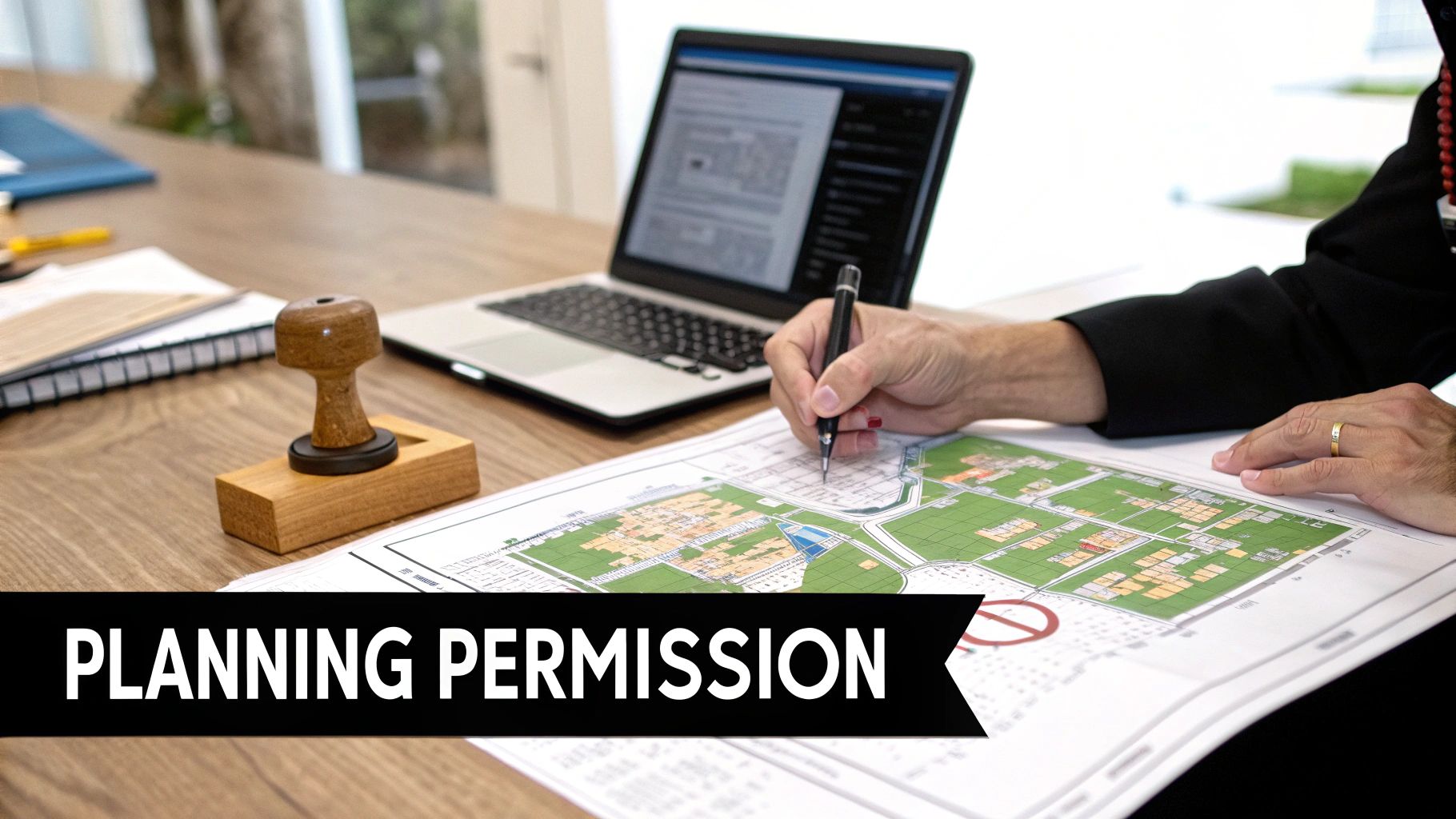
Before submission, a thorough understanding of local land use regulations is critical. Consulting a complete guide to zoning in architecture provides a valuable foundation for any successful application.
Outline vs. Full Planning Permission: What’s the Right Move?
Your first strategic decision is which type of planning permission to pursue. The two primary paths offer different levels of risk and investment.
- Outline Planning Permission (OPP): This application seeks agreement on the principle of the subdivision without requiring detailed architectural drawings. It is a lower-cost, lower-risk method to test the viability of your proposal. OPP is ideal if you intend to sell the plots with permission for a developer to complete the project.
- Full Planning Permission: This comprehensive application requires detailed drawings, full site plans, and specifications for any proposed construction. While it demands a greater upfront investment, it provides certainty and significantly increases the land’s value. This is the preferred route if you plan to develop the plots yourself or sell them at a premium.
For many landowners, beginning with OPP is the most logical approach. It validates the land’s development potential without the substantial cost of full plans, thereby enhancing the asset’s value.
Putting Together a Winning Application
A strong application is defined by clear, professional, and comprehensive documentation. Your goal is to anticipate and answer a planning officer’s questions before they are asked.
Your application package must include:
- Clear Site and Location Plans: Drawn to a recognised scale, these must show the existing site, proposed new boundaries, access points, nearby roads, and adjacent structures.
- A Persuasive Design and Access Statement: This narrative explains the rationale behind your subdivision, how the design respects the local character, and the provisions for safe access to the new plots.
- Necessary Supporting Reports: Depending on the site’s characteristics, you may require additional assessments, such as a traffic impact survey, a flood risk assessment, or an ecological report if protected species or habitats are present.
In the UK, planning policies are highly location-dependent. Strict regulations protect undeveloped land, creating a significant contrast between regions. As of April 2022, only 8.7% of England’s total land area was classified as developed. In a dense urban centre like London, 40.6% is developed, whereas in the South West, the figure is just 7.0%. This context means a proposal’s reception will vary dramatically based on its urban or rural setting.
Working With the Planners, Not Against Them
A proactive and professional relationship with the local planning authority can significantly improve your chances of success.
Utilising the pre-application advice service offered by most councils is a highly effective strategy. For a fee, you can discuss your proposal with a planning officer before formal submission. This provides invaluable feedback, helps identify potential issues early, and demonstrates your commitment to a collaborative process.
It is common to receive objections from neighbours or community councils. The key is to address these calmly and professionally. If a valid planning concern is raised—such as overlooking or an unsafe access point—be prepared to amend your plans. Demonstrating a willingness to listen and compromise can be instrumental in securing approval.
Ticking the Technical and Legal Boxes
With planning approval secured, your project transitions from a theoretical exercise to a practical undertaking. This phase requires technical and legal experts to finalise the subdivision. Their expertise is not merely helpful—it is essential for transforming a single title into multiple, legally sound, and marketable plots of land.
Your first engagement should be with a chartered surveyor. They create the definitive, legally binding boundary plan. This is a meticulous document that establishes the new plot lines, dimensions, and positions with precision. This plan forms the basis for the new title deeds registered with the Land Registry.
Engineering the Practicalities
Working in tandem with the surveyor, a civil engineer often plays a crucial role. They are responsible for designing the infrastructure required to make each plot functional and ready for development.
An engineer’s remit typically includes:
- Access Roads: Ensuring new roads or driveways comply with local council standards for width, gradient, and safety.
- Drainage Systems: Designing solutions for surface water and sewage, whether connecting to public sewers or implementing sustainable drainage systems (SuDS).
- Utility Connections: Mapping the most efficient routes for water, gas, electricity, and broadband to each new plot.
Their work is vital for satisfying the infrastructure-related conditions of your planning approval, without which the project cannot receive final sign-off.
The Final Legal Hurdle: Creating New Titles
The final, and arguably most critical, phase is managed by your solicitor. They navigate the complex legal process of creating new, separate legal titles for each plot, often referred to as a ‘transfer of part’.
In the UK, this involves drafting specific legal documents, most commonly the Form TP1 (Transfer of Part of Registered Title) or, if selling the entire subdivided site, the Form TR1 (Transfer of Whole of Registered Title).
A solicitor’s role at this stage demands perfectionism. Minor errors in the transfer deeds or a failure to demonstrate compliance with planning conditions can lead to rejection by the Land Registry, causing frustrating and costly delays.
This legal stage integrates all elements of the project. The surveyor’s plans are officially attached to the transfer deeds, new rights of way or covenants are legally established, and all evidence of compliance with planning obligations is compiled.
It is only when the Land Registry is fully satisfied that it will close the original title and issue new, individual title numbers for each plot. This is the moment your subdivided land officially exists as separate legal entities, ready for sale or development.
With technical and legal work underway, selecting the right professionals is paramount. For further insight, this guide to subdivision contractors in NSW, though based in Australia, offers universal principles for choosing a qualified team. This final stage requires painstaking attention to detail, but its successful execution is what unlocks the value you initially set out to create.
Getting Your Numbers Straight: Budgeting for a Profitable Subdivision
A land subdivision project is fundamentally a financial endeavour, and its success hinges on meticulous budgeting. Without a firm grip on your finances from the outset, potential profits can be eroded by unforeseen costs. Mastering the budget is non-negotiable for any serious investor.
This requires building a realistic financial model that provides a clear-eyed view of your potential return on investment.
Itemising Your Core Expenses
The costs associated with subdividing land extend far beyond the initial application fee. A comprehensive budget must account for professional services, council charges, and construction work.
Typical expenses to factor in include:
- Professional Fees: This is often the largest cost category, covering your chartered surveyor, solicitor or conveyancer, and planning consultant. An architect or engineer may also be required depending on the project’s complexity.
- Council and Application Fees: Each local authority has a fee structure for planning applications. Budget for extras like pre-application advice, building control inspections, and fees for discharging planning conditions.
- Utility and Service Connections: This can be a significant and variable expense. The cost of connecting services like water, electricity, gas, and sewerage depends heavily on the distance from your site to the nearest mains connection.
- Site Works and Infrastructure: This includes the physical work of demolition, site clearance, and the construction of new access roads or driveways.
- Taxes and Levies: In the UK, Capital Gains Tax (CGT) is a primary consideration on any realised profit. Depending on the local council, you may also be liable for infrastructure levies, such as the Community Infrastructure Levy (CIL).
It is advisable to build a detailed spreadsheet from the beginning, itemising every potential cost and tracking expenditure against it.
Estimated Cost Breakdown for a Typical UK Land Subdivision Project
A detailed look at the potential expenses involved in subdividing a single residential plot into two.
| Expense Item | Typical Cost Range (GBP) | Notes and Considerations |
|---|---|---|
| Professional Fees | £8,000 – £20,000+ | Includes surveyor, solicitor, planning consultant, and potentially an architect. Highly variable based on project complexity. |
| Council Application Fees | £500 – £2,500 | Varies by local authority. Includes main application, pre-app advice, and condition discharge fees. |
| Utility Connection Fees | £5,000 – £15,000 | Per plot. A major variable depending on the distance to mains services. Obtain quotes early. |
| Site Works & Access Road | £10,000 – £30,000+ | Covers basic site clearance, drainage, and creation of a new driveway or access point. |
| Land Registry Fees | £200 – £600 | For registering new titles once the subdivision is legally complete. |
| Contingency Fund | 10% – 20% of total cost | An essential buffer for unforeseen issues. Non-negotiable for any serious developer. |
| Taxes (CGT/CIL) | Variable | Dependent on your profit margin and local council policies. Seek professional tax advice. |
These are estimates; every project is unique, so obtaining specific quotes is vital.
Calculating Your Return on Investment
With a solid grasp of your costs, you can calculate your potential profit. This financial modelling underpins any smart investment, whether developing locally or exploring opportunities in markets like Homes for Sale in France.
The formula is straightforward:
(Gross Development Value) – (Original Land Value + Total Project Costs) = Net Profit
Your Gross Development Value (GDV) is the estimated market value of the new plots once ready for sale. This can be determined by researching comparable sales or consulting local estate agents.
Subtracting your total costs from the GDV yields your net profit—the key metric that determines whether the project is worth the time, effort, and risk.
Planning for the Unexpected
No project proceeds exactly as planned. Therefore, incorporating a contingency fund into your budget is not just advisable—it is essential.
This fund acts as a financial shock absorber for unexpected issues like poor ground conditions or planning delays. A standard contingency fund is typically between 10% and 20% of total estimated project costs. This disciplined approach to budgeting is what distinguishes professional, profitable developers from speculators.
Marketing and Selling Your New Land Plots
With the administrative and legal work complete, the final stage is to convert your efforts into profit. Successfully selling subdivided land requires a clear strategy to reach the right buyers and achieve the best possible price.

Potential buyers range from self-builders and small local developers to larger construction firms. While their objectives may differ, they all value clarity and certainty. Your role is to provide it.
Preparing a Comprehensive Sales Pack
To attract serious buyers and facilitate a smooth transaction, a professional sales pack is essential. This dossier should contain every document a buyer needs to conduct their due diligence.
A robust sales pack should include:
- Official copies of the new title deeds.
- All approved planning permission documents.
- Detailed boundary survey plans.
- Clear information on available utility connections.
- Any relevant engineering or ecological reports.
“International buyers prioritise clarity and security; a well-prepared legal pack removes uncertainty and accelerates their decision-making.”
— Nick Marr, founder of HomesGoFast.com
The contribution of subdivision to new housing supply is significant. In the UK, for example, government statistics show a substantial portion of new homes originate from splitting existing plots. This mainstream role in the housing ecosystem gives buyers confidence in the legitimacy and financeability of your offering.
Choosing Your Sales Channel
With your sales pack prepared, you must decide on the most effective sales channel. Options include working with a specialist land agent, selling at auction to create a competitive bidding environment, or listing on global property portals to reach a wider audience. For further insights on this final step, consult our guide on how to sell your land fast.
Your Land Subdivision Questions Answered
For those new to the process of how you subdivide land, many questions arise. Here we address some of the most common enquiries from property owners and investors.
FAQs on How Do You Subdivide Land
How long does a land subdivision typically take?
A realistic timeline, from initial feasibility studies to receiving new title deeds, is between 9 to 18 months. The most significant variable is the planning permission stage, which can take 3-6 months for a straightforward application but may extend if complications or objections arise. The subsequent legal and technical work usually adds another 3-6 months.
Is it possible to subdivide land with an existing mortgage?
Yes, but it requires your lender’s consent. Your mortgage is secured against the entire property, and subdivision alters this security. The lender will need to agree to release their charge over the portion of land being split off. This process typically involves a re-valuation and may require a partial repayment of the mortgage to maintain an acceptable loan-to-value ratio.
What are the main tax implications of subdividing land?
The primary tax consideration is typically Capital Gains Tax (CGT), payable on the profit realised from the sale of the new plot(s). Certain reliefs may be available, such as Private Residence Relief in the UK if the land was part of your main home’s garden, but strict conditions apply. Given the complexity, seeking professional tax advice tailored to your specific circumstances is essential.
Should I sell a plot with or without planning permission?
Land with planning permission is almost always more valuable. By securing permission, you have de-risked the asset for a potential buyer, making it a more attractive proposition. While it is possible to sell land ‘subject to planning’, this approach generally yields a lower price. The optimal strategy depends on your risk appetite, available capital, and timeline. If feasible, obtaining permission before selling is the best way to maximise your financial return.
About Homesgofast.com
HomesGoFast.com is a leading international property website, established in 2002, helping homeowners, real estate agents, and developers reach overseas buyers. Featuring thousands of listings from over 50 countries, the platform connects global property seekers with homes, apartments, villas, and investment opportunities worldwide.
Looking for expert mortgage guidance? Get international property mortgage advice here:
https://homesgofast.com/mortgages-overseas/
Explore more overseas homes for sale at our global partner site:
https://homesgofast.com/overseas-property/
Looking to sell real estate to foreign buyers? Go to
https://homesgofast.com/sell-overseas-property/