
Deciding to sell your property without a real estate agent—what’s known as a ‘For Sale By Owner’ or FSBO sale—puts you firmly in the driver’s seat. The success of this approach, especially in the competitive global market, boils down to one key document: a well-drafted for sale by owner contract. This is the legal paperwork that solidifies the terms you and the buyer have agreed upon before the solicitors get involved to handle the official legal transfer of title.
Understanding The For Sale By Owner Process

Selling your property privately isn’t just a trend; it’s a strategic move that a growing number of savvy owners and international investors are making across the world’s most desirable markets. The biggest draw is often financial—cutting out the agent’s commission can lead to significant savings. But the perks for sophisticated sellers don’t stop there.
The FSBO route gives you complete autonomy. You’re in charge of everything, from setting the price and managing viewings to negotiating directly with potential buyers from markets like the USA, Europe, or emerging hotspots in South America. This direct line of communication is a massive advantage when dealing with international investors, as it cuts through the noise and allows for faster, more transparent negotiations.
The Appeal for Savvy Sellers
This method is perfect for sellers who have a solid grasp of their property’s market value. It gives you the agility to react quickly to market dynamics, without any middlemen slowing you down.
For example, the UK property market is incredibly active. In February 2023 alone, there were a staggering 529,085 new property instructions. This kind of dynamic market is where direct control really pays off, allowing you to negotiate more effectively. You can dig into the numbers yourself by checking out the latest UK property market insights from TwentyCI.
As Nick Marr, founder of HomesGoFast.com, points out, “We’re seeing a surge in savvy owners who understand their property’s value and prefer to manage the sale directly, especially when tapping into a competitive international market. Control and transparency are paramount for HNW individuals.”
This guide is here to give you the foundational knowledge you need to handle a private property sale with confidence. Before you dive into drafting contracts, the first step is to get comfortable with the overall process. Our guide on selling your house without an agent is the perfect starting point, providing the essential groundwork for mastering for sale by owner contracts.
See our latest Homes For Sale By Owner
Drafting Your Legally Sound FSBO Contract
When you sell your home privately, your for sale by owner contract is the single most important document you’ll create. It’s the foundational agreement for the entire sale. While you’ll absolutely need a solicitor or notary for the final legal transfer, getting the initial terms right empowers you to negotiate from a position of strength.
Think of this document as a ‘Memorandum of Sale’ or ‘Heads of Terms’. It’s not the final, binding contract your solicitor will draft, but it’s the blueprint you and your buyer agree on before the conveyancing process officially kicks off. Getting this right from the start ensures everyone is on the same page and saves a ton of time and potential headaches down the line.
Nailing Down the Basics: Parties and Property
First things first: total clarity. The contract has to state, without a shred of doubt, who is buying and who is selling. This means full legal names and current addresses for everyone involved. Any ambiguity here is a recipe for delays later on.
Just as critical is identifying the property itself. We need more than just the street address. The contract must include the full title number or official land registry reference. This is a non-negotiable detail that ensures there’s zero confusion about the exact parcel of land and buildings being transferred.
- Parties: State the full legal names of the seller(s) and the buyer(s).
- Property: Include the full postal address and, most importantly, the official title number.
- Example Wording: “This agreement is made between Johnathan Michael Smith of [Address] (the ‘Seller’) and Maria Isabella Rossi of [Address] (the ‘Buyer’) for the sale of the property located at [Address], with Title Number [e.g., AV123456].”
This initial precision builds a solid, undisputed foundation for the rest of your agreement.
Key Clauses For Your For Sale By Owner Contract
Before we go further, it helps to see the core components laid out. This isn’t an exhaustive list for every possible scenario, but these are the absolute must-haves for any preliminary agreement. Getting these right sets the stage for a smooth handover to your legal team.
| Clause Component | What It Achieves | Example Wording To Consider |
|---|---|---|
| Purchase Price | States the exact agreed-upon sale price, leaving no room for misinterpretation. | “The agreed purchase price for the property is £500,000 (five hundred thousand pounds sterling).” |
| Deposit Amount | Specifies the deposit amount (typically 10%) and confirms the buyer’s financial commitment. | “A deposit of £50,000, representing 10% of the purchase price, shall be payable.” |
| Deposit Handling | Clarifies that funds will be held securely by solicitors, protecting both parties. | “The deposit will be transferred from the Buyer’s solicitor to the Seller’s solicitor upon exchange of contracts.” |
| Contingencies | Outlines conditions that must be met for the sale to proceed (e.g., survey, mortgage). | “This agreement is conditional upon the Buyer obtaining a satisfactory structural survey within 21 days.” |
| Fixtures & Fittings | Lists specific items included in the sale (chattels) to prevent future disputes. | “The sale shall include the following items: integrated dishwasher (Brand/Model), all fitted carpets, and garden shed.” |
| Target Completion Date | Sets a provisional, non-binding date for the final transfer of ownership. | “The parties agree to work towards a target completion date on or around [Date], to be formally agreed upon by their solicitors.” |
Having a clear structure like this makes your initial negotiations far more professional and efficient. It shows the buyer you’re serious and organised.
Talking Money: Price, Deposit, and Financials
The financial terms are the real heart of your for sale by owner contract. Always state the agreed purchase price clearly in both numbers and words. This simple trick prevents any confusion caused by a typo. For instance, write “£500,000 (five hundred thousand pounds sterling).”
The deposit arrangement is just as important. In the UK, a 10% deposit is standard practice. Your contract must specify that this deposit will be paid by the buyer’s solicitor to your solicitor when contracts are formally exchanged. It should never be paid directly to you.
A quick but crucial tip from experience: never, ever accept a deposit directly from a buyer. This creates huge legal and financial risks. The proper channel is for the funds to be held securely in a solicitor’s client account, which protects both you and the buyer.
This clause ensures the buyer has skin in the game and that the money is handled safely through the correct legal process.
Your Safety Nets: Contingencies and Special Conditions
Contingency clauses (often called ‘subject to’ clauses) are your safety nets. They make the sale conditional on certain things happening, and they protect both you and the buyer. Don’t see them as a sign of a weak deal; they’re the mark of a well-thought-out agreement.
Some of the most common contingencies you’ll see are:
- Subject to Survey: The buyer is making their offer on the condition that a chartered surveyor doesn’t find any major problems.
- Subject to Finance: The deal is off if the buyer can’t secure a formal mortgage offer from their lender.
- Sale of Buyer’s Property: The purchase depends on the buyer successfully selling their own home (this creates a chain).
You can also add your own special conditions. A common one is a list of ‘chattels’—fixtures and fittings—that you’re including in the sale. Be explicit about everything from the integrated dishwasher to the garden shed. Mentioning these details in the initial for sale by owner contract stops arguments from popping up when you’re just weeks away from completion.
When you’re ready to see how professional listings present these details, you can browse examples of International Property For Sale to get a feel for the market.
Managing The Legal Requirements And Due Diligence
So, you’ve drafted a preliminary agreement. That’s a great start, but let’s be crystal clear: navigating a private property sale in any jurisdiction is a serious legal undertaking. This is where the professionals absolutely must step in.
Even with a perfectly drafted for sale by owner contract, the non-negotiable next step is to engage a qualified conveyancer or solicitor. Their involvement isn’t just a good idea; it’s essential for the sale to be legally completed. Think of them as the captain who steers the ship into port after you’ve plotted the initial course.
Your solicitor will take the terms you and the buyer have agreed upon and transform them into the final, legally binding contracts. They handle the critical property searches that can uncover hidden issues—things like planning permission disputes, local land charges, or environmental risks you’d never find on your own. Most importantly, they manage the secure transfer of funds and legally register the new ownership with the relevant Land Registry.
Your Obligations As A Seller
As the seller, the law requires you to be upfront. This duty of disclosure is often handled by completing a detailed Property Information Form. You need to be honest and accurate. It covers everything from boundary disputes and planning notices to any structural defects you know about.
Cutting corners or failing to disclose a known problem can come back to haunt you with severe legal consequences down the line. When it comes to property law, transparency is everything.
This diagram breaks down the core pieces that need to be solid in your initial agreement before the legal experts take the reins.
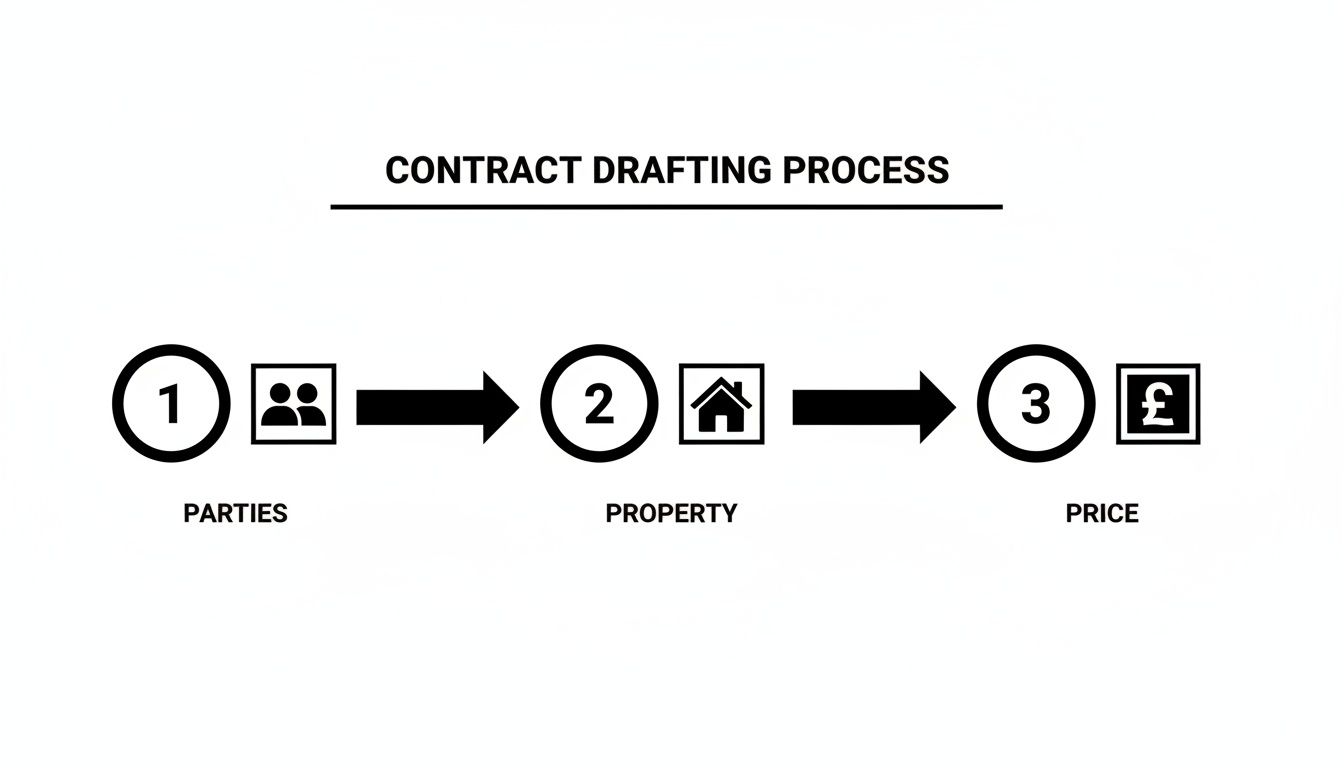
It really highlights that having total clarity on the parties, the property, and the price is the bedrock from which all the legal due diligence flows.
Buyer Verification And Property Types
Another crucial job for your solicitor is verifying who your buyer is and where their money is coming from. This isn’t just them being nosy; it’s a mandatory part of Anti-Money Laundering (AML) regulations in most developed nations. It’s a vital safeguard that protects you from getting involved in a fraudulent transaction.
The legal journey also changes depending on the property’s tenure:
- Freehold: This is the most straightforward. You own the property and the land it sits on outright, which generally makes for a simpler conveyancing process.
- Leasehold: Here, you own the property for a fixed term but not the land itself. This brings extra layers of legal complexity, like having to review the lease agreement, scrutinise service charges, and liaise with the freeholder or a management company.
A key piece of advice from my experience: instruct your solicitor the moment you have an offer you plan to accept. Getting them on board early shows the buyer you’re serious and allows the legal prep work to start immediately, heading off any unnecessary delays.
To protect against any nasty surprises with the property itself, both parties in a private sale should understand the value of comprehensive pre-purchase building inspections. While the buyer usually arranges this, a savvy seller who knows the process can prepare their property and anticipate what might become a point of negotiation. A clean inspection report can seriously speed up the timeline to exchanging contracts.
By getting a firm grip on these legal duties, your private sale won’t just be successful—it will be fully compliant with the law.
Negotiating Effectively With International Buyers
The negotiation table is where a private sale really comes into its own. You’re in the driving seat, talking directly with your potential buyer. When that buyer is from overseas, the game changes slightly. Success often comes down to understanding their cultural norms and what they’re truly looking for in an investment, which can be worlds away from a typical domestic buyer’s priorities.
This is where your draft for sale by owner contract becomes your most powerful tool. It’s not just a legal document; it’s the foundation for every conversation you have.
This direct line of communication also gives you incredible agility. In the UK’s fast-moving property market, which saw a staggering 1,374,050 transactions in 2021-22, being able to react quickly is a massive advantage. While agents are juggling multiple clients, you can pivot and negotiate in real-time. For a deeper dive into these figures, the residential property transaction data from IBISWorld is well worth a read.
Managing Offers And Counter Offers
When an offer lands—especially from an international investor—don’t just see a number. See it as the first move in a conversation. Your job is to respond promptly and professionally, using your draft agreement to frame the discussion. If their offer is below your asking price but you sense they are serious, it’s time to send a counter-offer.
But a good counter-offer isn’t just about nudging the price up. Think creatively and use the other clauses in your for sale by owner contract to find common ground. It shows you’re flexible and serious about making a deal happen.
- Completion Date: International buyers often need more time to sort out their finances and travel plans. Offering flexibility on the completion date can make your property far more appealing than another that’s more rigid.
- Included Chattels: Is there a small gap between your price and their offer? Offering to include some key furnishings or high-end appliances can often close that gap without you taking a big financial hit.
- Payment Terms: While deposit rules may be standard in your jurisdiction, it’s smart to get ahead of any confusion about currency exchange. Clarifying this in the contract early on prevents headaches down the line.
This kind of back-and-forth builds a good relationship and keeps the momentum going.
Recognising Investor Tactics And Preserving Value
You’ll find that seasoned international investors and high-net-worth individuals often negotiate differently. They’re playing the long game, focusing on building a strong portfolio. They might test your resolve with a lowball initial offer or ask for extensive documentation.
The key is to respond with confidence, backed by solid market data and a clear understanding of your property’s unique value proposition. Stand firm on your price if your valuation is robust, but show flexibility on non-critical terms.
It’s about knowing where you can give a little without giving away the farm. Being firm on the price while flexible on the completion date, for instance, shows you’re a serious seller who also understands their buyer’s needs.
For anyone looking to attract this calibre of buyer, mastering the private sale is essential. We’ve actually put together a guide on selling your property internationally without commission that dives deeper into these strategies. By understanding these nuances, you can navigate the entire process with confidence and secure a final deal that truly reflects your property’s value.
Selling Investment And Second Home Properties Privately

The For Sale By Owner (FSBO) approach is particularly powerful for experienced investors and owners of second homes. When you’re managing a property portfolio or selling a cherished holiday home, using for sale by owner contracts gives you a level of discretion and control you just don’t get with a traditional sale.
This corner of the market simply operates with a different set of priorities. For a seasoned investor looking to quietly rebalance their assets, a private sale offers confidentiality that’s hard to beat. If you prefer keeping things low-key, exploring a guide to stealth selling rental properties offers some fantastic insights into these kinds of private deals.
And this market is significant. In 2023, 23% of UK property purchases were for non-primary residences like rentals or holiday lets. With over 32% of buyers already owning another property, FSBO contracts are the perfect tool for sellers wanting to connect directly with these experienced investors.
Handling Unique Property Scenarios
Selling an investment or second home brings its own unique complexities, and your for sale by owner contract needs to address them head-on. Every property type demands specific clauses to make sure the handover is smooth and legally sound.
- Buy-to-Let Properties: If you’re selling a property with tenants in place, the contract absolutely must detail the transfer of the tenancy agreement. This means clearly stating the current rent, the deposit details (including which tenancy deposit scheme it’s held in), and when the tenancy started. The buyer is stepping into your shoes as the new landlord, so there can be no grey areas.
- Holiday Homes: One of the biggest hurdles with holiday lets is pinning down an accurate valuation, especially with income that ebbs and flows with the seasons. Your negotiations need to be backed by solid financial records. Your contract should also explicitly list any future bookings the new owner must honour and detail how any deposits will be transferred.
Financial And Marketing Considerations
Financing a second property isn’t the same as buying a primary residence; it often involves different mortgage products and stricter lending criteria. It’s well worth reviewing second home financing options to get a better handle on what your potential buyers are dealing with.
Marketing these properties also requires a more targeted strategy. Forget broad local advertising. Instead, focus on niche platforms like HomesGoFast.com, which attract a global audience of affluent buyers and serious investors who are actively looking for these exact opportunities. When managed correctly, a private sale is the ideal path for these high-value transactions.
FAQs: Mastering For Sale By Owner Contracts
What makes an international for sale by owner contract legally valid?
For an FSBO contract to be legally valid in most common law jurisdictions like the UK or USA, it must contain key elements: a clear offer and acceptance, consideration (the price), the intention of both parties to create legal relations, and certainty of terms. Critically for property, it must be in writing and signed by both parties. However, this initial agreement typically serves as a memorandum of sale; the transaction only becomes fully binding upon the formal exchange of contracts managed by legal professionals.
What are the main challenges when creating a contract for a foreign buyer?
The primary challenges involve navigating legal and financial compliance across borders. This includes strict Anti-Money Laundering (AML) checks to verify the buyer’s identity and source of funds, managing currency exchange rate fluctuations, and understanding potential tax implications in both the seller’s and buyer’s countries. It is vital that your legal counsel has experience in international property transactions.
How do I handle a deposit from an overseas buyer in an FSBO sale?
Never accept a deposit directly. The deposit should always be transferred from the buyer’s solicitor to your solicitor’s secure client or escrow account upon the formal exchange of contracts. This is standard international practice that protects both parties. Your for sale by owner contract should explicitly state this process, including the currency and the conditions under which the deposit is held and released.
Are template for sale by owner contracts reliable for international deals?
While a template can provide a useful starting structure, it is highly inadvisable to rely on one for a cross-border transaction. Property law varies significantly between countries, from freehold vs. leasehold systems in the UK to different regulations in emerging markets like Brazil or Colombia. Always have a qualified solicitor or attorney draft the final contract to ensure it is compliant with local laws and protects your specific interests.
What is the most critical clause in a for sale by owner contract for an international sale?
While all clauses are important, the ‘contingencies’ or ‘subject to’ clause is arguably the most critical for international sales. This section should clearly outline conditions that must be met for the sale to proceed, such as the buyer securing international financing, obtaining necessary visas or residency permits, or receiving a satisfactory property survey. This clause provides a legal exit strategy for both parties if key conditions are not met, which is essential given the added complexities of a cross-border deal.
About Homesgofast.com
HomesGoFast.com is a leading international property website, established in 2002, helping homeowners, real estate agents, and developers reach overseas buyers. Featuring thousands of listings from over 50 countries, the platform connects global property seekers with homes, apartments, villas, and investment opportunities worldwide.
Looking for expert mortgage guidance? Get international property mortgage advice here:
👉 https://homesgofast.com/mortgages-overseas/
Explore more overseas homes for sale at our global partner site:
👉 https://homesgofast.com/overseas-property/
Looking to sell real estate to foreign buyers? Go to
https://homesgofast.com/sell-overseas-property/