

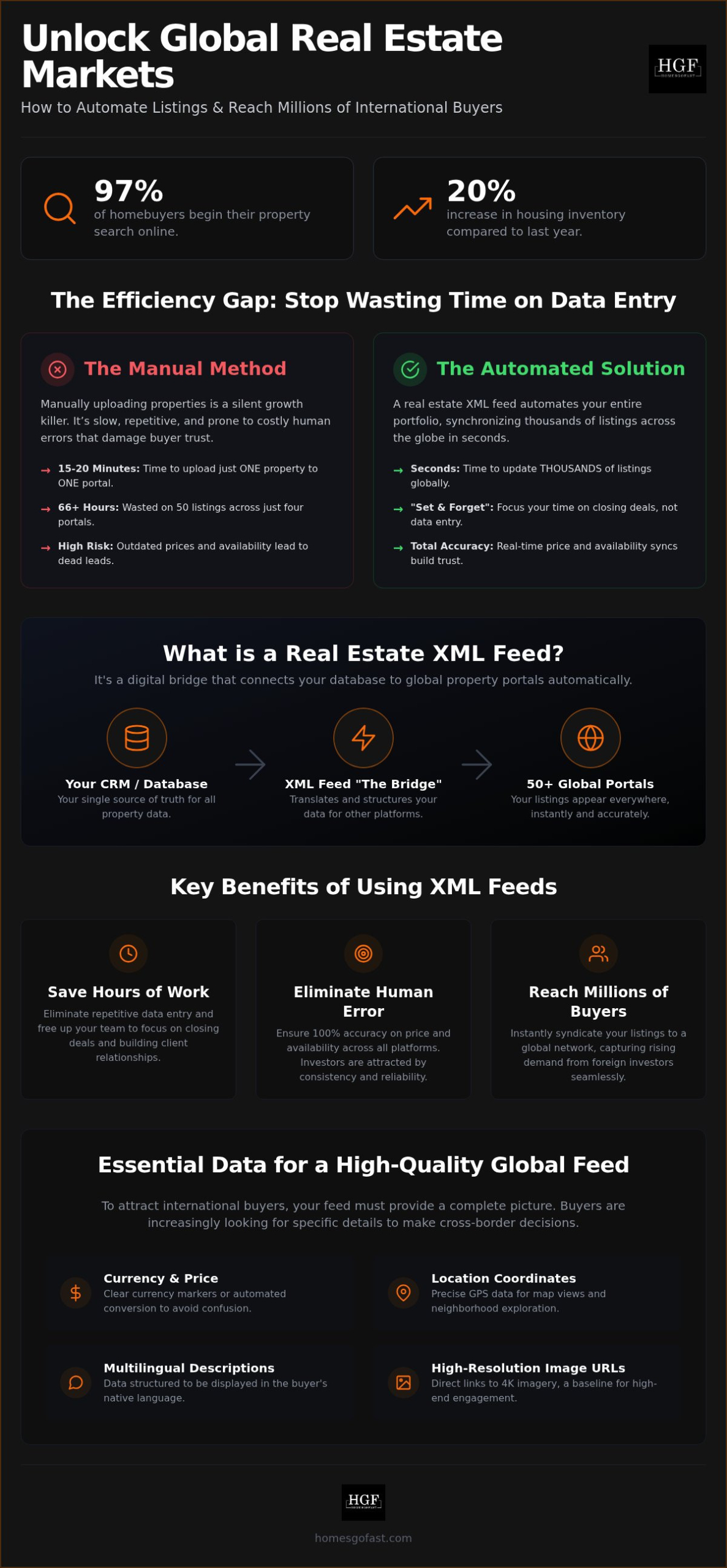
With 97% of homebuyers now starting their search online, your digital presence is your most powerful sales engine. If you’re still manually uploading listings to various portals, you’re fighting a losing battle against time. A robust real estate XML feed isn’t just a technical file; it’s your primary tool for global scalability. It allows you to automate your workflow and focus on closing deals rather than repetitive data entry.
You likely know the frustration of managing multiple platforms. It’s exhausting to update a price in one place only to find an outdated listing generating dead leads elsewhere. This is especially critical now that housing inventory has risen 20% compared to last year. Investors are attracted by accuracy. They expect to see the latest data on price and availability the moment they land on a page, regardless of which country they’re searching from.
In this guide, you’ll discover how to leverage automation to reach millions of international buyers instantly. We’ll show you how to eliminate hours of manual work while keeping your portfolio perfectly synchronized across the globe. You’ll learn about the latest RESO Web API standards and how to position your properties to capture the surging interest from foreign buyers who are increasingly looking for seamless digital experiences.
Key Takeaways
- Learn how to automate your property listings by creating a digital bridge between your CRM and global platforms, saving you hours of manual data entry.
- Discover the power of “set and forget” marketing to ensure your properties reach millions of international buyers across multiple continents instantly.
- Understand how to select the correct real estate XML feed format, such as RESO or Kyero, to maintain technical compatibility with major advertising portals.
- Improve your search engine visibility and lead quality by utilizing structured data that keeps price and availability updated in real-time.
- Find out how to leverage an Agent Pro Account to seamlessly sync your entire portfolio and capture rising demand from foreign investors.
What is a Real Estate XML Feed and Why Do Agents Need It?
A real estate XML feed is a dynamic data file that acts as a translator between your internal database and the wider world. It uses Extensible Markup Language (XML) to structure information so that different software systems can read and display your listings accurately. Think of it as a digital bridge. Instead of you visiting every portal to type in details, the bridge carries that data automatically. This ensures your listings remain updated across dozens of platforms at once without you lifting a finger.
To better understand this concept, watch this helpful video:
XML vs. Manual Entry: The Efficiency Gap
Manual entry is a silent growth killer for modern international agencies. When you manually upload a property, it typically takes 15 to 20 minutes to fill in descriptions, upload photos, and set prices. If you manage 50 listings across four portals, you’re looking at 66 hours of repetitive work. A real estate XML feed handles thousands of listings in seconds. This speed is vital because buyers expect instant gratification. If your data isn’t live, you don’t exist to them.
Automation also wipes out human error. Investors are attracted by accuracy. If a price drops on your website but remains high on a global portal, you’ll lose trust before the first phone call. By syncing your data, you free up your team to focus on closing leads and building relationships. You shouldn’t be wrestling with spreadsheets when you could be negotiating deals.
Essential Data Fields in a Global XML Feed
When you advertise properties internationally, basic fields aren’t enough. Buyers are increasingly looking for specific details that help them make cross-border decisions. A high-quality feed must include more than just the bedroom count. It needs to provide a complete picture that search engines can index effectively.
- Currency and Price: Automated conversion or clear currency markers to avoid confusion for foreign buyers.
- Location Coordinates: Precise GPS data so buyers can explore the neighborhood via map views or satellite imagery.
- Multilingual Descriptions: Data that allows portals to display your listings in the reader’s native language.
- High-Resolution Image URLs: Direct links to 4K imagery, which is now a baseline requirement for high-end engagement.
Structured data helps global portals categorize your assets correctly. This ensures your listings appear in front of the right buyers at the right time. It maximizes your global reach without adding a single hour to your administrative burden.
How XML Synchronization Powers Global Property Marketing
Imagine making a price adjustment on a luxury villa in your CRM and having that change reflect across every international portal you use within minutes. This is the ripple effect in action. A single update in your local database triggers a wave of changes across 50 or more global platforms. It ensures your brand maintains a professional, consistent image regardless of where a buyer finds you. Investors are attracted by accuracy; they want to know the price they see in London is the same one listed in New York.
The Library of Congress classifies XML as a flexible text format, which is exactly why it has become the gold standard for property data. It’s reliable, structured, and easily understood by various systems across different borders. When you manage French homes for sale, your target audience is rarely just local. Synchronization allows you to reach buyers in the UK, the US, or Asia instantly. You don’t need to manage a dozen different logins; you simply manage your own inventory.
The Difference Between API and XML Feeds
You might hear developers talk about APIs versus XML feeds. It’s helpful to think of this as push versus pull technology. An API “pushes” data to a portal in real-time, while a real estate XML feed is a file that portals “pull” or download on a schedule. While APIs offer extreme speed, XML remains the most widely accepted standard for international property portals. It provides a stable, universal language that works across diverse software environments, making it the practical choice for most agencies looking for global reach.
Frequency of Updates: Keeping Your Data Fresh
In a fast-moving market, daily updates are often the bare minimum. Buyers are increasingly looking for real-time availability. If a property is sold but remains active on a portal for three days, you’ll waste time fielding calls for a dead listing. This can damage your agency’s reputation and frustrate potential clients. High-quality platforms like HomesGoFast prioritize frequent feed refreshes to ensure your data stays current. This keeps your listings at the top of search results and guarantees that the leads you receive are for properties that are actually available. If you want to see how automation can transform your lead volume, you can advertise properties using our streamlined synchronization tools.
Key Benefits of Using XML Feeds for International Listings
Implementing a real estate XML feed is about more than just moving data; it’s about maximizing your return on investment. While home sales are projected to increase by 14% in 2026, you can’t simply work 14% more hours to keep up. Automation allows you to scale your inventory across multiple continents without adding to your administrative headcount. It transforms your agency into a lean, global operation that responds to market shifts in real-time.
Search engines and property portals prioritize listings that provide clean, structured information. By adhering to data standards established by the Real Estate Standards Organization (RESO), you ensure that your property details are easily indexed by global algorithms. This improved SEO visibility means your listings rank higher when buyers search for specific assets, such as luxury villas or investment apartments. High-quality data leads to high-quality leads.
Cross-border compliance is another critical advantage. With new regulations like the 2024/1028 EU mandate requiring standardized data for short-term rentals, having a structured feed ensures you meet local legal requirements automatically. It reduces the risk of your listings being flagged or removed due to missing registration numbers or incorrect formatting. This reliability builds a foundation of trust with both the platforms you use and the buyers you serve.
Eliminating the ‘Stale Listing’ Problem
Nothing kills buyer trust faster than a “dead” lead. If an investor finds a property that was sold weeks ago, they’ll likely move on to a competitor. A synchronized feed automatically removes sold properties and updates pending statuses. This keeps your portfolio looking professional and current. The psychological impact on a buyer is significant; they are more likely to enquire when they see “Live” data that matches the current market reality. Accuracy is your best tool for maintaining a premium brand reputation.
Multi-Portal Distribution Strategy
A single feed can populate everything from niche boutique sites to the world’s largest property portals. This broad reach is essential for reaching buyers who may be unfamiliar with your local market. You can learn how to advertise properties to a global audience by leveraging these automated networks to test which regions provide the highest engagement. By tracking which portals deliver the best ROI from your feed, you can refine your marketing spend and focus on the territories where demand is strongest. This data-driven approach ensures you aren’t just reaching more buyers, but the right ones.
Technical Requirements: Setting Up Your Real Estate Feed
Setting up your real estate XML feed doesn’t require a computer science degree. It does require a clear plan. Your CRM is the foundation of this process. You must verify that your software generates a clean, automated export that portals can read without manual intervention.
Portals don’t usually host your images. They pull them from your feed. If your image URLs are broken or private, your listing will appear incomplete. Use stable, direct links to high-resolution files to ensure your properties look their best. High-quality imagery is a baseline requirement in 2026.
Validation is your final safety net. Use a feed checker to catch errors or missing data before your listings go live. This prevents corrupted data from reaching your global audience. Investors are attracted by precision, and clean data helps build immediate trust from the first click.
Working with Your CRM Provider
Ask your software provider if they support “scheduled exports.” You also need to know if you can map custom data fields. If you are listing property for sale in Spain, you’ll need to map local details to fields that international buyers understand.
Common bottlenecks happen when the CRM and portal aren’t in sync. Ensure your CRM can handle the “pull” requests from major platforms without timing out. This keeps your data flow consistent. It ensures that your availability status remains accurate across every site in your network.
Industry Standard Formats You Should Know
- Kyero: This is the gold standard for European property feeds. It is specifically designed to handle the nuances of multilingual listings and diverse international tax rules.
- RESO: The North American market has fully transitioned to the RESO Web API Core 2.0.0. This standard uses the Data Dictionary 2.0 to ensure uniform data. Note that older versions like 1.7 are being phased out in 2026.
- BLM: Originally developed for Rightmove, this format is still widely used by UK agencies. It remains a reliable and straightforward choice for international syndication.
To skip the technical struggle and start reaching buyers today, you can advertise properties through our automated Agent Pro system.
Maximizing Leads: Connecting Your Feed to HomesGoFast
Connecting your real estate XML feed to a high-traffic global network is the final step in your automation journey. The Agent Pro Account serves as the bridge between your CRM and a worldwide audience of motivated investors. By syncing your entire portfolio, you ensure that every property you list is visible to buyers across multiple continents the moment it goes live. This isn’t just about visibility; it’s about the speed of results.
Investors are attracted by transparency and detail. When you automate your listings through HomesGoFast, you can use “Featured” upgrades within your feed to boost visibility for key developments or luxury assets. This keeps your highest-value properties at the top of search results, ensuring they capture maximum attention. You can then use your dashboard to track lead volume and monitor the ROI of your automated marketing efforts in real-time.
Optimizing Your Feed for Global Buyers
Don’t settle for basic descriptions. Buyers are increasingly looking for the “dream” as much as the data. You should include lifestyle keywords in your automated descriptions to help search engines index your properties for specific search intent. Terms like “sea view,” “private pool,” or “traditional architecture” act as magnets for international buyers. You can check our international property listings for inspiration to see how top-tier agents optimize their portfolio for global search.
- Accessibility: Always include the distance to the nearest international airport to help buyers plan their visits.
- Community: Mention nearby expat communities or international schools to reassure foreign families.
- Investment Logic: Highlight rental yield potential or capital growth prospects to appeal to financial goals.
Getting Started with Agent Pro
The onboarding process is designed for efficiency. Once your real estate XML feed is ready, simply submit the URL to our technical team. We handle the initial mapping and synchronization to ensure your data flows perfectly. You can view our Agent Pro pricing and listing packages to find the right fit for your agency’s scale and goals.
During the initial testing phase, we verify that every high-resolution image and multilingual description displays correctly. This quality control stage ensures that your global debut is professional and error-free. Once synchronized, your properties are ready to capture the interest of millions of international buyers, allowing you to focus on closing deals while the automation handles the outreach.
Future-Proof Your Global Property Strategy
The transition to automated property marketing is no longer optional for agents looking to compete on a worldwide stage. By implementing a high-quality real estate XML feed, you eliminate the growth-killing burden of manual data entry and ensure your listings are always synchronized. This precision builds the foundation of trust that international investors demand, especially as they look for “rental-ready” assets and real-time pricing updates across different borders.
HomesGoFast has been a trusted connector in the market since 2002. We’ve helped thousands of global agents automate their workflow and reach millions of international buyers every month. Our systems provide seamless synchronization with major CRMs, ensuring your portfolio stays fresh and visible without extra administrative effort. It’s time to let technology handle the heavy lifting so you can focus on what matters most: closing sales and building your brand.
Don’t let outdated manual processes limit your agency’s potential. Scale your agency with an Agent Pro Account and XML Sync and start capturing the rising demand from foreign buyers today. The global market is waiting, and the right tools make all the difference.
Frequently Asked Questions
What is the best XML format for international real estate?
The best format depends on your target market and the portals you use. Kyero is the standard for European and Spanish listings, while North American platforms require the RESO Web API. Choosing a widely accepted format ensures your properties are indexed correctly across diverse international portals without technical glitches.
Do I need a developer to set up an XML feed?
You don’t usually need a developer if your CRM supports automated exports. Most real estate software providers include a feature to generate a real estate XML feed URL. You simply provide this link to the advertising platform, and their technical team handles the mapping and synchronization for you.
How often should my real estate XML feed update?
Your feed should update at least once every 24 hours to maintain accuracy. In high-demand markets where inventory levels are 20% higher than last year, more frequent refreshes prevent “dead leads” from sold properties. Some platforms support multiple updates per day to ensure your data remains perfectly synchronized with your CRM.
Can I use an XML feed to list on multiple websites at once?
Yes, you can use a single XML feed to distribute your listings across an unlimited number of websites simultaneously. This “one-to-many” distribution is the most efficient way to scale your global reach. It ensures brand consistency across every platform without requiring you to log in and update each site manually.
What happens if there is an error in my XML feed?
If an error occurs, your listings may fail to synchronize or display incorrect information like broken image links. Most platforms will notify you of “failed” uploads in your dashboard. It’s best to use a validation tool or a “feed checker” before going live to ensure your data structure is perfect.
Is an XML feed better than an API for property listings?
XML is currently better for broad international distribution because it is the most universally accepted standard among global portals. While APIs offer real-time “push” technology, they are often more expensive and complex to implement. XML provides a reliable, cost-effective digital bridge for the majority of international agencies.
Does HomesGoFast support custom XML feed formats?
HomesGoFast supports a wide variety of formats, including custom XML structures for Agent Pro members. Our technical team works directly with your CRM provider to map your specific data fields. This ensures your multilingual descriptions and local currency details are displayed accurately to our millions of monthly global visitors.
How do I track leads that come through an automated feed?
You can track lead volume directly through the HomesGoFast member dashboard. Most modern CRMs also allow you to tag leads coming from specific real estate XML feed sources. This data helps you calculate your ROI and determine which international portals are delivering the highest quality enquiries for your portfolio.