

What if the 20% tax rate you’re expecting on your plot of land is actually 37% because you misclassified the asset? You’ve likely spent years watching your property value climb, but the excitement of a sale often turns into anxiety when it’s time to calculate the capital gain on sale of land. Buyers are increasingly looking for land in emerging markets, with demand rising 12% in the last year alone, yet 40% of sellers struggle to correctly identify their cost basis. This confusion often leads to unexpected liabilities that can eat into your hard-earned profits.
We’ll help you master these complexities with a clear breakdown of calculations and global investment strategies updated for the 2026 market. You’ll learn exactly how to determine your basis, discover which exemptions apply to your specific region, and gain the confidence to list your property for an international audience. We’re providing a streamlined framework to minimize your tax liability and maximize your final ROI. By utilizing international property listings, you can reach a wider pool of buyers. This guide ensures your cross-border transactions remain efficient, helping you find the best overseas property opportunities.
Key Takeaways
- Learn the exact formula to calculate your net profit and understand how your cost basis determines your total tax liability.
- Discover why timing your exit is critical to securing lower tax rates by distinguishing between short-term and long-term holding periods.
- Explore proven legal strategies to minimize your capital gain on sale of land, including 1031 exchanges and global rollover relief options.
- Find out how to attract serious investors by preparing a professional Tax Disclosure Pack that streamlines the due diligence process.
- Understand why buyers are increasingly looking for tax transparency and how this clarity helps you close international deals faster.
Understanding the Fundamentals of Capital Gain on Land Sales
When you sell a piece of land for more than you originally paid, the resulting profit is what tax authorities call a capital gain. In simple terms, this is the difference between your “basis,” which includes the purchase price plus certain acquisition costs, and the final sale price. For a deeper dive into the global standards of this concept, Understanding Capital Gains provides a solid foundation for any international investor looking to build a robust portfolio.
Not all land is treated equally by tax codes. You must distinguish between raw land, which lacks utilities or structures, agricultural land used for farming, and land specifically zoned for development. For most private sellers, land is classified as a capital asset. However, if you’re frequently buying and selling parcels, authorities might view your land as inventory. This distinction is vital because inventory is often taxed as regular income, while a capital gain on sale of land usually benefits from lower long-term rates.
To better understand this concept, watch this helpful video:
Investors are attracted by land because it offers a unique path to wealth with significantly lower maintenance costs than buildings. You don’t have to worry about broken boilers or tenant disputes. This simplicity makes it a favorite for those looking at overseas property as a long-term hedge. However, this simplicity comes with specific tax triggers that you need to monitor closely as we move into 2026, especially regarding how long you hold the asset before selling.
Land vs. Residential Property: Key Tax Differences
Unlike a house, land rarely qualifies for the “Primary Residence” tax exclusion. In most jurisdictions, you can’t claim a tax-free gain unless a habitable dwelling exists on the property and serves as your main home. Additionally, you cannot claim depreciation on raw land because it doesn’t “wear out” like a physical building. Unimproved land refers to a capital asset that remains in its natural state without any man-made enhancements like roads, water lines, or buildings.
When Does the Tax Liability Trigger?
Your tax bill isn’t based on how much your land’s value grows over time. Instead, the liability only triggers upon the “realization” of the sale. This means you don’t owe money while the land sits in your portfolio, even if the market price doubles. The “date of sale” varies by region; for instance, the UK often uses the date of contract exchange, while the US and many EU nations focus on the final closing or deed transfer date. Your tax residency status is also a critical factor, as it determines which country has the primary right to tax you when you sell overseas property.
How to Calculate Capital Gains on Land: A Step-by-Step Breakdown
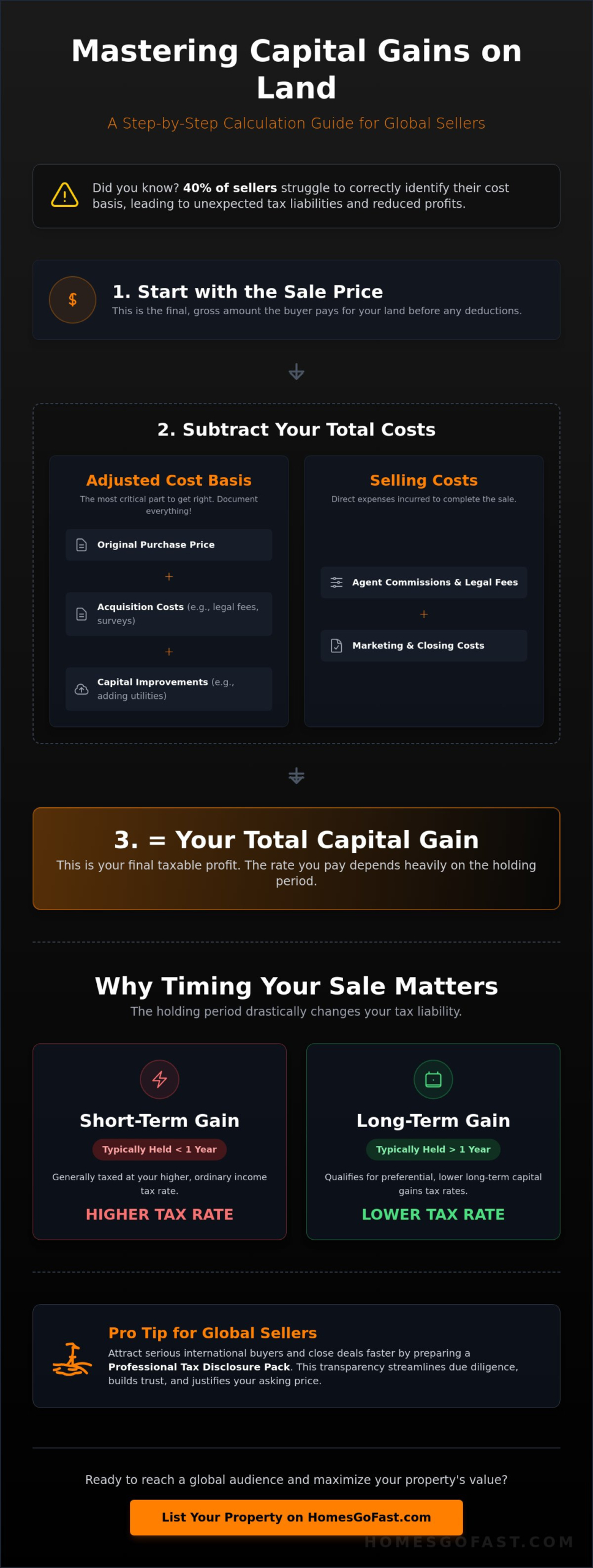
Calculating your capital gain on sale of land is more than just subtracting your purchase price from your final sale price. You need to account for every dollar spent protecting or improving your investment to ensure you don’t overpay the tax authorities. The fundamental formula is straightforward: Sale Price – (Adjusted Cost Basis + Selling Costs) = Capital Gain.
Buyers are increasingly looking for clear documentation of land value to ensure they’re making a secure investment. You should maintain a digital folder of every receipt and contract related to the property from the day you bought it. This level of detail helps you justify your asking price and provides a broader view of your investment’s journey. For a deeper dive into international regulations, see the Capital Gains Tax on Sale of Property: The 2026 Global Seller’s Guide.
Determining Your Adjusted Cost Basis
Your cost basis isn’t static. It grows as you invest in the physical state of the land. Investors are attracted by parcels that have already undergone significant prep work because it reduces their future development risk. You can add the following land-specific expenditures to your initial purchase price to increase your basis:
- Professional land clearing, grading, and leveling.
- Construction of access roads, culverts, or permanent fencing.
- Legal fees, title insurance, and survey costs paid at the time of purchase.
- Costs for installing utility lines or improving soil drainage.
Consider a practical example. If you bought a 10-acre plot for $100,000 and spent $12,000 on a professional survey and legal fees, plus another $28,000 to clear the brush and add a gravel road, your adjusted basis is $140,000. When you sell that land for $200,000, you’re only taxed on a $60,000 gain, not the full $100,000 difference. To understand how these assets are treated under federal guidelines, you should consult IRS Publication 544.
Deductible Selling Expenses
Transaction costs can eat into your profits, especially in the overseas real estate market where fees vary wildly by region. Fortunately, these costs are fully deductible from your taxable gain. You must track these expenses as they occur to ensure you maximize your return on investment. Common deductible expenses include:
- Real estate agent commissions and broker fees.
- Global marketing and digital advertising expenditures.
- Legal conveyancing and notary fees required to transfer the title.
- Staging costs or temporary signage for the property.
Overseas real estate sales often involve higher transaction costs, such as specialized legal counsel for foreign ownership rules, that you must track meticulously. Be sure to keep records of your owner pricing strategy and any advertising invoices. If you want to reach a massive audience of motivated buyers, you can advertise your property on a global platform to secure the best possible market price.
Short-Term vs. Long-Term Capital Gains: Why Timing Your Sale Matters
Timing is the most powerful tool in your investment kit. The duration you hold an asset determines whether the tax office treats your profit as ordinary income or a privileged investment gain. In most global jurisdictions, the magic threshold is 12 months. Sell a day before the one-year anniversary, and you could lose nearly half your profit to high income tax rates. Wait until day 366, and you unlock preferential brackets that significantly boost your net ROI.
Investors are attracted by the lower rates associated with long-term holdings. While short-term gains are typically taxed at your marginal income tax rate, long-term gains often benefit from capped percentages. For instance, according to the 2024 Capital Gains Tax Rates, US investors can see rates as low as 0% or 15% for long-term assets, compared to short-term rates that climb toward 37%.
The “holding period” start date is vital for calculating your capital gain on sale of land. If you purchased the land, your clock starts the day after the closing. However, inherited land often receives a “step-up in basis” to the fair market value on the date of the previous owner’s death. In many regions, inherited property is automatically treated as a long-term holding regardless of how long you personally owned it.
| Holding Period | Tax Treatment | Tax on $100k Gain (Est.) | Net Profit |
|---|---|---|---|
| Short-Term (<12 Months) | Ordinary Income (e.g., 37%) | $37,000 | $63,000 |
| Long-Term (>12 Months) | Preferential Rate (e.g., 20%) | $20,000 | $80,000 |
The Impact of International Tax Residency
Your residency status dictates how much cash you walk away with. Non-resident sellers often face immediate withholding taxes, such as FIRPTA in the United States, which can claim 15% of the total gross sales price upfront. If you are looking at French homes for sale or plots in Spain, Double Taxation Treaties are your best friend. These agreements prevent you from paying full tax in two different countries on the same capital gain on sale of land. Always remember the “Situs” rule: tax is usually paid to the country where the land is physically located before your home country gets a slice.
Tax Brackets and Income Levels
Legal Strategies to Minimize Your Tax Liability on Land Sales
Smart investors don’t just accept a massive tax bill as an inevitability. They use specific legal mechanisms to protect their profits. In the US, the 1031 Exchange is the gold standard; it allows you to defer taxes by reinvesting proceeds into “like-kind” property. The UK offers a similar tool known as Rollover Relief for business assets. These strategies ensure your capital keeps working for you instead of being depleted by the tax office. You have a limited window, often 180 days in the US, to complete these transactions, so speed is essential.
You can also lower your capital gain on sale of land by utilizing tax-loss harvesting. This involves selling underperforming stocks or other assets at a loss to cancel out the gains from your land sale. If you’re feeling philanthropic, donating land to a registered charity can provide a deduction for the full market value. This often eliminates the capital gains tax entirely while supporting a cause you care about. To dive deeper into these methods, check out this How to Avoid Capital Gains Tax on Real Estate: A 2026 Strategy Guide.
Installment Sales and Deferred Payments
Receiving your sale price over several years can effectively spread your tax burden across multiple fiscal periods. This strategy is popular for high-value development land where the buyer might not have all the cash upfront. By receiving payments in installments, you may stay in a lower tax bracket. You must be careful; there are interest implications and the risk of the buyer defaulting before the final payment. Always vet your buyer’s financial standing before agreeing to these terms to secure your investment.
Inheritance and the “Step-Up” in Basis
When you inherit land, the “basis” or original value usually resets to the market value at the time of the owner’s death. This “step-up” is a powerful tool for families. If you sell the property shortly after inheriting it, your capital gain on sale of land could be near zero because the sale price matches the new basis. This avoids decades of accumulated appreciation tax.
Heirs preparing to sell Italian homes for sale or rural plots should follow this checklist:
- Obtain a professional appraisal immediately after the passing to document the new basis.
- Clear any outstanding local property liens or historical taxes.
- Verify the title is correctly transferred to your name according to local succession laws.
- Consult a tax professional to confirm the specific “step-up” rules in the country where the land is located.
Investors are attracted by these resets because they allow for a clean exit or a fresh start for a portfolio. If you are looking to move your capital into a new market, browse our international property listings to find your next high-yield opportunity.
Preparing Your Land for a Global Market: Tax Transparency as a Selling Point
Selling land across borders in 2026 requires more than just a plot map and a few photos. Modern buyers are sophisticated and risk-averse. They want to know exactly how much of their profit will remain after the taxman takes his share. When you provide clear, upfront tax data in your property marketing, you instantly separate yourself from amateur sellers and attract a higher caliber of investor.
You should prepare a “Tax Disclosure Pack” before you even list the property. This pack should include your original purchase price, a record of any capital improvements, and current local tax rates. Having these documents ready speeds up the due diligence process by several weeks. It also demonstrates that you’re a professional seller who understands the complexities of a capital gain on sale of land.
Transparency builds the trust necessary to close deals fast. If you’re ready to reach a motivated audience, you can sell overseas property through platforms that specialize in connecting with tax-savvy global investors. This proactive approach reduces the friction often found in cross-border transactions and helps you secure a commitment much sooner.
Marketing Land to Foreign Investors
Investors are attracted by clear ROI projections that factor in local taxes and maintenance costs. They aren’t just buying dirt; they’re buying a financial future. Highlighting the proximity to major infrastructure, such as a 20-minute drive to a regional airport or a new high-speed rail link, adds tangible value to your listing that justifies a higher price point.
Don’t let language barriers or complex local laws stall your sale. You can use the HomesGoFast glossary to explain specific tax terms to foreign buyers. This helps them feel confident and informed. When a buyer understands the fiscal landscape, they’re much more likely to move from “interested” to “under contract.”
The Role of Professional Appraisals
A formal appraisal is vital for establishing the “Fair Market Value” required by tax authorities. In many jurisdictions, an official valuation from a certified professional is the only way to justify your cost basis and minimize the capital gain on sale of land. It provides both a legal shield and a powerful marketing tool during negotiations.
A high-quality appraisal justifies a premium asking price on global portals. It proves to the buyer that the price isn’t arbitrary. When you combine transparency with global exposure, you increase the speed of your sale significantly. Take a moment to browse current international real estate listings to see how the world’s most successful land sellers are positioning their assets for the coming year.
Secure Your Investment Returns in 2026
Maximizing your returns requires more than just a high sale price. You’ve seen how timing your exit to qualify for long-term rates can significantly lower your tax bill. Investors are increasingly looking for transparent documentation and clear tax histories before they commit to a purchase. By mastering the calculation of your capital gain on sale of land, you protect your profit margins and build trust with sophisticated international buyers.
The global market moves fast; don’t let complex cross-border rules slow you down. Since 2002, we’ve helped owners navigate these hurdles with specialist guides for transactions in over 50 countries. You can leverage our 20 years of international property marketing experience to ensure your land stands out to a massive audience of motivated investors. Our platform simplifies the process, ensuring your listing meets the high standards today’s buyers expect.
Ready to move? List your land on HomesGoFast to reach global buyers today and tap into a network designed for speed and results. Your next successful investment exit starts with the right exposure.
Frequently Asked Questions
Do I pay capital gains tax if I sell land for a loss?
You don’t pay capital gains tax if you sell land for less than your adjusted cost basis. Instead, you can use that loss to offset other capital gains you’ve realized during the same tax year. In the US, the IRS allows you to deduct up to $3,000 of net capital losses against your ordinary income annually, helping you manage your overall investment liability.
How long do I need to hold land to qualify for long-term capital gains?
You must hold the land for more than 365 days to qualify for preferential long-term capital gains tax rates. Selling the property in under a year results in short-term gains, which are taxed at your standard income tax rate, potentially as high as 37%. Holding for the long term typically reduces this rate to 15% or 20% for most high-income investors.
Can I avoid capital gains tax by selling my land to a family member?
Selling to a family member doesn’t eliminate your tax obligations and often triggers strict related-party transaction rules. Tax authorities like the IRS or HMRC require these sales to reflect the Fair Market Value of the property. If you sell at an artificial discount, the government may still calculate your capital gain on sale of land based on the actual market price at the time of transfer.
What happens if I sell land that was part of my primary residence?
You can often exclude up to $250,000 of gain, or $500,000 for married couples, if the land is part of your main home’s footprint. Under Section 121 rules, you must have owned and used the property as your primary residence for two of the last five years. Investors are attracted by this exemption, though it usually requires the land and house to be sold together in a single transaction.
Is capital gains tax on land different for foreign nationals?
Foreign nationals are subject to specific withholding rules, such as the 15% FIRPTA withholding in the United States. While the tax rates on the actual gain may be similar to residents, the administrative process is more complex due to tax treaties and residency certificates. Many buyers check international property listings to find markets where tax treaties minimize the risk of double taxation on their global assets.
Are there specific tax exemptions for agricultural or farm land?
Specific exemptions exist for agricultural land, such as the UK’s Agricultural Property Relief which can provide 100% relief from inheritance tax in certain conditions. In the US, some states offer lower property tax assessments for land that has been actively farmed for at least 5 years. Buyers are increasingly looking for these rural opportunities to secure long-term wealth while benefiting from lower carrying costs and specialized tax breaks.
Can I use a 1031 exchange for international land sales?
You cannot use a 1031 exchange to swap domestic land for international property because the IRS requires “like-kind” assets to be located within the United States. If you’re looking to diversify your portfolio abroad, you’ll need to pay the tax on your domestic sale first. Once you’ve secured your profit, you can explore high-yield property for sale in Spain or other European markets to continue your investment journey.
What records should I keep to prove my cost basis on land?
You must keep your original purchase contract, closing disclosure statements, and receipts for all physical improvements made to the lot. Documentation for legal fees, title insurance, and costs for clearing or surveying the land from your 2024 records will be vital. These records allow you to accurately calculate the capital gain on sale of land, ensuring you only pay tax on your actual profit rather than the gross sale price.