 by
by 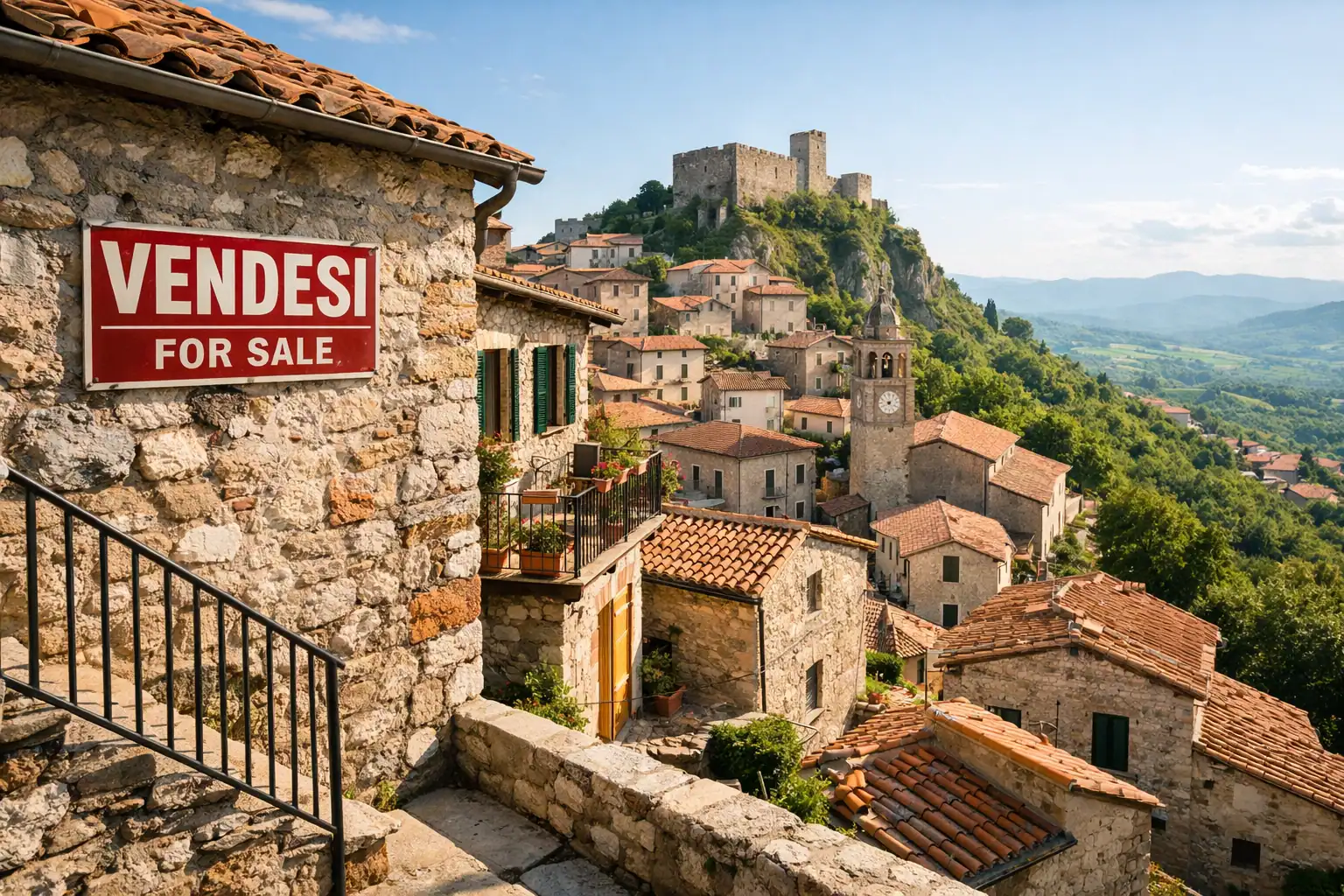
The narrative surrounding the Italian “1 Euro” property market has shifted from a viral curiosity into a structured municipal policy. In my experience operating within the international property sector, these schemes are often misunderstood as simple real estate transactions. They are, in reality, complex urban renewal contracts. As of March 2026, the data indicates a maturation of this market, moving away from experimental pilots toward a standardized framework used by approximately 70 participating towns across the peninsula.
To understand the current inventory of cheap houses for sale in italy, one must look past the headline price. The Italian government and local municipalities have refined their incentives to attract long-term residents rather than short-term speculators. This analysis breaks down the actual costs, the shifting policy landscape, and the financial incentives currently driving the 2026 market.
The Geography of Depopulation: Where the Data Points
The concentration of highly discounted properties remains highest in regions suffering from severe demographic decline. Sicily continues to be the primary hub for these initiatives, with towns like Mussomeli and Sambuca di Sicilia leading in terms of transaction volume. However, we are seeing a significant uptick in participating municipalities within Sardinia and Abruzzo.
Our data shows that approximately 70 towns are now actively participating in some form of symbolic pricing scheme. While the southern regions dominate, mountain communities in Piedmont and Liguria have also introduced similar measures to prevent the complete abandonment of Alpine villages. These locations are chosen not for their tourist appeal, but because their survival as functional administrative units is at stake.

When evaluating these regions, the proximity to infrastructure is the most critical variable for long-term value. A “cheap” house located three hours from an international airport or a major healthcare facility carries a different risk profile than one within an hour of a provincial capital like Agrigento or Pescara.
The Fallacy of the €1 Price Tag: Real-World Renovation Costs
The most frequent error I see from international buyers is the failure to distinguish between the acquisition cost and the total capital expenditure. In 2026, the term “1 Euro House” is almost entirely symbolic. Based on my analysis of completed projects, the actual renovation costs for these properties currently range from €20,000 to over €100,000.
Most of these properties have been vacant for decades. They often require complete structural overhauls, including new roofs, reinforced foundations, and entirely modern electrical and plumbing systems. The “cheap” entry point is effectively a trade: the municipality gives you the title in exchange for a guaranteed injection of capital into the local economy via construction.
For those looking at the broader market of cheap houses for sale in italy outside of the €1 schemes, there is a secondary tier of properties. These “ready-to-move-in” or “cosmetic-fixer” homes in regions like Calabria or Molise typically list between €25,000 and €60,000. For many investors, this tier represents a more efficient use of capital because it bypasses the strict municipal oversight attached to the symbolic pricing schemes.
Policy and Compliance: The Municipal Contract
Acquiring a property through a municipal scheme involves entering into a binding legal contract with the local council. These contracts are designed to ensure that the buyer follows through on the renovation promise. The following requirements are standard across most participating towns in 2026:
- Surety Deposits: Buyers are generally required to pay a deposit ranging from €3,000 to €10,000. This is held by the municipality as a guarantee. If the renovation is not completed within the agreed timeframe, this deposit is forfeited.
- Strict Timelines: Policy dictates that a renovation plan must be submitted for approval within 6 to 12 months of purchase. The actual works must typically be completed within a three-year window.
- Local Labor Preference: While not always a legal requirement, many councils provide preferential administrative treatment to buyers who employ local contractors and architects.
Failure to meet these deadlines can result in the property reverting to the municipality. This is not a standard real estate purchase; it is a performance-based asset transfer.

Navigating the 2026 Tax Incentives
The fiscal landscape for Italian property underwent significant changes leading into 2026. The aggressive “Superbonus” era has been replaced by more sustainable, targeted incentives. These are crucial for anyone calculating their return on investment or total project cost.
Currently, the Italian tax code offers a 50% deduction for renovation expenses on primary residences. For those purchasing a secondary home or a holiday property, the deduction is set at 36%. Both incentives are capped at a maximum spend of €96,000 per property.
These deductions are typically spread over a ten-year period as credits against your Italian income tax. For non-residents without an Italian income, these credits can be difficult to realize unless the buyer utilizes a “credit transfer” mechanism with a bank, although these facilities have become more restrictive and costly to arrange in recent years.
Residency, Tax, and Bilateral Agreements
The decision to become a resident in Italy significantly impacts the financial viability of a renovation project. Beyond the higher tax deduction for primary residences, residents also benefit from lower purchase taxes (imposta di registro) at 2%, compared to 9% for non-residents.
For non-EU buyers, particularly from the UK and the US, residency is governed by bilateral agreements and visa requirements. The “Elective Residency Visa” remains the standard route for those not intending to work in Italy, but it requires proof of significant passive income.

I advise buyers to scrutinize how their home country’s tax treaty with Italy handles property assets. While Italy has moved to simplify the process for foreign investors, the intersection of local municipal rules and national immigration policy remains a bottleneck that requires professional navigation. You can find more specific data on regional market trends via our news archives.
Community Renewal vs. Speculative Flipping
The most important takeaway for any serious investor is that the Italian government has intentionally designed these schemes to discourage speculative flipping. Between the renovation timelines, the residency incentives, and the high transaction costs for short-term holds, the “quick profit” model does not apply here.
The real value in cheap houses for sale in italy lies in the long-term stabilization of these communities. Success stories in towns like Sambuca suggest that when a critical mass of international buyers renovates correctly, the local economy pivots toward services, tourism, and remote work infrastructure.
If your objective is to find a high-yield, low-effort investment, these properties are likely to disappoint. However, if the goal is to acquire a historic asset at a low base cost and you have the stomach for a complex three-year project, the current policy environment is as stable as it has been in a decade.
Conclusion: A Calculated Entry Point
The data from early 2026 shows that the market for cheap Italian property is bifurcating. On one side, we have the €1 municipal schemes which are essentially “sweat equity” projects for those willing to manage a restoration. On the other, we have a robust market of sub-€50,000 homes that offer a more traditional, less regulated path to ownership.
The incentives: both the symbolic price and the 2026 tax breaks: are designed to offset the inherent risks of rural restoration. For the intelligent buyer, the primary task is not finding the cheapest house, but finding the municipality with the most efficient bureaucracy and the best access to reliable local labor. The era of the “free” house is over; the era of the strategic rural restoration is in full swing.