

Your property listing is visible to the entire world, yet you’re still waiting for a single serious inquiry to hit your inbox. It’s frustrating to watch your marketing budget vanish into a void of low-quality leads and silent portals. Investors are attracted by clear growth prospects, but they’ll never find your listing if it’s buried under poor technical execution. This guide identifies the common mistakes when marketing property internationally so you can stop wasting resources and start capturing the attention of high-value buyers through HomesGoFast.com.
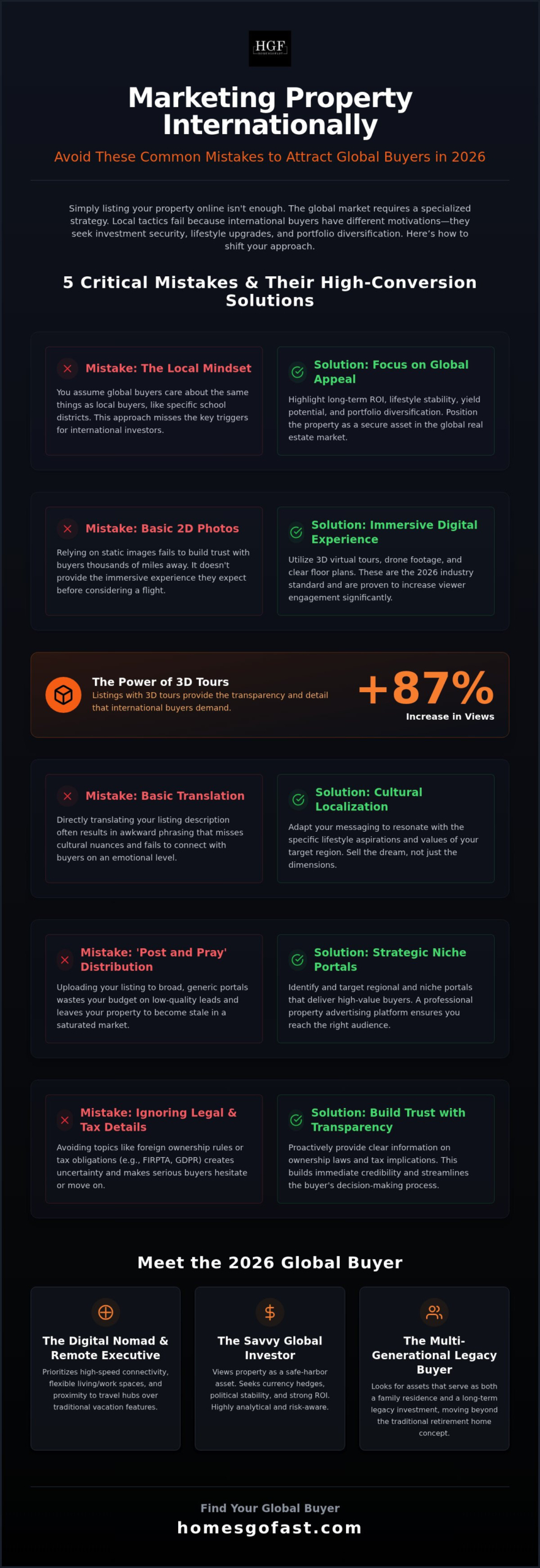
Buyers are increasingly looking for transparency and immersive digital experiences before they even consider a cross-border flight. In 2026, relying on static images or basic translations is a recipe for failure. We’ll show you how to position your assets effectively, from utilizing 3D tours that increase views by 87 percent to navigating the latest FIRPTA and GDPR updates. You’ll gain a clear strategy to boost visibility within a global marketplace and learn exactly how to price your home for an audience that values both lifestyle and investment logic.
Key Takeaways
- Stop treating global sales like local ones; international marketing requires a specialized approach to attract serious cross-border investors.
- Avoid common mistakes when marketing property internationally by replacing outdated 2D photos with high-impact 3D tours and accurate metric measurements.
- Move beyond basic translation to cultural localization, ensuring your property’s lifestyle appeal resonates with the specific values of your target region.
- Identify which niche and regional portals deliver high-quality leads rather than wasting your budget on broad, low-conversion platforms.
- Build immediate credibility by being transparent about foreign ownership rules and tax obligations like FIRPTA to streamline the buyer’s decision-making process.
The Mindset Gap: Why Local Marketing Fails on a Global Stage
International Property Marketing is the strategic positioning of real estate across borders to meet specific foreign demand. It is a specialized discipline that requires far more than just a translated description and a few high-resolution photos. One of the most common mistakes when marketing property internationally is falling into the domestic bias trap. You might assume that the selling points that work in your local town will resonate in Dubai or London. They often don’t. While a local buyer might care about the proximity to a specific school, an international investor is likely looking at the broader global real estate market for security, yield, and portfolio diversification.
Buyers are increasingly looking for lifestyle stability and long-term ROI over just a simple holiday home. They want to know how the asset fits into their global footprint. If you market your property using a local mindset, you’ll likely miss the specific triggers that motivate cross-border capital. Marketing across borders means competing on a world stage. You aren’t just competing with the house down the street; you’re competing with villas in Spain, condos in Thailand, and apartments in Portugal. This global competition is why understanding the mindset gap is crucial. It’s the difference between a listing that sits and a property that sells.
Understanding the 2026 Global Buyer Persona
The profile of the overseas buyer has shifted dramatically. Digital nomads and remote executives now prioritize high-speed connectivity and flexible living spaces over traditional vacation features. Investors are attracted by currency hedges and political stability in 2026, viewing property as a safe harbor for their wealth. We’re seeing a move away from the traditional retirement home concept toward multi-generational assets that serve as both a residence and a legacy investment. These buyers are more risk-aware than ever. They perform deep independent research before making contact. If your strategy doesn’t provide the analytical data they crave, they’ll simply move on to the next listing.
The Cost of ‘Post and Pray’ Strategies
Simply uploading a listing to a portal and waiting for the phone to ring is a losing game. In a saturated market, you must identify specific target corridors to avoid the common mistakes when marketing property internationally. For example, knowing that UK buyers are actively searching for French homes for sale allows you to tailor your messaging to their specific lifestyle aspirations. Failed marketing leads to stale listings. Once a property has been online too long without movement, it loses perceived value. Savvy buyers will wonder why the property hasn’t moved and assume there’s a hidden defect or an unrealistic price point. Using a professional property advertising platform ensures your home stays visible to the right audience before it loses its market momentum.
Visual and Technical Pitfalls: Beyond the Standard Listing
In the world of cross-border real estate, your digital presentation is your only handshake. One of the most common mistakes when marketing property internationally is treating a global listing like a local one. While 2D photos might suffice for a neighbor down the street, they fail to build the necessary trust with a buyer thousands of miles away. 2026 buyers expect a comprehensive digital experience. If your listing lacks high-resolution visuals or interactive elements, you’re likely losing high-value leads before they even read your description.
Digital staging is no longer a luxury. It’s a tool to show potential. Buyers are increasingly looking for a vision of their future lifestyle. Without a clear floor plan, most international leads will bounce immediately. They need to understand the flow of the space without being there physically. This is one of the common mistakes for overseas buyers and sellers alike; neglecting the structural layout leads to confusion and filtered-out searches. Transparency in the layout helps bridge the distance gap.
The 2026 Standard for Property Photography
Drone footage and 360-degree virtual tours are now the industry baseline. You must show the property in context. This means highlighting proximity to airports, expat hubs, and local amenities. AI tools can now help refine lighting or remove clutter, ensuring your property looks its best for a global audience. These technologies reduce the “risk perception” that often plagues international transactions. It’s about providing a sense of place that goes beyond the four walls. High-quality visuals serve as a universal language that bypasses cultural barriers.
Data Accuracy and Currency Transparency
Technical data is where many sellers stumble. Always list prices in major global currencies like USD, EUR, and GBP alongside your local price. This eliminates friction. Be precise with land sizes; a buyer in the US thinks in acres, while a European buyer thinks in hectares. Incorrect GPS tagging is another silent killer. If your property doesn’t appear correctly on international maps, it effectively doesn’t exist. Investors are attracted by transparency and ease of access to data. If you’re ready to reach a wider audience, you can sell overseas property more effectively by verifying every technical detail before going live.
Localization vs. Translation: The Cultural Nuance Trap
One of the biggest common mistakes when marketing property internationally is relying on automated translation tools. Google Translate might get the dictionary definitions right, but it often misses the emotional pulse of a high-value real estate sale. You aren’t just selling a structure; you’re selling a future. If your property description reads like a robotic manual, you’ll lose the trust of sophisticated investors before they even look at the price. Localization is about more than words. It’s about adapting the “dream” to fit the cultural values of your target audience.
Cultural nuances can make or break a deal. For example, a “secluded retreat” might appeal to a buyer seeking privacy, but to an investor from a culture that prioritizes community and security, it could sound isolated and risky. You need to understand these triggers. Using multilingual listings is a powerful way to build immediate credibility. When a buyer sees a property presented fluently in their own language, it signals that you respect their background and understand their specific needs. This level of detail is what separates a generic listing from a successful cross-border transaction.
Regional Triggers: What Different Buyers Value
Investors are attracted by different features depending on where they’re from. North American buyers often prioritize “accessibility,” looking for proximity to international airports, high-speed rail, and reputable expat schools. In contrast, European or Asian investors might place a higher value on historical significance, specific investment yields, or even the cardinal orientation of the building. To capture this traffic, you must use region-specific keywords. Terms like “overseas real estate” are essential for capturing organic search from buyers who are just beginning their global journey. Tailoring your description to these regional desires ensures you aren’t just seen, but understood.
The Role of Professional Multilingual Support
Managing inquiries from across the globe requires a streamlined approach. An Agent Pro Account is vital for managing multilingual feeds and ensuring your data remains consistent across different regions. You don’t want to lose a lead because you couldn’t handle the initial inquiry in a foreign language. Building credibility through localized landing pages on international real estate listings allows you to provide a seamless user experience. Buyers are increasingly looking for platforms that reduce friction. By providing clear, localized information from the start, you position yourself as a professional who is ready to do business on a global scale.
Strategic Distribution: Avoiding Inefficient Portal Selection
A frequent error among sellers is the “scattergun” approach. You might think that listing on fifty different websites guarantees a sale, but choosing quantity over quality is one of the most common mistakes when marketing property internationally. Not all portals are created equal. Some focus on local rentals, while others cater specifically to high-net-worth individuals looking for a second home or a high-yield investment. If your property is listed on a platform that doesn’t align with its value, it loses its aspirational appeal and becomes just another piece of digital noise.
Investors are attracted by platforms that provide verified data and historical trends. They want to see more than just a price tag; they want context. This is where the niche versus mass debate becomes critical. While global giants offer massive traffic, regional specialists often provide higher-quality leads that are further along in the buying journey. Using a platform that lacks automated XML synchronization is another technical trap. Without it, your listing data can become outdated, leading to frustrated buyers and missed opportunities. Ensuring your data flows seamlessly across a network of international real estate listings is essential for maintaining accuracy and trust.
Evaluating a Property Advertising Platform
When you choose where to advertise properties, you must look at SEO authority and audience reach. A platform’s tenure matters. For instance, HomesGoFast has been connecting sellers with global buyers since 2002. This established tenure provides a trust halo for your listing, signaling to foreign buyers that they are dealing with a reputable source. Featured placements are also a vital tool. They allow your home to cut through the global noise, ensuring it appears at the top of search results when interest spikes in specific target corridors.
Lead Management: The ‘Slow Response’ Killer
The speed of your response is often more important than the quality of the listing itself. International leads are notoriously time-sensitive. In the fast-paced 2026 market, responding within two hours is often the difference between a viewing and a dead lead. You must account for time zone differences. A buyer in Sydney or Tokyo won’t wait twelve hours for a seller in London to wake up. Using automated dashboards to track and nurture overseas interest allows you to stay organized. Buyers are increasingly looking for efficiency and professionalism. If you don’t provide a quick, data-driven response, they’ll simply move on to a competitor who can.
Building a High-Conversion Global Strategy for 2026
Success in the 2026 market isn’t just about being seen. It’s about being trusted. One of the most common mistakes when marketing property internationally is hiding the practical details until the final stages of a deal. High-value buyers are risk-averse and research-heavy. They’ll appreciate a seller who provides a clear roadmap of the transaction from day one. By integrating transparency into your marketing, you reduce the friction that typically kills cross-border sales.
The “Transparency Advantage” means disclosing ownership rules and potential costs upfront. For instance, providing insights into capital gains tax on sale of property helps an investor calculate their true ROI immediately. Buyers are increasingly looking for clarity on FIRPTA withholding in the US or wealth taxes in Europe. When you provide this data, you stop being a salesperson and start acting as a “Smart Advisor.” This shift in persona is essential for building the rapport needed to close a deal worth hundreds of thousands, or even millions, of dollars.
Before you launch your campaign, run through this final high-conversion checklist to avoid the common mistakes when marketing property internationally:
- Visuals: Ensure you have 360-degree tours and drone footage that highlights local lifestyle hubs.
- Localization: Verify that your listing isn’t just translated, but adapted to the cultural triggers of your target region.
- Distribution: Select portals based on lead quality and SEO authority rather than just total listing volume.
- Lead Response: Set up a system to ensure every international inquiry receives a data-rich response within two hours.
Leveraging the HomesGoFast Ecosystem
You don’t have to manage this complex process alone. When you choose to advertise properties through an established platform, you gain access to a pre-qualified global audience. There is a powerful synergy between private listings and professional agent networks that helps your property gain maximum traction. You can also utilize our global market trends glossary to educate your buyers, positioning your listing as a safe and well-researched investment opportunity.
Next Steps for Serious Sellers
Embrace a “Value over Visibility” philosophy. It’s better to have ten high-quality leads from a specific target corridor than a thousand clicks that never convert. We recommend a tiered approach. Start by building a rock-solid base listing with professional visuals and localized text. Once that foundation is set, you can upgrade your reach to cut through the noise in competitive markets. If you’re ready to move forward, list your property globally today to reach active buyers in over 50 countries.
Secure Your Global Sale with Precision and Strategy
Marketing across borders in 2026 requires more than just high visibility. It demands a shift from a local mindset to a global one. By prioritizing cultural localization and technical accuracy, you eliminate the friction that often stops international buyers from taking the next step. Avoiding the common mistakes when marketing property internationally ensures your listing attracts serious investors who value transparency and professional presentation.
With over 20 years of international marketing expertise, HomesGoFast connects you with active buyers in 50+ countries. We are trusted by professional agents and developers worldwide to deliver high-quality leads that actually convert. Don’t let your property get lost in the noise. It’s time to position your asset as a premier global investment that resonates with the right audience.
Advertise your property to a global audience today and start your journey toward a successful cross-border transaction. The international market is full of opportunity for those who present their assets with clarity and confidence. Your ideal buyer is out there; it’s time to help them find you.
Frequently Asked Questions
What is the biggest mistake people make when selling property to foreigners?
The biggest mistake is applying a domestic mindset to a global sale, often ignoring the specific lifestyle and investment triggers of foreign buyers. You can’t assume that local selling points like proximity to a specific school will outweigh global concerns like residency rules or currency stability. This failure to adapt is one of the most common mistakes when marketing property internationally, as it ignores the risk-aware nature of cross-border investors.
How do I attract international real estate buyers in 2026?
You attract 2026 buyers by offering high-transparency listings that include 3D virtual tours and detailed data on potential ROI. Buyers are increasingly looking for immersive digital experiences that allow them to vet a property thoroughly before booking a flight. Investors are attracted by assets that provide clear financial projections and legal clarity alongside aspirational lifestyle imagery that highlights the “dream” of ownership.
Do I need to translate my property listing into multiple languages?
Professional localization is far more effective than simple word-for-word translation, which often feels robotic and untrustworthy. While you don’t need to translate your listing into every language, providing fluent descriptions in the primary languages of your target corridors builds immediate credibility. High-value buyers expect a seamless experience, and localized content proves that you understand their specific cultural values and investment priorities.
Which property portals are best for reaching overseas buyers?
The best portals are those that combine high SEO authority with a pre-qualified audience, such as HomesGoFast.com or specialized regional sites. Avoid the trap of choosing quantity over quality; focus on platforms that offer automated XML synchronization to keep your listing data accurate across different time zones. Choosing niche portals often yields higher-quality leads that are further along in their buying journey than those on mass-market sites.
Why are my international property leads not converting into sales?
Poor conversion usually stems from slow response times or a lack of transparency regarding ownership rules and local taxes. International leads often go cold within two hours, so you must have a rapid follow-up system that accounts for global time zone differences. If you aren’t providing immediate, data-rich answers to their technical questions, buyers will simply move on to a seller who acts as a smart advisor.
Is it worth paying for a premium listing on a global property website?
Premium listings are worth the investment because they provide the “Featured” status needed to cut through global noise and stay at the top of search results. Higher visibility on a trusted property advertising platform ensures your home is seen by buyers in specific target regions when demand spikes. This small upfront cost often leads to a faster sale by capturing the attention of high-intent investors early.
How does currency fluctuation affect international property marketing?
Currency shifts directly impact the perceived value and “deal” status of your property for foreign investors. If your local currency weakens against major global currencies like the USD or EUR, your property effectively becomes a “discounted” asset for those buyers. You should highlight this increased purchasing power in your marketing to create a sense of urgency and attract buyers looking for a sound financial hedge.
What digital tools are essential for marketing property abroad in 2026?
Essential tools for 2026 include 3D virtual tour software, AI-driven digital staging, and automated lead management dashboards. These technologies help you avoid common mistakes when marketing property internationally by bridging the physical and cultural distance between you and the buyer. Using these tools demonstrates professionalism and provides the technical precision that modern international buyers demand before they commit to a cross-border transaction.