

What if the most critical document in your international acquisition isn’t the property deed itself, but the professional indemnity insurance of your legal counsel? The overseas property buying process is an intricate dance between lifestyle aspirations and complex jurisdictional frameworks. Whether you are exploring overseas real estate for a sun-drenched retirement or a high-yield portfolio addition, the rules of the game change the moment you cross a border.
You likely feel the tension between the excitement of a new culture and the grounded fear of hidden tax liabilities or language barriers in legal contracts. We agree that navigating foreign land registries should not feel like a gamble. Our promise is to help you master the complexities of international law and learn how to secure your global investment with the right independent counsel.
This guide provides a clear framework for selecting a lawyer who acts as your advocate rather than a neutral party. You will gain a deep understanding of 2026 legal costs, timelines, and the essential due diligence required to ensure your property title is clean. We move beyond generic advice to provide the practical logic you need to buy with total confidence.
Key Takeaways
- Understand how international real estate law differs from your home country and identify the specific 2026 regulations that impact your purchase.
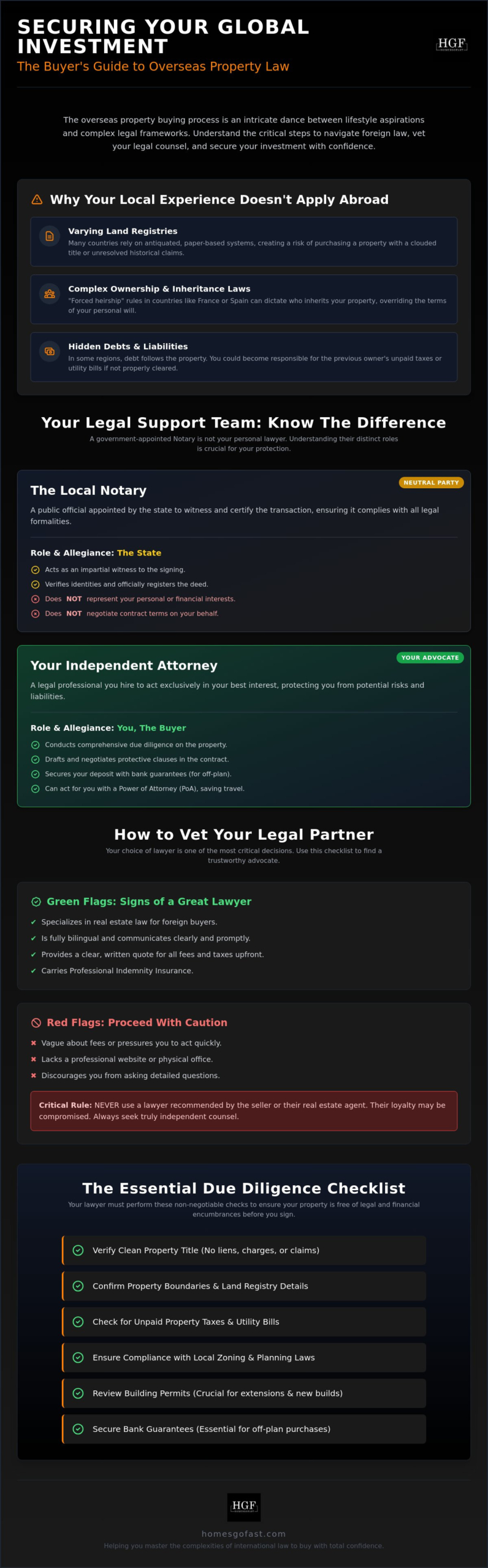
- Learn why a Notary Public is a neutral party and why you must hire an independent attorney to act as your personal advocate.
- Secure your overseas property buying process by following our vetting criteria, including a strict rule against using lawyers recommended by the seller.
- Master the essential due diligence checklist to verify clean property titles and ensure your home complies with local zoning and urban planning laws.
- Gain the confidence to move from your initial property search to a successful settlement with a clear framework for legal security.
Navigating the Legal Landscape of International Property Acquisitions
The overseas property buying process is a journey through vastly different legal systems that rarely align with your local experience. In 2026, buyers are increasingly looking for transparency as cross-border transactions reach new heights. While investors are attracted by high yields in emerging markets, they only maintain their positions when they feel legally secure. You must recognize that international real estate law is not a simple extension of domestic conveyancing; it is a unique field where local customs often override standard expectations.
One of the most significant hurdles you’ll face is the variation in land registry systems. Some countries maintain digital, highly accessible records, while others rely on antiquated, paper-based archives that are difficult to verify. Without a professional to navigate these registries, you risk purchasing a property with a clouded title or unresolved historical claims. This lack of familiarity with local bureaucracy is where most unrepresented buyers encounter their first major setback.
To better understand this concept, watch this helpful video:
Why Domestic Experience Does Not Translate Abroad
Your previous success in purchasing a home does not guarantee a smooth transition into foreign markets. The fundamental legal principles of real property vary wildly between jurisdictions. For instance, the “fee simple” ownership common in the U.S. and UK might be replaced by complex leasehold structures in parts of Asia or the Middle East. You may also encounter “forced heirship” laws in civil law countries like France or Spain, which can dictate who inherits your property regardless of what your will says.
Standardized contracts that protect buyers in your home country are often non-existent elsewhere. You might find yourself presented with a one-page document that lacks essential protections. When you browse overseas property for sale, remember that the listing is just the beginning. The legal framework supporting that listing determines whether your investment is a legacy or a liability.
The Consequences of Foregoing Professional Legal Advice
The risks of skipping independent legal counsel are tangible and often expensive. It’s common for buyers to discover, far too late, that their new villa was built with illegal extensions or sits on protected agricultural land. In some regions, debt follows the property rather than the person. If the previous owner didn’t pay their taxes or utility bills, those liabilities could become your responsibility the moment you sign the deed.
Buying off-plan carries even higher stakes. Without a lawyer to secure a bank guarantee, your deposit could vanish if the developer goes bankrupt before completion. In an international context, conveyancing is the process of transferring legal title while proactively identifying and neutralizing financial or regulatory risks before they can impact your portfolio.
Local Notary vs. Independent Attorney: Understanding Your Legal Support Team
You might assume that a government-appointed official is enough to protect your interests during a foreign transaction. In reality, the overseas property buying process often involves a Notary whose primary allegiance is to the state, not the individual buyer. Investors are attracted by the transparency of civil law systems, but they still require a personal advocate to negotiate specific contract protections that a neutral party simply won’t provide.
Buyers are increasingly looking for bilingual legal partners who can bridge the gap between their home country’s expectations and local realities. This is especially true when managing a Power of Attorney (PoA), which allows your representative to finalize the deed without you needing to board a plane for the closing. Having a dedicated lawyer ensures that your signature on a PoA is backed by a professional who understands your specific investment goals.
The Role of the Civil Law Notary
In countries like Spain, the Notary verifies identities and witnesses signatures but does not perform the investigative work you might expect from a domestic solicitor. They ensure the transaction follows the letter of the law, but they won’t tell you if the local infrastructure plans will block your view. This contrasts with common law systems where a single legal representative handles both the state’s requirements and your personal due diligence.
When to Hire an Independent International Lawyer
A dedicated attorney provides the essential “second set of eyes” necessary for high-value transactions or purchases involving complex corporate structures. They are your primary defense when navigating cross-border financing or heritage laws that the Notary is not required to explain to you in detail. To see the variety of legal environments you might encounter, it’s helpful to browse international property listings and compare the ownership requirements in different regions before you commit to a specific territory.
How to Vet Your Legal Partner: Essential Criteria and Red Flags
Choosing the wrong legal partner can derail your entire overseas property buying process before it even begins. You must follow one non-negotiable rule: never use a lawyer recommended by the seller, the real estate agent, or the developer. While it might seem convenient or cost-effective, their primary allegiance often lies with the party providing them with repeat business. You need an independent advocate whose only priority is protecting your capital and ensuring your future home is legally sound.
Investors are attracted by the promise of high yields and lifestyle freedom, but they stay for the peace of mind that comes with a clean, undisputed property title. To achieve this, you must verify that your chosen lawyer holds valid professional indemnity insurance within the target country. This insurance provides a critical safety net if a legal error occurs during the transaction. Additionally, always verify their credentials through the local bar association to ensure they are registered and in good standing. For example, in Spain, you should check the national registry of lawyers to confirm their license is active.
Questions to Ask Before Retaining Counsel
Before you sign a retainer agreement, conduct a brief interview to gauge their expertise. A lawyer who is technically proficient but lacks experience with foreign buyers may struggle with the specific nuances of your situation. Ask the following questions to ensure they are the right fit for your needs:
- How many transactions have you handled for foreign nationals this year? You want a partner who is current on the latest residency requirements and foreign ownership restrictions for 2026.
- What are your total fees, and do they include taxes like VAT or IVA? Hidden costs can quickly inflate your budget. Ensure you have a written estimate that covers all local taxes and administrative charges.
- Who will be my primary point of contact? Confirm that the person handling your file speaks your language fluently to avoid critical misunderstandings during the contract review.
Red Flags That Should Stop a Transaction
Your intuition is a powerful tool in the overseas property buying process. If a legal professional exhibits any of the following behaviors, it is time to walk away and find new representation immediately. Professionalism should be evident from your first interaction.
- High-pressure tactics: Any lawyer who pressures you to sign a contract immediately or pay a deposit in cash is likely hiding a conflict of interest.
- Discouraging independent surveys: A reputable lawyer will always encourage you to perform structural or environmental surveys to verify the property’s condition.
- Vague financial requests: Never send funds to a personal bank account. All payments should go through an official firm account or a secure escrow service.
Taking these steps ensures you aren’t just buying a house, but securing a legitimate asset. Once you’ve vetted your counsel, you can confidently browse international property listings knowing your legal foundation is solid and your interests are protected.
The 2026 Legal Due Diligence Checklist for Cross-Border Buyers
Moving from a verbal agreement to a binding contract is the most sensitive phase of the overseas property buying process. While investors are attracted by the high yields found in emerging markets, those returns are only guaranteed if the underlying asset is free of legal encumbrances. In 2026, due diligence has evolved to include both traditional title verification and modern digital safeguards against sophisticated fraud.
Your lawyer must prioritize a comprehensive title search to verify that the seller holds absolute ownership and that no historical liens or mortgages are attached to the property. Beyond the deed, they must investigate local zoning and urban planning records. This ensures your villa wasn’t built on protected agricultural land or in a coastal zone where future development is restricted. To help you weigh your options, consider the following trade-offs when securing representation:
- Pros of Independent Counsel: Full fiduciary duty to you; unbiased title investigation; proactive identification of illegal extensions or debts.
- Cons of Independent Counsel: Higher upfront search costs; potentially slower closing speed as they prioritize safety over developer timelines.
- Pros of Seller-Recommended: Often cheaper or bundled with the purchase; faster paperwork processing.
- Cons of Seller-Recommended: Significant conflict of interest; may overlook zoning violations or existing debts to ensure the sale completes.
2026 Cost Breakdown: Legal and Administrative Fees
Buyers are increasingly looking for transparency in fee structures to avoid the “hidden tax” of international acquisitions. While every jurisdiction varies, the following table provides a realistic range of what you should budget for the legal phase of your purchase.
| Service Category | Typical Cost Range | What it Covers |
|---|---|---|
| Independent Legal Fee | 1% – 1.5% of Price | Contract review, PoA management, and advocacy. |
| Title & Zoning Search | $500 – $1,500 | Land registry verification and urban planning checks. |
| Stamp Duty / Transfer Tax | 2% – 10% (Varies) | Government taxes required to register the new deed. |
Modern Risks: AI Scams and Residency Rules
Technology has introduced new risks into overseas real estate transactions, including deepfake property listings that simulate non-existent luxury interiors. Your lawyer must verify the property’s physical existence through independent local surveyors rather than relying on digital brochures. Furthermore, if you are purchasing to secure a Golden Visa or residency, your lawyer must confirm the property meets the specific 2026 eligibility criteria, as these rules are frequently updated in countries like Spain and Portugal. Ensuring these details are handled before the settlement allows you to move forward with the confidence that your investment is fully protected.
Securing Your Investment: From Search to Settlement with Confidence
The final stage of the overseas property buying process is where your meticulous planning transforms into tangible ownership. You’ve moved past the initial excitement of the search, vetted your independent counsel, and cleared the hurdles of due diligence. Now, the focus shifts to the precise execution of the settlement. A truly successful purchase isn’t just about the aesthetics of the villa or the potential ROI; it’s about the peace of mind that comes from knowing you sleep well at night because your asset is legally ironclad.
Buyers are increasingly looking for properties that offer both cultural richness and legal stability. By following a structured approach, you’ve ensured that your global investment is a source of freedom rather than a legal burden. The transition from a prospect to a homeowner requires attention to detail, but with a seasoned legal expert by your side, the path to the keys is clear and efficient.
The Final Closing and Post-Purchase Tasks
Once the signatures are dry, several critical administrative tasks remain to finalize your status as a homeowner. Your lawyer must immediately register the deed at the local land registry to secure your ownership against any third-party claims. In many jurisdictions, this step is what legally transfers the title, regardless of when the money changed hands. The overseas property buying process doesn’t end at the signing table; it ends when your name is officially recorded in the state archives.
You’ll also need to manage the practicalities of international ownership to ensure a smooth transition. Your lawyer plays a central role here, ensuring that all taxes from the sale are settled with the local treasury to avoid future penalties. You should also prepare for the following post-purchase steps:
- Establishing a local bank account to handle mortgage payments and property taxes.
- Transferring utility contracts, such as water and electricity, into your name to avoid service interruptions.
- Obtaining a local tax identification number if required by the jurisdiction for ongoing property management.
Your Global Property Journey Starts Here
Investors are attracted by the lifestyle freedom of a second home, but savvy buyers begin their journey with data. Before you even retain a lawyer, use HomesGoFast to research market trends, compare price ranges, and understand the local demand in your chosen region. This early research phase allows you to approach legal counsel with a clear understanding of the market’s reality and the specific ownership rules that apply to your target territory.
Buying abroad is an incredibly rewarding experience when you have the right team and a structured approach. If you’re still refining your strategy, refer to our glossary of global market trends for deeper insights into international finance and ownership structures. The complexities of 2026 are manageable when you prioritize legal security and professional guidance from the very first click.
Ready to find your next investment? Browse overseas property for sale and start your search today.
Secure Your Global Future with Expert Legal Strategy
Mastering the overseas property buying process is about more than just finding a beautiful location; it’s about building a secure financial legacy. You now have the tools to distinguish between a neutral notary and an independent advocate who works solely for you. By following the 2026 due diligence checklist, you can navigate shifting tax laws and avoid the digital pitfalls of the modern market with absolute confidence.
Investors are attracted by the freedom of international ownership, but they achieve lasting success by pairing market insights with rigorous legal protection. HomesGoFast has been connecting buyers and sellers since 2002, offering expert guides for over 50 global markets. Trusted by thousands of international property investors, our platform serves as the perfect starting point for your discovery phase while your legal counsel acts as the safeguard for execution.
Take the first step toward your next acquisition today. Explore International Real Estate Listings and Find Your Dream Home. Your journey into the global market is just beginning, and with the right team, the rewards are limitless.
Frequently Asked Questions
Do I really need a lawyer if the real estate agent says they handle the contracts?
Yes, you absolutely need independent counsel to protect your interests. Real estate agents often have a conflict of interest because they represent the seller or the developer. Your own lawyer performs deep due diligence that an agent might overlook, ensuring the contract terms don’t leave you vulnerable to future liabilities.
How much does a real estate lawyer typically cost for an overseas purchase?
Legal fees vary significantly by country, but you can generally expect to pay between 1% and 2% of the property purchase price. Some firms offer fixed fees for standard conveyancing services. Always ask for a comprehensive written estimate that includes local taxes, such as VAT or IVA, and any administrative filing fees.
Can I use a lawyer from my home country for a property purchase abroad?
It’s rarely effective to use a domestic lawyer unless they’re specifically licensed in the target jurisdiction. Property law is highly localized and requires access to regional land registries. You need a professional who understands the specific tax codes and zoning regulations of the country where you’re buying.
What is the difference between a Notary and a Solicitor in Europe?
A Notary is a neutral public official who witnesses the signing of the deed and ensures the state’s legal requirements are met. A Solicitor, or independent lawyer, acts as your personal advocate. They are the ones who perform the actual investigation into the property’s title and negotiate the contract terms for you.
How do I verify if a foreign real estate lawyer is legitimate?
You should verify their credentials through the national or regional Bar Association in the target country. Most jurisdictions provide an online database where you can check if a lawyer is currently licensed and in good standing. This step is a vital part of the overseas property buying process to avoid potential fraud.
What happens if I buy a property with hidden legal issues?
You may become responsible for unpaid taxes, utility debts, or even demolition orders if the property has illegal extensions. In some cases, historical inheritance claims could threaten your ownership. This is why thorough legal due diligence is the most important safeguard for any international property investor.
Is Power of Attorney safe to use for an international property closing?
Power of Attorney is a safe and common tool when managed by a reputable, licensed lawyer. It allows your legal representative to sign the final deeds and manage the settlement on your behalf. This is particularly useful if travel restrictions or personal schedules prevent you from attending the closing in person.
Do I need a separate lawyer for inheritance planning when buying abroad?
Often, it’s wise to consult a specialist to draft a local will for your foreign assets. Many countries have “forced heirship” rules that could conflict with your wishes back home. Addressing this during the overseas property buying process ensures your investment is protected for future generations without complex legal battles.