

Your property’s sale price isn’t the number on the contract; it’s the amount that actually lands in your home bank account after the markets have had their say. When you’re understanding currency exchange in property sales, you quickly realize that timing and strategy are just as vital as the bricks and mortar. It’s frustrating to watch your hard earned equity vanish because of a sudden market dip or a bank’s predatory exchange rate. Investors are attracted by the potential of global markets, but the savvy ones know that currency volatility is the silent partner in every cross-border deal.
This guide will show you exactly how to master foreign exchange to protect your capital and maximize your returns. We’ll empower you with a clear strategy to lock in favorable rates using forward contracts and explain why specialist brokers consistently beat high street banks. You’ll also discover the specific regulatory changes in 2026, such as updated UK due diligence thresholds and shifting European mortgage rates, that you need to know to repatriate your funds safely and without surprise losses.
Key Takeaways
- Mastering the nuances of understanding currency exchange in property sales helps you protect your equity from market shifts that can outweigh legal costs.
- Identify the hidden “spread” between bank rates and the true interbank rate to avoid losing thousands on your cross-border transaction.
- Use forward contracts to lock in current exchange rates for up to 12 months, providing complete budget certainty before your completion date.
- Prepare for the final hurdle of fund repatriation by navigating local exit taxes and the rigorous anti-money laundering checks expected in 2026.
- Position your property on global platforms to reach international buyers who are actively monitoring currency trends for the best time to invest.
The Critical Role of Currency Exchange in International Property Sales
In the 2026 real estate market, your property’s value isn’t a static number. It’s a moving target influenced by global financial shifts. Understanding currency exchange in property sales is no longer just for institutional investors; it’s a fundamental requirement for anyone looking to protect their equity when moving money across borders. If you don’t have a strategy for the “invisible price tag,” you’re leaving your profit to chance.
Think of exchange rates as a fluctuating filter through which every international buyer views your home. While you list your villa in Euros, a buyer in London sees the cost in Pounds, and a buyer in New York sees it in Dollars. A 2% or 3% shift in the exchange rate during the conveyancing process can often cost you more than your entire legal bill. This makes active currency management just as important as setting the right listing price.
To better understand this concept, watch this helpful video:
The Impact of Volatility on Your Listing Price
Investors are attracted by markets where their home currency has strong purchasing power. If your local currency weakens, your property effectively goes on sale for foreign buyers without you ever officially dropping the price. This dynamic can trigger a surge in interest from overseas, but it also introduces the risk of “price creep” during the long period between an offer and the final transfer of funds.
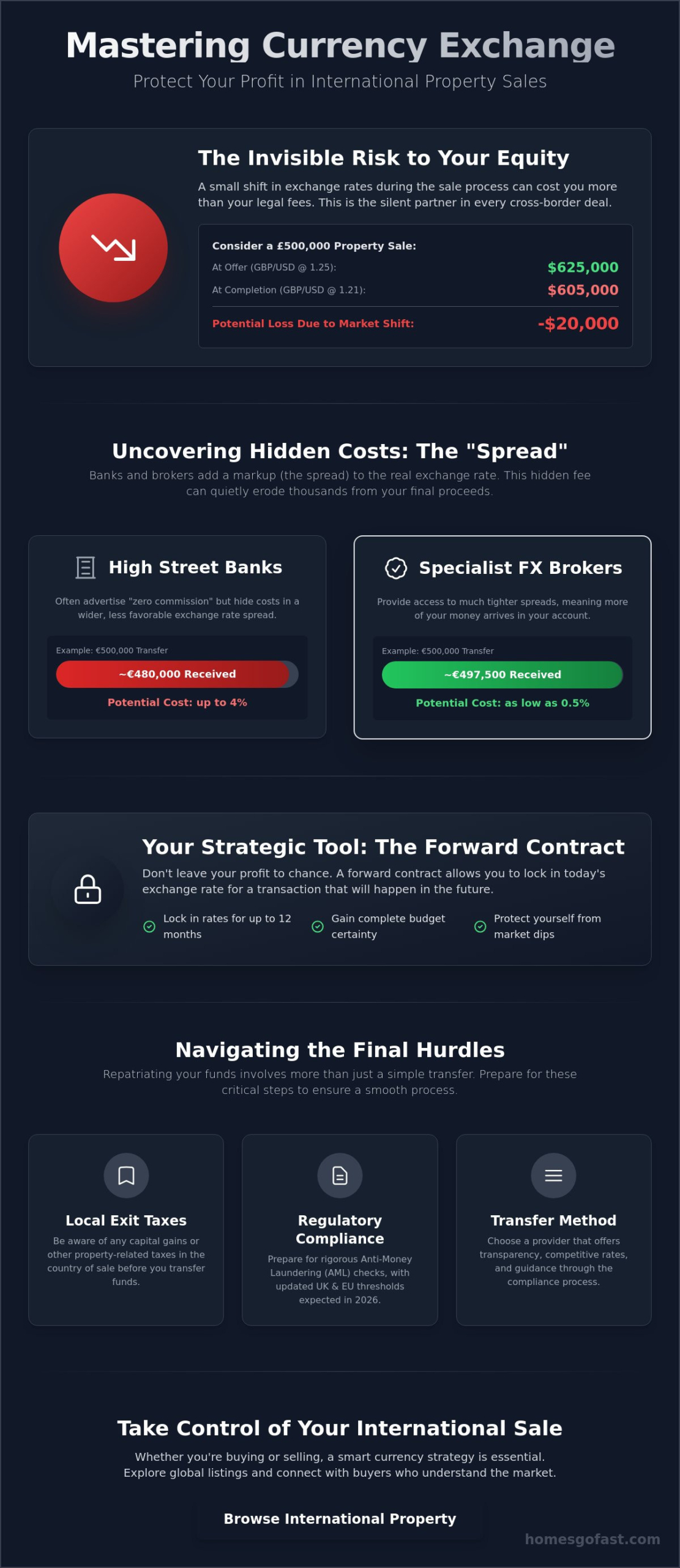
Price creep happens when the value of your sale proceeds changes between the contract signing and completion. Consider a £500,000 property sale as a practical example. If the GBP/USD rate is 1.25 at the time of the offer, the value is $625,000. If a 4-cent currency swing occurs during the three-month closing period, dropping the rate to 1.21, the value in Dollars falls to $605,000. You’ve lost $20,000 of your equity without any change in the property’s market value.
Why 2026 Market Trends Require Active Management
The 2026 market is defined by rapid shifts in central bank policies and evolving international trade agreements. These factors create significant foreign exchange risk for both buyers and sellers. Because of this, there’s a massive shift toward digital FX platforms that offer tighter spreads and better visibility than traditional high street banks.
Whether you’re using an Agent Pro account to market to a global audience or managing a sale by owner, you must account for market volatility. We define market volatility as the primary risk to overseas property equity. It represents the unpredictable fluctuations in currency value that can erode your hard-earned returns in an instant. Successful sellers in 2026 don’t just wait for the bank to handle the transfer; they take control of the timing and the rate.
Beyond the Mid-Market Rate: Identifying Hidden Costs
While you might see one rate on a news ticker, the price your bank offers is often quite different. Understanding currency exchange in property sales requires you to recognize that the “mid-market rate” is reserved for institutional trades. For individual transactions, providers apply a “spread,” which is essentially a markup on the exchange rate. This hidden cost can quietly erode your ROI, especially on high-value overseas real estate acquisitions where even a fraction of a percent represents thousands of units of currency.
Your bank might promise “zero commission,” but this is often a marketing sleight of hand. The cost is simply moved into the exchange rate itself. By comparing providers, you can ensure that your hard earned equity stays in your pocket rather than the bank’s profit margin. Buyers are increasingly looking for ways to trim these overheads as interest rates fluctuate globally.
| Provider Type | Typical Spread | Transfer Fees | Cost on £250,000 Transfer |
|---|---|---|---|
| High-Street Bank | 2.5% – 4.0% | £25 – £50 | £6,275 – £10,050 |
| Specialist Broker | 0.5% – 1.0% | £0 | £1,250 – £2,500 |
Banks vs. Specialist Currency Brokers
Investors are attracted by the convenience of their existing bank, but this familiarity comes at a premium. Specialist brokers provide dedicated “Property Desks” that help you mitigate the risk of fluctuating foreign currency rates. Unlike banks, which treat currency as a secondary service, brokers focus on securing the tightest spreads possible. They also waive the receiving bank charges that often surprise sellers during the final transfer.
- Pros of Brokers: Better rates, expert market timing, and zero transfer fees.
- Cons of Brokers: Requires setting up a new account and providing ID for compliance.
- Pros of Banks: Instant access if funds are already in your account.
- Cons of Banks: Poor exchange rates and lack of specialized property market knowledge.
The Psychology of the “Safe” Bank Option
It’s common to feel that a major bank is the only safe place for your property proceeds. However, reputable FX firms are strictly regulated by authorities like the FCA, requiring client funds to be held in segregated accounts. Choosing a bank purely for perceived safety often results in a “convenience tax” that serves no practical purpose. Many of these specialized services are built on modern banking infrastructure like Gemba, providing the same level of security and compliance as traditional institutions but with much greater efficiency.
Rising demand from foreign buyers means transactions are moving faster than ever. If you want to maximize your net proceeds, it’s worth exploring how international property listings are viewed by buyers in different currency zones. Don’t let an expensive bank rate be the reason you lose out on your next investment opportunity.
Strategic Currency Tools: Protecting Your Property Equity
Identifying hidden costs is the first step, but understanding currency exchange in property sales means moving from defense to strategy. You have several financial instruments at your disposal to ensure that the price you agree on is the price you actually receive. These tools turn market uncertainty into a manageable variable that protects your hard earned equity.
For immediate needs, such as paying an initial reservation fee or a small deposit, a “Spot Contract” is the simplest option. It allows you to buy currency at the current market rate for instant delivery. However, for the bulk of your transaction, you’ll likely need more sophisticated protection. Using these tools provides essential price certainty for international real estate listings, helping both parties stay aligned on value.
How to Use Forward Contracts in a Property Sale
A “Forward Contract” is perhaps the most powerful tool for any international buyer or seller. It allows you to lock in a specific exchange rate for a future date, often up to 12 months in advance. This is vital because the time between an initial offer and the final completion can span several months, leaving you exposed to market shifts.
Consider the process for French homes for sale. Once you sign the “Compromis de Vente,” you’re legally committed to the purchase, but the final payment isn’t due for weeks or months. By securing a forward rate at the moment of signing, you eliminate the risk of the Euro strengthening against your home currency in the interim. You’ll usually pay a small deposit to secure this rate, ensuring your budget remains intact regardless of market swings.
Automating the Process with Limit and Stop-Loss Orders
You don’t have to watch market screens 24/7 to get a great deal. A “Limit Order” allows you to set a target exchange rate that is better than the current market level. If the market hits that spike, even for a few seconds, your broker automatically executes the trade. This automation is a key component of understanding currency exchange in property sales for modern investors who want to maximize their returns without the stress of constant monitoring.
Conversely, a “Stop-Loss Order” acts as your financial floor. It sets a minimum rate at which your currency will be exchanged if the market drops. This protects your minimum required sale proceeds, ensuring you don’t lose your equity if the economy takes a sudden downturn. These automated strategies are a core part of a professional Agent Pro Account approach, allowing sellers to provide realistic, stable guidance to their international clients while building long term trust.
Managing the Repatriation of Funds: A Guide for Overseas Sellers
The final stage of your international journey is moving your capital back home. While earlier sections focused on securing rates, understanding currency exchange in property sales also involves navigating the complex regulatory landscape of repatriation. Buyers are increasingly looking for sellers who demonstrate professional financial readiness, as this clarity helps prevent delays during the final settlement of funds.
Moving large sums across borders requires more than just a bank account; it requires a strategy for compliance. Investors are attracted by markets with clear exit rules, but you must be proactive to avoid the “frozen funds” trap. For those managing their own exit, The For Sale By Owner Guide to Selling Overseas in 2026 offers a holistic view of planning your final move.
Compliance and the Paper Trail
In 2026, anti-money laundering (AML) checks are more rigorous than ever. In the UK, for instance, the June 2026 amendments require enhanced due diligence for any transaction exceeding £10,000. You must prepare a comprehensive paper trail to ensure your home bank accepts the incoming transfer without delay. Proactive communication with your currency provider is essential to avoid administrative bottlenecks.
- Keep your original “Compromis de Vente” or local equivalent readily available.
- Ensure you have a certified Notary letter confirming the source of the sale proceeds.
- Verify the receiving bank’s limits for high-value international transfers.
Tax Implications of Currency Gains
Repatriation also brings tax considerations that many sellers overlook. If the foreign currency has strengthened against your home currency since you purchased the property, you may be liable for tax on that gain. This is separate from the property’s value increase. For instance, US sellers must navigate the Foreign Investment in Real Property Tax Act (FIRPTA), which typically requires a 15% withholding of the gross sales price.
Calculating your “Net Proceeds” in your home currency is the only way to measure true ROI. To understand how these rules vary by territory, consult our detailed guide on Capital Gains Tax on Sale of Property. Once you’re ready to start the process, you can advertise properties to our global network and begin your journey toward a successful exit.
Maximising Global Visibility with HomesGoFast
Mastering the financial side of a transaction is only half the battle. To truly protect your equity, you need to find the right buyer at the right time. Understanding currency exchange in property sales allows you to time your marketing to coincide with favorable shifts in major currency pairs. When you use a platform that integrates these global financial realities, you reach investors who are actively looking to capitalize on their currency’s strength.
Investors are attracted by platforms that speak their language, both literally and financially. Selling overseas property requires more than just a photo and a description; it requires global visibility that accounts for multi-currency displays and multilingual reach. This transparency builds immediate trust with international buyers who may be hesitant about cross-border regulations or fluctuating costs.
The Power of Global Reach
HomesGoFast leverages over 20 years of expertise in international lead generation to connect you with buyers from higher-value currency zones. For example, when the US Dollar is strong against the Euro, American buyers often flood the market for Mediterranean villas. Our platform ensures your listing is visible to these high-intent audiences the moment the exchange rate tips in their favor, making your property an even more attractive acquisition.
By providing data-backed property descriptions and professional presentation, we help you stand out in a crowded marketplace. We act as your savvy mentor in the global market, ensuring your asset is positioned as a sound financial decision rather than just a lifestyle purchase. Buyers are increasingly looking for sellers who provide clear, accessible information that simplifies the complexities of an international purchase.
Choosing the Right Listing Package
Whether you’re an individual seller or a high-volume agency, we offer tailored solutions to meet your specific needs. Individual sellers often choose our one-off listing fees for a straightforward “for sale by owner” experience. This gives you direct access to our established audience without the need for a traditional brokerage, allowing you to keep more of your sale proceeds.
For professionals, our Agent Pro Account provides a scalable way to manage multiple listings and generate high-quality foreign property buyer leads. Premium upgrades are particularly effective in competitive markets like Spain, where high visibility is key to attracting serious interest from abroad. Don’t leave your international sale to chance. Advertise your property to a global audience today and secure the returns your investment deserves.
Take Control of Your Global Property Returns
Success in the 2026 international market requires more than just finding a buyer; it demands a proactive approach to your financial strategy. By understanding currency exchange in property sales, you move from being a passive observer to a savvy investor who protects every cent of equity. Whether you’re locking in a rate with a forward contract or bypassing expensive bank spreads, these strategic choices ensure that market volatility doesn’t erode your hard earned profit.
Global property success is built on trust and visibility. Established in 2002 with over two decades of global property expertise, we help you reach a network of millions of international buyers and investors. We provide specialised lead generation for Agent Pro members and private sellers who want to maximize their reach and efficiency without the stress of navigating the market alone.
Ready to turn your property into a global success story? List your home for sale worldwide with HomesGoFast and leverage our reach to find the right buyer at the perfect moment. Your international journey is just beginning, and with the right strategy, your returns will be as rewarding as the dream itself.
Frequently Asked Questions
How much can I save by using a currency broker instead of a bank?
You can typically save between 2% and 4% of the total transaction value by choosing a specialist broker over a high street bank. This saving primarily comes from tighter exchange rate spreads and the removal of flat transfer fees. On a £300,000 property purchase, this strategy could keep up to £12,000 extra in your pocket. These savings often cover a significant portion of your international legal and moving costs.
What is a forward contract in real estate and how does it work?
A forward contract is a financial tool that lets you fix an exchange rate for a future date, usually up to 12 months away. You pay a small deposit to lock in the rate today, providing total budget certainty for your completion. This is essential for understanding currency exchange in property sales because it protects you from sudden market drops during long conveyancing periods when your capital is most at risk.
Do exchange rates affect the value of my property in the local market?
The local market value of your property remains the same in its native currency regardless of exchange shifts. However, the perceived value for international buyers changes constantly. If the local currency weakens, your property becomes cheaper and more attractive to overseas investors holding stronger currencies. This dynamic can lead to a faster sale or more competitive bidding from foreign buyers looking to maximize their purchasing power.
Can I pay for an overseas property in my home currency?
While it’s technically possible if both parties agree, most sellers and local authorities require payment in the local currency to settle taxes and legal fees. Paying in your home currency often complicates the notary process and may lead to unexpected bank conversion fees for the seller. It’s usually cleaner and more cost effective to use a specialist broker to handle the conversion and ensure the exact local amount is delivered.
What happens to my currency rate if a property sale falls through?
If you’ve used a spot contract, the money is already converted and stays in your currency account until you’re ready for another purchase. If you have an active forward contract, you’re still legally obligated to fulfill that trade. Most brokers will allow you to roll the contract forward to a new property or sell the currency back to the market, though this may incur a cost depending on market movement.
Are there specific tax rules for currency gains on property sales?
Many jurisdictions treat currency fluctuations as a separate taxable event. If the foreign currency strengthens against your home currency while you own the asset, you might owe capital gains tax on that specific profit even if the property price stayed flat. Understanding currency exchange in property sales requires consulting a tax professional to ensure you’re accounting for these invisible gains when you finally repatriate your funds to your home account.
How long does an international currency transfer usually take for a house sale?
Most transfers through specialist brokers are completed within 24 to 48 hours. While traditional banks can take three to five working days, modern FX platforms use local payment networks to speed up the process significantly. It’s vital to coordinate with your notary or lawyer to ensure the funds arrive in time for the scheduled completion appointment, as delays can sometimes lead to financial penalties under the sale contract.
Is it better to exchange money before or after the property completion?
It’s generally better to secure your rate before completion using a forward contract to avoid last minute market volatility. Waiting until the day of completion leaves your final price to chance. By exchanging or locking in your rate early, you ensure you have the exact amount of local currency required to meet your legal obligations. This proactive approach eliminates the risk of a sudden shortfall that could jeopardize the entire deal.