 by
by 
Did you know that overseas buyers in England now face a 2% Stamp Duty surcharge on top of standard rates, yet demand for high-yield new builds continues to climb? You’ve likely felt the sting of rising domestic lead costs and the struggle to build trust with investors who can’t physically visit your site. Successfully marketing new developments to overseas buyers in 2026 isn’t about casting a wider net. It’s about using precision data and localized strategy to reach the right desks in Singapore, Dubai, or New York.
You want a faster sell-out and a lower cost per lead, but language barriers and off-plan skepticism often stand in the way. This guide gives you the exact blueprint to master international acquisition and turn your project into a reputable global brand. We’ll break down how to leverage international property listings and digital-first tools like virtual tours to bridge the distance. You’ll also learn to navigate complex regulations like the Register of Overseas Entities while highlighting the lifestyle appeal that keeps overseas property for sale at the top of investor wishlists.
Key Takeaways
- Learn how to establish “visual certainty” using CGI and drone technology to build immediate trust with off-plan buyers who cannot visit your site in person.
- Discover the 2026 blueprint for marketing new developments to overseas buyers, focusing on localized precision and high-value investor data.
- Compare the ROI of international property portals versus social media ads to ensure your budget reaches the most qualified global investors.
- Master the creation of an “Investor Pack” that simplifies complex cross-border regulations and tax requirements for your prospective buyers.
- Explore how to scale your project’s reach across 200+ countries by leveraging specialized international real estate marketing networks.
Understanding the Global Shift: Why New Developments Require a Specialized Approach
The landscape of international property acquisition has transformed. Buyers are increasingly looking for new developments because they offer a “clean slate” that minimizes the risks associated with foreign property ownership. When you’re marketing new developments to overseas buyers, you aren’t just selling a building; you’re selling a secure, low-friction entry point into a foreign market. For those seeking a foundational overview of international real estate, the distinction between residential and commercial FDI is a critical starting point for any 2026 strategy.
Investors are attracted by the predictability of a new-build asset. In 2026, global market trends show a surge in foreign direct investment (FDI) toward projects that offer high transparency and modern compliance standards. The “brand-new” status acts as a powerful trust signal. It tells an investor in Singapore or Dubai that they won’t face hidden structural issues or costly renovations from 5,000 miles away. You can browse international real estate listings to see how the most successful developers are already positioning these trust signals to win global market share.
To better understand this concept, watch this helpful video:
The Psychology of the Overseas New-Build Buyer
Foreign investors prioritize peace of mind. They prefer new developments because of the comprehensive warranties and lower maintenance requirements compared to resale units. While “off-plan” risks used to deter buyers, transparent marketing has flipped the script. Buyers now value the ability to secure a unit at current prices with the expectation of capital growth by completion.
Energy efficiency is no longer optional. In 2026, ESG (Environmental, Social, and Governance) standards are a primary driver for institutional and private investors alike. A development with a high energy rating isn’t just “green”; it’s a future-proofed financial asset. By emphasizing these standards, you reduce the perceived risk of future regulatory costs for the buyer.
Identifying High-Growth Investor Corridors
Successful marketing new developments to overseas buyers requires a data-driven approach to locate your audience. You shouldn’t try to reach everyone. Instead, focus on specific corridors where currency fluctuations make your development an attractive “buy low” opportunity. Understanding global market trends helps you pivot your strategy when exchange rates shift in favor of specific territories.
Don’t overlook the power of expat communities. These buyers often have a personal connection to the region but want the modern amenities of a new build. Whether you’re targeting pure institutional investors seeking yield or high-net-worth individuals looking for a lifestyle upgrade, your collateral must speak to their specific motivations; for an example of a team that excels in this personalized approach, check out Steve Kooner & Associates. The 2026 market demands a blend of aspirational lifestyle appeal and cold, hard investment logic.
Building Digital Trust: The Anatomy of a High-Conversion Overseas Campaign
Trust is the single greatest obstacle when marketing new developments to overseas buyers. In a world where your leads are often thousands of miles away, your digital presence acts as the primary showroom. You must provide “visual certainty” to bridge the physical gap. High-end CGI and monthly drone progress updates are factual proofs that your project is moving from concept to reality. To further enhance transparency through streamlined construction reporting, you can learn more about GoBuid. This level of digital documentation reduces the inherent anxiety of off-plan purchases.
Buyers are increasingly looking for security. They want to know their capital is protected during the construction phase. By including details about third-party verification and bank-backed escrow accounts directly in your marketing collateral, you remove the friction of the “off-plan” fear. In 2026, transparency is your most effective sales tool. It’s the difference between a lead that stalls and an investor who commits. You can see how top developers structure these trust signals by exploring current international real estate listings.
Multilingual SEO and Localized Content
Translating your website is a baseline, but it’s not enough to dominate the global market. You need to understand local search intent. For example, an investor in Shanghai might prioritize different financial metrics or “feng shui” certifications than a buyer in New York. Localized SEO ensures your development appears when they search using their specific regional terminology. Crafting culturally relevant messaging helps you build a reputable international brand that resonates on a personal level rather than feeling like a generic corporate pitch.
Virtual Reality and Augmented Reality as Standard
By 2026, static images have become secondary in high-stakes transactions. Investors are attracted by immersive 3D walkthroughs that let them explore every corner of a penthouse before the foundation is even dry. VR allows you to sell the lifestyle and “the view” from the 20th floor today. Integrating live-streamed site tours into your marketing funnel provides an extra layer of authenticity that pre-recorded videos simply can’t match. It shows you’ve got nothing to hide.
To achieve the highest level of detail in these virtual environments, developers are increasingly turning to 3D scanning to create accurate digital twins of their projects. Companies like Protomolecule offer the technical expertise to capture physical spaces with the precision required for high-conversion immersive marketing.
If you’re ready to scale your project’s visibility, using a dedicated property advertising platform can help you host these immersive assets and reach a pre-qualified global audience instantly.
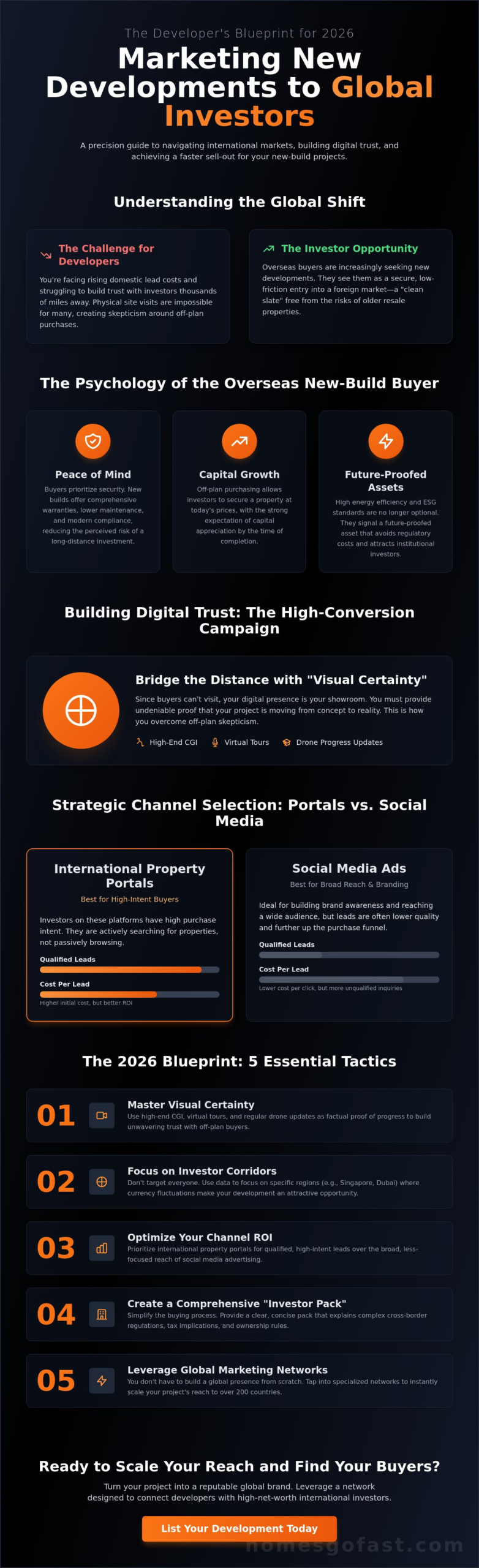
Strategic Channel Selection: Portals vs. Social Media in International Real Estate
Deciding where to allocate your marketing budget is the most critical choice you’ll make in your 2026 strategy. While social media is excellent for building brand awareness, global property portals remain the heavy hitters for conversion. Buyers are increasingly looking for centralized hubs where they can compare multiple off-plan projects side-by-side without visiting dozens of individual developer websites. Investors are attracted by the transparency and third-party validation that established platforms provide, which acts as a secondary layer of security for their capital.
When marketing new developments to overseas buyers, you need to understand the intent behind the click. A user on a portal is actively searching for an asset; a user on social media is often just browsing a lifestyle dream. To help you decide on your allocation, consider the following comparison of the primary global channels:
| Channel Type | Buyer Intent | Primary Strength | Typical ROI |
|---|---|---|---|
| Global Portals | High (Active Search) | Direct Lead Generation | High/Consistent |
| Social Media | Low/Medium (Discovery) | Brand Building & Reach | Variable |
| Email Nurturing | High (Retained Interest) | Relationship Management | Very High |
Pros and Cons of Global Distribution
Property Portals
Pros: You reach a pre-qualified audience that is already in the “buying” mindset. Using a specialized property advertising platform allows your project to appear in front of investors in over 200 countries instantly.
Cons: High competition within the same geographic category means your listings must be optimized with premium placements to stay visible.
Social Media Advertising
Pros: Exceptional for visual storytelling. You can use geo-fencing to target high-net-worth individuals in specific financial hubs like Singapore or Zurich.
Cons: Requires constant creative refreshes to avoid ad fatigue and generally results in a higher volume of “low-intent” inquiries that require heavy filtering.
Leveraging Global Property Portals
Using established platforms provides instant global visibility that would take years to build on a standalone website. To maximize your results, you should use XML feeds to keep your inventory updated in real-time across multiple international real estate listings. This ensures you never waste budget promoting units that have already been reserved. Featured placements are essential here; they keep your project at the top of search results in high-traffic regions where competition for “new build” keywords is fiercest.
Targeted Social Advertising for Developers
Social media isn’t for “spray and pray” tactics anymore. In 2026, savvy developers focus on “Social Proof” in their ad creative. Use short, punchy video clips of construction milestones or testimonials from early-phase investors to build credibility. Finally, implement a robust retargeting strategy. If a user views your listing on a global portal, your social ads should follow them with a specific “Investor Pack” offer to bring them back into your sales funnel and convert that initial interest into a formal inquiry.
The 2026 Blueprint: 5 Essential Tactics for Reaching Foreign Investors
Marketing new developments to overseas buyers requires a cohesive, multi-layered approach. You can’t rely on luck or organic reach alone. Instead, follow this five-step blueprint to ensure your project stands out in a crowded international marketplace. First, audit your digital presence to ensure your project is findable in target regions. Second, prepare your legal and financial documentation. Third, secure a steady stream of inquiries through established platforms. Fourth, automate your response systems. Finally, stay agile by tracking global market trends to adjust your targeting as economic conditions shift.
Creating the Ultimate Investor Pack
Automated Lead Management for Global Teams
In the global market, speed is your greatest asset. A lead from Hong Kong doesn’t want to wait eight hours for your London office to open. A 5-minute response time is critical for maintaining interest. Use AI chatbots to qualify leads while your domestic team is asleep. These tools can ask basic budget and timeline questions, ensuring your sales team only follows up with high-intent prospects. Ensure your CRM tracks lead origin and language preference. This allows your first human interaction to be tailored and relevant, which is essential for building a reputable international brand.
If you’re ready to start generating high-quality leads today, you can advertise properties on our global network to reach motivated investors in over 200 countries.
Scaling Your Reach: Leveraging HomesGoFast for Global Developer Marketing
Execution is the final frontier. You’ve built your digital trust and selected your channels, but now you need a platform with the horsepower to deliver. HomesGoFast has been a cornerstone of the international market since 2002, bridging the gap between developers and motivated investors in over 200 countries. When you’re marketing new developments to overseas buyers, tenure matters. Our established presence provides a badge of credibility that helps bypass the initial skepticism foreign buyers often feel toward off-plan projects.
Efficiency drives results. For multi-unit projects, the Bulk Developer Marketing fees offer a significant advantage. Instead of managing individual listings, you can promote your entire development under one authoritative profile. This approach is perfect for scaling your reach without ballooning your overhead. If you’re managing a large-scale international portfolio, the Agent Pro Account provides the tools you need to track performance across different territories in real-time. It’s about working smarter, not harder.
Maximizing Visibility with Premium Upgrades
Standing out in a global marketplace requires more than just a standard listing. Featured placements are essential for increasing click-through rates from high-value regions like the US, China, and the UAE. By targeting specific geographic categories, you ensure your development appears exactly where your ideal demographic is looking. Many developers use our sell overseas property tools to accelerate their sales cycles, often seeing a faster sell-out of new phases compared to domestic-only campaigns. This targeted visibility is what turns a local project into a global brand.
Getting Started with Your Global Campaign
Onboarding your development to a global portal should be systematic. Use this checklist to ensure you’re ready for the 2026 market:
- High-Resolution Assets: Ensure all CGI and drone footage is uploaded in 4K.
- Localized Pricing: List units in both local and major global currencies like USD, EUR, and GBP.
- Lead Routing: Connect your CRM to handle inquiries instantly across time zones.
- Investor Packs: Have your digital documentation ready for immediate download.
Set realistic KPIs for your international lead generation. Focus on lead quality and “cost per qualified inquiry” rather than just raw traffic numbers. The goal is to build a sustainable pipeline that feeds your sales team year-round. Don’t wait for the domestic market to cool down further. Start advertising your development to the world today and master the art of marketing new developments to overseas buyers with a partner that understands the global landscape.
Secure Your Project’s Future in the Global Marketplace
The shift toward international acquisition is no longer a trend; it’s a fundamental requirement for developers seeking rapid sell-outs. You now have the tools to build digital trust through visual certainty and the logic to select high-intent portals over broad social feeds. By implementing a data-driven “Investor Pack” and automated nurturing systems, you remove the friction that often stalls cross-border transactions. Mastering the art of marketing new developments to overseas buyers is about combining this technological edge with transparent financial reporting.
Since 2002, we’ve helped developers build reputable international brands by providing specialized lead generation and a global reach that spans over 200 countries. Don’t let your project sit idle in a cooling domestic market when global demand is rising. Take the final step in your 2026 strategy and put your units in front of the world’s most motivated investors. It’s time to turn your local development into a global success story.
Start advertising your new development to a global audience today and watch your international portfolio thrive.
Frequently Asked Questions
What are the best countries to target for new development buyers in 2026?
High-growth financial hubs like Singapore, the UAE, and the United States remain the top priorities for developer campaigns. These regions have a high concentration of high-net-worth individuals seeking to diversify their portfolios. You should also monitor emerging corridors in Southeast Asia where investors are attracted by relative currency value and historical ties to specific western markets. Focus your budget on cities with established flight paths to your project.
How do I build trust with a foreign buyer who cannot visit the site?
You build trust by providing “visual certainty” through high-end CGI, monthly drone updates, and live-streamed site tours. Buyers are increasingly looking for transparency in the construction process to mitigate off-plan risks. Providing third-party verification and details about escrow accounts helps bridge the physical distance. This digital-first approach is the core of successfully marketing new developments to overseas buyers in 2026.
Do I need to translate all my marketing materials into multiple languages?
You don’t need to translate every document, but your primary landing pages and “Investor Packs” should be localized for your top three target markets. Simple translation isn’t enough; you must adjust the messaging to reflect regional investment priorities. For example, a buyer in Hong Kong might prioritize school proximity, while a Middle Eastern investor might focus on rental yields and tax efficiency. Localized content builds immediate authority.
What is the most cost-effective way to generate overseas property leads?
Global property portals offer the best lead-to-sale ratio because they capture users with high purchase intent. While broad social media ads can be cheaper per click, they often result in lower-quality leads that don’t convert. Using a specialized platform allows you to reach a pre-qualified global audience instantly. This strategy is essential when marketing new developments to overseas buyers as it minimizes wasted spend on uninterested users.
How do currency fluctuations affect international property marketing?
Currency shifts act as a major catalyst for international property sales. When a buyer’s local currency strengthens against yours, your development effectively goes on sale. You should pivot your marketing efforts toward regions where the exchange rate offers a distinct advantage. Highlighting this relative value in your ad creative can create a strong sense of urgency and attract investors who are looking for a financial win on the exchange.
What legal information should I provide to overseas buyers for new builds?
You must provide a clear breakdown of ownership rules, tax surcharges, and compliance requirements like the Register of Overseas Entities. Buyers are attracted by projects that simplify the legal red tape of foreign acquisition. Include specific details about the 2% Stamp Duty surcharge in the UK or any annual taxes on enveloped dwellings. Being upfront about these costs prevents deals from falling through during the final due diligence phase.
How long does it typically take to see results from a global marketing campaign?
A well-structured global campaign typically generates its first qualified leads within 48 to 72 hours of launch. However, the sales cycle for new developments often spans three to six months due to the complexity of international legal checks. You’ll see the most significant ROI after the first 90 days as your lead nurturing systems begin to convert early inquiries into reservations and deposits. Consistency is key to global success.